My somewhat cynical take on bullies in academia is that they’re a feature, not a bug. I touched on this with an earlier tweet, but the qualities we commonly associate with “top scientist” in academia are extremely present in the kinds of people who bully others.
I can't stop flipping back and forth between the Hubble and James Webb Space Telescope images of the Carina Nebula. In the Hubble image the dust is just this wall that looks solid, and JWST has revealed the structure in that dust that has remained hidden for so long.
✋🏼 Galactic high five!
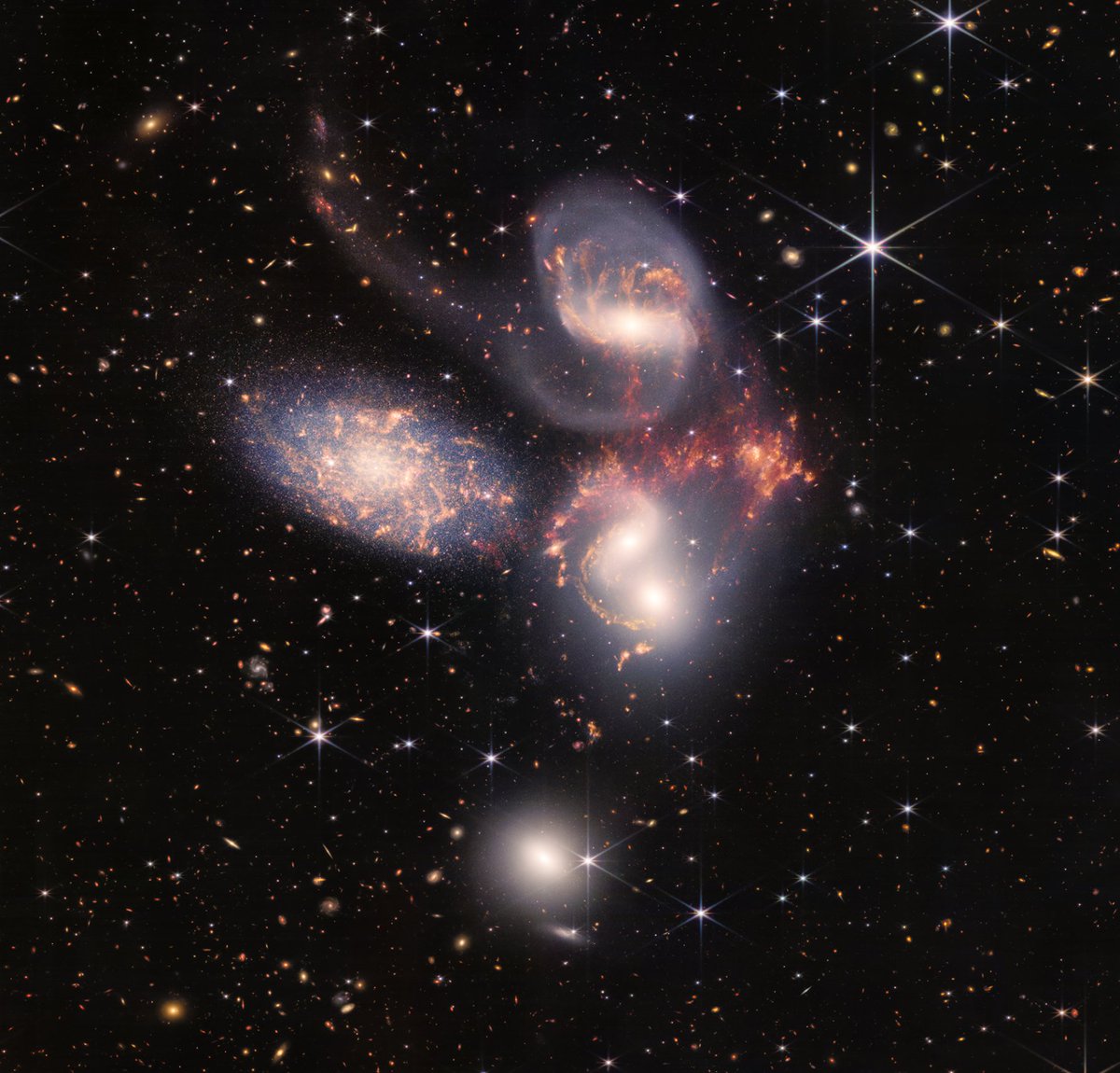
In Webb’s image of Stephan’s Quintet, we see 5 galaxies, 4 of which interact. (The left galaxy is in the foreground!) Webb will revolutionize our knowledge of star formation & gas interactions in these galaxies: https://t.co/tlougFWg8B #UnfoldTheUniverse
Interested in active galactic nuclei? #COSPAR2022 Session E1.18 will key results covering the X-ray to gamma-ray band.
More information: https://t.co/mpNhpMnpSU
📡 Sono tra i più massicci #BuchiNeri nell'universo remoto, solo un miliardo di anni dopo il Big Bang. Li ha scoperti un team guidato da Tullia Sbarrato dell'#INAF osservandone i getti relativistici #radio con il Very Large Array ⤵️ @TulliaSb @astrobrera
https://t.co/6rr6ETpal5
Direct observation of an extended X-ray jet at z=6.1, by Ighina et al., with Dallacasa, Spingola #irapapers @crispingola @TulliaSb@chandraxray https://t.co/uxTjjdIpJy
Recap — 1) at high z, jets are more numerous than expected; 2) all extremely massive black holes might host jets, *even if they are radio-quiet*; 3) radio-loudness underestimates the jetted population at high z; 4) jets might play a crucial role in fast evolution of SMBHs! 🧶🥂
#Paperday! We don’t know how the earliest supermassive black holes form and evolve, assembling such large masses (>10^9M⊙) in less than a Gyr. Relativistic jets might play a prominent role in the process and are surely more frequent than expected! 🧵 https://t.co/vlinv5gJvF
How can jets help the accretion process? They (should) need a spinning BH to exist, and accretion around spinning BHs converts a lot of mass-energy in radiation, slowing accretion itself. What if jets use some of it to be launched? Less radiation → more mass accreted!🪡
Paper day today! Jets may be more common than we think at very high z: if the #blackhole is massive enough a #jet might be there but not easy to be found. Look around and put jets in your toolbox if you want to be fast and build huge SMBHs. More about this later today 😉 @arxiv