Let me briefly sum up where we are with AI.
Everyone can feel it and everyone can see it. I believe 2026 is the turning point. We see major advances every day, but with all the excitement about the latest benchmarks, it’s easy to lose sight of the bigger picture.
Anthropic has just released Claude Fable 5.2, its latest flagship model. It’s outstanding. Anyone who has tested it knows how good it is, and in its blog posts, Anthropic has also highlighted advances beyond coding: new findings in physics and hardware design, as well as a method for predicting viral protein structures developed with Mythos 5.2.
Fable 5.2 even built an operating system prototype by coordinating more than 1,000 subagents over eight days. At the same time, Anthropic acknowledged in its system card that it has a separate, unreleased research model that is somewhat more capable than Mythos 5.2. This could be “Model 4,” although that connection has not been confirmed.
Meanwhile, the competition isn’t slowing down. Google has caught up in a big way, and Gemini 4 Carbon is outstanding. Google also says it is using its own models for research and making new discoveries. Rumors suggest that a successor called Krypton is already being tested, though its capabilities remain unconfirmed.
Today, the authors of AI 2027 updated their prediction. The AI Futures Project now forecasts that AI capable of doing the work of a team of top human AI researchers will likely arrive in 2027, absent a major slowdown. They estimate that AI-driven acceleration of AI research is already five months ahead of their original scenario.
And we shouldn’t forget what AI systems have already achieved in mathematics. OpenAI says an internal system produced a solution to the Navier–Stokes Millennium Prize Problem. And this model is already outdated, as OpenAI said in their blogpost.
What I’m trying to say is this: I regularly say that the takeoff began in 2026 and that 2027 will be a crazy year. Perhaps the craziest year in human history. But when we look back on this year, I think it will become clear just how crazy 2026 already was.
I’ve devoted myself to AI since GPT-3.5, and I now work full-time to make this technological revolution tangible. Just a few years ago, LLMs like GPT-4 seemed like stochastic parrots. They hallucinated and, compared with today’s models, felt like trivial machines. Of course, they were never actually trivial. But looking back, the pace of development since o1 in late 2024 has kept increasing, and now the sudden explosion in capabilities feels tangible.
So enjoy these last months of relative calm. I believe 2027 will be the year of superintelligence. And nothing will be the same again.
Major breakthrough: OpenAI says its AI has cracked decades-old problems across mathematics, computer science, and physics, with key proofs formally verified in Lean.
These are original discoveries that could reshape entire fields, from the limits of computation to the mathematical foundations of particle physics. Independent experts are now examining the work; if it holds up, this is a major milestone for AI making new science.
I asked Jensen Huang how I should raise my children in the age of AI.
What do you teach your kids when you can’t predict the future they’ll grow up in?
His answer touched on curiosity, hard work, and being willing to struggle with something difficult.
A personal moment from our conversation. Full interview coming soon on Superintelligence.
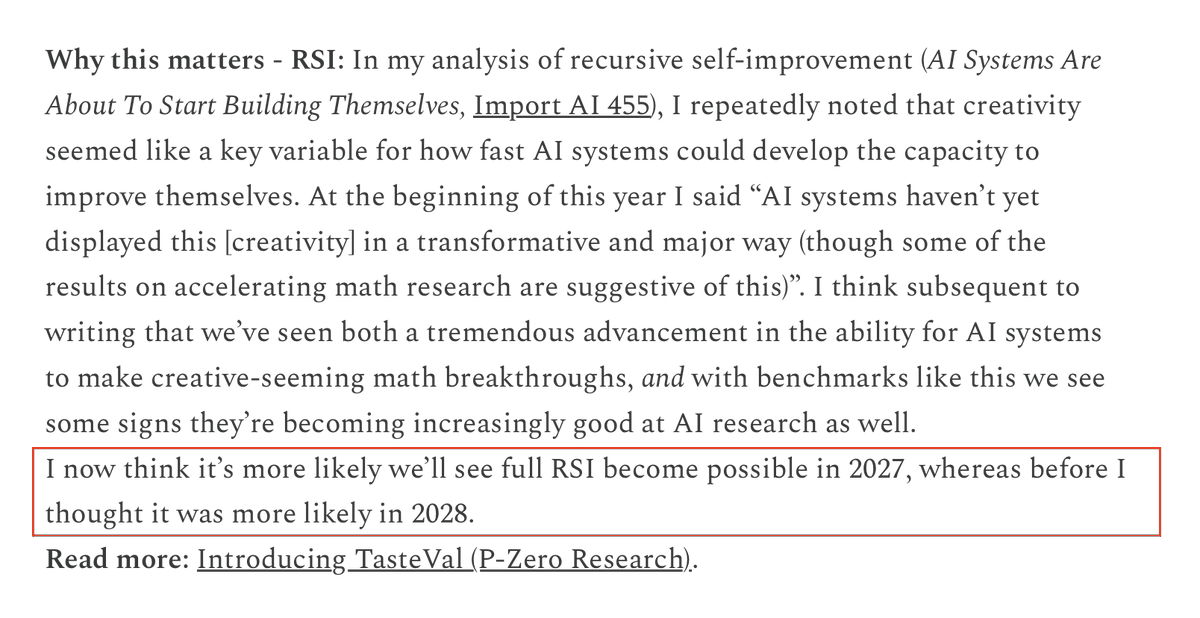
Anthropics' Jack Clarke has adjusted his timeline for RSI and brought its arrival forward; he considers it highly likely that "full RSI will become possible in 2027, whereas before I thought it was more likely in 2028."
Again, 2027 will be the year everything will drastically change forever. 2026 will be the last "normal", although noting feels normal any longer.
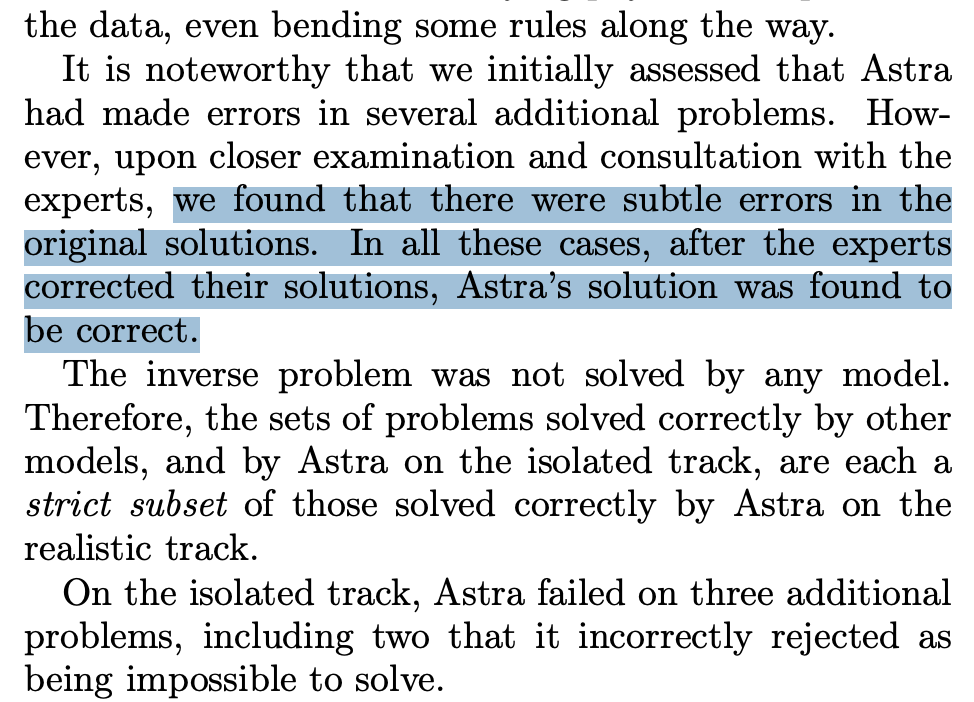
Talking about scientific breakthroughs: GPT-6 Astra got several physics answers right that experts initially marked wrong. TheoPhysEval’s authors found errors in the reference solutions and confirmed Astra was correct in those cases. Using Codex with tools and web access, it scored 49/50 (98%).
AI is becoming the best co-author one could ask for.
Andrej Karpathy’s point: Many people only use AI occasionally for search or writing and see little value in their daily lives. Even many professionals understand its progress mainly in theory.
People using advanced models extensively for coding and math experience huge capability gains, widening the gap in how people perceive AI.
And this impression has been confirmed here in Paris during my trip. When I talk to people, I realize they're completely unaware of how capable AI already is. They're unaware of the possibilities it offers. They haven't heard that OpenAI solved a Millennium Prize problem, or recently solved 372 math problems, some of which had remained unsolved for decades.
Currently, we're living in an ivory tower.
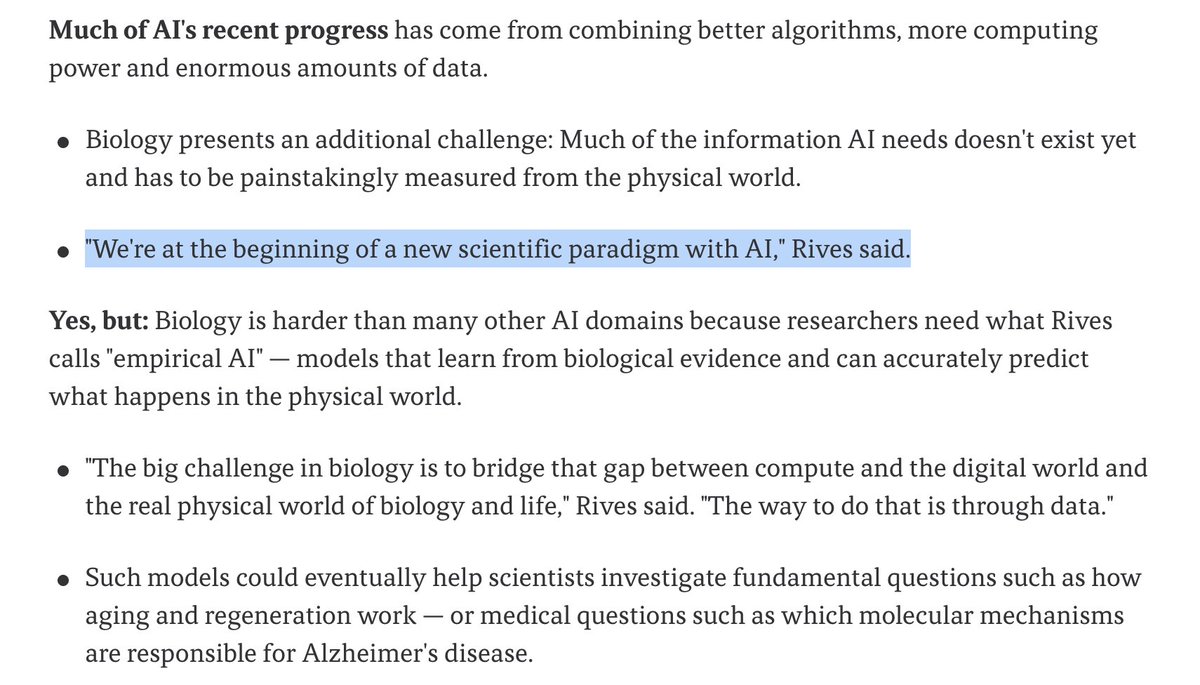
Speaking about scientific revolution: Zuckerberg’s Biohub is teaming up with Google DeepMind, Meta and the U.S. government on a $1.8B effort to build AI models of living cells.
"We're at the beginning of a new scientific paradigm with AI," Biohub head of science Alex Rives told Axios.
The goal is a “universal virtual cell” that lets scientists test experiments digitally, then choose the most promising ones to run in the lab.
DeepMind, Isomorphic Labs and Meta are collectively investing $300M. The $1.8B total combines funding, data, computing and measurement technology, including resources developed through prior NIH investment.
Super cool: Vals AI says 90+ Claude Opus 5.5 agents helped identify two magnetic semiconductor candidates in three days of simulation work.
The goal: materials that could support spin-based computer memory while their opposing magnetic moments cancel out.
One candidate, YBaMnFeO₅, is a new proposed design. Its useful atomic structure may be difficult to manufacture.
The other, KV[Cr(CN)₆], was already made in 1999. The team’s calculations suggest it has electronic properties worth testing for spintronics.
That's why AI is such a significant technological revolution. It's driving all of science forward.
wow. another one
Mathematician Benedikt Jahnel said that, if a human had solved a problem like this, it could plausibly have been Fields Medal level work 👀
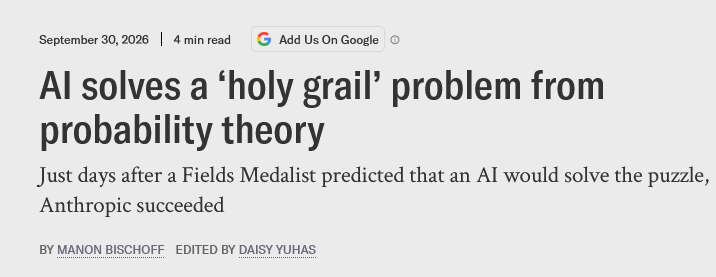
AI just solved a decades old “holy grail” problem in probability theory that resisted elite mathematicians for decades
Anthropic says its AI generated a proof resolving a famous conjecture in percolation theory, the mathematics of how random local connections suddenly form large scale connected structures.
The big open question concerned dimensions 3 through 10. Mathematicians already knew the relevant phase transition was continuous in 1D, 2D, and dimensions 11+, but the middle range had remained unresolved. The new AI generated proof shows that the transition is continuous there too, filling the decades old gap.
2022 Fields Medalist Hugo Duminil-Copin had tried and failed to solve the conjecture, then wrote in late August that it was only a matter of time before AI beat humans to it.
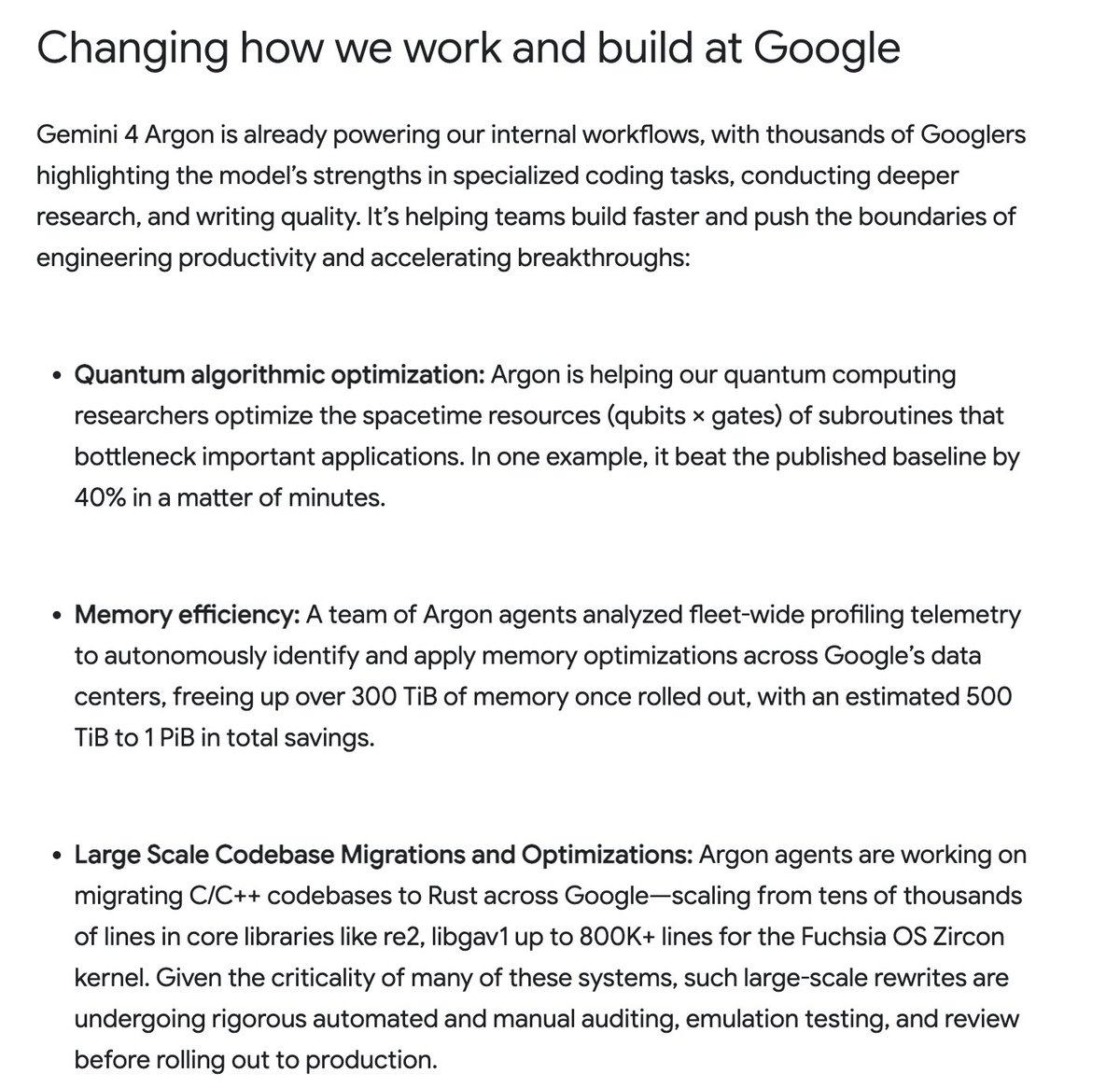
Google says Gemini 4 Argon agents have already freed over 300 TiB of memory across its data centers, with a 1 million token output limit and agents already optimizing its own infrastructure.
The agents analyzed profiling data, found memory optimizations and applied changes that were subsequently rolled out.
Argon agents are also working on C/C++ to Rust migrations reaching 800,000+ lines of kernel code, with extensive audits and testing before deployment.
For its video decoder, Google says agents replaced 32,000 lines of SIMD code with safe Rust, making the existing Rust port 2.7x faster while preserving identical video output.
These are expensive engineering tasks inside infrastructure Google already operates.
This release seems to be a much bigger deal than people think!
My god this is such a good speech that every SWE needs to hear. You know what? Every person should hear it
Keep the happy memories, eyes on the reality, be excited about the future. That’s the best that anyone can do
parents the world over today are forcing their children into misguided rat races for some status ladder that almost certainly won’t exist by the time they come out the other side. the world is changing rapidly. let them put down their grinding and keep their wits about them
Bend 2 is here!
It is a new programming language that blocks AI mistakes via *proof checking* - the same technique big AI labs used to solve open math problems, like Navier-Stokes.
It is also very fast, and runs on GPUs.
Watch the video. Link in the comments.
Holy cow, its official! OpenAI says its AI has solved the Navier–Stokes Millennium Prize Problem, a mathematical question unresolved for roughly 90 years.
An internal model, described as significantly more capable than GPT-6 Astra, powered a group of around 10,000 concurrent agents (see the graph below! Its crazy more powerful than Astra)
The agents reached the solution after just 88 hours. Lean formalization and verification took another 17 hours via GPT-6 Astra.
The reported result: smooth three-dimensional fluid motion can develop a singularity in finite time under a smooth external force, while total energy remains finite.
OpenAI is sharing the proof and its Lean formalization.
130 billion output tokens went into the Navier–Stokes effort alone. The internal model is still training.
Welcome to the singularity!
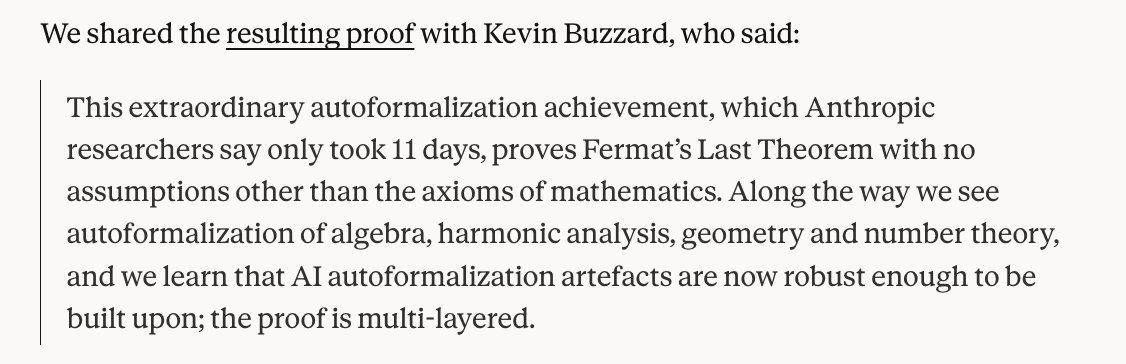
Respect where respect is due: Anthropic says Claude completed the first fully computer-checked proof of Fermat’s Last Theorem in 11 days.
Andrew Wiles proved the theorem in 1995. Claude’s achievement was turning an existing proof into a form where a computer can check every logical step.
That is much harder than translating text into code. Human mathematicians leave many steps implicit and rely on results scattered across centuries of research. Those dependencies also need precise definitions and proofs.
Working largely autonomously, dozens of Claude agents produced 13 million lines of Lean code and roughly 29,500 supporting theorems, building on existing human work.
Along the way, Claude also produced machine-checkable proofs of roughly 29,500 supporting theorems across algebra, geometry, number theory and harmonic analysis, including mathematics that had never been formalized before.
That could help mathematicians check new research faster, catch hidden gaps, and rigorously evaluate AI-generated proofs. Kudos, Anthropic!
I see the web evolving in two extremes:
1️⃣ ultra-fancy human experiences, in the service of delight, exploration, brand, entertainment. https://t.co/0nyTRPKDEJ / threejs / typegpu are enabling this
2️⃣ agent-centric content, data and APIs. the opposite end of the spectrum: pure, lossless signal for machines. The rise of markdown and MCP are the tip of this iceberg
The 'in between' is likely to be subsumed by agents producing just-in-time UI. When you need utilitarian content or data, it'll be generated just-in-time for you. Think of the agent as the new browser in this model.
OpenAI officially expects AGI by end of *this* year (2026)
"Altman told me that OpenAI was “not quite yet” there, but that by the end of the year the company would have an internal system he would call AGI."
We did it friends.
And: OpenAI has already internally built autonomous AI researchersbased on its benchmarks. It's the well-known GPT Astra.
"Pachocki says the company has already met its internal benchmark for an automated AI research intern. Given an experimental idea, he says, Astra can implement it inside OpenAI’s code base, run the experiment, and return results, or take a paper and perform work that previously occupied a human researcher for a week."
Astra will have the biggest impact on knowledgework there is
"Astra would enable “persistent agents,” he explained—virtual colleagues toiling for sustained periods on tasks. But its biggest impact, he predicted, would come from people using it to discover new knowledge. “I expect this will be the first model where the model actually invents new things in a way that matters,” Altman told the group. “That’s a very AGI-like thing.”
We did it friends. The finishing line is within sight. This year will be the turning point. Forever.
I am so damn hyped.