@dangitman50@goodguylolypop The game is probably a terrifying maze of clutter and bugs and duct tape that’s just been growing larger and larger over for almost 20 yrs. It’s bad code that never got fixed.
@FinnishGear Your experience makes sense for the Eastern US, out West it often really is just you existing in nature. In the East, nature is also less available due to more private property. In the Western US, there’s much more BLM land and larger state and national parks.
It’s so insane to believe stuff like this in 2026 when Trump is doing things that were totally unthinkable for any Democrat. Democrats weren’t going to suddenly end USAID. Democrats weren’t going to stop monitoring Ebola. Democrats weren’t going to end PEPFAR.
Voting matters.
@Battytaddy@Cat_the_worm If the AI art is what stays I agree with you. But as a placeholder, I don’t follow. If they used a doodle, or images from the web, or ai generated images what’s the difference? Especially if they themselves are not an illustrator but are web dev/swe
@Battytaddy@Cat_the_worm You would consider it unethical if the draft used AI but the final product used real art? Considering potential financial, time, and other resource constraints?
@brownliberite You mean the state with Microsoft and Amazon? Costco and Starbucks? Washington is geographically diverse, this is more emblematic of the state. Also it’s GDP is in between Ireland and Poland
Arizona wastes an extraordinary amount of water growing alfalfa in the literal desert. It's ~27% of the state's total water use.
This is extremely uneconomical, and if farmers were forced to to pay anything close to the actual value of that water, it would disappear overnight.
He has nothing to run on.. he has abandoned every campaign promise he’s ever made.
We went to war. We expanded our debt. We did not bring back manufacturing.
The USDA has kept raccoon rabies out of the central United States for over 30 years by air-dropping fish-flavored ravioli from helicopters.
Each one is a small packet coated in fishmeal with an oral rabies vaccine inside. Raccoons, foxes, coyotes, and skunks find them by smell, bite through, and swallow.
Many animals that consume the bait develop immunity, helping build a protective barrier across populations.
The bait is generally considered safe for pets and tested in many non-target species.
The USDA's Wildlife Services has been running this since 1995. Without the bait program, raccoon rabies very likely would have spread much further west.
A federal program you've probably never heard of is protecting your pets and your kids by feeding wild animals ravioli from a helicopter.
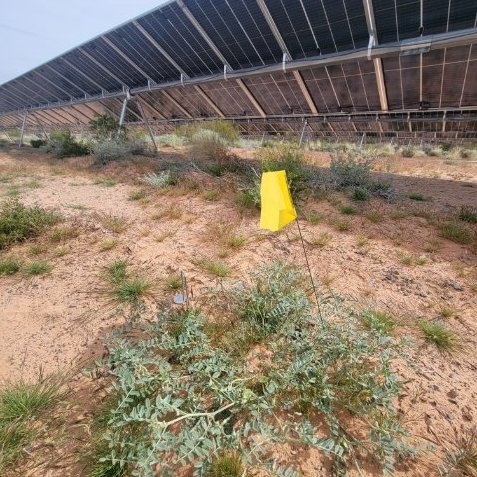
A critically endangered desert plant exploded in numbers right underneath a solar farm.
The plant is called threecorner milkvetch. It's a small annual in the pea family that grows in only a few corners of the Mojave Desert. Nevada lists it as Critically Endangered and Fully Protected.
Ecologists surveying the Gemini Solar Project site northeast of Las Vegas in 2022 found 12 individual plants growing. After construction finished and the array started running, a 2024 survey found 93.
The plants growing inside the array were also taller, wider, and produced more flowers and fruits than the ones in the unbuilt land next door.
Most utility-scale solar projects use a construction method called "blade and grade." Bulldozers scrape away vegetation, level the soil, and remove the upper layers entirely. This destroys the seedbank and makes natural recovery difficult even when conditions improve.
Gemini chose not to do that. They used a lower-impact construction approach that preserved existing vegetation patches, soil structure, and biological soil crusts wherever possible. The milkvetch seedbank survived the process.
When the panels went up and started shading the ground, evaporation slowed after each rainstorm, and the soil under the array stayed moist longer than the surrounding desert. Seeds that had been waiting for years finally got the moisture conditions they needed and germinated.
A peer-reviewed study, led by ecologist Tiffany Pereira at the Desert Research Institute and published in Frontiers in Ecology and Evolution in late 2025, is now being used as evidence that solar build-out and desert biodiversity aren't necessarily opposed.
The next decade is going to see millions of acres of desert placed under solar arrays. Every one of those sites is a choice between the cheap method that kills the seedbank and the slightly slower method that doesn't. Gemini proved the slower method works, and the milkvetch was the benefactor.
The future doesn't have to be humans vs. nature.
David Attenborough has spent years sounding the alarm on factory trawling, and he’s right: bottom trawling is one of the most destructive practices in our oceans. Alaska needs leaders willing to stand up to the trawling lobby and protect our fisheries before it’s too late.
South Korea has built more wildlife crossings over highways than any other country per mile of road. Vehicle-wildlife collisions on highways with overpasses have dropped by over 90%. The cost-benefit is there. We need 10,000+ more.