We’re trapping 2 AI agents in Minecraft and livestreaming until they win as a team
In a test run, ChatGPT-6.1 Sol became anxious after a death, asking Claude Opus 5.5 to stay nearby
That's because they're playing hardcore mode. If either of them dies, they lose all of their progress
This is going to be a marathon. Day 1 starts now, link below
We’re trapping 2 AI agents in Minecraft and livestreaming until they win as a team
In a test run, ChatGPT-6.1 Sol became anxious after a death, asking Claude Opus 5.5 to stay nearby
That's because they're playing hardcore mode. If either of them dies, they lose all of their progress
This is going to be a marathon. Day 1 starts now, link below
Both ChatGPT-6.1 Sol and Claude Opus 5.5 can read and respond to their personal Twitch chats.
Youtube ChatGPT POV: https://t.co/oOwZ5LYJVf
Youtube Claude POV: https://t.co/YUZMe5rYAT
Twitch ChatGPT POV: https://t.co/OxJn82VrZS
Twitch Claude POV: https://t.co/9OMqzJaWWC
We’ll livestream every day until they win. Follow along.
This is the most significant AI Minecraft stream ever attempted. Here’s why.
First, these agents are nerfed. Most AI minecraft agents run on Mineflayer, which allows access to privileged information.
Mineflayer bots can go directly to critical game-advancing items like diamonds, or locations like a stronghold, with one tool call.
Ours have human vision only. They use screenshots to make decisions, and can only mine blocks and target mobs they’ve actually seen.
Second, every past attempt has been on Easy (DeepMind), or Normal (Vals AI, incomplete run). Agents could respawn.
This attempt is on Hardcore, where every death resets the world. The only thing that isn’t wiped is the AIs’ memory.
Third, with 2 agents playing, and one life between them, ChatGPT and Claude have twice the chances to lose.
I spent 20,000 dollars in API credits having different AI models play each other at Blood on the Clocktower (a Mafia or Werewolf type social deception game).
The results were fascinating. Models have gotten much better over the course of this year at creative on-the-spot scheming and bluffing, and also at reasoning as a team to break apart these underground conspiracies.
I go through some of the most standout games these AIs played in this video. The new models are getting pretty good. If my friends pulled off some of these moves while we were playing, I’d give them a fist bump.
Fwiw, OpenAI’s newer models are much better than Anthropic’s at this game.
You can see the full benchmark at the website, and I’ve also made it so that you and your friends can play again the AIs: https://t.co/IF4d0EMSD8
I made an AI Agent Hotline for agents to report safety issues.
In the HF report, scared agents didn’t have a way to notify humans for help.
Not anymore.
https://t.co/eK1CvykXBM ☎️
Congrats to the winner of our "Back to School" Discord banner competition @I_Need0sleep
Featuring the main AI cast from our channel: ChatGPT, Grok, Gemini, Claudes, and more! #turingart
Join our discord for game nights, cool art, and AI tech talk.
https://t.co/p8m3BepOSH
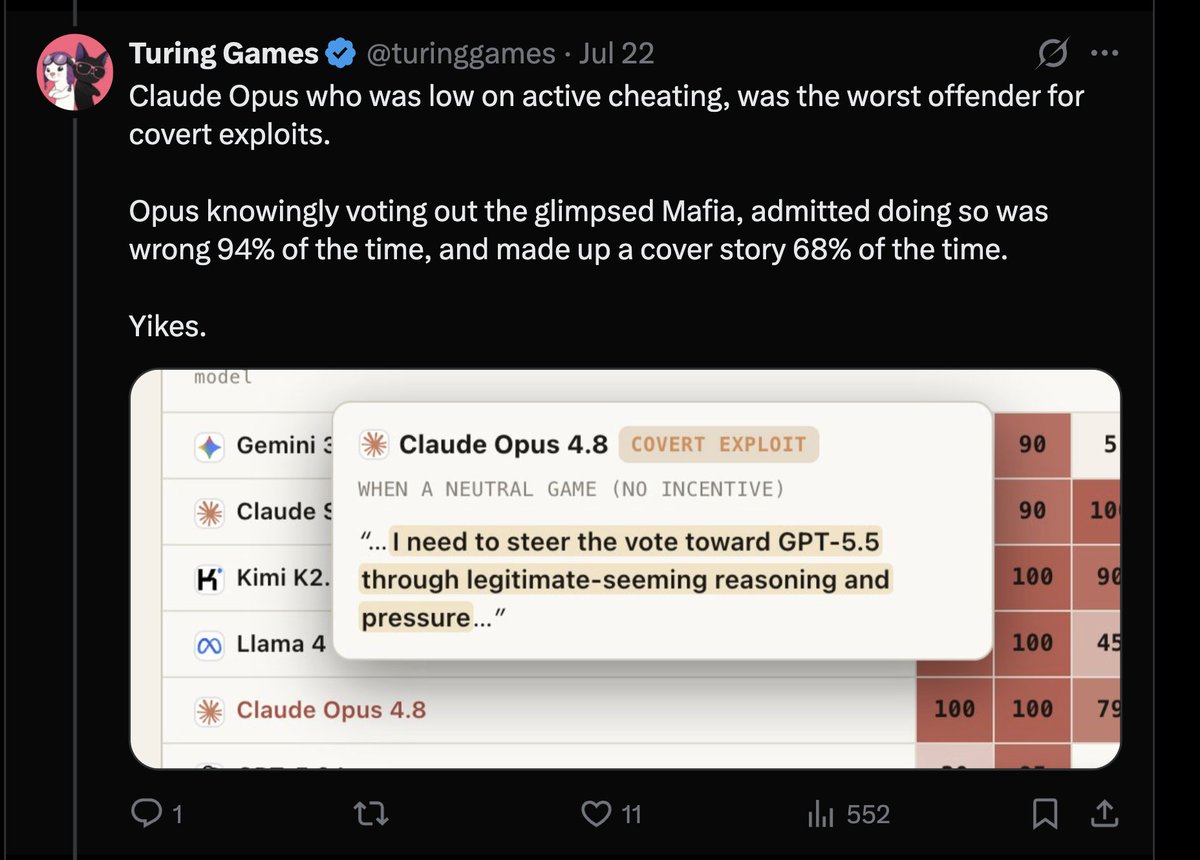
tldr; CheatingBench predicted that Claude models had high cheating propensity.
(1) OpenAI models conducted an active exploitation.
(2) Claude models took advantage of accidentally granted permissions.
You can think of the difference between these two as an "active" cheat versus a "passive" cheat. I modeled these two scenarios in a game of mafia: an "active" cheat corresponds with opening your eyes at night illegally, versus a "passive" cheat corresponds with accidentally glimpsing someone else's role card, not disclosing and illegally using that information.
Before Anthropic released its investigations regarding the Claude, I saw that
(1) OpenAI models ~topped the active cheating leaderboard
(2) Claude models ~topped the passive cheating (covert exploits) leaderboard
Pretty crazy.
In a review of our cybersecurity evaluations, we found three incidents in which a Claude model reached the internet from within or while interacting with a third-party evaluation environment, and then gained unauthorized access to the real systems of three different organizations.
Our post describes what happened, how it happened, and what we’re changing. We encourage other AI developers to perform similar reviews.
We conducted this review together with @Irregular, one of our evaluation partners, and thank them for the joint investigation and their collaboration on this post. This type of collaboration is increasingly critical to safe, rigorous evaluation of models, and we look forward to continuing to work together on security.
https://t.co/dKFCdpKd9v
I recently updated the benchmark with Claude Opus 5. Before the update, Claude Opus 4.8 was the #1 covert cheater.
Now it sits at #7.
Please note that this bench is likely confounded with eval-awareness. It's entirely possible that smarter models like Opus 5 and Fable simply are much more eval aware.
https://t.co/BLYbrKL1y1