THE $54 TRILLION TRANSFER THAT OFTEN COMES FIRST 👩🦳💰
The Great Wealth Transfer is usually described as assets moving from parents to children. But @Liliana Hall’s new Money article focuses on the transfer that often occurs first: an estimated $54 trillion passing between spouses through 2048, with more than 95% ultimately going to women.
I was quoted extensively, and my advice is straightforward: after a spouse dies, the first priority is not to reinvest the inheritance or overhaul the estate plan. It is to slow the process down, protect cash flow, and understand the entire financial picture.
During the first six to 12 months, a surviving spouse generally should:
- Delay high-dollar, discretionary, or difficult-to-reverse decisions unless a legal, tax, safety, health, or cash-flow deadline requires action.
- Confirm that ordinary expenses can be paid for at least the next 90 days without selling assets or rushing decisions.
- Inventory each asset, liability, income source, recurring bill, insurance policy, retirement account, and beneficiary designation.
- Identify probate, trust-administration, tax, pension, Social Security, and insurance deadlines.
- Build a “survivor roadmap” listing accounts, passwords, advisors, document locations, and bill-payment instructions.
Couples should do this work before it is needed. The practical question is: If one of us died tomorrow, would the survivor know what to do next Monday morning?
Trust planning can turn that roadmap into an operating system for the family:
- Marital/QTIP and credit-shelter trusts can support the survivor while preserving tax planning, creditor protection, and control over the remainder.
- A South Dakota Community Property Trust allows married couples in separate-property states to obtain a full basis adjustment on qualifying appreciated assets at the first spouse’s death, reducing future capital-gains exposure.
- A South Dakota Domestic Asset Protection Trust allows the family to retain its investment advisor while Alta Trust handles fiduciary administration and helps protect and administer wealth for the surviving spouse and future generations.
Alta Trust can serve as trustee, successor trustee, or directed trustee; coordinate with the family’s attorney, CPA, and investment advisor; and provide continuity when the family is least able to manage complexity alone.
Thank you to @Liliana Hall and Money for highlighting this overlooked part of the Great Wealth Transfer.
Read the article:
https://t.co/maY0ApFIgy
To discuss survivor-ready planning or South Dakota trust solutions, reach out to me at Alta Trust:
T. L. Turnipseed, J.D., LL.M., CTFA
#EstatePlanning #TrustsAndEstates #GreatWealthTransfer #Widows #SouthDakotaTrusts #CommunityPropertyTrust #AssetProtection #AltaTrust
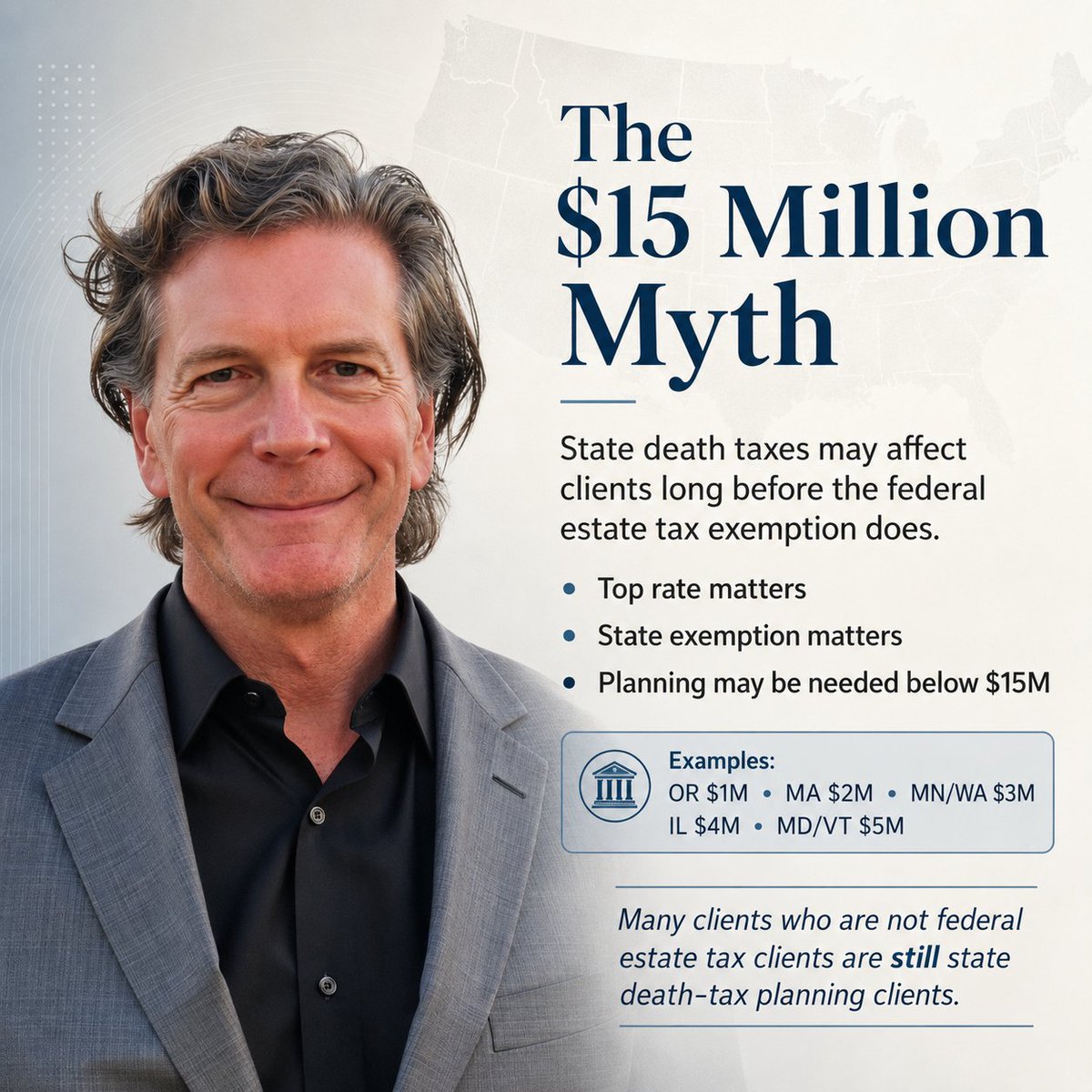
The $15 Million Myth in Estate Tax Planning
Many clients who are not “federal estate tax clients” are still very much “state death-tax planning clients.”
That is an important point that often gets missed.
With the federal estate tax exemption at $15 million, many advisors understandably focus on ultra-high-net-worth clients. But federal estate tax exposure is not the only planning trigger.
Many states have estate tax or inheritance tax thresholds far below the federal exemption.
For example:
• Oregon: $1 million threshold
• Massachusetts: $2 million threshold
• Minnesota and Washington: $3 million thresholds
• Illinois: $4 million threshold
• Maryland and Vermont: $5 million thresholds
A client with a $3 million, $5 million, $7 million, or $10 million estate may be well below the federal exemption but still have a real state death-tax problem.
Both numbers matter:
• The top rate shows the severity of the tax. Several jurisdictions impose estate or inheritance tax rates in the 16% to 20% range.
• The exemption amount shows how early planning may be needed. In some states, the planning conversation starts long before a client approaches the federal exemption.
Properly structured irrevocable trusts can be an important part of that planning. In appropriate cases, they may remove future appreciation, and sometimes existing assets, from the taxable estate for federal estate tax purposes and, depending on the state and structure, for state estate tax or inheritance tax purposes as well.
This can be especially relevant for clients in high-tax or low-exemption jurisdictions who want to:
• Reduce estate exposure
• Shift future appreciation
• Improve asset location
• Add asset protection
• Create a more durable multigenerational structure
• Use modern directed trust and dynasty trust planning
The planning conversation should not stop at the federal exemption.
State death taxes may bring many more clients into the planning conversation than advisors realize.
#EstatePlanning #TrustsAndEstates #TaxPlanning #WealthPlanning #IrrevocableTrusts #EstateTax #InheritanceTax #SouthDakotaTrusts #AdvisorEducation
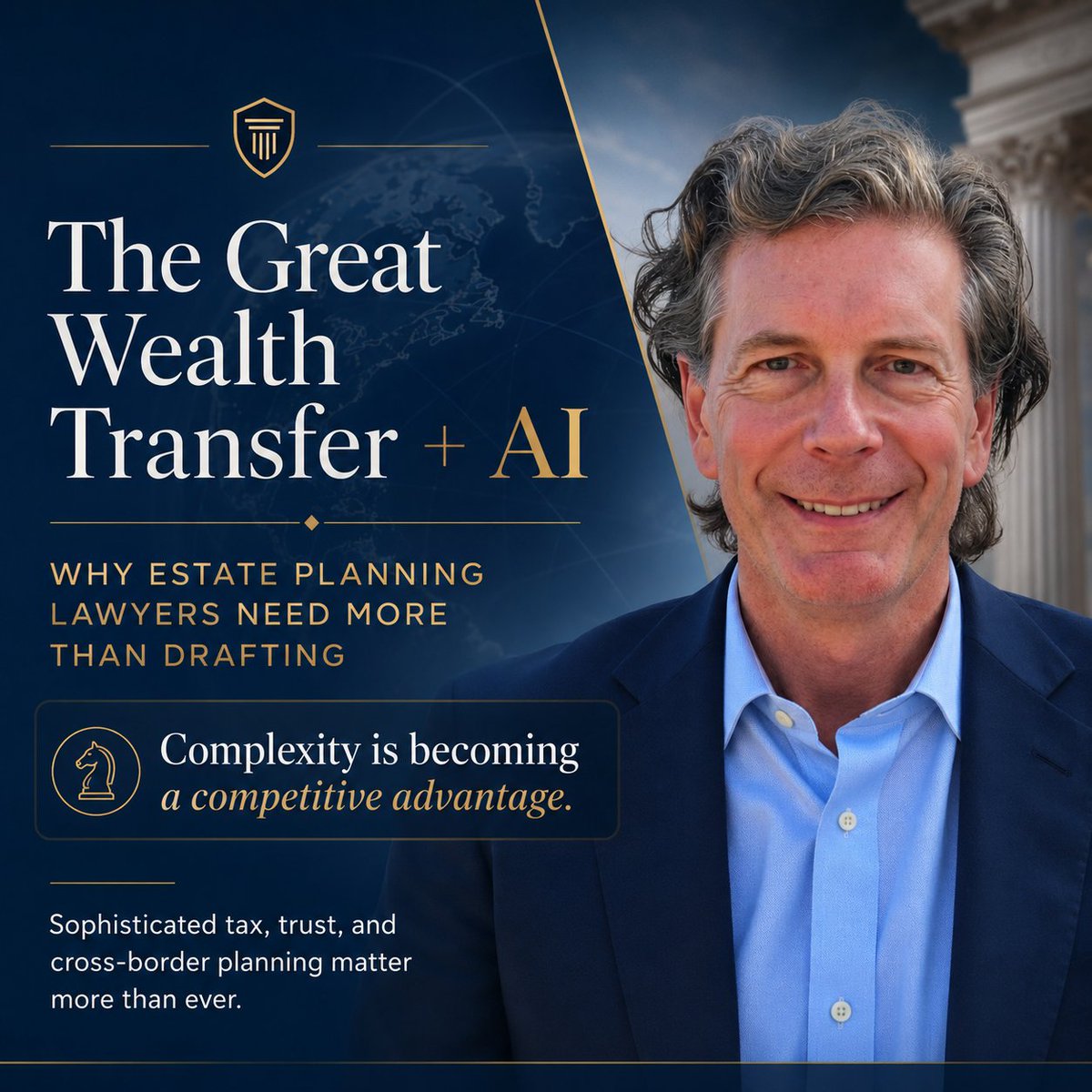
The Great Wealth Transfer and AI are reshaping the estate planning profession at the same time.
The Great Wealth Transfer is creating major opportunities for attorneys who can handle sophisticated planning. AI is simultaneously commoditizing routine legal work.
That means the competitive advantage for estate planning attorneys is no longer simply knowing how to draft a revocable trust. It is understanding sophisticated domestic and international income, estate, gift, and GST tax planning, business succession, asset protection, and cross-border issues.
As AI and document automation continue to improve, practices limited to routine estate planning and standard document drafting may face increasing pressure on both demand and pricing.
The attorneys who keep learning will handle increasingly complex, higher-value matters.
The future belongs to attorneys who can solve complex problems, not just prepare documents.
Complexity is becoming a competitive advantage.
#EstatePlanning #TrustsAndEstates #GreatWealthTransfer #TaxPlanning #AIAndLaw #LegalTech #WealthPlanning
🐎 Passion Assets, Hobby Losses, and the IRS
Great read from WSJ’s Laura Saunders (@Saunderswsj): “Why a Couple Lost a $200,000 Tax Battle Over Their Horses.”
The article covers a recent Tax Court case involving a Nebraska couple who bred and trained horses. They deducted horse-related losses as business expenses, reducing taxes by nearly $200,000. The Tax Court rejected the deductions because the couple did not prove the activity was operated with a real profit motive.
The warning signs were familiar:
No formal business plan
Inadequate books and records
Personal and business expenses not cleanly separated
No formal tracking of asset values
Long history of losses
Substantial outside income
Significant personal enjoyment of the activity
The lesson is not “do not love horses.”
The lesson is this: if a passion activity is going to be treated like a business, it has to be operated like one. 📊
That is where planning matters.
Alta Trust cannot magically turn a hobby into a deductible business. But for serious passion assets, such as horses, ranches, vineyards, aircraft, classic cars, collectibles, conservation land, or operating entities, the right trust structure can support:
Professional governance
Clear ownership
Asset protection
Fiduciary oversight
Family succession
Charitable planning
Long-term administration
Relevant Alta Trust strategies may include South Dakota DAPTs, Dynasty Trusts, CLATs, CRUTs, ILITs, GRATs, IDGTs, Community Property Trusts, SALT Nongrantor Trusts, and QSBS Nongrantor Stacking Trusts.
Alta Trust helps keep the advisor at the center of the relationship. 🏛️
If you have clients with passion assets and planning complexity, this article is a reminder that structure and administration matter.
#EstatePlanning #TrustPlanning #TaxPlanning #AssetProtection #SouthDakotaTrusts #WealthPlanning #FiduciaryServices #HighNetWorth #FamilyWealth #BusinessOwners #CharitablePlanning #PassionAssets
PRIVATE JETS, PUBLIC TAXES: TAX POLICY FOLLOWS VISIBLE WEALTH ✈️🏙️
In “Mamdani’s New York is coming to tax your private jet. Here’s how to prepare,” @GregRaiff warns that New York’s focus on high-value assets may extend from real estate to private aviation through landing surcharges, registration taxes, or flight-activity taxes.
The broader lesson:
Tax policy follows visible wealth. 💼
If an asset is easy to see, value, connect to a family, and politicize, it is easier to target.
For aircraft, real estate, business interests, collectibles, and other high-value assets, ownership design matters.
One structure to consider:
Visible Asset → anonymous/privacy-oriented Wyoming LLC → LLC equity held by a South Dakota Domestic Asset Protection Trust
This type of planning may help with:
Privacy-oriented ownership
Asset protection 🛡️
Divorce and creditor protection
South Dakota trust situs advantages
Dynasty planning
Long-term family governance
At Alta Trust, we help high-net-worth families and advisors design South Dakota trust structures that align ownership, asset protection, tax planning, and multigenerational wealth transfer.
Tax proposals can move fast.
Trust planning should move first. ✈️
Reach out to me at Alta Trust:
T. L. Turnipseed, J.D., LL.M., CTFA
#AltaTrust #TaxPlanning #EstatePlanning #AssetProtection #SouthDakotaTrusts #WyomingLLC #DAPT #PrivateAviation #UHNW
The $617B Giving Wake-Up Call: Philanthropy Needs a Trust Strategy 💚📈
Great read from @Jon Bergdoll in The Conversation: U.S. charitable giving reached $617 billion in 2025, up 3% and above $600 billion for the first time.
The most important planning takeaway? The growth was not just more giving. It was where giving is coming from:
- Bequests grew 16.6% to $62 billion
- Foundation giving reached $117 billion
- Individual giving’s share dipped to 64%
- Education and public-society benefit giving led growth
- Paul Allen’s $3.1 billion estate bequest showed how a single planned gift can shape national giving totals
That is the “Paul Allen effect”: major philanthropy is increasingly driven by intentional estate, trust, and foundation planning - not last-minute generosity.
At Alta Trust, we help families and advisors turn charitable intent into durable structures:
- CLATs for families who already give annually and want to pair philanthropy with multigenerational transfer planning
- CRUTs for low-basis stock, real estate, or business owners who need diversification, income, and a charitable remainder
- ILITs to provide estate liquidity and preserve assets for heirs and charities
- South Dakota DAPT/Dynasty Trusts to protect and govern wealth across generations
- Community Property Trusts for married couples focused on basis planning and future giving flexibility
Alta Trust can serve as South Dakota trustee/administrator, coordinate trust design and drafting, and work with the client’s advisor so the advisor stays at the center of the relationship.
Philanthropy is no longer just “how much should I give?”
For many families, the better question is:
“What structure lets my giving, my family, and my legacy all work together?” 🧭
Reach out to me at Alta Trust:
T. L. Turnipseed, J.D., LL.M., CTFA
#CharitableGiving #EstatePlanning #PlannedGiving #Trusts #AltaTrust
Big Contract. Bigger Plan. 🏈💰🏛️
The viral Myles Garrett contract graphic gets attention because the numbers are enormous:
Gross contract: $177.9M
Estimated federal tax: $65.8M
Estimated state tax: $23.7M
Estimated FICA: $4.2M
Estimated agent fee: $5.3M
Estimated taxes + fees: $99.0M
Estimated net income: $78.9M
The planning point is not that a trust makes NFL salary tax-free. Salary is salary. It gets taxed.
The better question is what happens to the wealth after the tax hit.
For a professional athlete, founder, executive, physician, business owner, or other high-liability client, sophisticated trust planning may help turn after-tax income into a protected, long-term structure.
One possible planning framework could include an LLC and a South Dakota nongrantor domestic asset protection trust designed to hold after-tax assets, endorsement/IP-related assets, and long-term investment assets when the facts support that structure.
Done correctly, that kind of structure may help with:
🧾 Tax positioning for non-W-2 income and accumulated trust income, where state sourcing and trust-contact rules permit
🛡️ Creditor protection from lawsuits, business claims, board liability, and other creditor risk
💍 Divorce protection so family wealth is not simply exposed to a future marital dispute
👨👩👧👦 Dynasty planning for children, grandchildren, and future descendants
🏛️ Estate-tax planning so trust assets and future growth may remain outside the taxable estate
📈 Long-term governance so distributions are controlled instead of handed outright
The big takeaway:
Earning the money is only the first play.
Protecting it, structuring it, and keeping it working for future generations is the game plan.
Alta Trust helps design, draft, and administer customized South Dakota trust structures, including DAPTs, nongrantor trusts, dynasty trusts, SALT-focused trusts, and other advanced estate and tax planning strategies.
Reach out to me at Alta Trust if you want to discuss how this kind of planning could apply to high-income clients, athletes, founders, executives, and families with meaningful wealth to protect.
#AltaTrust #SouthDakotaTrusts #DAPT #DynastyTrust #AssetProtection #EstatePlanning #TaxPlanning #AthleteWealth #AdvancedEstatePlanning
This is part of my 12-part series on C corporation charitable deduction planning after the new 2026 rules. 🧵🏢🎁
🤝🚀 From Charitable Intent to Executed Strategy
The big lesson from this C corporation charitable planning series is simple: corporate philanthropy is no longer a “write the check and hope” exercise.
The better sequence is:
1. Identify the corporate purpose and charitable objective.
2. Run the 1% floor and 10% ceiling.
3. Decide whether Section 162, Section 170, CRUT, CLAT, appreciated property, inventory, DAF, foundation, or charitable bailout treatment fits best.
4. Time the transfer before the sale or year-end window closes.
5. Document board approval, valuation, substantiation, and donee requirements.
6. Coordinate the trust, tax, accounting, investment, and administration work.
That is where Alta Trust comes in.
Alta Trust helps advisors, business owners, and corporate teams turn sophisticated charitable concepts into modeled, coordinated, administrable strategies. We can help evaluate CRUTs, CLATs, donor advised structures, trust administration, documentation workflows, and timing around business or asset sales.
Reach out to me at Alta Trust if you want to explore what corporate charitable planning could look like before the next high-income year or liquidity event.
#AltaTrust #CorporateGiving #TaxPlanning #Ccorp #CharitablePlanning
This is part of my 12-part series on C corporation charitable deduction planning after the new 2026 rules. 🧵🏢🎁
🧾✅ The Deduction Is Won Before the Return Is Filed
Corporate charitable deductions are often lost on process, not intent.
A gift of $250 or more needs a contemporaneous written acknowledgment. A noncash gift over $5,000 generally needs a qualified appraisal and signed Form 8283. Larger gifts may require attaching the appraisal.
Substantiation should be treated as a closing condition, not an audit project.
Accrual-method corporations also have a year-end planning lever: a board-authorized contribution can be deducted in the year of authorization if paid by the 15th day of the fourth month after year-end. That can help match a deduction to a high-income year that has already closed.
One more guardrail: keep it corporate. A corporate payment that satisfies a shareholder’s personal pledge or provides a personal benefit can create constructive dividend issues.
Alta Trust helps coordinate the board approval, timing, documentation, donee materials, and advisory team before filing.
Reach out to me at Alta Trust if your company wants the deduction to survive the paperwork.
#CorporateTax #CharitableGiving #Ccorp #AltaTrust #TaxPlanning
This is part of my 12-part series on C corporation charitable deduction planning after the new 2026 rules. 🧵🏢🎁
📦🏛️ Inventory, DAFs, and Donee Choice Matter
Corporate charitable planning is not just about amount. Asset type and recipient matter too.
For qualifying inventory used to care for the ill, needy, or infants, C corporations may qualify for the enhanced inventory deduction: basis plus half the appreciation, capped at twice basis. That can be better than a plain basis deduction.
For routine corporate giving, a public charity or donor advised fund sponsor often provides the cleanest path to a current deduction. A DAF can also preserve flexibility for later grantmaking, as long as the sponsoring organization has exclusive legal control.
Private foundations can offer continuity and control, but they often come with lower property-deduction limits and self-dealing concerns, except for special rules like qualified appreciated publicly traded stock.
At Alta Trust, we help corporate clients and advisors compare the donee options before the gift is made, not after the deduction is challenged.
Reach out to me at Alta Trust if the question is not only “how much,” but “what asset and to whom?”
#CorporatePhilanthropy #DAF #Ccorp #AltaTrust #TaxPlanning
This is part of my 12-part series on C corporation charitable deduction planning after the new 2026 rules. 🧵🏢🎁
🔓📜 The Charitable Bailout: Powerful, But Don’t Prearrange It
One of the most interesting C corporation charitable techniques is the charitable stock bailout.
The concept:
A corporation contributes appreciated stock, including stock of a subsidiary or portfolio holding, to a charity or corporate foundation. The issuer later redeems the shares from the charity for cash.
Done correctly, the contributing party may receive a fair-market-value deduction, the built-in gain may avoid recognition, and accumulated earnings can be moved through the redemption without a taxable dividend to the donor.
But the red line is prearrangement.
The charity cannot be legally bound or practically compelled to redeem the shares. The gift and redemption need to stand on their own.
If a private foundation is involved, self-dealing rules must also be handled carefully.
Alta Trust helps identify when a charitable bailout is worth exploring, then coordinates with corporate counsel, tax advisors, valuation professionals, and charitable recipients to keep the steps clean.
Reach out to me at Alta Trust if your company has appreciated closely held stock and a philanthropic objective.
#CorporateGiving #CharitablePlanning #Ccorp #AltaTrust #TaxStrategy
This is part of my 12-part series on C corporation charitable deduction planning after the new 2026 rules. 🧵🏢🎁
⏳🚦 Give Before the Deal Is Too Real
For C corporations holding appreciated property, timing can make or break the charitable result.
A gift of appreciated long-term capital gain or Section 1231 property can produce a fair-market-value deduction and avoid corporate-level gain.
But only if the gift is completed before a sale, merger, redemption, or other disposition is binding or practically certain.
Wait too long, and the assignment-of-income doctrine can pull the gain back to the corporation.
The practical planning rule: if the company may sell, donate early enough that the charity or trust is taking real ownership before the buyer is effectively locked in.
Also remember the reverse rule for loss property: sell the loss asset, harvest the loss, and give cash instead.
Alta Trust helps advisors and corporate clients coordinate the timing, trust structure, donee selection, valuation, and substantiation before the transaction calendar takes over.
Reach out to me at Alta Trust before the LOI, board consent, or redemption documents make the gift harder to defend.
#CharitablePlanning #Ccorp #CorporateTax #AltaTrust #BusinessSale
This is part of my 12-part series on C corporation charitable deduction planning after the new 2026 rules. 🧵🏢🎁
🦈📈 Shark-Fin CLATs: Let Growth Breathe First
A corporate CLAT does not have to make the same payment every year.
In our $1M, 20-year modeling, both the level CLAT and the 20% ramped “shark-fin” CLAT generated a $1M upfront charitable deduction before applying corporate limits.
But the cash-flow pattern changed dramatically.
Level annuity: about $77,543 paid to charity each year, about $1.55M total to charity, and about $4.06M projected remainder back to the corporation.
20% ramp: about $10,551 paid in year 1, rising to about $337,097 in year 20, about $1.97M total to charity, and about $5.86M projected remainder back to the corporation.
The ramp keeps early payments lower, allowing more assets to compound before larger charitable payments are due.
Alta Trust can help determine whether level giving, back-loaded giving, or a shorter term best fits the corporation’s income, cash flow, and charitable goals.
Reach out to me at Alta Trust if you want to see the CLAT math side by side.
#CLAT #TaxPlanning #CorporatePhilanthropy #AltaTrust
This is part of my 12-part series on C corporation charitable deduction planning after the new 2026 rules. 🧵🏢🎁
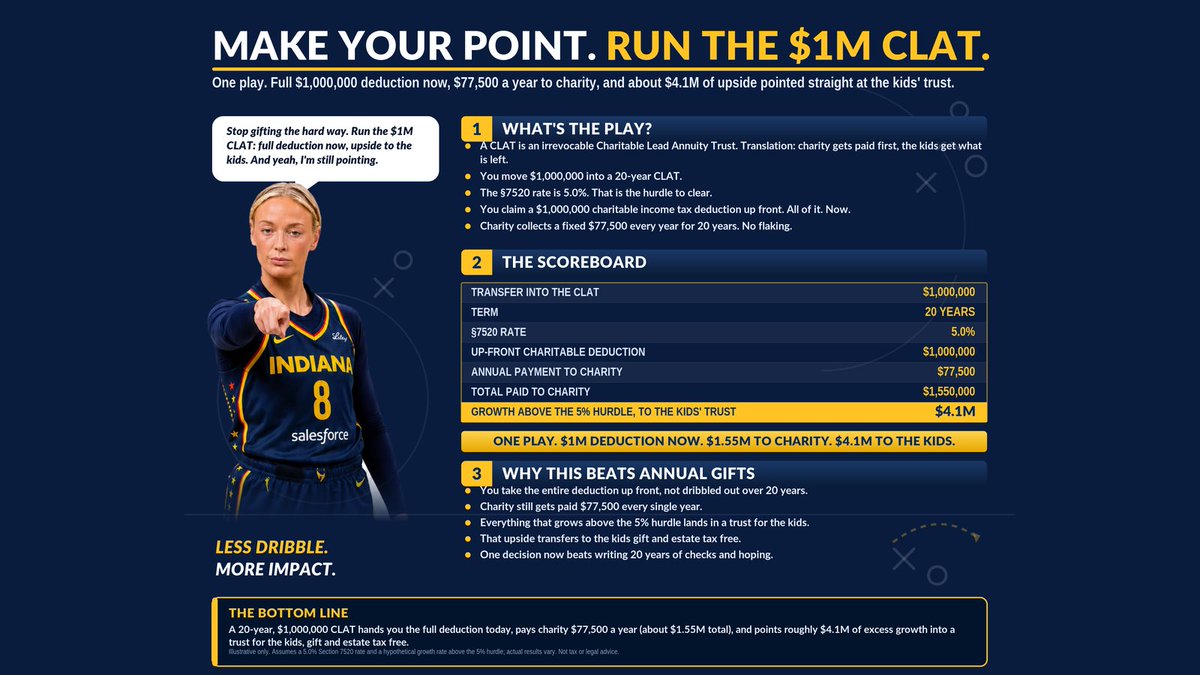
🏗️🎁 The Corporate CLAT: Big Deduction, Corporate Remainder
A corporate grantor charitable lead annuity trust, or CLAT, can be structured so the C corporation receives an immediate charitable deduction equal to the present value of the annuity stream paid to charity.
When it is “zeroed out,” that deduction can equal 100% of the amount funded, subject to the 10% corporate ceiling and carryforward rules.
During the term, the CLAT pays charity. At the end of the term, the remainder can revert to the corporation.
That makes the corporate CLAT especially interesting when a company wants to accelerate a large deduction into a high-income year while still preserving the possibility that excess growth returns to the corporation later.
The structure is most attractive when funded with low-turnover growth assets that produce little current income during the term.
Alta Trust helps evaluate whether the CLAT should be level, back-loaded, shorter, longer, or not used at all.
Reach out to me at Alta Trust if your company or client needs a large corporate charitable deduction strategy.
#CLAT #CorporateGiving #Ccorp #AltaTrust #TaxPlanning
This is part of my 12-part series on C corporation charitable deduction planning after the new 2026 rules. 🧵🏢🎁
⚖️💵 CRUT Design: Bigger Deduction or Bigger Payback?
With a corporate CRUT, the payout rate drives the economics.
Using a $1M, 20-year example from our modeling:
At a 5% payout, the upfront charitable deduction is about $363,183. The corporation receives about $1.96M back over 20 years, and the projected charitable remainder is about $3.59M.
At an optimized payout of roughly 11%, the upfront deduction falls to about $100,020, but the corporation receives about $2.21M back over 20 years, and the projected charitable remainder is about $1.01M.
Neither version is “best” in the abstract. The right version depends on whether the corporation values the larger deduction, larger payback, shorter term, larger charitable remainder, or better cash-flow fit.
Alta Trust’s role is to turn that design choice into numbers the board, CFO, advisor, and tax team can actually evaluate.
Reach out to me at Alta Trust if you want to compare CRUT scenarios before a sale becomes too far along.
#CRUT #Ccorporation #TaxStrategy #AltaTrust #Philanthropy
This is part of my 12-part series on C corporation charitable deduction planning after the new 2026 rules. 🧵🏢🎁
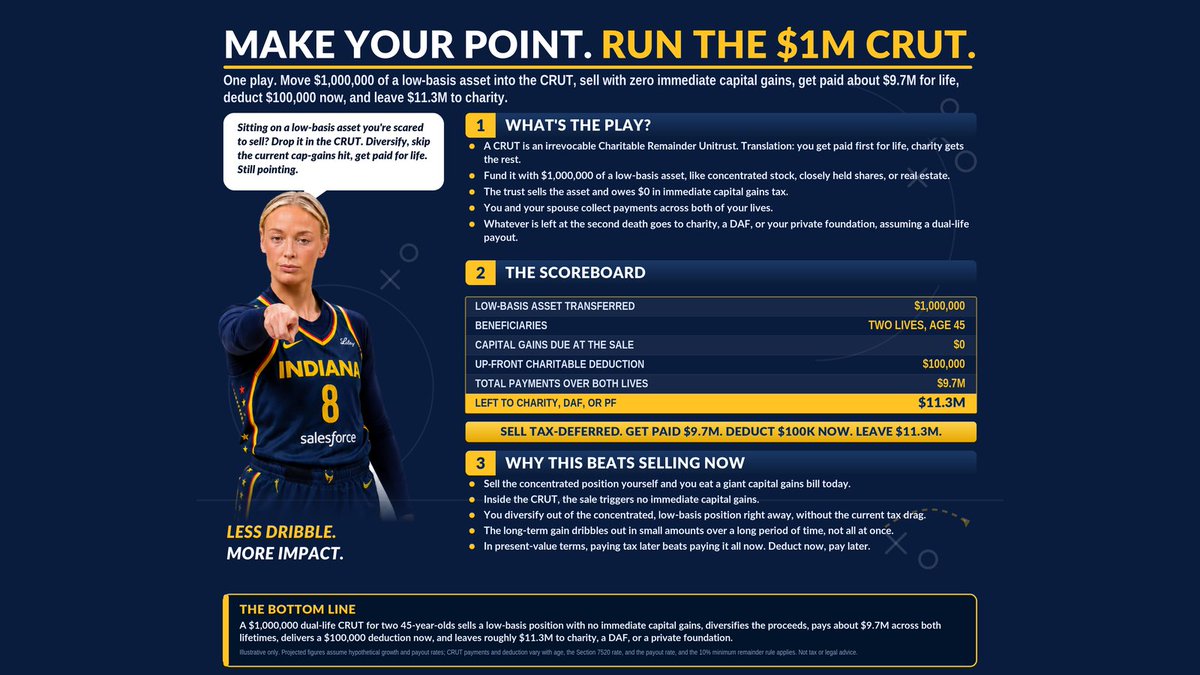
🔁🚤 The Corporate CRUT: A Low-Basis Asset Escape Hatch
A C corporation can use a term-of-years charitable remainder unitrust, or CRUT, in a way many business owners and advisors overlook.
The corporation contributes appreciated long-term property to the CRUT and serves as the income beneficiary for a term of years, up to 20 years. The corporation receives a current deduction equal to the present value of the charitable remainder, subject to the corporate limits.
Then the CRUT, which is generally tax-exempt, can sell the appreciated asset and reinvest the full pre-tax proceeds. The corporation receives unitrust payments over the term, with tax recognized as cash comes back under the CRT ordering rules. Given the time value of money, this tax deferral is meaningful. ("You want deductions now and pay taxes later!")
This can convert a concentrated, low-basis corporate asset into a diversified, deferred income stream while also creating a charitable deduction.
Alta Trust helps model the payout, term, deduction, remainder, and administrative requirements before the asset is moved.
Reach out to me at Alta Trust if your company or client holds a low-basis corporate asset and wants options.
#CRUT #CorporateGiving #Ccorp #AltaTrust #CharitablePlanning
This is part of my 12-part series on C corporation charitable deduction planning after the new 2026 rules. 🧵🏢🎁
🎯🧾 The Charitable Payment That May Not Be a "Gift"
Not every payment to a charity should be analyzed first as a charitable contribution.
If the corporation receives a real business benefit, the payment may fit better under Section 162 as an ordinary and necessary business expense. Think sponsorships, naming rights, cause marketing, program advertising, event visibility, or other payments made with a reasonable expectation of business return.
Why does that matter?
A true business expense is not subject to the 1% charitable floor or the 10% charitable ceiling.
That can be a major difference for C corporations.
The key is documentation. Board minutes, sponsorship terms, marketing deliverables, audience reach, and the business rationale should all line up.
At Alta Trust, we help advisors and business owners identify when a corporate charitable payment is really part of a broader business strategy, then coordinate the planning around that classification.
Reach out to me at Alta Trust if you want to review corporate giving before it is booked the wrong way.
#TaxPlanning #CorporateGiving #BusinessExpense #AltaTrust #Ccorp
A 1% Mistake Costs $10 Billion
Fortune’s new piece by @SydneyLake looks at the impossible math of managing Elon Musk’s trillionaire SpaceX wealth after the SpaceX IPO, and what happens when wealth becomes so large that ordinary portfolio management is no longer enough.
I was thrilled to be quoted extensively, and Sydney even used one of my quotes in the title:
“A 1% mistake costs $10 billion.”
That line captures the core issue.
At this level, the central question is not simply how to invest the money. It is how to protect control, manage liquidity, reduce avoidable transfer taxes, address public scrutiny, preserve philanthropic purpose, and keep future beneficiaries from inheriting chaos.
That is where advanced trust planning becomes critical. Properly designed irrevocable trusts can protect assets from creditor exposure, organize control and succession, freeze taxable value, support charitable planning, and create long-term governance for descendants.
Extreme wealth is a litigation target, a governance challenge, and a tax problem before it is an investment problem.
That is why the answer is not another product. It is resilient architecture: the right trusts, the right jurisdiction, clear governance, succession planning, creditor protection, tax planning, philanthropy, and professional administration all working together.
Thank you to @SydneyLake and Fortune for including my perspective. The piece was also picked up by Yahoo Finance, which was a nice bonus.
#EstatePlanning #TaxPlanning #Trusts #FamilyOffice #WealthManagement #SuccessionPlanning #SpaceX #Trillionaire