Pround to announce that my first first author paper has just been released 'The role of asking more complex questions in creative thinking' Big thanks to my collaborators and mentors
@yoed_kenett
and
@RRPcreativity
Check it out here:
https://t.co/QZcvAGSWAY
Thrilled to share this Nature Reviews Psychology piece! 🧠 It covers a profoundly important article on how our memory systems drive creative ideation.
Read it here: https://t.co/yvEUUUNOfm
#CognitiveScience#Creativity#Psychology
Had a great time talking about the important role of questions in learning with @LastShowPizza. We spoke about how standardized tests may be harming high-level question askers in academia.@yoed_kenett
Spotify:
https://t.co/xpHGT6Oa1I
Apple Podcast:
https://t.co/tG7RX28yuu
Does knowing more make you ask better questions? 🧠 In our new paper, we say yes, but traditional tests don't reward it.
We find that great question-askers actually score WORSE on multiple-choice exams, but excel at open-ended projects!
@yoed_kenett https://t.co/S4AIQrMApd
As students learn, their ability to ask complex questions grows. A new study suggests this advanced questioning skill boosts performance on creative assignments but actually leads to lower scores on traditional multiple-choice exams. https://t.co/Yn43kx9ASU
As students learn, their ability to ask complex questions grows. A new study suggests this advanced questioning skill boosts performance on creative assignments but actually leads to lower scores on traditional multiple-choice exams. https://t.co/Yn43kx9ASU
New paper out!📄@yoed_kenett
Can people accurately judge their own question?
Across 3 studies, self-ratings weakly match objective scores. People overrate simple questions, underrate complex ones, and greatly improve after brief training.
Open access:
https://t.co/mr0Fx0mgIK
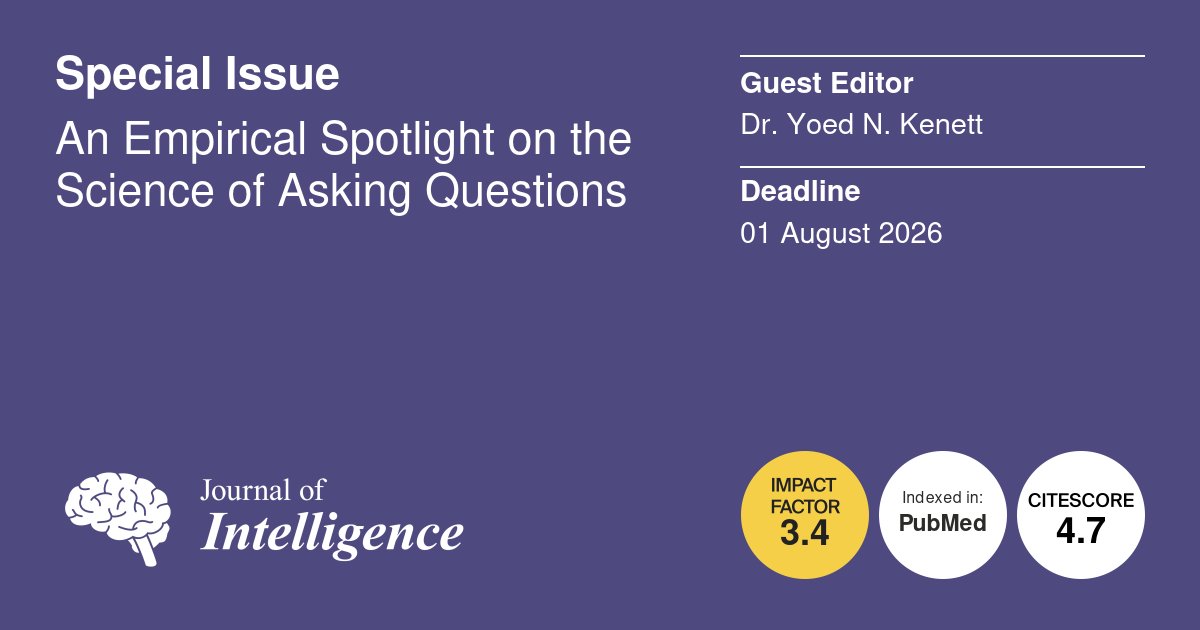
🔍 Call for Submission: Special Issue on An Empirical Spotlight on the Science of Asking Questions
📩 Submit your research and join us in advancing this emerging field!
https://t.co/iLYsAzAlhw
#specialissue#intelligence#asking
Extremely honored to have received an @APADivision10 Early Career Research Microgrant and excited for the work ahead, and the opportunity to further research question-asking based interventions!
Huge congrats to my grad student Tuval Raz (@tuvalraz) on receiving an Early Career Research Microgrant from @APADivision10! It will fund his awesome research on question-asking interventions!
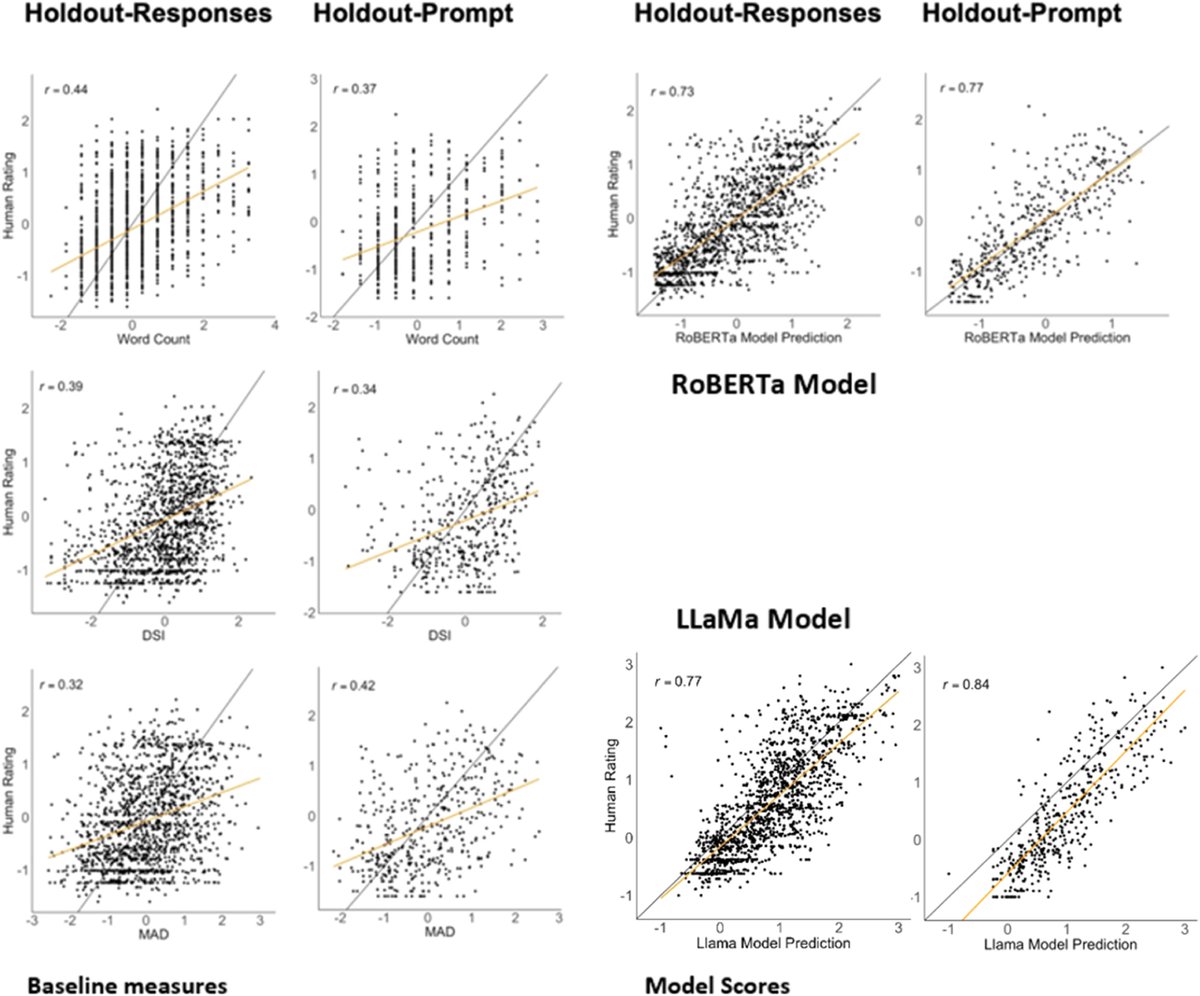
•Both models predict open-ended question complexity and align strongly with human ratings.
•Introduces PrediQT, a free web app for automated question-complexity scoring: https://t.co/v7TEQ2VTUF
•Bridges creativity, cognition, and AI for educational assessment innovation.
It’s been a long road, but our paper is finally out!🚨
We used LLMs to automate the scoring of cognitive question complexity, outperforming older methods. Check out the paper!
🔗 Link: https://t.co/n9nEa742Uf
@Simone_Luchini@RogerBeaty@yoed_kenett#Creativity#AI#NLP#EdTech
• We Introduce two automated transformer models for assessing cognitive question complexity: high-performing LLaMA 2 and efficient, robust RoBERTa.
•These fine-tuned transformer language models greatly outperform surface-based and semantic-distance baselines.
Question-asking lies at the heart of how we make sense of the world, yet this essential skill remains surprisingly under-studied.
Luckily @yoed_kenett is launching a special issue in @JIntell_MDPI to change that. 📢 Submit here: https://t.co/ZpdvLPlUIs
Submission deadline: 8.1.26
Super excited to launch a new Special Issue I will be guest editing in @JIntell_MDPI, with the title of “An Empirical Spotlight on the Science of Asking Questions.” - https://t.co/9y2p4w2z1w
These results highlight a fundamental tension in education: we aim to encourage innovative, inquisitive thinkers, yet often evaluate them with assessments that reward only narrow, convergent recall.
🚀New research alert
Check out our new preprint exploring how students’ question-asking changes as they gain relevant knowledge, and why this matters for the future of education.
@yoed_kenett
https://t.co/xWDPNR5MMG
We find that the most creative, complex question-askers actually struggle on multiple-choice tests, but shine on open-ended projects. Additionally, Over a semester, domain-specific question originality and complexity increased while general questioning ability stagnated.
🔎 People tend to underestimate their most complex questions and overestimate simple ones.
✍️After a brief training on question complexity participants became much better at judging both the complexity and creativity of their own questions.
Overestimation bias was also reduced.
🤔How accurately do we judge our questions?
Our study finds people misjudge their question complexity and creativity, but a brief explanation of question complexity can significantly boost self-assessed accuracy.
With the great @yoed_kenett
Read more: https://t.co/Q9g4TT5xoe
🚨Check out our recent preprint on human-AI co-creativity in story writing!
🔍🔍🔍We investigate the mechanisms that underlie the outcomes of human-AI co-creativity in a highly naturalistic setting.
https://t.co/k1kf0oRsDH