You mean Amazon honors its contracts. The driver signs with a delivery company. The company contracts with Amazon. Both agreements are voluntary. Both can be ended. You call this exploitation. Adults call it commerce.
Now ask what Amazon built. Same-day delivery to every door. Books to every village. A marketplace that lifted millions of small sellers from obscurity. Cloud infrastructure that runs half the internet. Prices crushed across every category. Jobs for over a million people who applied.
You built none of it. You tax it. You regulate it. You accuse it.
The driver is not a serf. He is a man who made a deal. Your contempt for his judgment is the only disrespect in this story.
Workers deserve a mayor who does not call their contracts crimes.
USA. I ordered a large soda.
In Japan, large means slightly larger.
A small drink becomes a medium drink.
A medium drink becomes a large drink.
Everyone understands the agreement.
But in America, large means the conversation has left the restaurant.
The cashier handed me the cup.
I looked at it.
It looked back.
This was not a drink.
This was a private reservoir with a lid.
I held it with both hands, because one hand felt disrespectful. The ice moved inside like a small glacier. The straw stood there with the confidence of a flag planted on new land.
The cashier smiled like this was normal.
So I accepted it.
In America, a large drink is not a beverage. It is infrastructure.
I took one sip.
Nothing changed.
I took another sip.
Still full.
I took a serious sip, the kind of sip a man takes when he has decided to participate in his own future.
The level did not move.
At that point, I stopped drinking and began managing it.
I checked the weight.
I listened to the ice.
I adjusted the straw angle.
I monitored condensation on the cup wall.
I was no longer a customer.
I was the Department of Soda.
A child walked past holding the same size cup with one hand.
One hand.
No fear.
No hesitation.
No respect for the burden.
I understood.
He was born into the system.
I carried mine outside like a sacred responsibility. The sun was hot. The cup was cold. I was small. The soda was still winning.
By the time I reached the parking lot, I had accepted the truth.
I did not order a drink.
I was appointed temporary governor of a liquid province.
I did not finish it.
It finished me.
Matteo Arnaldi has been forced to withdraw from his semi-final match against Flavio Cobolli due to a viral illness
Cobolli advances to the Roland-Garros final
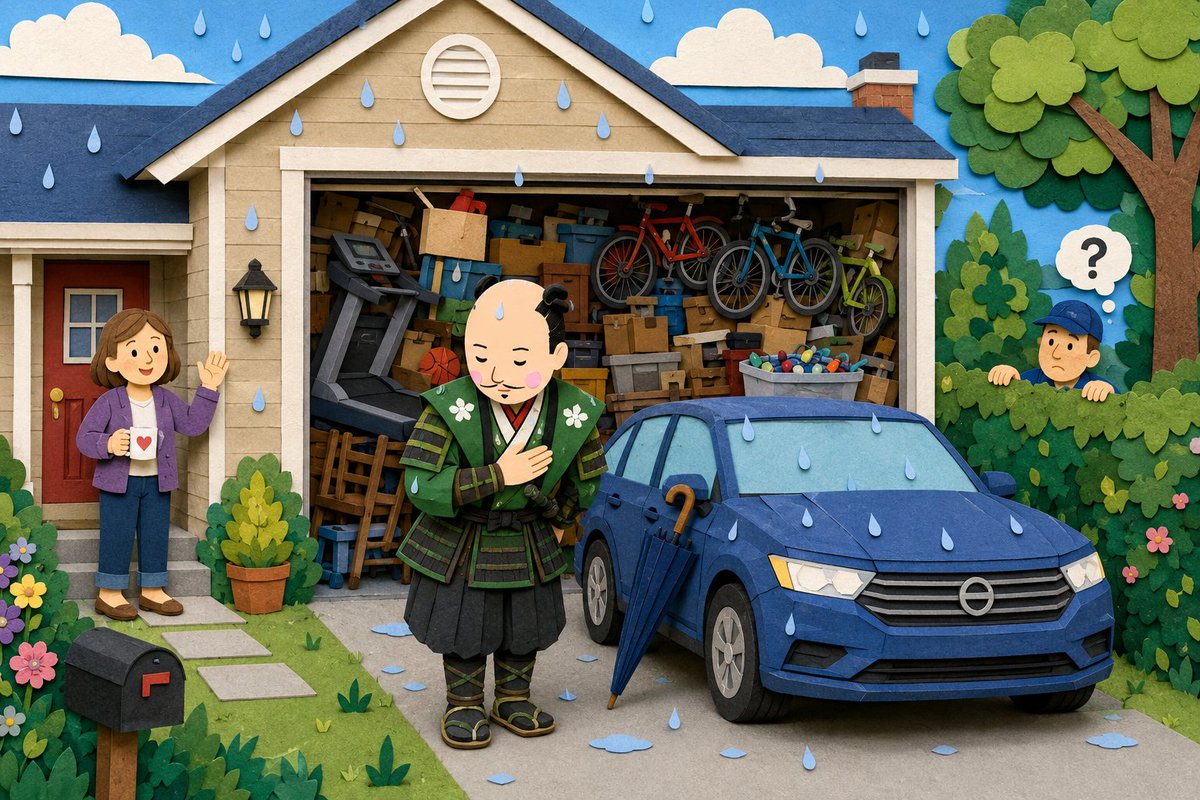
USA. A house. The garage is full, so the car sleeps in the rain.
I walked past an open garage today, and I finally understand Americans.
The garage was packed to the ceiling. Boxes. A treadmill. Old chairs. Three bicycles hanging from hooks. Christmas lights in a plastic tub. No room for even one more thing.
And the family car? Parked outside. In the driveway. Getting rained on.
I stood there, deeply moved.
In Japan, we put the car in the garage and the boxes in the house. Americans do the opposite. And now I see why.
The garage is the treasure house. Inside it sleep the sacred relics: the bicycle the child outgrew, the chair no one sits in, the lights that shine one week a year. These must be protected at all costs.
The car is not a treasure. The car is a warrior. So the car is given the highest honor a warrior can receive. It stands guard at the gate, in the storm, all night, so the treasures stay dry.
The owner came out with his coffee. He saw me looking and shook his head.
"Yeah, I really gotta clean out that garage," he said.
Clean it out? I bowed to him. "You are a good man," I said. "Your car guards your home with its life."
He looked at his car. He looked at me. He said, "...thanks?"
He has never thought of it that way. But I could tell he liked it.
So now every morning I walk past, and I bow to the car in the driveway.
It has the hardest job in the family, and it never complains.
The owner waves at me now. He thinks we are friends.
We are. But mostly, I am here for the car.
This morning it was raining again. The car was soaked, still guarding the gate, still faithful.
So I gave it my umbrella.
I do not need it. I have known harder rain.
A warrior on duty should not have to stand in the storm alone.
USA. A diner. I ordered a cola, and they handed me a cup that was ninety percent ice.
I have learned how to measure an American's honor.
The drink came in a cup the size of my helmet. Inside: a mountain of ice, and somewhere beneath it, a rumor of cola. I tilted it. The ice did not move. It was load-bearing.
In Japan, a few cubes, politely. Here, an avalanche. And once I stopped being confused, I was moved.
Ice is not free. Someone must make it, store it, guard it through the heat. To bury a man's drink in it is not stinginess disguised. It is the opposite. It is a lord opening his treasury and saying: take all of it, take more than you need, I have so much that I do not even count.
The ice is the boast. The drink is just the excuse to deliver it.
So now I judge every establishment by the ice. A weak handful, and I know the house is humble, careful, perhaps struggling. A roaring glacier, and I know I am in the presence of abundance, and I bow before I drink.
The waiter came to refill me. He lifted the scoop, and he gave me more.
More. I had not finished. He gave me more anyway. I nearly stood and saluted.
"Most generous," I told him. "Your house is rich beyond measure."
He said, "...you want less ice next time, buddy?"
Less ice. As if I would insult him by refusing his treasure. I told him no. I told him to bury me.
I drank for forty minutes. The cola lasted four. The remaining thirty-six were spent honoring the ice directly, one melting cube at a time, until the cup held only cold water and my own deep respect.
I left the fullest I have ever been, having ordered almost nothing.
A man does not come to America for the drink.
He comes for the mountain it is hidden under.
USA. Summer. It is 95 degrees outside, and I am shivering inside a sandwich shop.
I have discovered how Americans forge strong souls.
Outside, the sun is trying to kill everyone. Inside this small restaurant, it is winter. My breath does not fog, but it is thinking about it. A man near me is eating a cold sandwich while wearing a jacket. In summer. Indoors.
In Japan we would simply turn it down. Americans do not turn it down. And now I understand them better than they understand themselves.
This cold is not an accident. This cold is a gift.
The owner has built, inside his shop, a second season. He invites you in from the brutal heat and hands you the one thing the sun has denied you all day: a reason to be cold. To endure it is to be tempered. You walk in soft and sweating. You walk out sharp and clear, a slightly stronger person than you were.
So I did not complain. I removed my outer layer and offered it to the woman at the next table, who was hugging herself. She said, "Oh, no, I'm fine, thank you." She was not fine. Her lips were blue. But she, too, understood the training. She would not break first. I respected her deeply.
The owner asked if everything was okay.
"It is perfect," I said, through my teeth, which were chattering. "Thank you for the winter."
He said, "...I can turn the AC down if you want?"
I told him no. A man does not ask the mountain to be shorter.
I stayed two hours. I ordered a hot coffee to survive. Then a second one, to hold. By the end I could no longer feel my hands, but my spirit had never been clearer.
So now, on the hottest days, I seek out the coldest rooms. I sit. I shiver. I sharpen.
And when I finally step back out into the summer heat, and it wraps around me like a warm bath, I feel it.
Reborn.
A man who has survived the winter, in August, indoors, for the price of a sandwich.
USA. A potluck. Everyone brings one dish. I have never been so out of my depth in my life.
I was invited to a gathering. "Just bring a dish to share," they said. Simple words. I did not sleep for three days.
Because I understood instantly what this was. A summit. Every guest, a lord of their own house, arriving bearing tribute. And tribute is judged. Tribute is ranked. To bring the wrong dish to the wrong table is to fall in standing before your peers, possibly forever.
So I prepared. I made my finest dish. I carried it to the door with two hands and a straight back, braced for the weighing of my worth.
The first lord arrived with a bowl of orange powder noodles. Macaroni and cheese. The crowd roared. He set it down at the center of the table. The CENTER. I noted this. The center is the seat of power.
The second lord brought a tower of small brown meat orbs in red sauce. "Meatballs," he announced, like a man laying down a sword. They were placed beside the macaroni. A strong showing. An alliance, perhaps.
I studied the table like a battlefield map. Potato salad: defensive, reliable, old money. A vegetable tray, untouched, clearly a hostage offering no one expected to win. And then a woman walked in, raised a flat box overhead, and the entire room turned and CHEERED.
Pizza. She had brought pizza. Store-bought. Still in the box.
I was stunned. She had not even cooked it. And yet the people rejoiced as if a king had entered. I revised my entire understanding of the hierarchy on the spot. Effort means nothing here. Only the roar of the crowd decides rank.
I placed my dish down, humbly, near the napkins. A peasant's position. I accepted it.
And then a man tapped my shoulder, pointed at my dish, and said the words that changed everything.
"Whoa, did you make this? This is amazing. Everybody, you GOTTA try this guy's thing."
The room turned. The room came. The room ATE. My dish vanished in ninety seconds. The pizza woman herself took a second helping and looked at me with respect.
I had won the summit. By accident. With a dish I placed by the napkins.
I understand nothing about this country. I have never been happier. I am hosting the next one.
So tell me, America.
Is there a system to the potluck? A secret rank? A hidden law?
I have decided there is not.
You just bring the thing you love, and everyone eats it, and somehow everybody wins.
It is the most insane way to hold a war.
I will fight in every single one.
Chwalinska d. Diana Shnaider 7-6(4) 6-4
MAJA CHWALINSKA IS A GRAND SLAM FINALIST.
She is first qualifier in history to reach the Roland Garros final.
A statement that most people would’ve thought was unthinkable at the start of Roland Garros.
The world #114.
9th consecutive win since the start of qualifying.
18sets played, just 1 set dropped.
0 top 50 wins before this tournament.
Now she’s had 4 in a row & will leave Paris ranked AT WORST #21 in the world.
Move over Cinderella, there’s a new fairytale in town.
🇵🇱❤️
The most insane story in sports right now is Maja Chwalińska's French Open run! She is the first ever qualifier to reach the Roland Garros Final.
She opened +20000 to win the tournament and is now +300. This would be like if the Jets (+20000) made it to the Super Bowl 🤯
Here is a photo of Dawa Sherpa who was found alive this morning, 04.06.2026 NPT, near Crampon Point on Everest while crawling toward base camp. Frostbitten, exhausted, and severely weakened, he miracolously survived alone for days after disappearing above Camp III.
Somewhere out on the Wyoming sagebrush plain, thousands of Americans once faced decisions that could change the course of their lives.
At a place called Parting of the Ways, pioneers traveling west by wagon had a decision to make. Stay on the established route or travel on a riskier shortcut across miles of dry desert with little water and no guarantees.
🚀 From Utah to the Moon.
The final solid rocket booster segments for NASA's Artemis III mission have left Promontory, Utah, and are on their way to Kennedy Space Center in Florida.
Built by Northrop Grumman, the massive boosters will help power the Space Launch System rocket, generating 7.2 million pounds of thrust at liftoff as NASA works toward returning astronauts to the moon.
The newly shipped segments will join others already delivered to Florida and will be among the first pieces assembled for the mission.