A student submitted an essay she wrote by hand. Her university ran it through an AI detector. The detector said she cheated. She is autistic.
Her name is Moira Olmsted. Adelphi University. February 2026. Turnitin flagged her essay as 100% AI-generated. She was disciplined.
Two other AI detectors classified the same essay as human-written.
She sued. She won. The court called the school's decision "arbitrary and capricious."
She is not the only one.
In May 2026, a high school student in Palo Alto was expelled after an AI detector flagged his work. He faced visa revocation. He filed a federal civil rights lawsuit.
A researcher at Griffith University just proved mathematically why this keeps happening. The paper is on arXiv. The finding is one sentence.
AI text detectors have a structural flaw that no amount of better engineering can fix.
Here is what the math says.
If a university wants its detector to catch 80% of cheaters, at least 750 out of every 10,000 innocent students will be wrongly accused. That is not a software problem. It is a theorem.
If the university tries to limit false accusations to 1%, detection power collapses to 6%. It catches 6 out of every 100 AI-written papers. The other 94 get through.
There is no setting where the detector is both fair and effective.
The reason is diversity. Every student writes differently. Non-native English speakers use simpler vocabulary. Shorter sentences. Clearer structures. So does AI. A Stanford study found that 61.3% of TOEFL essays written by non-native English speakers were misclassified as AI-generated. A separate analysis tested 14 commercial detection tools. Zero out of 14 reached 80% accuracy.
The students most likely to be wrongly accused are non-native English speakers, neurodivergent students, and anyone who writes with clarity and precision. The qualities that make their writing effective are the same qualities the detector mistakes for a machine.
Vanderbilt University understood this. They disabled Turnitin's AI detection in 2023 after calculating that even a 1% error rate across 75,000 submissions would produce 750 wrongful accusations per year.
750 students accused of cheating for writing like themselves.
The paper's conclusion is not that we need better detectors. It is that the diversity of human writing itself makes accurate detection mathematically impossible.
The same thing that makes your writing yours is the thing that gets you accused.
https://t.co/L91ldtXP05
the success of heated rivalry should have indicated that we actually just want more queer stories and it wasn’t really about the hockey but it seems like maybe that wasn’t clear
#F1 | Toto Wolff when asked if he’d like to fight Lewis Hamilton for the World Championship:
“I'd rather not fight with him for a title, because I know what he's capable of.”
“If he smells blood, he goes [for it]. I've seen it many years where suddenly, the Lewis Hamilton train, started to go, and then it's very difficult to stop it.”
Thank you Steve Dangle for being the only hockey podcast I have listened to this week who has mentioned that Carter Hart should not be playing hockey rather than engaging in the discussion about his goaltending
Finally: National News coverage on Georgia Power using eminent domain to seize Americans homes for Data Centers
330 property owners impacted
21 homes slated for complete demolition
Georgia Power is planning power lines just 12 feet from bedroom windows. Georgia Power trucks and crews full access right next to living spaces
Multiple data centers involved, even one major data center in a different county. 3 additional data centers already approved in Coweta County that will use the new power
If homes don’t agree to sell they are given condemnation threats
Family farms, cow pastures, chicken coops, animals, and beautiful country homes being torn down or devalued. Homes are already being demolished by Georgia Power for the same project
They are claiming it’s for “public good”
Eminent domain being used to benefit private data centers is not for “public good”
They are kicking Americans off their generational homes and calling it a “public good”
I also learned homeowners are reporting Georgia Power is undervaluing properties. As of right now the number is up to about 30 properties they could be facing full demolition
finding out the artemis ii astronauts talked with poets and studied poetry so they knew how to properly convey what they were seeing in words and saying that the arts played a huge role in their time in space. oh my god
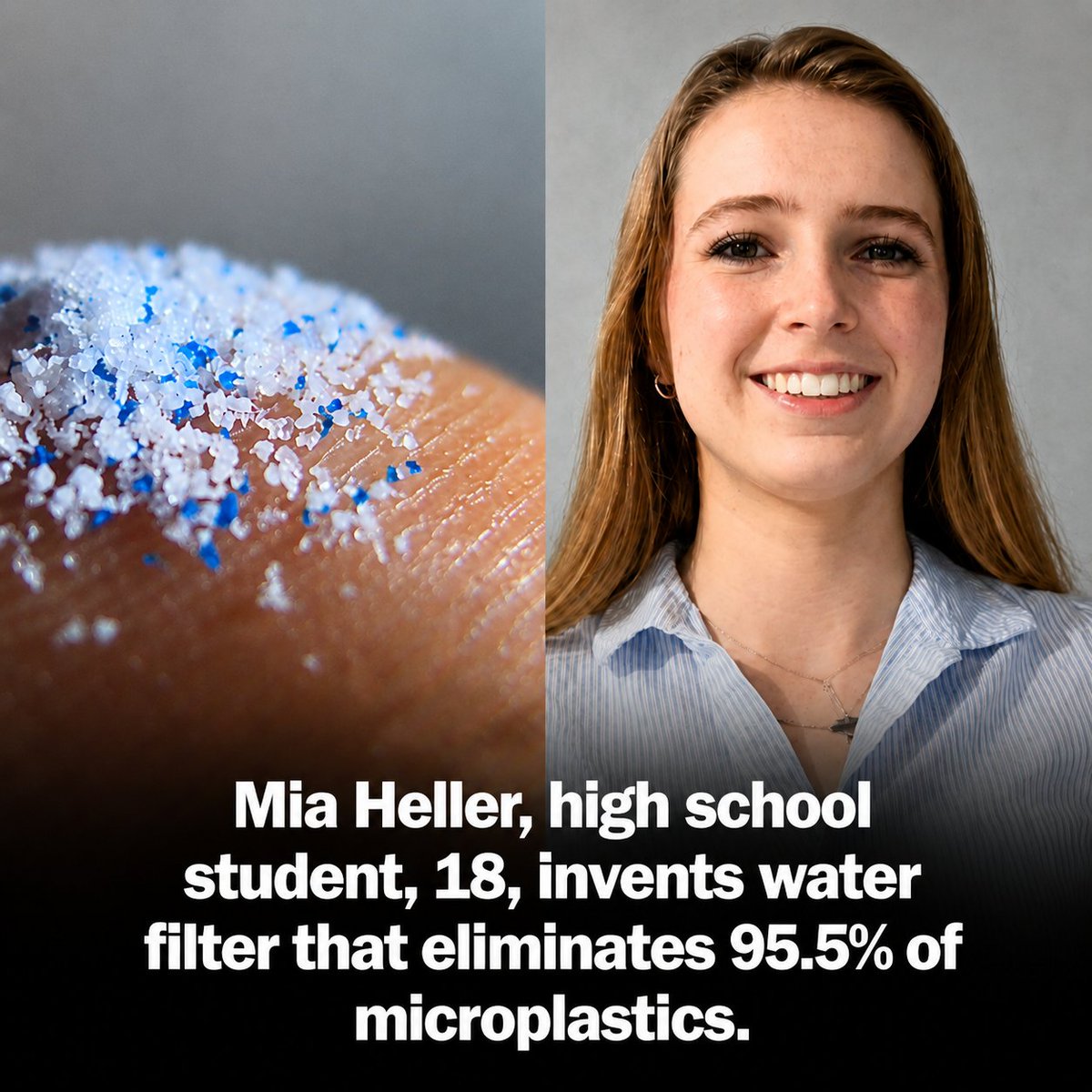
An 18-year-old just did what billion-dollar water companies couldn't.
Meet Mia Heller.
A high school junior from Warrenton, Virginia who built a water filter in her garage that strips out 95.5% of microplastics from drinking water.
That's better than most government treatment plants, which sit somewhere between 70% and 90%.
Her secret weapon? Ferrofluid. A magnetized liquid made of oil and powder that latches onto microplastic particles. Then a magnet yanks them out. No membranes. No constant filter replacements. No endless maintenance bills.
The ferrofluid even gets recycled, around 87% of it, in a closed loop.
The spark for all of this wasn't a classroom project. It was a local newspaper article warning that her town's tap water was loaded with PFAS and microplastics, and that nobody was coming to fix it.
So she watched her mom swap out filter after filter and thought, there has to be a smarter way.
She built the prototype herself. Tested it with a homemade turbidity sensor. Then walked into the Regeneron International Science and Engineering Fair and walked out with a special award from the Patent and Trademark Office Society.
Up against nearly 1,700 students from 62 countries.
She's now eyeing a household version that sits under your kitchen sink.
The future of clean water might not come from a lab in Silicon Valley. It might come from a teenager's garage in Virginia.
Source: Smithsonian Magazine
A data center in Georgia used 30 million gallons of water illegally, and locals only noticed when their water pressure was abnormally low.
The data center claimed it was an honest mistake, but locals were told by the town to conserve water while the data center kept running.







![fiagirly's tweet photo. #F1 | Toto Wolff when asked if he’d like to fight Lewis Hamilton for the World Championship:
“I'd rather not fight with him for a title, because I know what he's capable of.”
“If he smells blood, he goes [for it]. I've seen it many years where suddenly, the Lewis Hamilton train, started to go, and then it's very difficult to stop it.”](https://pbs.twimg.com/media/HK2lFk-XcAAv2SZ.jpg)