Good morning, everyone!
I'm looking for decent accommodation in Mohali, preferably near Dr. B.R. Ambedkar State Institute of Medical Sciences Mohali (AIMS Mohali), with good connectivity to nearby areas and public transport.
If you know of any good PGs, flats or reliable accommodation options, please share the details or DM me.
Any leads would be really helpful. Thank you!
Ms Jyoti Singh successfully defended her thesis, “Study on the usage of social media platforms by central scientific organisations in India for science communication,” on 19.11.26 at CSIR-NIScPR under the supervision & co-supervision of Dr Dinesh Velip and @TVVen
The real measure of a reusable rocket is how reliably, how often and at what cost it can fly again. Reusability must make access to space cheaper, says Visiting Prof, IISER-Mohali TV Venkateswaran @TVVen in The Tribune @thetribunechd#TheTribuneOpinion
https://t.co/w7008AavTY
Why could India take another 10-15 years to develop reusable rockets? Science communicator and visiting faculty at IISER Mohali, TV Venkateswaran, explains why ISRO needs a bigger, next-generation launch vehicle to make rocket reusability viable.
@TVVen#ISRO#ReusableRockets #PSLV #GSLV #SpaceTechnology
On November 18, 2026, 3.46 pm Indian Standard Time (IST), NASA's Voyager 1 spacecraft will reach a distance of one light-day from Earth. It will then be about 25.9 billion kilometres away, becoming the first human-made object to travel so far, writes @TVVen
Read more: https://t.co/zCker0VWsh
#NASA #Voyager1 #SpaceExploration #OneLightDay #NASAmission #DeepSpace #SpaceScience #SolarSystem #InterstellarSpace #SpaceTechnology #HumanAchievement #Astronomy #TheFederal
#TheEighthColumn | On November 18, NASA’s Voyager 1 will become the first human-made object to be one light-day from Earth, about 25.9 billion km away. A radio signal sent to it will take 24 hours to arrive, and its reply another 24 to return. Nearly five decades after launch, the spacecraft is still running on a shrinking power @TVVen
Read more: https://t.co/zCker0VWsh
#Voyager1 #NASA #SpaceExploration #Interstellar #TheEighthColumn
India needs more satellites to build a reliable, independent network, says Visiting Prof, IISER-Mohali TV Venkateswaran @TVVen in The Tribune @thetribunechd#TheTribuneOpinion https://t.co/WimCP4GHiZ
India needs more satellites to build a reliable, independent network, says Visiting Prof, IISER-Mohali TV Venkateswaran @TVVen in The Tribune @thetribunechd#TheTribuneOpinion https://t.co/WimCP4GHiZ
#EighthColumn | Neutrinos pass through Earth almost untouched; catching them took generations of physicists, a failed ocean experiment, a Siberian lake and Antarctic ice, writes @TVVen#Neutrinos#IceCube#Physics#Science#Nobel
https://t.co/0WrteUaoPk
#EighthColumn | Scientists suspect that dark matter may accumulate in places such as the Sun. IceCube searches for such signals. It has not yet detected convincing evidence of dark matter, but its observations help narrow the possibilities, writes @TVVen#DarkMatter#IceCube #Physics #Science #Nobel
https://t.co/dTLHSqJgIO
#TheEighthColumn | Francis Halzen has won the 2026 Nobel Prize in Physics for his work on the IceCube Neutrino Observatory. Buried in Antarctic ice, IceCube is the world’s largest neutrino detector, and it has since opened a new window on the universe’s most energetic events, writes @TVVen
Read more: https://t.co/dTLHSqJgIO
#FrancisHalzen #IceCube #NobelPrize #Neutrinos #Physics
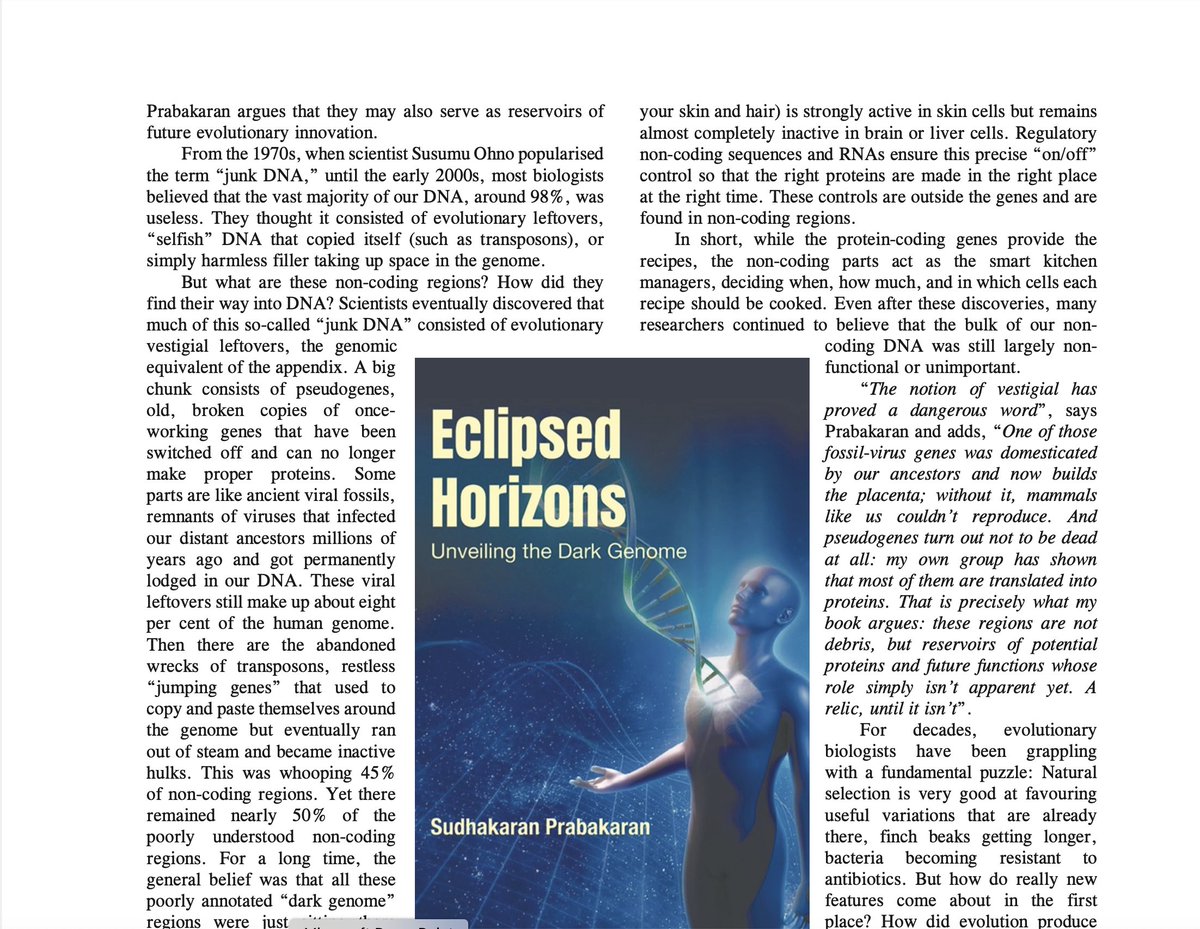
grateful to @TVVen for reviewing Eclipsed Horizons in Science Reporter — one of India’s oldest popular science magazines (CSIR-NIScPR, since 1964). he takes the dark genome seriously as an anticipatory architecture, not junk — and keeps Homo minimus where it belongs, as a testable conjecture.
https://t.co/VjgxUuM8IN
#DarkGenome #Genomics #DarkProteome
The idea for AstroSat began in 1996, during a meeting led by K Kasturirangan, the then chairman of the Indian Space Research Organisation (ISRO). The goal was ambitious: a compact multi-wavelength observatory. The reasoning was solid. Many of the universe's most energetic and violent processes, such as flares on distant stars and thermonuclear explosions on white dwarfs (the dense core remnant of a star that has exhausted its nuclear fuel), emit radiation across multiple wavelengths simultaneously, writes Kulinder Pal Singh, @TVVen
Read more: https://t.co/SyFf6EBqTQ
#AstroSat #ISRO #IndianSpaceResearch #SpaceExploration #Kasturirangan #Astronomy #SpaceScience #MultiWavelengthAstronomy #WhiteDwarfs #CosmicExplosions #Universe #TheFederal
IISER Mohali currently invites applications for 21 vacant Assistant Professor positions through direct recruitment in the areas of Physics, Chemistry, Mathematics, Biology, Earth & Environmental Sciences, Humanities & Social Sciences, Data Science, Science Education, and Artificial Intelligence.
We seek exceptionally motivated scientists with a strong and innovative research program, a proven commitment to academic excellence, and a passion for teaching, particularly at the undergraduate level.
For more information, please see the link given below:
https://t.co/zyx4Bf7eoH
For submitting an online application for a faculty position, please refer to the link below.
https://t.co/Pci8dhk4xu
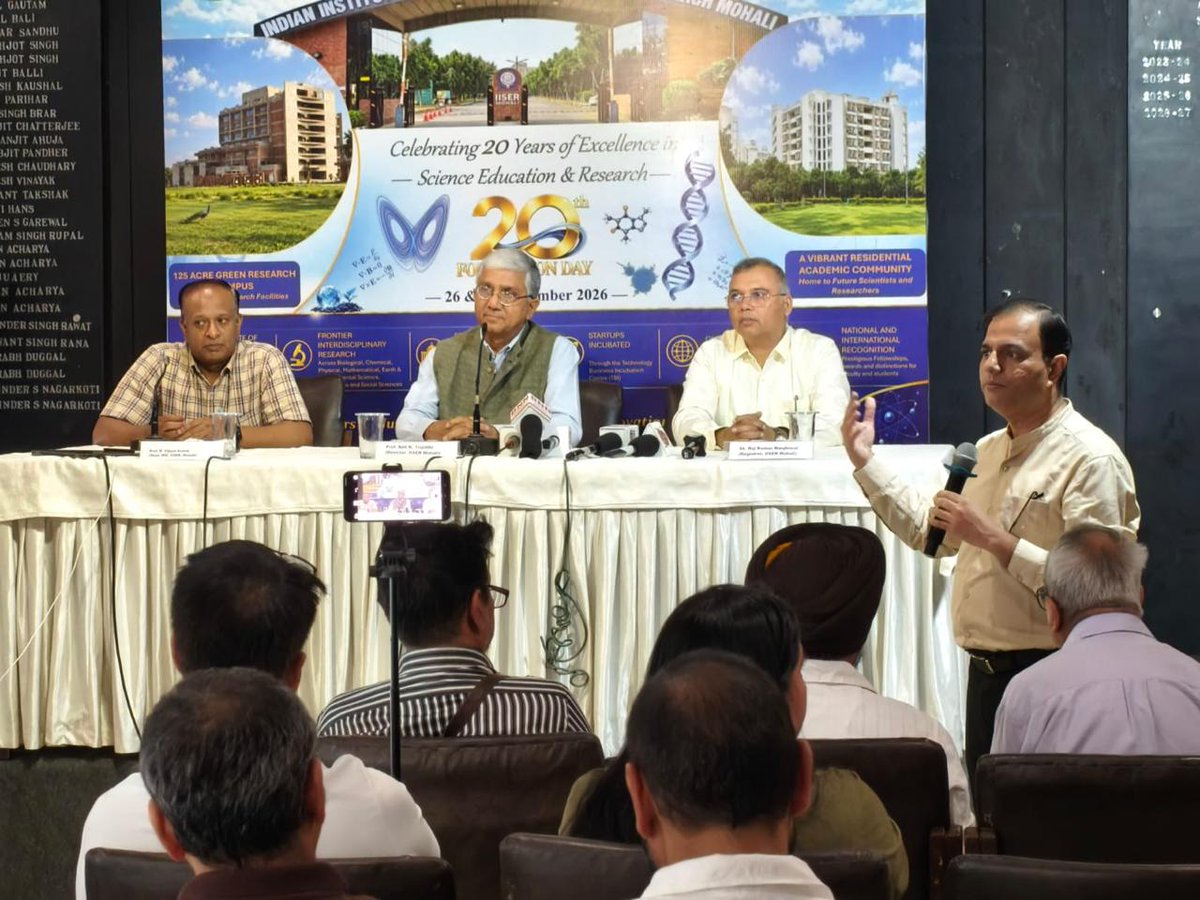
A press conference was organized by IISER Mohali today at the Chandigarh Press Club as part of the Institute’s 20th Foundation Day celebrations. The Director of IISER Mohali, Professor Anil K. Tripathi, addressed members of the media and highlighted the Institute’s remarkable journey and achievements over the past two decades.
Prof. Tripathi began by presenting the history and evolution of IISER Mohali since its establishment. He then outlined the Institute’s significant academic and research accomplishments, emphasizing the contributions of its faculty, students, and alumni. He also showcased several notable recent and ongoing research projects, illustrating their scientific significance and potential societal impact. The address provided a comprehensive overview of IISER Mohali’s growth as a leading institution for science education and research in India.
#TheEighthColumn | It was a late evening in March 1929. Twenty-six-year-old Fritz Houtermans was out for a walk with Charlotte Riefenstahl, a fellow young physicist. Both had received their doctorates in theoretical physics from Göttingen University two years earlier and were still associated with the university, writes @TVVen
Read more: https://t.co/O7KQCtIYpM
#FritzHoutermans #PhysicsHistory #TheoreticalPhysics #QuantumPhysics #HistoryOfScience #Physics #ScienceHistory #GöttingenUniversity #Göttingen #Physicists #ScientificHistory #ScienceAndDiscovery #1929 #ModernPhysics #WomenInScience
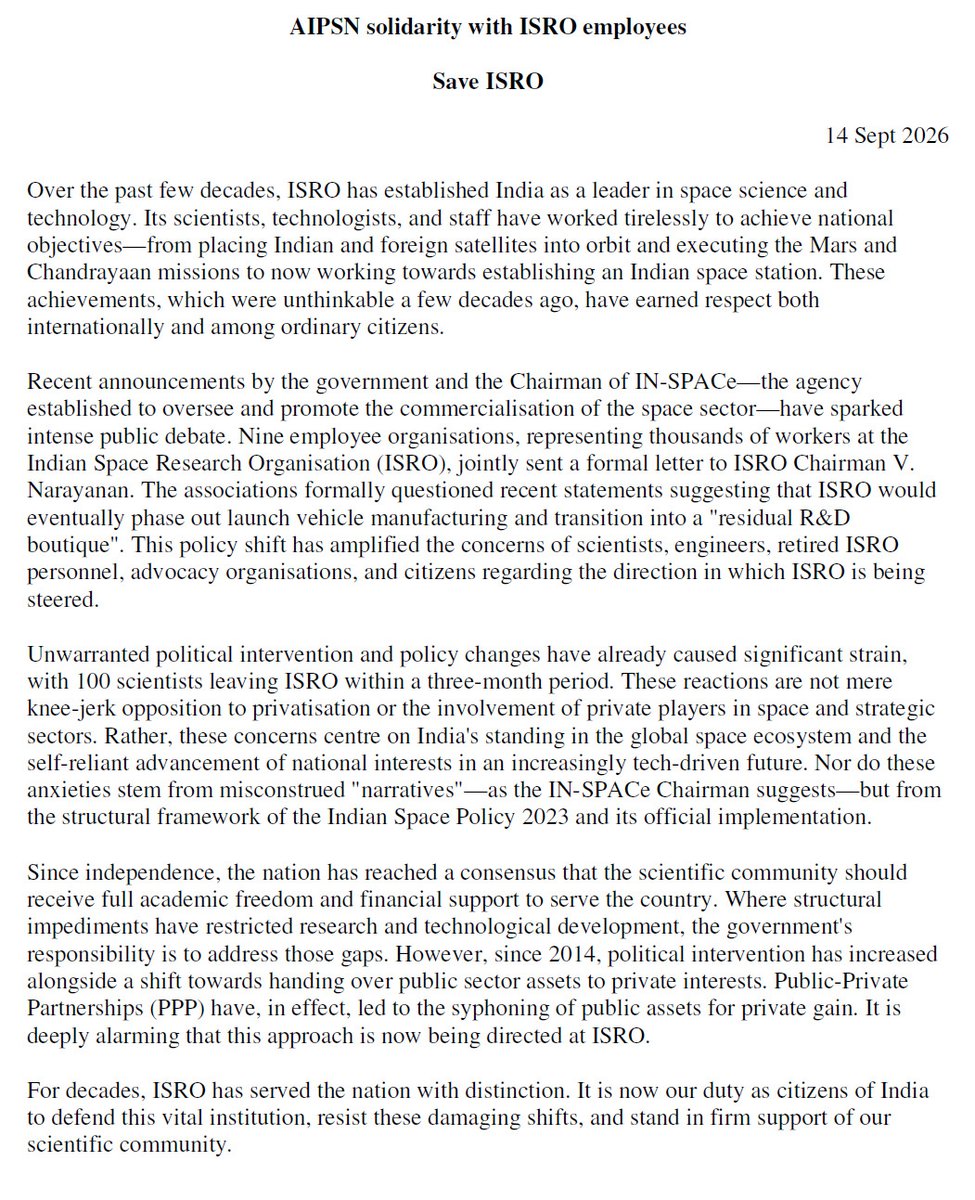
AIPSN solidarity with ISRO employees
#SaveISRO#ISRO
https://t.co/oHdxsvXc65
PDF at https://t.co/oSpNjCWFkw
It is now our duty as citizens of India to defend this vital institution, resist these damaging shifts, and stand in firm support of our scientific community.