The digitization of finance has been evolving for over half a century.
What comes next will be shaped by secure, scalable, and efficient systems.
Move is designed to power that shift.
Built for money @movement_xyz
Note that:
Over time, @movement_xyz will become the main hub of the decentralized global finance ecosystem.
All the technical, philosophical, and operational foundations required to achieve this vision are already in place.
All we need to do is keep moving.
Money is the visible form of value.
Movement builds infrastructure where value moves and grows seamlessly for everyone.
Where money lives.
#wheremoneylives#therailsofmoney
Money is the visible form of value.
Movement builds infrastructure where value moves and grows seamlessly for everyone.
Where money lives.
#wheremoneylives#therailsofmoney
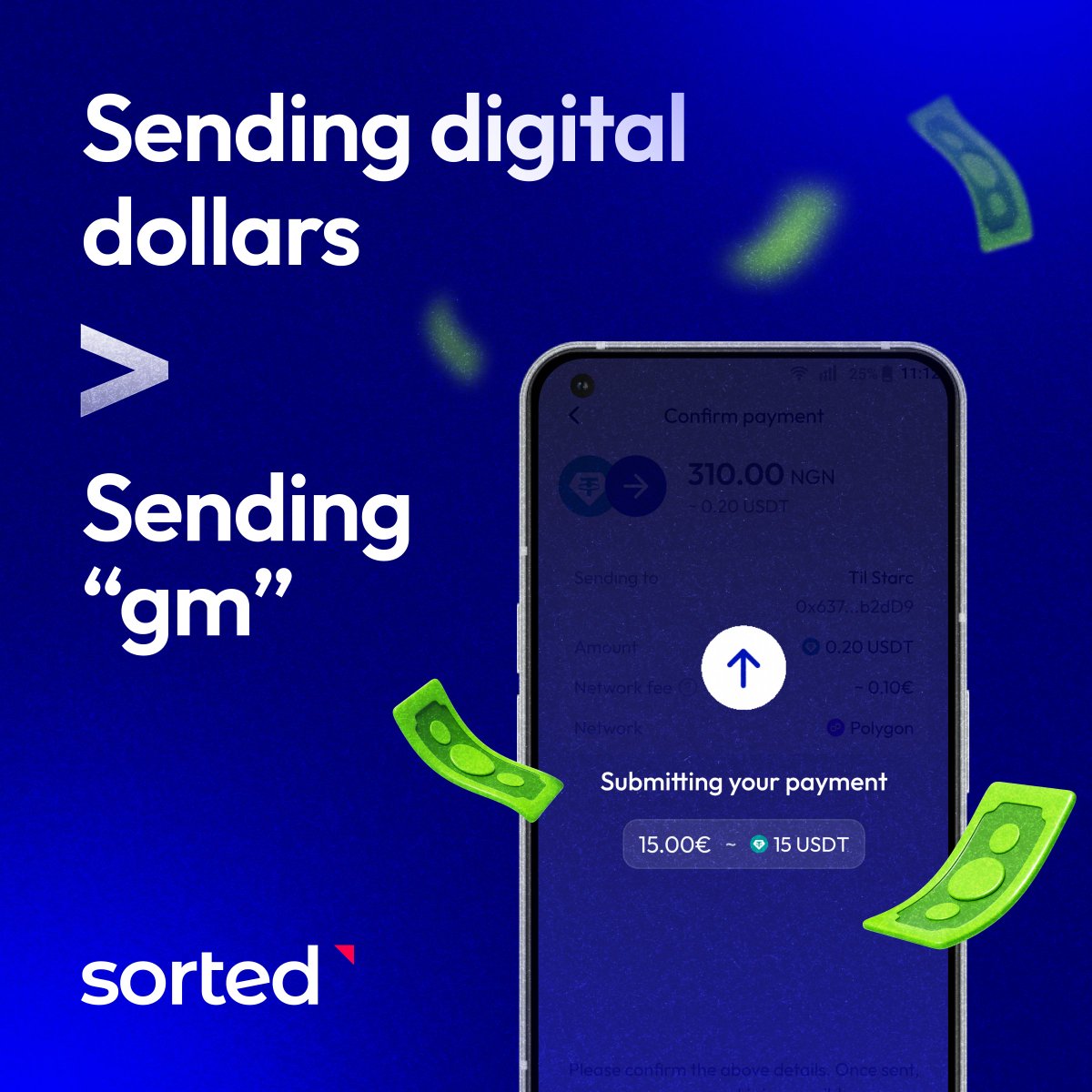
In a world where we're more connected than ever, sending money to someone you care about should be just as easy as sending a message 📲
Whether it's helping out a friend or supporting family back home, money is one of the most meaningful things we exchange every day 💸
At Sorted, our goal is simple: make it easier for anyone, anywhere, to send, receive or store 💙
#Sorted #Stablecoins #Payments #DigitalDollars
Finally an important announcement from @movement_xyz: global payments might be getting a serious redesign.
International transfers still run on something that feels like a mix of fax machines, Excel sheets, and hope.
Money does not really move directly from A to B. It hops through layers of correspondent banks, each adding delays, fees, and friction. Even in 2026, cross-border transfers can take 2 to 5 days and cost 6 percent or more, especially in remittance-heavy corridors across the Global South.
Behind every payment is a network most people never see. Invisible rails quietly move trillions of dollars around the world every day. Movement is focused on rebuilding those rails for a stablecoin-native future.
The core claim is simple but bold: they have secured access to licensed payment rails in the US, EU, and Canada. That matters more than it sounds, because most crypto infrastructure stops at being fast and global but struggles to connect cleanly with regulated fiat systems. Without that bridge, scale is limited.
Movement’s idea is to become a settlement and financial layer for the stablecoin economy.
Let’s break it down with a real-world example.
Imagine someone in Nigeria receiving money from family in Germany.
Today:
- funds go through Western Union or similar services
- high fees eat into the transfer
- settlement takes days
- local currency conversion adds another layer of loss
In Movement’s model:
- value moves in a stablecoin like USDC
- settlement happens near instantly on-chain
- funds can be held in US dollar equivalent form
- and optionally placed into yield-bearing savings products
That last part is important. It is not just payments. It is money that can earn while it sits.
This is where the yield layer comes in. Instead of idle balances, users or fintech apps can put funds into savings products backed by instruments like US Treasuries or other low-risk assets through integrated partners. A 500 dollar balance does not simply wait. It can generate return in the background.
On top of that sits the infrastructure layer for builders.
Neobanks, wallets, and fintech apps do not need to assemble everything themselves. In theory, they integrate once and get:
- cross-border payments
- settlement rails
- savings accounts
- yield products
All in one stack.
That is why you see partners like:
- @KASTxyz for payments and user onboarding
- @circle for USDC infrastructure
- @YuzuMoneyX for conservative yield through T-bills
- @orogoldapp for tokenized gold exposure
- @zothdotio for real-world asset yield infrastructure
- @sortedwallet for mass-market mobile access in emerging regions
Each plays a different role in closing the loop between holding, sending, and growing money.
The broader thesis is becoming increasingly clear. Stablecoins are already the de facto dollar layer across many emerging markets. In places where banking is expensive, slow, or unreliable, USDT and USDC often function as savings accounts by default.
What has been missing is the bridge between crypto rails and traditional financial infrastructure.
Movement is positioning itself at that intersection. Not as a replacement for banks, but as the layer connecting legacy finance with stablecoin-native economies.
Instead of money moving like paperwork through institutions, it can move more like data through the internet.
That is the future they are building toward.
And if they succeed, a bank account may no longer be the only meaningful entry point into global finance.
That is why the phrase "Movement is where money lives" feels less like a slogan and more like a vision for how money could move in the decades ahead.
#wheremoneylives #therailsofmoney
@Guildcreation@SpartansOfMove@ScholarsOfMove@pathfinderstw@movement_explor
"Every chain has to basically pick a lane and start winning in that lane. And the Move language was created by Facebook particular for money."
Our lane is money.
Here's our CEO Torab (@torabyou) explaining this mission on Stabledash (@stabledash).
The rails that move money should be as seamless as the rails that move information.
A connected world deserves connected finance.
Rebuilding the invisible rails that make money move.
@movement_xyz@Guildcreation#wheremoneylives#therailsofmoney
Gmove ⚡⚡
Money already moves.
The problem is how.
While information travels globally in seconds, money is still slowed by fragmented and outdated infrastructure.
Movement is rebuilding the invisible rails that make money move.
Where Money Lives.
#wheremoneylives #therailsofmoney
@SpartansOfMove@movement_xyz