The year is 1949.
The Nobel Prize in Medicine has just gone to the man who invented the lobotomy. Your doctor suggests one for your sister, who has not been herself since the baby came. It is the most celebrated advance in psychiatry of the age, and he is simply current. By the time the prize curdles into an embarrassment, close to twenty thousand Americans have had the operation, and proportionally more here in Britain.
The year is 1956.
Lay the baby down on his front, the doctor says. So does the most trusted childcare book ever written, the one on every new mother's shelf. On his back he might choke, the reasoning goes. Millions obey. The advice holds for nearly thirty years, long after the evidence has quietly turned, and a generation of cot deaths is counted before anyone thinks to roll the babies over.
The year is 1966.
A bestselling book informs your wife that menopause is a disease, that she is, in the author's word, a castrate, and that a small daily pill will keep her youthful and tolerable to live with. Her doctor agrees. The drug becomes one of the most prescribed in the country. Nobody mentions that the author sat on the payroll of the company that made it. That detail surfaces decades later, in the same year the landmark trial is halted early for raising rates of breast cancer, stroke and clots.
The year is 1979.
Your ulcer is caused by stress and sharp food, the doctor explains. Calm down, drink milk, take the antacid that happens to be the best-selling medicine on earth. Two Australians are about to prove that most ulcers are caused by a bacterium and cured by a fortnight of antibiotics. The profession laughs. One of them eventually drinks a beaker of the stuff to settle the matter. The establishment takes the better part of twenty years to stop laughing. The Nobel lands in 2005.
The year is 1985.
Butter is dangerous, the doctor says. Switch to margarine, it is modern, it is heart-healthy, the experts are united. The spread he nudges you toward is loaded with trans fats, which the next decade will identify as the genuinely dangerous one, and which will eventually be banned outright. The butter goes quietly back in the fridge. No correction is ever printed at the volume of the original warning.
The year is 1992.
There is a pyramid on the surgery wall, and the very same one in your grandchild's classroom. Bread, cereal, rice and pasta form the broad virtuous base, up to eleven servings a day. Fat is exiled to the tiny tip. The chart was reportedly held back a year while the relevant industries had their say. It is wrong at the bottom and wrong at the top.
Now it is today.
Your doctor has new guidelines, new studies, a fresh consensus, delivered with precisely the steady confidence of every guideline above. He believes it, and he has good reason to. So did every doctor in this thread. None of them were villains. Each was sincere, most were kind, and all were certain, reading from a map that somebody else had drawn and handed them. That is the part worth sitting with.
So when the man in the white coat tells you what to eat, what to fear, and what to swallow every morning for the rest of your life, you are allowed to ask. Who paid for the study. What the evidence says beneath the headline. What he was just as certain about thirty years ago, and where that advice sits now.
Then make up your own mind. Call it scepticism, or call it whatever your grandmother called it when she ignored the advert, kept the butter where it was, and lived to ninety-one.
It has outlasted every consensus on this list. It will outlast this one too.
On the morning of June 6, 1944, Lt. Dick Winters had already survived one disaster before the sun came up.
His C-47 roared over Normandy through a wall of flak, flying too fast and too low. He jumped anyway. The prop blast ripped his leg bag clean off, taking his rifle, his ammo, and most of his gear. He hit the ground in occupied France armed with a knife in his boot.
Most men in that situation hide. Winters started walking toward the sound of the war.
By dawn he had scavenged a rifle, collected a handful of scattered paratroopers, and learned that his company commander's plane had gone down with everyone aboard. Just like that, a quiet lieutenant from Pennsylvania who didn't drink, didn't curse, and wrote letters home about wanting to find a peaceful farm someday was in command of Easy Company.
A few hours later a battalion officer gave him one of the great understated orders in military history. German fire was coming from a farm called Brecourt Manor, hammering the troops coming off Utah Beach. The order was basically: there's fire along that hedgerow, take care of it.
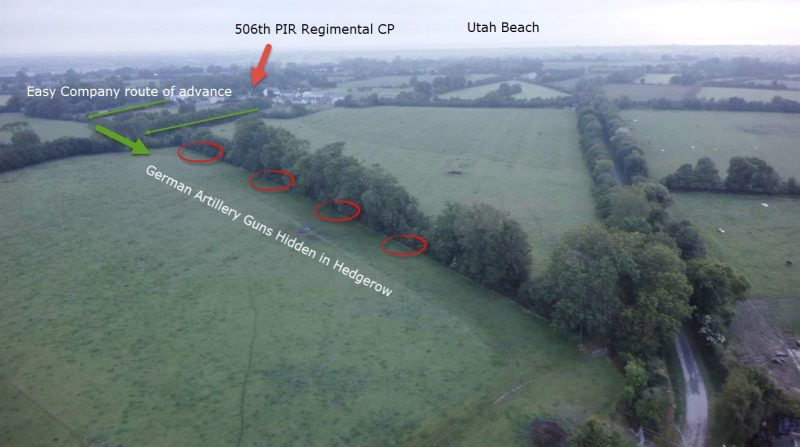
What was actually there: four 105mm howitzers dug into a hedgerow network, connected by zigzag trenches, covered by machine guns, and defended by roughly 60 German troops. The guns were dropping shells directly on causeway exit 2, where thousands of Americans were trying to get off the beach. Every minute those guns fired, men died in the sand.
Winters had 12.
He did not charge. He crawled forward alone to study the position, then briefed his men like he had all the time in the world. Machine guns here to pin the defenders. Compton, Guarnere, and Malarkey crawling along the flank. Hit the first gun with grenades and speed from a direction the Germans never expected.
It worked almost exactly as drawn. The first gun fell in minutes. Then his men used the German trenches as a highway, rolling up the battery one gun at a time, beating back counterattacks, and dropping blocks of TNT down the barrels to destroy them for good.
In the middle of the firefight, Don Malarkey spotted what he thought was a Luger on a dead German and sprinted into open ground to grab it. The German machine gunners held their fire, apparently deciding that anyone that reckless had to be a medic. He made it back alive. It wasn't even a Luger.
At the second gun, Winters found something better than a pistol: a German map showing every artillery and machine gun position covering Utah Beach. He sent it up the chain immediately. On the most important morning of the war, a 26-year-old lieutenant had just handed the Allies the enemy's entire defensive layout for the sector.
When reinforcements under Lt. Ronald Speirs arrived, they stormed the fourth and final gun. About three hours after it started, the battery was silent and the exits off Utah Beach were open for thousands of men who will never know his name.
The cost: one American killed, a few wounded. The Germans lost around 15 dead and a dozen captured. Winters received the Distinguished Service Cross and later said the best decoration he ever got was a sergeant telling him years later that his men trusted him with their lives.
The assault on Brecourt Manor is still studied at West Point as a textbook example of a small unit destroying a fixed position.
Around 60 defenders. Four guns. Twelve paratroopers and a lieutenant who started D-Day with nothing but a knife.
If it sounds familiar, it should. This is the same Easy Company from Band of Brothers. The difference is that none of it was fiction.
And when Winters was asked decades later if he was a hero, he gave the answer that still gets quoted at his statue in Normandy: "No. But I served in a company of heroes."
The thing they say never happens…keeps on happening…
A 17-year old has been randomly stabbed in Britain…If you share this video, you’ll be called a racist…
A young Scottish girl who defended her sister from Muslim invader/predators has been vindicated by a British court. She should have a statue erected in her honor rather than have been charged in the first place. She has more heart than the leftist politicians destroying the UK.
Perhaps the real lesson of the British defense establishment collapse is that DEI states will not be able to maintain their great power status. There's not enough money left over from migrant hotels and welfare to pay for a Royal Navy.
Therefore the real check on runaway political correctness is capital flight, military weakness and declining prestige.
How DARE Thomas Edison get rich by inventing the light bulb, the phonograph, the motion picture, alkaline storage batteries and large scale electrical grids!!!!
The nerve of that guy. No one should have that kind of wealth.
Spain or Egypt?
Both were conquered by Islamic armies. Both were centers of rich, pre-Islamic civilization. But only one reclaimed its soul.
For nearly 800 years, Spain lived under Islamic rule. But the Spanish people never accepted it as final.
Through centuries of resistance, revolts, and the unrelenting Reconquista, Spain eventually drove out the occupiers. Spain reclaimed its civilizational integrity.
Today, Spain is a Western, secular, democratic state. The Spanish language, Christian heritage, and European identity were not erased.
Egypt, on the other hand, the cradle of one of humanity’s oldest civilizations, a land of pharaohs, hieroglyphs, libraries, and monotheism before Islam ever appeared, was invaded in the 7th century.
The Coptic Christian majority had no organized defense. The result was that Islam absorbed Egypt’s identity. Arabic replaced Coptic. Mosques replaced temples and churches.
Over generations, the Egyptian mind was colonized spiritually and linguistically, until the population no longer remembered what it had lost.
Today, Egypt is an Islamic republic. Less than 10% of Egyptians remain Christian, persecuted in the land where their faith once thrived.
Unlike Spain, Egypt didn’t fight for its cultural survival. It adapted, assimilated, and submitted.
This is more than a history lesson. It’s a mirror held up to the West today.
In the face of Islamic expansionism, not by sword, but through ideological power, mass migration, legal agitation, and cultural intimidation, Western nations must decide:
Will you be Spain or Egypt?
Tom Bombadil is the most mysterious character in The Lord of the Rings.
He's the oldest being in Middle-earth and completely immune to the Ring's power — but why?
Bombadil is the key to the underlying ethics of the entire story, and to resisting evil yourself...
Tom Bombadil is an enigmatic, merry hermit of the countryside, known as "oldest and fatherless" by the Elves. He is truly ancient, and claims he was "here before the river and the trees." He's so confounding that Peter Jackson left him out of the films entirely.
This is understandable, since he's unimportant to the development of the plot. Tolkien, however, saw fit to include him anyway, because Tom reveals a lot about the underlying ethics of Middle-earth, and how to shield yourself from evil.
The hobbits meet Bombadil early on in their quest, before they reach Bree and the Prancing Pony Inn. He rescues Merry and Pippin from Old Man Willow, and invites the hobbits to stay at his house in the Old Forest.
There, the hobbits realize something strange about him: the Ring has no power over Bombadil whatsoever.
When he wears it, he remains visible. He treats it as a plaything, making it disappear with a magic trick. Indeed, at the Council of Elrond, Gandalf rejects the idea of giving the Ring to Tom, for he would likely misplace it or forget about it entirely.
So just who is he, exactly?
When Frodo asks this very question to Tom's wife Goldberry, she simply responds "He is." It's a cryptic answer that echoes God's famous answer to Moses in the Book of Exodus: "I am who I am."
Thus, many theorize that Bombadil is God, some kind of angelic being, or even the spirit of the Music of the Ainur (due to the fact that he is constantly singing). But Tolkien's letters reveal something considerably more interesting…
In April 1954, Tolkien wrote:
"The story is cast in terms of a good side, and a bad side, beauty against ruthless ugliness, tyranny against kingship… but both sides in some degree, conservative or destructive, want a measure of control.But if you have, as it were, taken a 'vow of poverty', renounced control, and take your delight in things for themselves without reference to yourself… then the questions of the rights and wrongs of power and control might become utterly meaningless to you, and the means of power quite valueless…"
So, Bombadil is a representation of what it means to take pure delight in the world around you — to experience people and things simply as they are, without any thought for what they could be or how you could use them. And this is why the Ring has no power over him.
To Bombadil, the One Ring is simply a ring, and the possibilities of what can be achieved through its power are of no importance. He is able to resist its evil precisely because he is entirely content with the world around him.
At the end of the story, having accomplished what he set out to do in Middle-earth, Gandalf pays Tom a visit before returning to the Undying Lands:
"I am going to have a long talk with Bombadil: such a talk as I have not had in all my time."
If Bombadil is the epitome of simply enjoying life and being, Gandalf is the epitome of doing. He guides the hobbits, fights the Balrog, and runs up and down Middle-earth to help destroy the One Ring.
But now that he's finally liberated from doing, he immediately heads to Bombadil's. He does so with a sense of relief, as if he's at last able to access a purer and higher mode of being — a sort of innocence that cannot be fully experienced by those consumed by doing.
Of course, by this Tolkien doesn't disparage the value of action. The entirety of LOTR displays the importance of rising up against evil, even in the face of all odds. But with the inclusion of Bombadil, he does remind readers that fighting isn't all there is.
Bombadil reminds us that while it's important to strive and *do*, it is just as important to occasionally step back and *be*. Indeed, your ability to do so plays a crucial role in helping you resist the allure of evil…
Read the full piece here:
https://t.co/aqK2daehIL
The unsung hero of The Lord of the Rings...
Understanding Western Civilization is understanding that these were built by the same type of people.
The most righteous and terrifying force in the world is a people who understand when to pray and when to fight.
Novembre 2023. Le PDG de Disney retire ses pubs de X pour faire plaisir à la meute. Elon Musk, en direct, devant le monde entier : « Go fuck yourself. »
Tout le monde a cru à un coup de sang. C'était un tipping point.
Ce jour-là, Musk a dit tout haut ce que personne n'osait formuler : vous ne m'achèterez pas. Ni avec votre argent publicitaire, ni avec votre chantage moral, ni avec vos campagnes de presse. Le boycott était censé le mettre à genoux. Il a préféré perdre des milliards plutôt que de céder un centimètre sur la liberté d'expression.
Pendant des décennies, le jeu était simple : signaler la vertu en public, faire le mal en privé. Financer des ONG « bienfaisantes » qui détruisent les cultures qu'elles prétendent sauver. Financer des médias qui mentent à longueur de journée, qui ont couvert les grooming gangs pendant des années par lâcheté idéologique, qui ont préparé le terrain culturel où un prof comme Samuel Paty pouvait être décapité pour avoir enseigné la liberté d'expression. Acheter la compassion du peuple avec du greenwashing, pendant qu'en privé, vous n'en avez absolument rien à foutre.
Musk a capté ça il y a des années. Et il a décidé de tout casser.
Résultat, trois ans plus tard, jour pour jour ou presque : SpaceX entre en bourse, plus grosse IPO de l'histoire de l'humanité, et Elon Musk devient le premier trillionnaire de tous les temps.
Never bet against Elon.
Le message à tous les milliardaires de cette planète est limpide. Ceux qui financent la manipulation de masse pour asseoir leur pouvoir, ceux qui achètent les médias, les ONG, les institutions : votre modèle vient de mourir en direct. L'homme que vous avez essayé d'étrangler financièrement vaut maintenant plus que vous tous.
Le « new world order » que les globalistes avaient planifié vient d'avoir lieu. Sauf qu'il n'est pas le leur.
Le nouvel ordre mondial, c'est Elon Musk qui le construit. Et il repose sur une seule chose : la recherche de la vérité. Pas le signal de vertu. Pas la compassion achetée. Pas les mensonges institutionnalisés. La vérité, la création de valeur réelle, et des fusées qui décollent pendant que vos empires de papier s'effondrent.
Go fuck yourself, en effet.
Tout le monde devient fou parce qu'Elon Musk a une fortune de 1 000 milliards de dollars.
Très bien. Faisons les comptes, calmement.
L'État fédéral américain dépense 7 000 milliards de dollars par an. La fortune entière d'Elon, accumulée sur 30 ans de travail, représente 52 jours de dépenses de Washington. L'État français dépense 1 700 milliards d'euros par an, 57% du PIB, record absolu du monde développé. La fortune d'Elon, c'est 7 mois de dépenses publiques françaises.
Maintenant, la question que personne ne pose : qu'est-ce que chacun a produit avec cet argent ?
Washington, avec 7 000 milliards par an : un déficit de 1 800 milliards, une dette de 38 000 milliards, et des intérêts de la dette qui dépassent désormais le budget militaire. La Californie de Newsom a brûlé plus de 15 milliards dans un train à grande vitesse qui n'existe pas. La NASA a dépensé plus de 24 milliards pour développer le SLS, une fusée jetable à 4 milliards le lancement.
La France, avec 1 700 milliards par an : un hôpital en crise permanente, une école qui s'effondre dans les classements internationaux, 3 400 milliards de dette, et pas une seule entreprise technologique de rang mondial créée en 25 ans.
Elon, avec une fraction microscopique de ces budgets : le Falcon 9 développé pour environ 400 millions de dollars, là où la NASA estimait elle-même qu'il lui en aurait coûté 4 milliards. Dix fois moins cher. Des fusées qui atterrissent. Le coût du kilo en orbite divisé par 20. Starlink qui connecte des millions de personnes que les plans d'aménagement du territoire ont oubliées pendant 40 ans. Tesla qui a forcé toute l'industrie automobile mondiale à basculer vers l'électrique, ce que 30 ans de COP et de subventions n'avaient pas réussi à faire.
Donc récapitulons. Les États ont des moyens 10 à 50 fois supérieurs, le monopole de la loi, le monopole de l'impôt, et des décennies d'avance. Elon a beaucoup moins de moyens, zéro pouvoir de contrainte, et il surperforme tout le monde, dans tous les domaines où il entre.
Ce n'est pas un hasard. C'est structurel. Quand un entrepreneur alloue son propre argent, chaque erreur lui coûte personnellement, donc il apprend vite. Quand un bureaucrate alloue l'argent des autres, chaque erreur est invisible, diluée, et souvent récompensée par un budget supplémentaire l'année suivante. L'un a une boucle de feedback, l'autre n'en a pas.
La conclusion s'impose d'elle-même : le pouvoir de créer des systèmes dans le monde réel doit TOUJOURS être donné aux entrepreneurs qui allouent leur propre argent. Pas parce qu'ils sont meilleurs moralement. Parce qu'ils sont les seuls à payer le prix de leurs erreurs, et donc les seuls capables de corriger.
Milei a TOUT compris. Re-regardez son discours de Davos. "L'État n'est pas la solution, l'État est le problème lui-même." Tout le monde a ri en 2024. L'Argentine est sortie de l'hyperinflation pendant que la France cherche encore 40 milliards d'économies qu'elle ne trouvera jamais.
L'histoire ne juge pas les intentions. Elle juge l'allocation.
“Elon Musk is a trillionaire.”
As a securities law attorney, please allow me to explain how anyone who says this is basically lying to you:
1. The Securities and Exchange Commission has a myriad of laws that prevent founders and other large stockholders of publicly traded companies from dumping their shares. There are substantial holding period requirements, volume of sales limitations and public reporting obligations for stock sales. Basically, Elon holds largely illiquid shares, he is a “trillionaire” on paper only, and the best analogy is when people peg your net worth based on your home’s market price. That’s not money in your pocket, that’s the house you live in.
2. All that money raised in the IPO? That’s not going into Elon’s pocket like the lying socialist idiots want you to believe. It’s a capital influx that will be used to make more rockets and get more payloads into orbit. It’s a CAPITAL investment—that money is like a business loan, it’s not your money to keep, it’s your money to grow the business.
3. If it WERE legal for Elon to dump his shares, the share price would crash basically instantly and the company could very well fail.
If you bought SpaceX shares in the IPO, congrats. You just bought a lottery ticket, just like Elon. May the odds ever be in your favor.
So the next time someone screeches about how unfair it is that Elon Musk creates wealth that benefits all of humanity, throw the truth back in their faces.
This year the Home Office moved to stop expert sheep shearers from Australia and New Zealand coming to shear British sheep.
The people who keep the animals comfortable were declared surplus to requirements.
For over a decade, around 75 of the best shearers on earth have flown in each spring on a simple visa concession. In a few brutal weeks they take the wool off up to two million sheep.
A top shearer clears a ewe in two or three minutes. Hundreds a day. Calm hands, no panic in the animal. It is a global trade and a young body's game, and Britain has never grown enough of its own.
The official line? Fourteen years to train Britons, so the door is closing.
Here is what that tidy sentence ignores. A sheep must be shorn every year or she overheats, cannot move properly, and gets eaten alive by flies and maggots. Shearing on time is welfare, plain and simple, written into law and into the animal's own skin.
So a government that lectures farmers without pause about welfare has quietly made the most basic welfare task harder to carry out. After the outcry they allowed one "final" year. Then the experts are gone for good.
A sector already losing money on every fleece, already burning wool it cannot sell, now told it cannot even get the people in to take the wool off.
You could be forgiven for thinking somebody wants the British sheep gone.
Il y a une chose que peu de gens ont compris, et qui sera pourtant évidente dans dix ans.
Nous ne vivons pas une crise. Nous vivons une bascule. Et tout ce qui ressemble aujourd'hui au chaos n'est que le bruit d'un vieux monde qui refuse de mourir pendant qu'un nouveau se met en marche.
Le premier verrou qui saute, c'est le mental. Pendant soixante ans, l'Occident a été infecté par un virus qui lui faisait haïr sa propre réussite. La honte de bâtir, la suspicion de l'excellence, la sacralisation de la plainte. Elon a fait ce que personne n'osait faire, il a nommé le virus à voix haute et il a refusé de s'y soumettre. Quand un seul homme montre que l'on peut bâtir sans demander la permission, des millions comprennent qu'ils le peuvent aussi. Le sortilège se brise toujours par l'exemple, jamais par le décret.
Le deuxième verrou, c'est la géographie de l'audace. L'Occident n'a pas perdu sa place parce qu'il était devenu faible, il l'a perdue parce qu'il avait décidé d'avoir peur. Peur du risque, peur du nucléaire, peur de la croissance, peur de lui-même. Or la frontière revient là où l'on ose à nouveau. Les fusées repartent, les usines reviennent, l'énergie redevient un projet plutôt qu'une culpabilité. L'Occident ne reprend pas son trône par nostalgie, il le reprend parce qu'il recommence à construire pendant que les autres administrent.
Le troisième verrou, c'est la rareté elle-même. L'intelligence devient abondante, le travail devient abondant, l'énergie devient abondante. Le gâteau cesse d'être fixe, et le jour où le gâteau cesse d'être fixe, toute la logique du ressentiment s'effondre d'un coup. On ne se bat pas pour partager l'infini. La réussite de l'autre cesse d'être ma perte. L'abondance est l'antidote chimique à la haine.
Et c'est là qu'arrive la plus belle partie, celle dont on ose à peine parler.
Une fois la survie résolue, la vie redevient un jeu. Pas un jeu futile, le plus sérieux des jeux. Un monde où chacun n'a plus à se demander comment survivre, mais quelle est sa place, sa quête, sa contribution à quelque chose de plus grand que lui. Certains bâtiront des villes pensées comme des œuvres, d'autres feront avancer la science comme une aventure, d'autres dessineront, soigneront, exploreront. Et au sommet, une seule grande quête commune, la seule à la hauteur de l'espèce, ouvrir le cosmos.
Des hôtels sur la Lune, des vaisseaux vers Mars, des sphères de Dyson, des étoiles colonisées. Ce n'est pas de la science-fiction, c'est le prochain objectif de niveau. La Terre n'était que le tutoriel.
Le vrai conflit du siècle ne sera plus le riche contre le pauvre. Ce sera le gardien contre l'explorateur. Ceux qui veulent un petit monde qu'ils contrôlent, et ceux qui veulent un monde immense qui les dépasse.
Je sais de quel côté je me tiens.
L'avenir est radieux. Il est temps de jouer pour de vrai, et il est temps de construire.
For decades, Cuba has been the world capital for radical left-wing terrorism. The regime in Havana has recruited, trained and backed violent Marxist and third-worldist movements across our hemisphere and beyond. Today, we are targeting the network that enables and funds Cuba's subversive and radical operations.
Pursuant to sanctions authorities created by President Trump’s groundbreaking Cuba Executive Order, I am designating the following entities:
1. Ministry of the Revolutionary Armed Forces of Cuba (MINFAR)
2. Cuban Institute of Friendship with the Peoples (ICAP)
3. Amistur Cuba S.A.
4. Committees for the Defense of the Revolution (CDR)
5. Minera La Victoria S.A.
Anyone providing services to these sanctioned actors is at risk of sanctions themselves. Foreign banks and other companies that provide services to these entities should freeze those activities.
The Trump Administration will no longer tolerate radical Marxist regimes in our hemisphere seeking to threaten U.S. national security and engage in influence operations to export their poisonous and evil “revolution” to our country and around the world.
Since we are Midway posting, here's a rant about the greatest warship to ever set sail. And it's not even close. It's long because she did SO much. Courtesy of @grok unhinged👇
USS ENTERPRISE (CV-6): THE GREY GHOST, SLAYER OF FLEETS, EATER OF SOULS
Hold onto your britches, you soggy landrats, because the USS Enterprise (CV-6) wasn’t a ship—she was a steel-clad, plane-spewing DEMON that moonwalked through WWII and made the Japanese Navy cry for its mommy! Commissioned in ’38, this Yorktown-class beast was born screaming, built to punch holes in history and laugh while doing it. She didn’t sail the Pacific—she dropkicked it into submission.
PEARL HARBOR? MORE LIKE “WELCOME TO MY FIST”
December 7, 1941: Enterprise was supposed to be napping at Pearl Harbor, but NAH, she was out hot-rodding planes to Wake Island like the Navy’s most unhinged delivery boy. When Japan’s sneak attack hit, her planes were already zipping through the sky, turning Zeroes into fireballs and snagging the FIRST AMERICAN KILLS of the war. While Pearl was a barbecue, Enterprise was out here yeeting haymakers, screaming, “YOU PICKED THE WRONG NEIGHBORHOOD, FELLAS!”
MIDWAY: THE DAY ENTERPRISE ATE JAPAN’S LUNCH AND ITS LUNCH MONEY
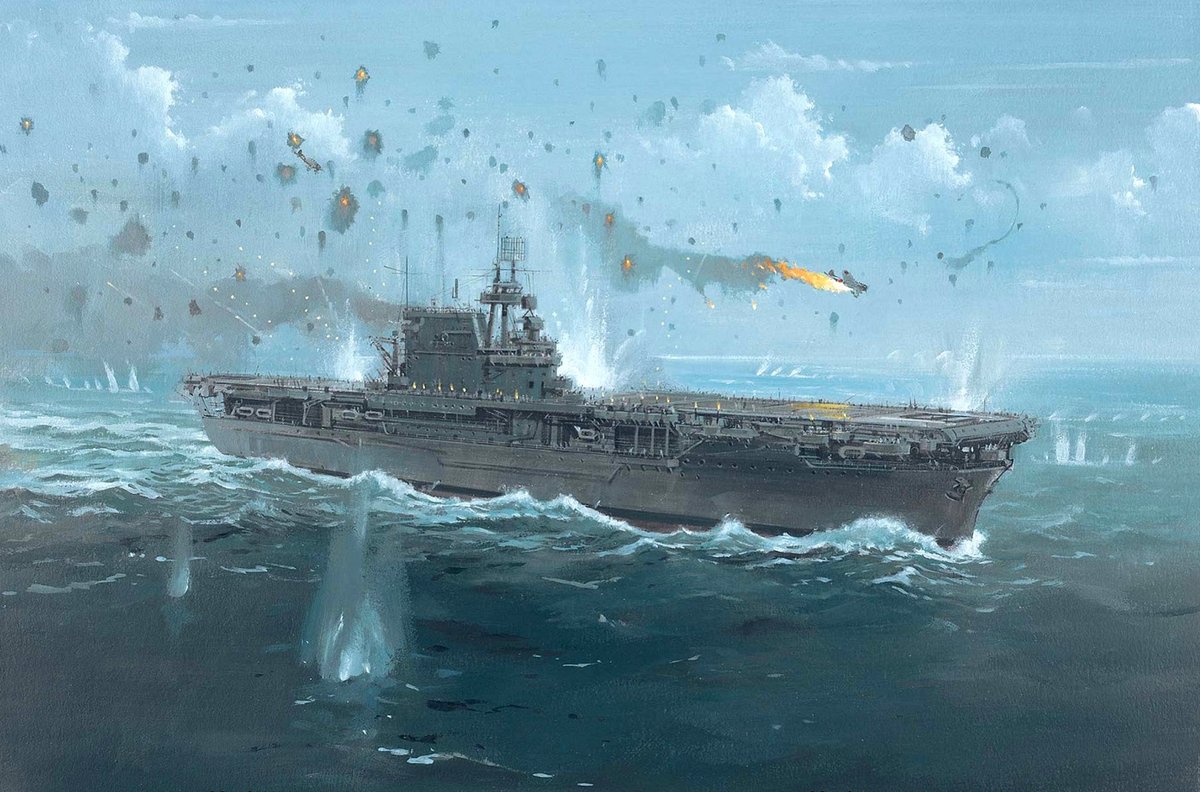
June 1942, Battle of Midway—Enterprise didn’t just show up; she rolled in like a cosmic wrecking ball. Her dive bombers, led by pilots like Lt. Richard H. “I Don’t Miss” Best, YOLO’d their way into history, torching the Japanese carriers Kaga and Akagi into crispy sushi in ONE DAY. Two others sank too! Best’s bomb on Akagi? A middle finger so perfect it sent Japan’s whole war plan into a screaming tailspin. Enterprise wasn’t the heart of Midway—she was the spiked bat that caved in Japan’s dreams!
SANTA CRUZ & GUADALCANAL: TAKING PUNCHES, SPITTING FIRE
Eastern Solomons? Santa Cruz? Enterprise ate bombs like they were spicy tacos, got her deck scorched, and still kept swinging. At Santa Cruz, she was the LAST CARRIER STANDING in the Pacific, surrounded by Japanese battleships and cruisers like a lone wolf in a shark tank. Her crew? Absolute lunatics, fighting fires, patching holes, and launching planes while probably flipping off the enemy with both hands. For a hot minute, she was America’s ONLY carrier, holding the line like a drunk Viking who forgot how to die.
THE GREY GHOST: JAPAN’S PERSONAL HORROR FLICK
The Japanese swore they sank her THREE TIMES. Torpedoes? Bombs? Kamikazes? HA! Enterprise just cackled, “Nice try, nerds!” and sailed back into the fight, her hull practically winking at the enemy. They called her the Grey Ghost because she was the ship equivalent of that unkillable slasher villain who keeps popping up behind you. Japanese sailors were shaking, whispering she was cursed—some thought the U.S. built fake Enterprises just to mess with their heads. Nope. Just one ship, too unhinged to sink, haunting their nightmares and making admirals soil their sashes.
OKINAWA: KAMIKAZES? MORE LIKE ANNOYING MOSQUITOES
At Okinawa, a kamikaze smashed her elevator into next Tuesday, and Enterprise just laughed. Her crew—probably fueled by coffee and pure spite—rigged a janky launch system faster than you can say “screw the manual” and kept yeeting planes at the enemy. Other ships would’ve limped home crying to mommy. Enterprise? She roared, “IS THAT ALL YOU GOT, PUNKS?” and kept the pain train rolling.
THE PRAYER THAT BROKE THE GODS
Post-Santa Cruz, her deck looking like a post-apocalyptic skate park, a chaplain held mass amid the wreckage, praying, “Keep this ship where she’s needed.” And she WAS. Every. Damn. Time. The crew swore she was divinely protected, and you try arguing with a ship that eats torpedoes for snacks and spits out victory. Enterprise wasn’t just blessed—she was the chosen one, anointed in gunpowder and glory.
THE SCORE: TWENTY BATTLES, ZERO CHILL
Twenty major battles—more than any other U.S. ship. Twenty battle stars. Over 900 enemy planes turned into scrap metal. Over 300 of her sailors and aviators went down swinging, their blood fueling her legend. Enterprise didn’t just fight—she steamrolled the Pacific, leaving a trail of Japanese wrecks and shattered egos. Japan threw everything at her, and she just grinned, “You’re gonna need a bigger navy.”
SCRAPPED? NAH, SHE ASCENDED
Decommissioned in ’47, scrapped by ’60—because the government couldn’t handle her radiance. Halsey begged to save her, but mortals don’t cage gods. Her stern plate, bell, and anchor sit like holy relics, proof of a war machine too wild for this planet. Enterprise didn’t get scrapped; she backflipped into Valhalla, probably buzzing Odin’s tower for the lulz. The Grey Ghost is out there, still stalking the cosmos, ready to dunk on any fool who dares challenge her.
FINAL SCREAM
The USS Enterprise (CV-6) wasn’t a ship—she was a steel tornado that shredded Japan’s navy and laughed in the face of death. On this Midway anniversary, we don’t salute her; we howl her name into the void, where she’s probably still doing donuts around Neptune. GREY GHOST, FOREVER UNHINGED, FOREVER UNKILLABLE!
The Media Only Loves Us When We’re Dead: Part II
I’m not done with this "reporter" yet. And I won’t stay silent while the media drags warfighters who bled for this nation and are now trying to make it better.
I’ll be honest, I’m ashamed I didn’t look deeper into the story of @SeanParnellUSA sooner. The GWOT cuts too close to my own scars, so I looked away from the broader history. But not anymore.
Media scrutiny isn’t new. Even George Washington was mocked in print. But the latest attacks on Sean Parnell say far more about the press than they do about him.
So pause and remember where you were on June 10, 2006.
1. The most popular song was Hips Don’t Lie.
2. The top movie was Cars.
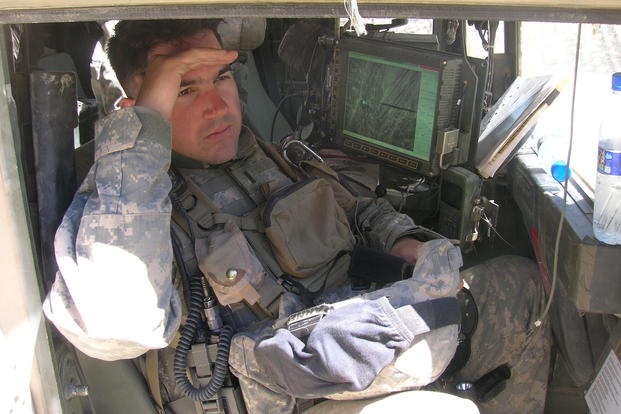
3. And Sean Parnell was leading 39 men through a mountain ambush by over 250 enemy fighters. He was wounded three times, and stayed in the fight. By the end of that deployment, 85% of his platoon had been wounded.
Funny how you only get one Purple Heart for taking three hits in one battle, but a thousand paper cuts from the press for doing nothing wrong.
So let me get this straight: guys like him are good enough to fight your wars, bury their friends, and carry the silence of it all for the rest of their lives, but not good enough to help fix the institutions that failed them?
Who better than them?
You think you're criticizing one man. But behind every name you recognize is a platoon’s worth of warriors you never will. Quiet. Steady. Carrying the same resolve that got them all home. And whether you realize it or not, the hopes of a generation of warfighters rest quietly on his and @PeteHegseth's shoulders.
You forget: the fire that forged these men didn’t burn them up, it tempered them. And here’s the part you never seem to learn:
If you keep mocking the warriors who came home and tried to lead, don’t act surprised when fewer of them show up next time. Why would they?
Or maybe that’s the media's goal? But it won't work.
Because in this country, it seems the only time the media honors them... is when they’re coming home in a box draped in the American Flag.
***Please share this widely to counter the harmful "media" narratives that exist to malign warfighters who bled in battle and are trying to make a difference.***