In 1968, the AHA had 16 board members with ties to the vegetable oil industry.
That year they told Americans to replace butter with margarine.
Trans fat deaths peaked two decades later.
Slaves in Rome lived on bread, olives and porridge. The nobility ate meat.
The men who raised the pyramids ran on bread, onions and beer. The pharaoh ate meat.
The medieval serf ate pottage and black bread. The lord ate venison and swan.
Tudor commoners ate coarse rye bread. Henry VIII's court got through thousands of cattle a year.
The Victorian poor ate bread whitened with chalk and alum, tea, and whatever was left. The aristocracy ate beef, game and butter.
Every century. Every empire. Every ladder men ever built.
The higher you climbed, the more meat was on the plate. It was the reward at the top, in every civilisation that ever had a top.
Now you're told to eat like the serf and be grateful for it.
I am pleased to release the fourth lecture from my We Who Wrestle With God collection. We plan to make this a Sunday ritual, far into the foreseeable future.
Today's topic: How can you become a good person? We're all dreaming up how we should act, and we produce our theories. Our great storytellers aggregate those theories and portray them back to us, in dramatic form.
We imitate the heroes of our stories. Thus we move ever closer to being good. We can do this consciously, too—explicitly—and aim at becoming the heroes of our own personal stories.
Lectured filmed in Abbotsford, Canada on April 1, 2025
Imagine a guy holding a room full of people hostage. He’s got his finger on a dead-man's switch, he’s making crazy demands, and he's totally calm. Why? Because behind him is an exit leading straight to a getaway car. As long as he has that back door, he can stretch the standoff out forever.
Well, the US military just walked up and nailed that back door shut.
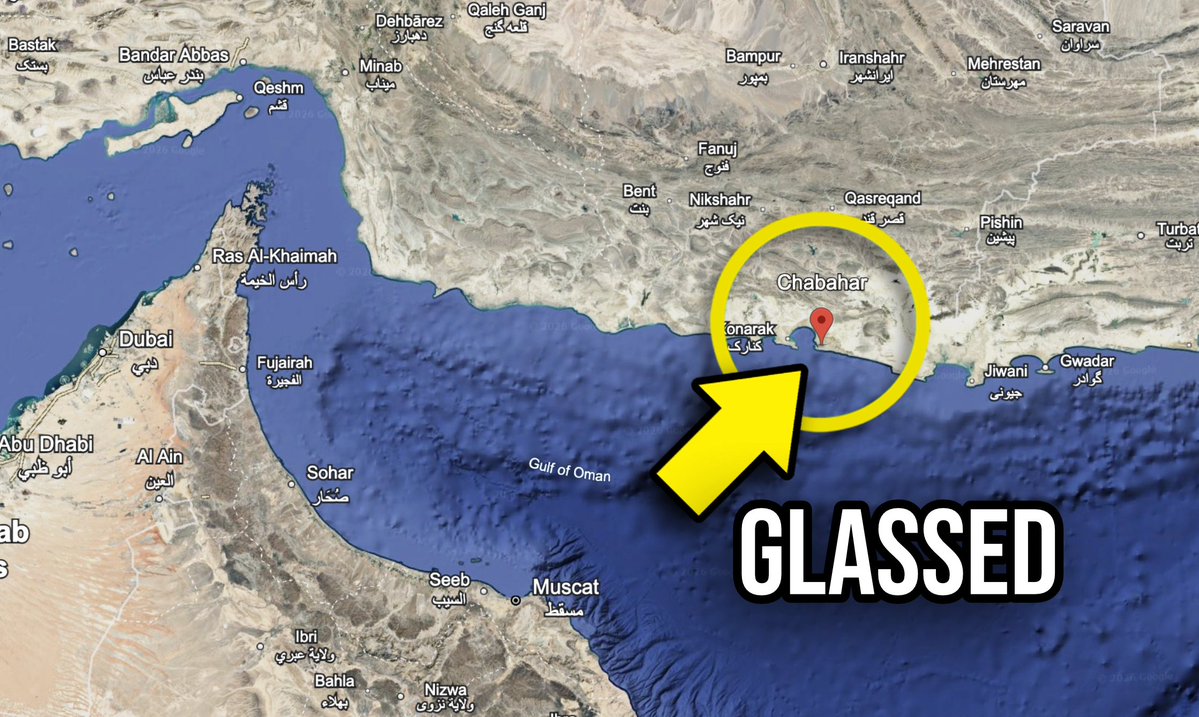
Over the course of two nights, the US dropped heavy metal on about 170 targets across Iran. But the place that took the absolute worst beating isn’t even in the Arabian Gulf. It’s a spot called Chabahar, sitting way out on the Gulf of Oman. The Pentagon pummeled it into spicy dust.
To understand why, you have to look at a map and realize that Iran’s geography is basically a chokehold waiting to happen. Pretty much all their maritime traffic has to squeeze through the Strait of Hormuz; the narrow little strip of water that handles a staggering one-fifth of the world’s oil. For months, Iran’s entire geopolitical strategy has been to threaten to close that strait, spike global oil prices, and watch the West panic.
But Chabahar was their cheat code.
Chabahar is Iran’s only deep-water ocean port. It bypasses the Strait of Hormuz entirely. India actually spent years pouring serious cash into developing it for exactly that reason. So, while every other US airstrike this week was focused on tactical, day-to-day annoying stuff (the missile trucks, the radars, the speedboats Iran uses to harass tankers) the strike on Chabahar was a philosophical statement.
It was about cutting off Iran's ability to breathe if the room fills with smoke.
The US took out Chabahar’s control tower, obliterated both main piers, and completely cratered the Islamic Revolutionary Guard Corps naval base sitting right next to them.
The strategy here is brutally simple: If Tehran decides to close Hormuz now, they aren't just trapping the world. They’re trapping themselves. Every time an Iranian politician gives a fiery speech about shutting down the strait, they are now threatening to sever their own last remaining artery.
And yet, right on cue, Iran’s chief negotiator is still out there on the airwaves, puffing his chest and insisting the strait will only open under "Iranian arrangements."
It's a spectacular level of delusion; the man is standing in a burning room, threatening to lock the only door he has left, completely oblivious to the fact that the handle just melted off.
Mark Carney’s government just gave us two perfect examples in one week of why trust in Ottawa is completely broken.
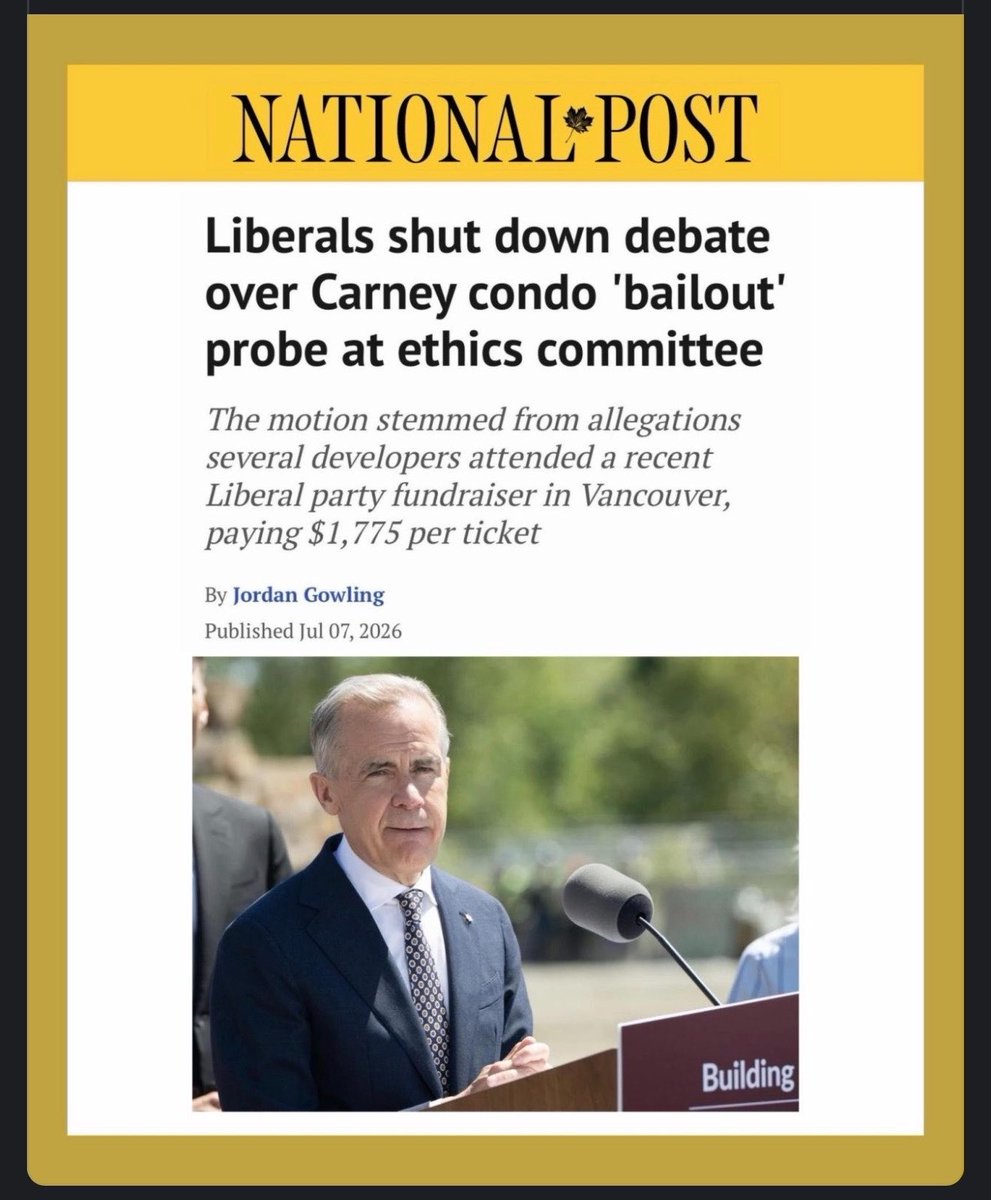
First, the $1.45 billion taxpayer-funded condo bailout in B.C. A program that conveniently helps developers offload empty units while regular Canadians still can’t afford a home. Brookfield Asset Management — the firm Mark Carney chaired before he entered politics — had just partnered on major industrial projects in B.C. right before this program was announced. Now Liberals are blocking any real investigation into it at the ethics committee.
Second, Canada just handed its largest military contract in history — $100 billion for 12 submarines — to Germany. South Korea offered a better deal: $70 billion in trade and investment, plus 25,000 Canadian jobs every year until 2044. Germany offered to build the subs in Germany and create “job years” spread over decades with almost no guaranteed Canadian work.
Carney chose the European option.
This is the same Prime Minister who keeps telling Canadians we need to get “closer to Europe” while treating our biggest trading partner and ally like the enemy. Same week the U.S. started unwinding parts of USMCA and China hit our farmers with new tariffs.
We’re watching real money and real decisions get steered in ways that benefit connected interests and foreign partners — while Canadians get higher costs, fewer jobs, and less accountability.
And when anyone tries to ask questions about any of it, the Liberals shut it down.
This isn’t competence.
It’s a pattern, do you see it??
They don’t feel a need to do their own research because they’ve trusted the media until now and as a previous poster said it’s propped up by the liberal boomers. They’re completely unaware cause they’re hearing all that they “need” to hear. Something has to change from the inside. We’re all here watching this unfold with our hands tied behind our backs and the threat that we can’t talk about it on top of it?!!!How do we unstuck ourselves? This is so demoralizing.
New RCT suggests ketogenic therapy can rapidly improve metabolic health in schizophrenia-spectrum and bipolar I disorders, and shows early signals of psychiatric improvement.
In this video, @bschermd breaks down this newly published study led by Dr. Judith Ford at UCSF.
Six months ago, tonight, Tehran went dark. All of Iran went dark. And into that darkness, millions of Iranians walked out of their homes anyway.
January 8th and 9th were not just two nights of protest. They were the night Iran's silence broke. Millions came into the streets, into the squares, onto their rooftops — but the regime answered them with bullets. Tens of thousands of my compatriots were killed in those forty-eight hours. Tens of thousands more have been arrested, tortured, and sentenced to die since.
They came out, determined and brave. I think of them every day. On those two nights I lost countrymen I will never get to meet. I do not hear a statistic when I hear the number 40,000. I see a son who did not come home to his mother. A daughter who will not sit at her family's table again. I think of each of them the way I would think of my own child, my own brother, my own sister. I carry the weight of every one of those names. But the families of the fallen I meet with, week after week, hearten our nation's will to carry on. Their children did not die in vain. They died for freedom, and they died with pride.
History will remember what these men and women did; I will make sure of it. Like the resistance who stood against tyranny in occupied Europe, and like the revolutionaries who fought for liberty in America. But theirs was a particular bravery. They had no army, no air cover, nothing but the belief in what they stood for. They stood anyway. A united nation choosing to face the guns together rather than live one more day in fear. The men and women of the 8th and 9th of January will be remembered in Iran's history as the greatest generation that preferred to die free and standing than to live cowered on their knees.
To the international community, I ask this: do not let a negotiating table in Geneva or Islamabad erase what happened in the streets of Tehran, Mashhad, and Kermanshah. They died for freedom. And when they are free, the Strait of Hormuz will open. The nuclear threat will end. And we will have true peace.
I have told my compatriots: what you did on January 8th and 9th cannot be undone. Together, we will reclaim our country’s rightful place in the world, our national dignity, and honor the lives of our heroes. Now is the time to reassess, regroup, and rededicate ourselves to victory.
We honor the fallen by finishing what they started. A free Iran is no longer a matter of hope. It is a matter of fact.
And know that my brave compatriots are not just fighting for their own liberation but for the peace and stability of the world.