We are honored to steward the future of the Indie mission!
2C will continue to offer expert Design & Development services, business as usual.
In the months to come, we will iterate on our learnings & ideas for the next version of future of work.
Stay tuned Indies!
We are excited to announce that Indie has been acquired by @twos_complement!
Huge thanks to the community for such a fun journey filled with ideas and creativity.
This concludes a wild first experiment, and it certainly won't be our last!
Read more: https://t.co/yPI72vIyKa
@Support we are seeing $300+ unauthorized charges for Premium+ but this account does not have premium plus, and there are no channels on the support website to get help with this issue. Will you please advise?
That app just acquired for $10B. Basic tech.
That company that just raised $100M. Basic tech.
Tech that has been around for a while is boring. But it's also:
🪨 Survived enough cycles to be ROCK SOLID
👥 Adopted by enough devs to be EASY TO HIRE FOR
🔌 Penetrated enough community to have TONS OF ADDONS
Devs like chasing the shiny new things. ✨ It's fun. ✨
When you are building a competitive business though, you need something that can scale, and benefits the bottom line.
Of course, you need your devs to know modern tech and use the right tools for the job, but your core stack should be as popular, boring, and basic as possible.
It's your competitive edge.
Save your creativity and fun factor for the novel parts of your product.
"Why on earth are we doing it this way?" said the manager.
"Because that's how the tool is sUpPoSeD tO bE UsEd!"
Tools should be working FOR YOU, not the other way around.
We've seen teams spend 30 minutes formatting reports because "that's how Jira works" when a simple spreadsheet would take 5 minutes.
Many of the slowdowns we see stem from diligent teammates trying to master the tool they have been assigned, but eventually becoming a slave to the tool itself.
✨ First the tool seems like a golden solution to a problem.
🔧 The team integrates the tool into their workflow.
🔄 Finally, over time, the team starts doing things a certain way to make the tool work, and forgets why it was added in the first place.
Teams need to regularly revisit each tool in their stack and ask if it's still working for them.
If it's not, ditch it.
Your teammates are wired to solve problems and add the right tools to your process and YOU as a founder need to constantly reset the tools that have taken control of your team.
Building everything from scratch doesn't make you Netflix.
It makes you broke.
It's not even about cost though, it's about where your team spends their mental energy and dozens of small side effects.
When you choose managed services, you get:
✅ one less thing to manage in your CI/CD process
✅ one less thing to manage security updates for
✅ one less thing to maintain documentation for
✅ one less thing to onboard new teammates into
✅ one less thing to provide customer support for
✅ one less thing to keep up to date with best practices
✅ one less thing to hold architecture in your mind for
✅ one less thing to debug when it's not working
✅ one less thing to design for
Each "one less thing" frees your team up to focus on what actually moves the needle for your business.
"I'm booked solid this week, back-to-back meetings!"
What people really hear: "Nobody here can make decisions without me watching." 💀
Congratulations. You just announced that your team has trust issues. 🤫
This isn't productivity. It's organizational dysfunction disguised as importance.
The Real Problem: Trust Deficit
Every unnecessary meeting is a symptom of broken trust. We meet because we don't trust systems, people, or processes to deliver without constant oversight.
The solution isn't better meeting hygiene. It's radical trust deployment.
Trust Flows Downward (When It Actually Exists)
1️⃣ Leaders: Set clear metrics → TRUST your managers will deliver their own way
2️⃣ Managers: Enable your team → TRUST they'll deliver results
3️⃣ Builders: Do the work → TRUST it creates real value
Each level only works when the level above it actually trusts.
What To Do When Things Go Wrong:
😳 When someone makes a mistake → Coach and support them
😤 When someone breaks trust → Remove them from the team
🤝 When someone is trusted → They'll optimize their own meeting load
Trusted team members naturally hold fewer meetings, invite fewer people, and eliminate unnecessary check-ins on their own.
When trust is absent, people default to "following the process". If your process is meeting-heavy, that's exactly what they'll do.
The Bottom Line
Meetings are the tax we pay for insufficient trust.
Set clear goals. Trust your team to deliver. Quickly part ways with anyone who can't be trusted to own their responsibilities.
Your calendar (and your company's future) depends on it.
Sometimes the smartest people make the dumbest assumptions.
Assuming something will be a certain way in tech is one of the largest pitfalls teams make when designing software.
All projects have certain ?'s: unknown unknowns and known unknowns.
Tackle the unknown unknowns by adding a design sprint workshop that allows the team to explore all areas of your product idea.
🚫 encourage the team to find things that will NOT work
🎪 think through wild ideas that seem silly on the surface
🎭 role play your customers
This effort will turn unknown unknowns => known unknowns.
Tackle the known unknowns with code spikes / R&D:
🏃♂️ sprint down each unknown area, vetting out implementation flows
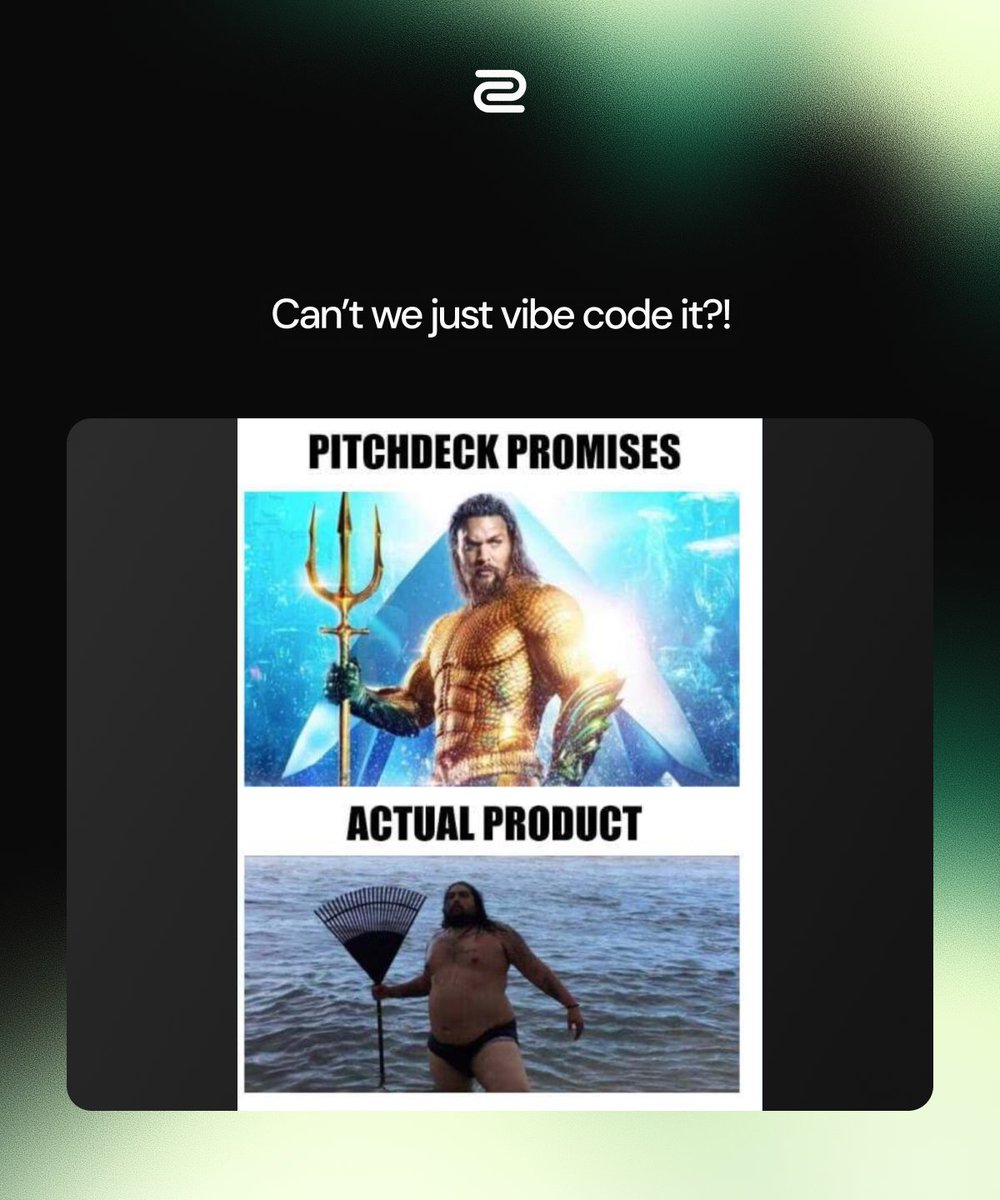
⚡ quickly vibe code or hack together a disposable prototype to validate assumptions
🔍 try various vendors/frameworks to vet the right choices
Smart engineers can "picture the implementation" in their heads, but even the smartest people miss details and mis-estimate effort until they have tried the actual work.
This work is akin to PRACTICE, and we all know what practice makes vs. what assumptions make.
At 2C we implement code spikes into each sprint planning effort to make sure there are no surprises down the road. How do you vet your unknowns?
Competitors can vibe clone your features in a matter of days.
Modularity is about creating systems that ADAPT faster than your competition can PIVOT.
The vibe clone Achilles' heel is QUALITY.
If you can architect a modular system, you can quickly adapt to competition pivoting, while maintaining quality that cannot be "vibe cloned".
Brand quality.
Experience quality.
Security quality.
Stability quality.
Modularity has always been important for efficiency, but with the growing abilities of generative AI, quality is becoming it's most significant benefit.
This looks like:
🧩 Modular brand, design & UX systems
🔧 Modular API architecture
⚙️ Modular component systems
🧪 Modular testing workflows
🚀 Modular feature testing workflows
At 2C, we include a section in all architecture planning to apply proper modularization to each workflow step.
This lets our teams re-arrange any of the product's individual parts quickly and without sacrificing any quality.
@LEGO_Group figured it out a long time ago 🧱