A major breakthrough for Nigeria’s anti-drug war: NDLEA officials stormed the largest secret methamphetamine production site ever found in the country, hidden in Ogun State. The operation led to the arrest of three Mexicans and other cartel members, alongside the recovery of drugs worth over ₦480 billion
PUBLIC NOTICE
This is to notify the general public that Nathan Oguwike, Esq., former Company Secretary of Post-Service Housing Development Limited (PHDL), has ceased to hold that position effective 23 April 2026 and is no longer in the service of the Company.
The individual is not authorized to represent or bind PHDL in any manner. PHDL accepts no liability for any actions or representations made by the individual subsequent to the cessation of his appointment.
AUGUSTINA NKEONYE
Lieutenant
Acting Public Relations Officer
Post-Service Housing Development Limited
23 April 2026
I Stand With the Nigerian Government’s Decision Concerning the 416 Boko Haram Captives – Ndume
I have talked to security agencies and those that matter, and they are working on it; the Nigerian government is not just sitting down doing nothing. The government is currently on its toes.
Senator Ali Ndume, APC Borno South
@ARISEtv The next presidential election will be an off-cycle election, as recent court judgments are gradually reshaping the electoral timeline in Nigeria.
ADC World Congress: INEC is Lying To Nigerians - Melaye
INEC claimed in their press ststement that ADC informed them of the NEC meeting and its resolution on September 9th. We have records showing they were served in August, after NEC was held on July 29th, where they were present and monitored.
Sen. Dino Melaye, ADC Chieftain
How to setup Drip Irrigation: simple guide
A Drip Irrigation System is one of the most powerful tools a farmer can install, yet many still rely on wasteful methods. This system delivers water slowly and directly to plant roots, reducing losses and increasing productivity. In regions with limited or expensive water, this is not just an option, it is a competitive advantage.
how the system works
Water is moved from a source such as a borehole, tank, or river using gravity or a pump. It passes through a filtration and pressure control unit before entering a network of pipes. From there, it travels through smaller pipes and exits through emitters placed near plant roots.
Flow sequence:
water source → filter → pressure regulator → main pipe → lateral pipes → emitters → plant roots
materials and components required
water supply
* water source (well, borehole, tank)
* pump (if gravity is not enough)
control unit
* screen or disc filter to remove dirt
* pressure regulator to control water pressure
* ball valves for opening and closing sections
* non-return valve to prevent backflow
* fertilizer injector (optional but highly recommended)
piping system
* mainline pipes (PVC or HDPE, 32mm–63mm)
* sub-main pipes (25mm–32mm)
* lateral pipes (16mm or 20mm polyethylene)
water delivery
* drip emitters (2–4 litres per hour common)
* drip tape for row crops like vegetables
* micro tubes (optional for precision)
fittings
* tees, elbows, connectors
* end caps
* take-off connectors and grommets
* clamps
support materials
* pipe stakes
* thread seal tape
* PVC glue
tools needed
* pipe cutter or hacksaw
* measuring tape
* hole punch tool
* adjustable spanner
* screwdrivers
* bucket for flushing
* marker or chalk
site preparation
Start by understanding your field. Measure the land, know your crop spacing, and identify your water source. A good layout reduces cost and improves efficiency.
Example:
If maize rows are spaced at 75 cm, lateral pipes should follow each row.
step by step installation
step 1: install water source and pump
Connect your pump to the water source and ensure stable flow. If using a tank, place it at an elevated position for gravity flow.
step 2: install the control unit
Attach the filter to the pump outlet. Connect the pressure regulator after the filter. Install a valve to control water flow. Always follow the correct flow direction marked on the filter.
step 3: lay the mainline pipe
Run the main pipe from the control unit across the field. Keep it straight and bury it slightly (10–20 cm) to protect it from damage.
step 4: connect sub-main pipes
Use tee connectors to branch from the mainline. These lines distribute water to different sections of the field.
step 5: install lateral pipes
Punch holes into the sub-main pipe and insert connectors. Attach lateral pipes along each crop row.
step 6: install emitters
Use a hole punch to insert emitters into lateral pipes near plant roots. For crops like tomatoes or cabbage, place emitters close to each plant. For crops like onions, use drip tape.
step 7: close pipe ends
Seal all pipe ends using end caps or folding methods to prevent water loss.
step 8: flush the system
Before full operation, open all ends and allow water to run through the pipes to remove dirt and debris. Close the ends after clean water flows.
step 9: test the system
Turn on the system and inspect for leaks, uneven flow, or blocked emitters. Make corrections immediately.
recommended specifications
* pressure: 1–2 bar (10–30 psi)
* emitter spacing:
vegetables: 20–40 cm
fruit trees: 2–4 emitters per plant
* filter mesh: 120–200 mesh
* emitter discharge: 2–4 litres per hour
maintenance guide
daily or weekly
* inspect emitters for blockage
* check for leaks
weekly
* clean the filter
monthly
* flush all pipes
seasonal
* inspect the full system
* replace damaged components
common problems and solutions
low water flow
cause: clogged filter
solution: clean the filter
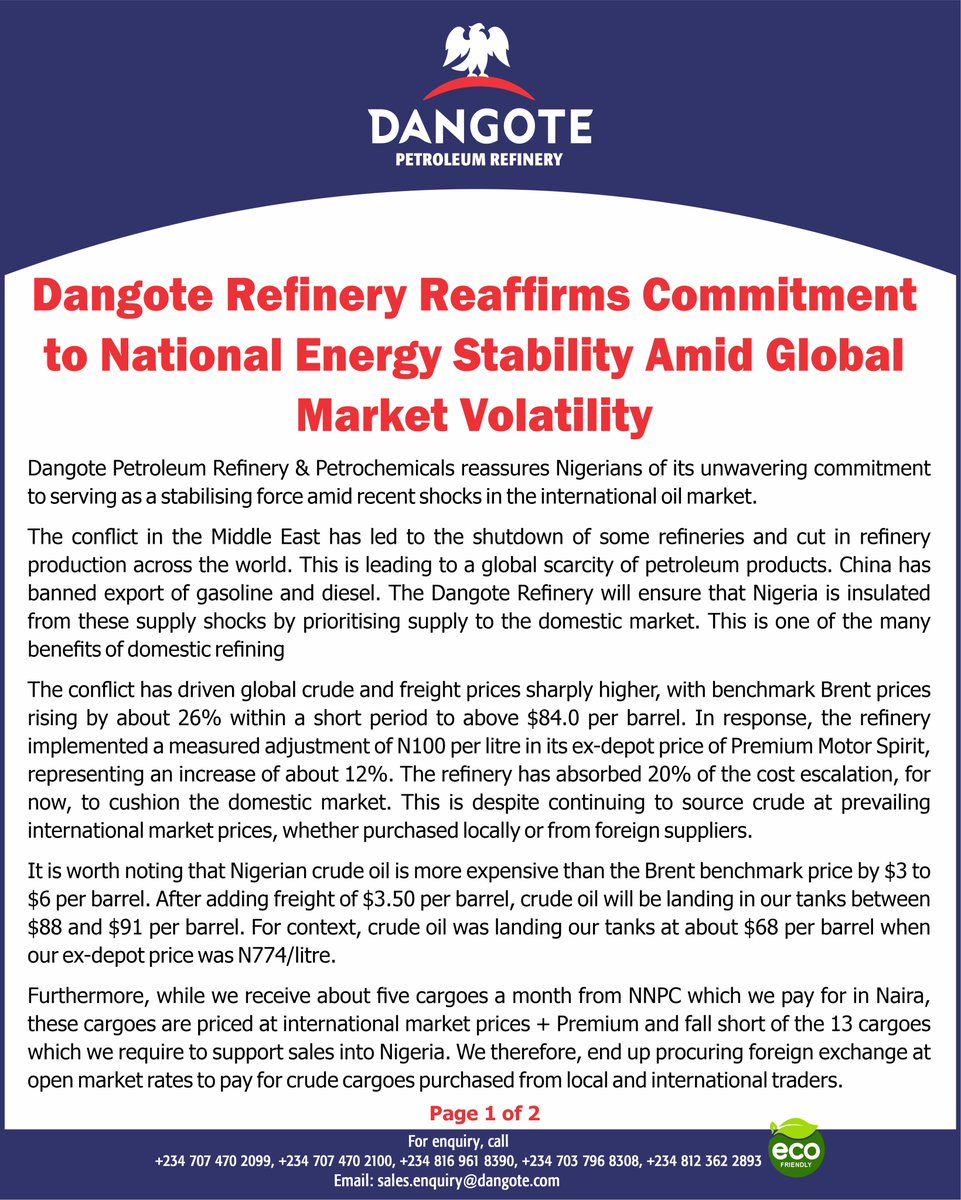
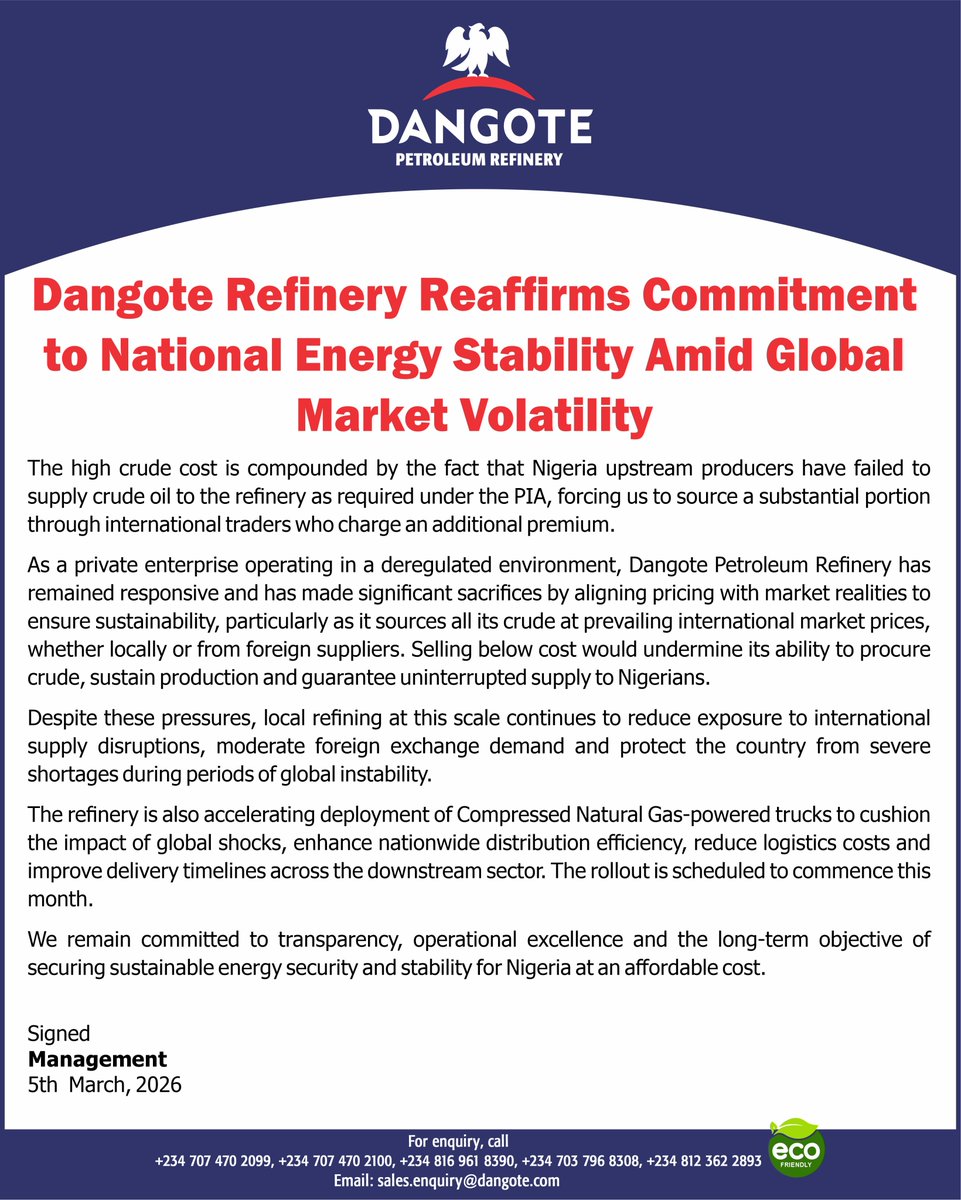
Dangote Refinery Reaffirms Commitment to National Energy Stability Amid Global Market Volatility
Dangote Petroleum Refinery & Petrochemicals reassures Nigerians of its unwavering commitment to serving as a stabilising force amid recent shocks in the international oil market.
The conflict in the Middle East has led to the shutdown of some refineries and cut in refinery production across the world. This is leading to a global scarcity of petroleum products. China has banned export of gasoline and diesel. The Dangote Refinery will ensure that Nigeria is insulated from these supply shocks by prioritising supply to the domestic market. This is one of the many benefits of domestic refining
The conflict has driven global crude and freight prices sharply higher, with benchmark Brent prices rising by about 26% within a short period to above $84.0 per barrel. In response, the refinery implemented a measured adjustment of N100 per litre in its ex-depot price of Premium Motor Spirit, representing an increase of about 12%. The refinery has absorbed 20% of the cost escalation, for now, to cushion the domestic market. This is despite continuing to source crude at prevailing international market prices, whether purchased locally or from foreign suppliers.
It is worth noting that Nigerian crude oil is more expensive than the Brent benchmark price by $3 to $6 per barrel. After adding freight of $3.50 per barrel, crude oil will be landing in our tanks between $88 and $91 per barrel. For context, crude oil was landing our tanks at about $68 per barrel when our ex-depot price was N774/litre.
Furthermore, while we receive about five cargoes a month from NNPC which we pay for in Naira, these cargoes are priced at international market prices + Premium and fall short of the 13 cargoes which we require to support sales into Nigeria. We therefore, end up procuring foreign exchange at open market rates to pay for crude cargoes purchased from local and international traders.
The high crude cost is compounded by the fact that Nigeria upstream producers have failed to supply crude oil to the refinery as required under the PIA, forcing us to source a substantial portion through international traders who charge an additional premium.
As a private enterprise operating in a deregulated environment, Dangote Petroleum Refinery has remained responsive and has made significant sacrifices by aligning pricing with market realities to ensure sustainability, particularly as it sources all its crude at prevailing international market prices, whether locally or from foreign suppliers. Selling below cost would undermine its ability to procure crude, sustain production and guarantee uninterrupted supply to Nigerians.
Despite these pressures, local refining at this scale continues to reduce exposure to international supply disruptions, moderate foreign exchange demand and protect the country from severe shortages during periods of global instability.
The refinery is also accelerating deployment of Compressed Natural Gas-powered trucks to cushion the impact of global shocks, enhance nationwide distribution efficiency, reduce logistics costs and improve delivery timelines across the downstream sector. The rollout is scheduled to commence this month.
We remain committed to transparency, operational excellence and the long-term objective of securing sustainable energy security and stability for Nigeria at an affordable cost.