4/ History suggests returns are often highest when fundraising is hardest. We’re focused on well-located Class A & B assets below replacement cost, with conservative leverage and durable cash flow.
Would love to hear any and all (especially the against) perspectives.
1/ Dallas–Fort Worth is entering a compelling multifamily buying window.
Not because fundamentals are broken—but because sentiment and capital structures are.
I cover this here: https://t.co/HSxdtDfYoI
3/ At the same time:
• 2021–22 buyers are impaired by floating-rate debt
• Debt stress is forcing capitulation
• Buyer depth is thin
• Sentiment is cautious to outright negative
This is a classic cycle moment: capital markets distress disconnected from demand fundamentals
AI is reshaping real estate demand and capital allocation.
The question isn’t "bull vs. bear." It’s about resilience across plausible futures.
I mapped out 4 scenarios to stress-test multifamily exposure in an AI-enabled world.
Key focus areas:
• Pricing power & constrained supply
• Jurisdictional strength
• How AI erodes traditional investor "edge"
Read the full memo here: https://t.co/2Zhbsp0VBb
How are you adjusting your portfolio for AI disruption?
#RealEstate #CRE #AI #Investing
🚨 BREAKING: THE CANNABIS ARBITRAGE THEY'RE HIDING
On December 18, 2025 at 4:47 PM, Trump signed an Executive Order that changes everything for five companies.
The financial media covered it for 11 minutes.
They missed the trade of the decade.
Here's what $50B in institutional capital can't see yet:
The order DIRECTS the Attorney General to "expedite and complete" Schedule III rescheduling.
Not study. Not consider. Complete.
This triggers Section 280E elimination.
Currently: Cannabis operators pay 70%+ effective tax rates. Post-rescheduling: 21%.
The math is brutal:
• Green Thumb: $90M annual cash unlocked overnight
• Trulieve: $110M
• Cresco: $55M
• TerrAscend: $18M
These companies trade at 4-5x EBITDA.
Alcohol trades at 12x. Tobacco at 9x.
The market prices Schedule III at ~20% probability.
The Executive Order makes it 75%+.
This is not a gap.
This is a canyon.
But here's what NOBODY is discussing:
The Farm Bill "Total THC" amendment effective November 2026 kills the $6B gray market.
Every gas station Delta-8 customer gets forced into licensed dispensaries.
$1.83B in industry debt matures in 2026.
Weak operators die. Survivors absorb them.
3-5 mega-MSOs will control 50%+ market share by 2028.
They're identifiable TODAY.
Trading at 80-90% below 2021 peaks.
MY PREDICTION:
By June 30, 2026, Schedule III will be effective OR the DEA hearing will be formally terminated via administrative action.
If I'm right: 100-200% upside.
If I'm wrong: I'll post the receipts.
Set your reminders.
The institutions can't buy OTC stocks.
You can.
For now.
Read the full deep dive articles on the top HOTTEST Cannabis Stocks👇
https://t.co/qcixgOv0Uc
Q: How do you design an amazing user experience?
In the clip below, Airbnb co-founder and CEO Brian Chesky explains that one route to a great UX and word-of-mouth growth is designing the perfect experience for one person:
“How do you make something for a million people? I don’t know where to start. But if you pick one person, study them, and take their journey, you can actually build something really personal. You can design something and keep iterating until they love it. Don’t stop improving it until that person loves it, and you’re not allowed to move to the second person until the first person loves it. Then you get the second person and keep iterating until they love it. And so on.”
As Brian argues, designing the perfect experience for one person is a much easier place to start than trying to design something for a million people. And when people truly love your service, they become your marketing department.
He uses storyboarding and tries to imagine a “10-star experience” for an Airbnb check-in as an example:
“A 5-star rating typically means nothing bad happened. But what if there was a 6th star?”
He proposes the following ever-improving scenarios:
6 stars: You get to your Airbnb and there’s a bottle of wine and fruit waiting for you with a hand-written note
7 stars: A limo picks you up from the airport, and when you get to the house there’s a surfboard because the host knows you like surfing
8 stars: You ride back from the airport on a giant elephant and there’s a parade in your honor
9 stars: You land at the airport and there’s 5,000 teenagers cheering your name and you do a press conference in the front lawn of your Airbnb (”The Beetles Check-In”)
10 stars: Elon Musk picks you up from the airport and says “we’re going to space”
The point here is that while you might not be able to create an 8+ star experience for your customers, the act of thinking through the most perfect experience for one customer and figuring out a way to scale something close to that to all of your users can help you arrive at a user experience that is truly amazing.
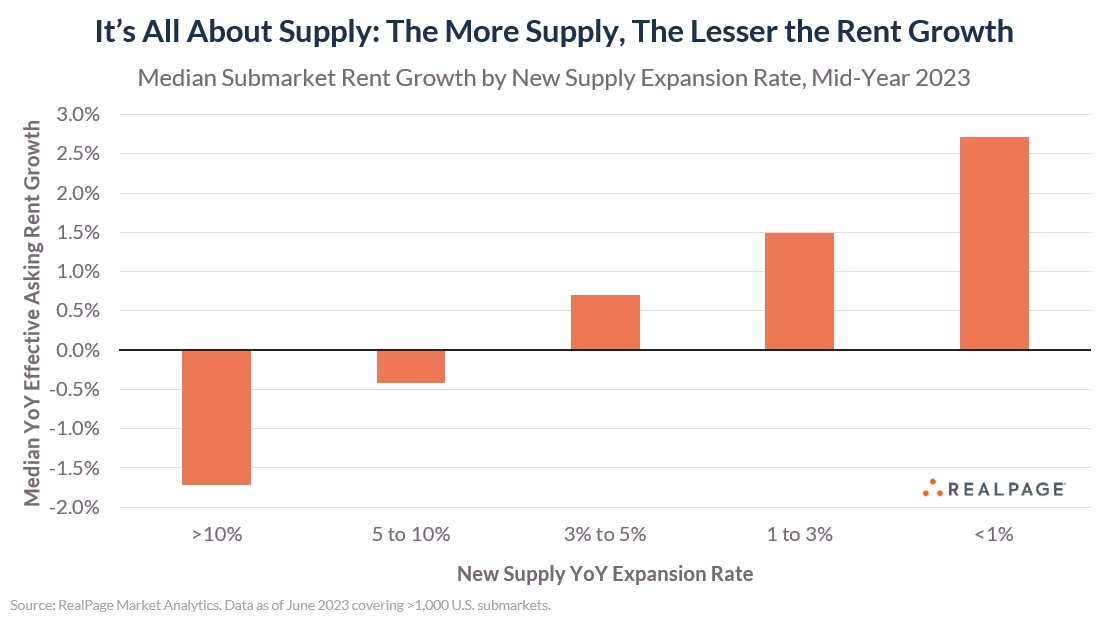
If you really care about rental affordability, you should really care about building as many new apartments as possible.
Econ 101 is playing out right now in the U.S. apartment market: It's all about supply and demand.
Build MORE, rents grow LESS.
Build LESS, rents grow MORE.
Check out the data showing rent change based on volume of new supply. There's a clear correlation between SUPPLY LEVEL and RENT GROWTH right now.
Submarkets expanding their apartment stock >10% cut rents nearly 2%.
Submarkets adding 5-10% more units cut rents by about 0.5%.
On the other end, submarkets that added <1% new units INCREASED rents nearly 3%.
To be fair: Rents don't always fall when supply is added -- particularly when supply fails to keep up with high demand. But there's no doubt rent growth is more limited than it'd otherwise be absent supply.
We expect these trends to widen over the next 18 months as apartment supply nationally hits multi-decade highs... but supply isn't evenly distributed, and neither will rent cuts/growth.
It's all about supply. Build, build, build.
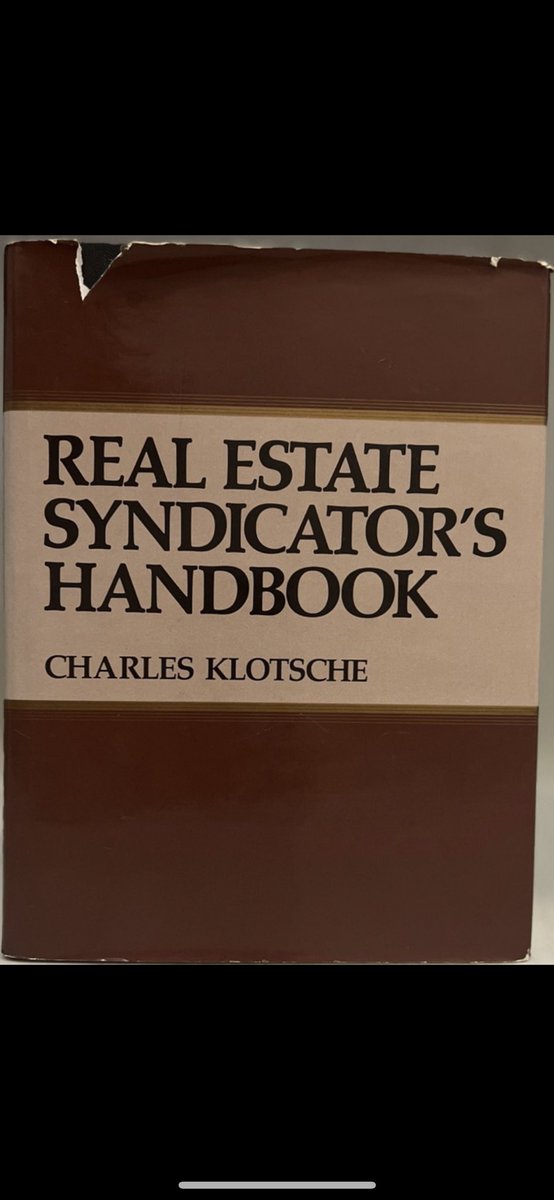
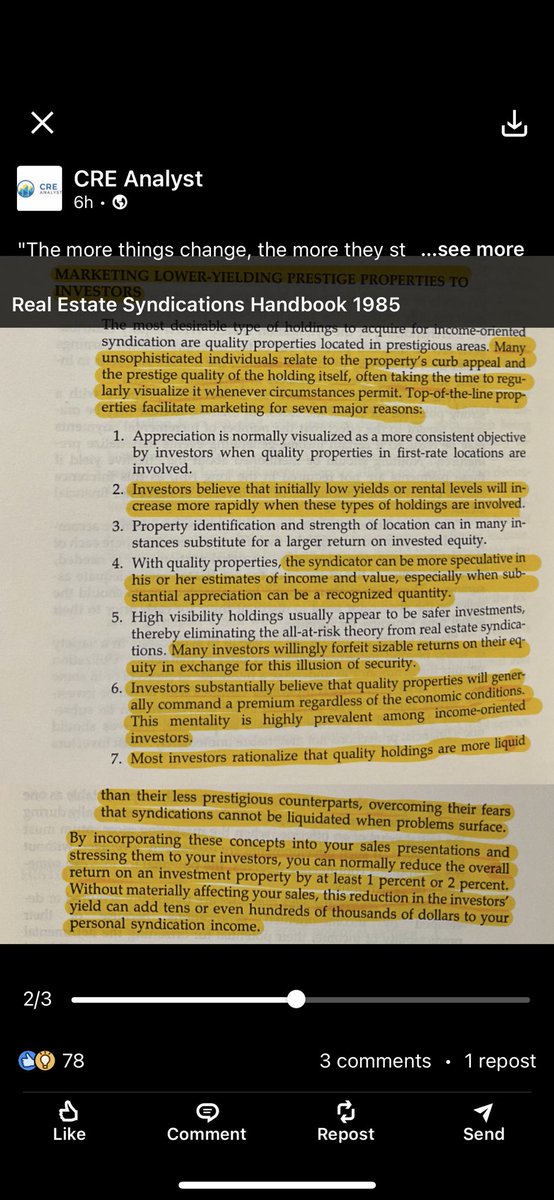
"The more things change, the more they stay the same."
The early 1980s were a crazy time of easy money for commercial real estate. Lenders threw money at projects, regardless of their viability, and syndicators pooled equity from small investors (often focused on tax benefits.)
This book was published immediately before the Tax Reform Act of 1986 undermined the equity syndication model by restraining investors' ability to harness extreme tax benefits from real estate. Shortly after, the S&L crisis blew up the debt markets. Needless to say, this book wasn't a bestseller since it was almost totally irrelevant within a year of being published.
However, some of this book's principles--especially those focused on convincing investors that lower-yielding properties have less risk--seem to have been implemented by recent apartment syndicators.
Hopefully, this round of syndications ends better than the mid/late 1980s experience. More than 30% of commercial mortgages originated in 1986 defaulted.
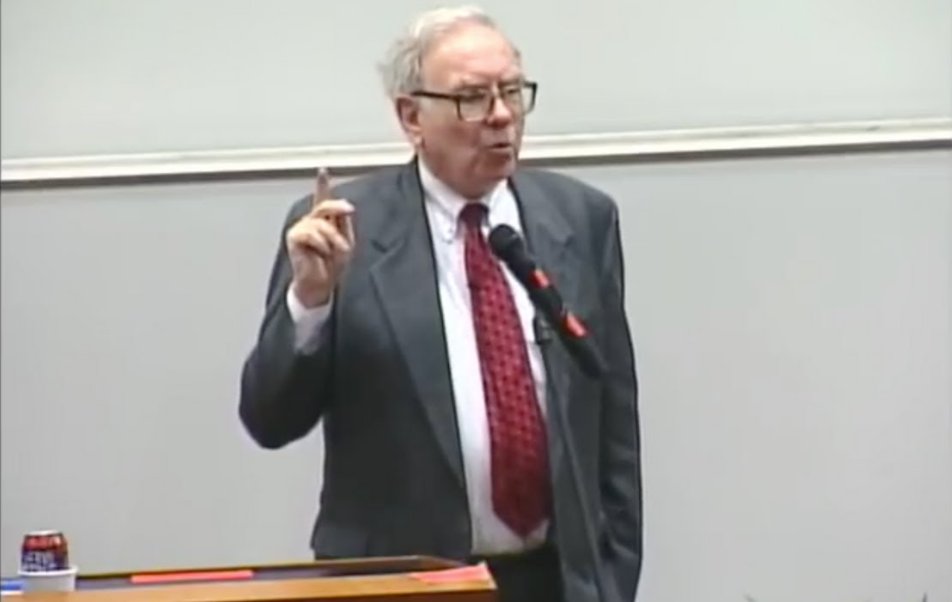
In 2001, Warren Buffett gave a talk at the University of Georgia.
He asked them the most Warren Buffett question ever:
• If you could invest in a friend and get 10% of their income for life -- who would you pick?
Once the students answered the question, he then asked this:
• Why would you invest in that person?
• What character traits do they have?
Now they have a list of character traits to adopt.
Shortly after this, Buffett asked:
If you could short a friend's earnings, who would you pick and why?
Now you have a list of character traits to avoid.
----
1. Do not think this thought experiment is only about money.
You can use it for whatever currency you value.
E.g. Happiness coin
If you could get 10% of a friend's happiness, who would you invest in and why?
If you could short someone's happiness, who would you pick and why?
You can run the same thought experiment with Fitness coin, Friendship coin, Romance coin, etc`
2. This thought experiment is genius because it hacks a bug in life's video game:
Humans are terrible at self-awareness.
But we are great at spotting things in other people.
E.g. If your friend is in the wrong relationship, you can realize in 10 minutes what may take them 10 years.
Daniel Kahneman summarised his book on cognitive biases with the following:
“The premise of this book is that it is easier to recognize other people’s mistakes than our own.” - Daniel Kahneman
3. Nuance - It has to be purely from merit.
Buffett says it can't be because someone will inherit a large sum from their parents.
It has to be based on their behavior.
E.g. If you want 10% of someone's fitness coin, it's not because of incredible genetics -- is because of the actions they take.
In a CNBC interview a few years back, Warren Buffet relayed a story of a time shortly after he and Bill Gates first met.
Gate's father asked a group of roughly 20 people to write down on a sheet of paper the one word that they thought accounted for their success.
Without seeing what the other wrote, both Buffet and Gates chose the same word: Focus.
With this in mind, I wondered: How they would advise someone to choose what they place their focus on?
In search of this answer, I ran across an article by author Scott Dinsmore which describes Buffet's 5-step framework for narrowing your focus to what really matters:
Your "Avoid At All Costs List."
The story is framed as a conversation between Buffet and his pilot (no idea if this is actually what happened) but you'll get the point nonetheless.
Here goes:
Buffet jokingly said to his pilot: "The fact that you're still working for me, tells me I'm not doing my job. You should be out going after more of your goals and dreams."
Warren then asked his pilot to take the following steps: (You should do the same)
• List your top 25: Make a list of the Top 25 things you want to do over the next few years or in your lifetime.
• Choose your top 5: Review your list and circle the Top 5 items that are most important to you. This is critical––you can only pick 5.
• Make a plan: Now that you have your Top 5, it's time to make a plan. How will you start working on these? Who do you need to enlist help from? When can you start? Hint: the answer should be now!
• Know your priorities: Now that you've made your Top 5 plan, let's talk about the other 20 items on your list: Buffet asked his pilot, "What is your plan for completing those?" The pilot stated that he word work on those intermittently, as he had time, since they were not part of the Top 5.
To the pilot's surprise, Buffet said: "No, you've got it all wrong. Everything you didn't circle just became your 'Avoid At All Costs List.' No matter what, these things get no attention from you until you've succeded with your Top 5."
•Be ruthless with your Top 5 list: I think most of us would have probably answered Buffet in a similar manner to his pilot. I mean, those other things are still important, right?
Well, according to Buffet (and seemingly Gates as well), the ability to focus on the few things that are the most important to you––what you really want––is the key to outsized results.
Letting yourself be distracted by the 20 (less important) things is why you never reach your potential on the 5 that matter the most.
For someone like me (with more ideas than time) this exercise was extremely helpful.
Take 20 minutes today and write out your own list and see what you come up with. You might be surprised at the results.
Warren Buffett called Philip Fisher's book, "Common Stocks and Uncommon Profits," one of the best books on investing.
It might be my favorite investment book ever, so much wisdom inside!
Here is Fisher's 15-point checklist of questions to consider before buying a stock:
Help me...
Good article
https://t.co/rQ5mFj5wgP
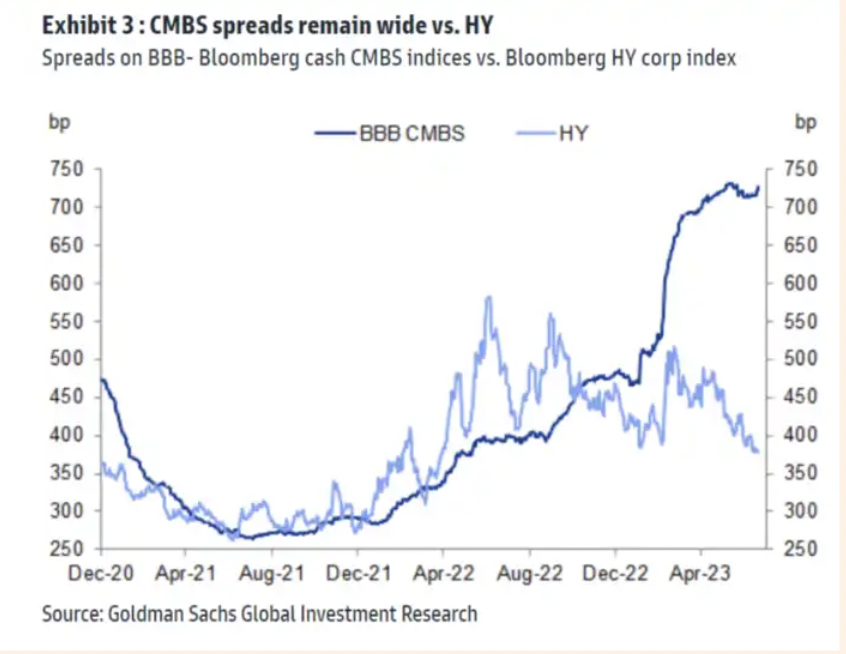
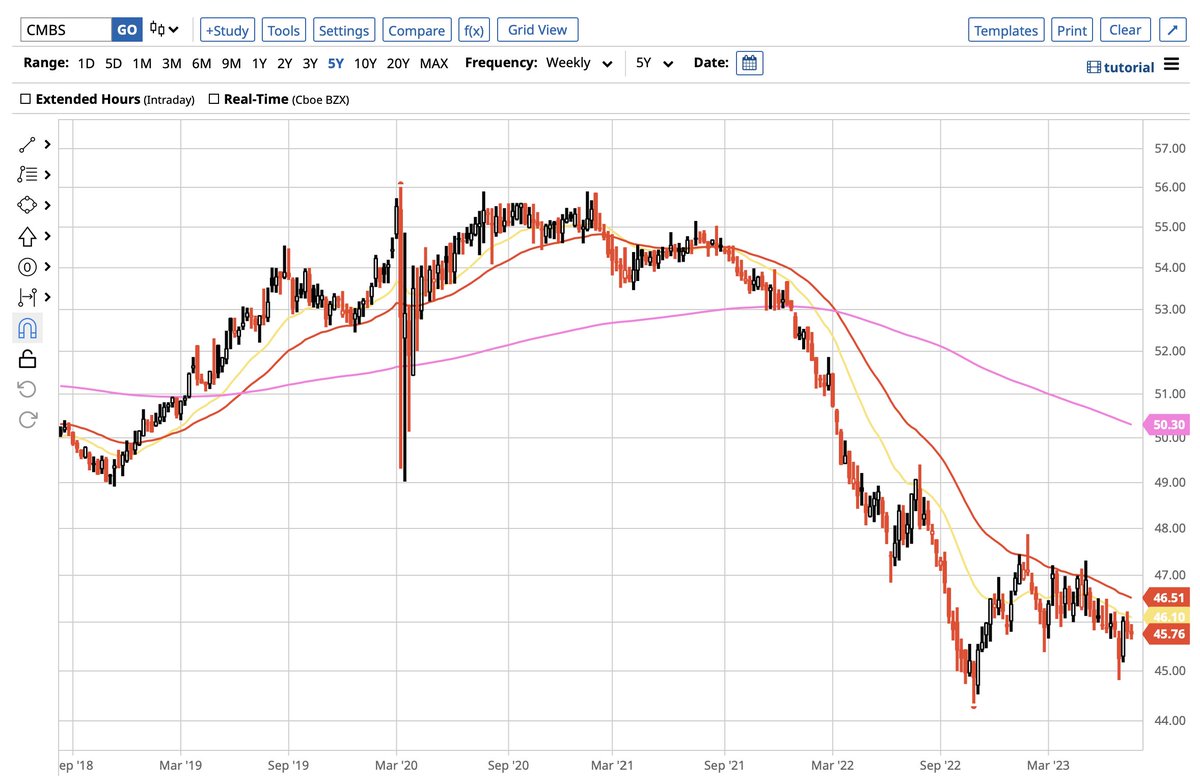
Great chart, BBB CMBS spreads almost 300 over corporate High Yield
You think, 🤔maybe its baked in, a known-known in the real estate market, might wanna take the other side and bet on those spreads narrowing
But then how come the $CMBS is yielding 2.8% and not over 7% ???
Its hot and humid as hell over here, maybe I'm missing something. What am I missing ???
@FTAlphaville
In 1997, at the age of 27, Matt Damon won his first Academy Award for Best Screenplay ("Good Will Hunting").
After Damon won the Oscar, he went home, sat down on his sofa, & looked at the award.
As he looked at it, he was suddenly overwhelmed by a heartbreaking thought.
"Imagine chasing that, and not getting it, and getting it finally in your 80s or your 90s with all of life behind you and realizing what an unbelievable waste of your life...It can't fill you up. If that's a hole that you have, that won't fill it."
"My heart broke," Damon said. "I imagined another one of me [not getting that award until I was] an old man, and going like, 'oh my god. where did my life go? What have I done?' And then it's over."
Takeaway 1:
Many successful, rich, famous, etc. people talk about chasing success, money, fame, etc., getting it, and realizing that it didn't feel like they thought it would. That it didn't, as Damon said, fill the hole they had.
One of my favorite analogies for this pattern comes from Sam Hinkie.
Hinkie was asked about what he's learned from reading Robert Caro's books—about some very successful, rich, famous, etc. people.
"I think of it like the Pacific Salmon," Hinkie said. "They spend their whole life making this journey upstream to spawn in this one spot. And as soon as they do, they die. That's largely what Caro shows you."
Takeaway 2:
Before he was a big-time comedian, Hasan Minhaj was asked if he thought he was going to become a big-time comedian.
“I don’t like that question,” he said. “I fundamentally don’t like that question.”
Because that question implies that he is only doing comedy as a means to some end (success, money, fame, etc.).
“No, no, no,” he said, “The set I get to do tonight at 7:20 PM is the win. I get to do comedy—I won. It being predicated on doing X or being bigger than Y—no, no, no. To me, it’s always just been about the work."
"The work is the win," as Ryan Holiday once told me.
- - -
"It's such a gift to be able to [do] something and to love it for the sake of it...I see people with talent, with all those things. But the one thing they don't have is just that love for doing it for the sake of it...So if there's anything, just find joy in what you do for the sake of it." — Rodney Mullen
Follow @bpoppenheimer for more content like this!
@elonmusk@ESPNF1 Here’s my proposal - stay with me - an autonomous BEV @F1 race car vs a human-driven BEV F1 race car and call it the “Man vs Machine” Race
This exchange between Warren Buffett and Charlie Munger is golden—lessons for building wealth and living a better life:
Buffett:
"Write your obituary and try to figure out how to live up to it. For business, You just want to make sure you don't make any mistakes that take you out of the game or come close to taking you out of the game. You should never have a night when you're worried about investing. You should spend a little bit less than you earn."
2 lessons Buffett said learned from Tom Murphy:
"You can always tell someone to go to hell tomorrow."
"Praise by name, criticize by category."
Buffett continued:
"I've never known anybody who was kind that died without friends. But I've known plenty of people with money that died without friends."
Munger:
"It's so simple: you spend less than you earn. Invest shrewdly. Avoid toxic people and toxic activities. Try to keep learning all your life. And do a lot of deferred gratification.
If you do all of those things, you are almost certain to succeed.
And if you don't, you're going to need a lot of luck. And you don't want to need a lot of luck. You want to go into a game where you're very likely to win without having any unusual luck."
Buffett added:
"You need to know how people can manipulate other people and you need to resist the temptation to do it yourself."
Munger agreed vehemently:
"Oh yes, the toxic people who are trying to fool you, lie to you, or who aren't reliable in meeting their commitments—a great lesson in life is to get them the hell out of your life. And do it fast."
Buffett:
"And do it tactfully, too, if possible. But do get them out of your life."