@EveKeneinan It's a whimsical children's story written very much in the British style, and is beautiful for what it is. Like a Monet painting. Plot holes and all.
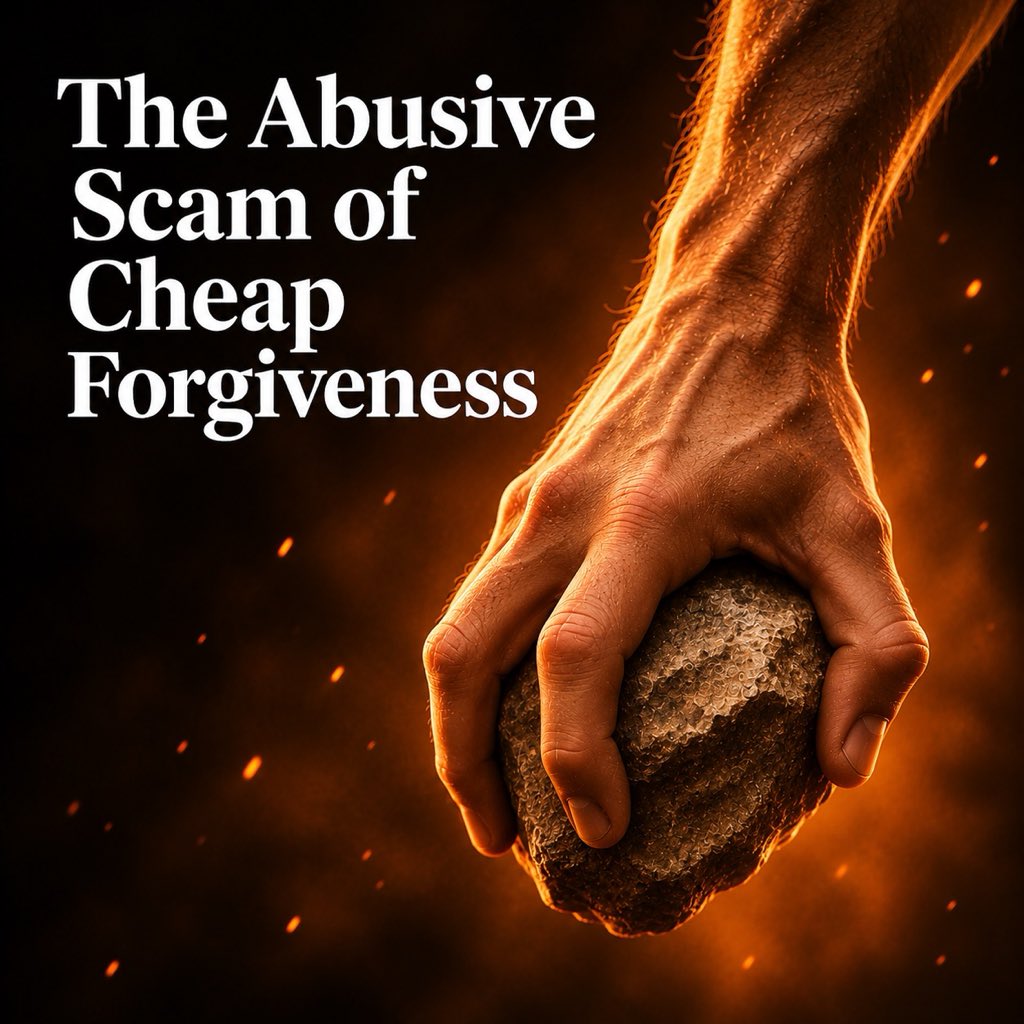
The Abusive Scam of Cheap Forgiveness
Adam, a man in his 50s that I coached, was estranged from his father. The guy had neglected him when Adam was a boy, and now in his old age picked stupid fights and judged him. During the COVID shutdown, his father’s new wife died (unrelated to COVID), and told Adam it was the fault of people like him for not wearing a mask. Adam could hardly talk about his dad without shaking with rage.
I remember looking him in the eye and asking what he wished his dad had done growing up. Being there for him, encouraging him, teaching him, etc. I asked Adam if he feels he is able to do those things with his kids. He said, “Yes! Not perfectly, but I try with all my heart.”
I pointed out to Adam that that meant he now possessed the “fatherhood” skill set that his dad lacked. And I asked him, “do you think you could be the dad for yourself that you never had?” He thought about it. Splitting his own persona in those moments of weakness, and using the same encouraging voice directed at himself that he wished his dad had done before. Maybe he could.
I then asked him, “if you did this perfectly, addressing every lack and wound in yourself like a capable father, what would you need from your dad now in his old age?” He thought long and hard. “Nothing.” He realized that all the ways that his dad TODAY was still able to trigger him was because he’s still subconsciously needing him to be the dad he never was.
And then the real revelation: if he no longer needed his dad to be anything but himself, that meant that he could...FORGIVE him. When his dad lambasted him for being a non-masker, he could be secure in his own frame and simply see a man lashing out after losing his wife. He had space to feel compassion, because his dad could no longer hurt him.
Bonhoeffer decried the doctrine of “cheap grace,”—the notion that you can peddle “forgiveness” as a platitude with no cost. He was right: you cannot forgive without paying the price of forgiveness.
Cheap forgiveness adds insult to injury. Like being forced to say, “Thank you sir, may I have another” as you are whipped. In addition to the injury you have suffered, you feel social pressure to lie about being OK with the person who injured you when you aren’t. Without being secure in God, the “forgiveness” of the Christian martyrs would have been meaningless suicide. Costly forgiveness is the fruit of work.
When St. Stephen looked up to heaven as the stones were being hurled at his head and prayed that God wouldn’t hold his killer’s sin against them, he did this from a posture of strength. He felt secure in God’s hands, knew that he would live forever, saw his present agony as a momentary inconvenience, and could then turn to lesser matters like “shall I pardon those guys who slipped up and killed me out of ignorance?” Stephen’s forgiveness was the fruit of all the work that Christ had already done and he himself had participated in, securing Stephen’s place by the right hand of power.
In Adam’s case, the price of being able to forgive his father was to heal himself. Only with the strength of not having all these gaping wounds festering (for his father to poke) could true forgiveness happen. And that would take years of intense sacrificial effort applying the love of God to his own soul. To neglect this would be to deprive himself of the power to forgive, and thus refuse to forgive.
Stop selling forgiveness on the cheap. Give people (and the Holy Spirit within them) room to work.
There is a story about this that haunts me in a deep way.
Flippant people sometimes talk about the the idea of living life the way you want, then repenting at the end so you "still get in to heaven" since all you have to do is say sorry. In a way, there is technical truth here. As long as you draw breath, no matter how far you have strayed, all you have to do is simply turn around and there God is right in front of your face, ready to embrace you.
But here is the catch. Turning your head around to look at God's face becomes harder and harder as we move. Like slowly calcifying into a statue, locking in your final form.
There was a man who changed the trajectory of my life through his love and discipleship. He told me the story of his own father, who rejected God til the bitter end. He shared the gospel many times over many years with patience and joy.
On his deathbead, his father had no arguments against God. There were no reasons he held on to, grievances or questions.
All he could say, was "I lived my whole life this way. I will die this way."
His neck was hardened rock, unable to turn.
We are always being shaped bit by bit into our final forms. Change is possible, but the difficulty and price increase more and more the longer we live.
Brothers,
Don't be deceived.
You can't suddenly later in life walk away from who you have made yourself become.
A man who has neglected self-control won't one day wake up and be able to flip it on like a light switch.
A man who has used others won't one day suddenly stop just because of a particular job, or a wedding, or a this or a that.
Today is the day you determine the kind of man will you will be tomorrow.
Make a wise choice. Your future self depends on it
Pete and @tyromper, I could not recommend highly enough The Way of Men with Maids by @GiffLasta for this. It isn't the normal weak Christian "avoid the sin" book. It is a vital map to becoming men, harnessing and wielding their sexuality for great power and joy instead of trying to suppress it. I absolutely intend to give it to every young man coming of age I know.
I would largely agree with this, in that investor relations are a massive time, energy, and emotion sink for founders.
At the same time, I find the 1-on-1 vibe check to be absolutely critical. Product may pivot. Plans have to adapt. I have a very short time to assess the founder's character and poke around, see if they respond with pride or humility.
I’m fundamentally not opposed to this. This particular example may have more nuance, but the premise is really interesting.
Remember, all fundraising activities do massive harm to a startup's focus on its customers.
And 'help' from investors is never more helpful than the tax on time and focus.
And there are lots of wonderful, hands-off investors that would happily invest directly in startups without the access of earning a meeting. Currently, they only get access through SPVs where there's a large fee+carry tax.
I would LOVE to see more entrepreneurs do a version of allowing investors to just request allocation first come first serve.
Most fundraising is high reps at investor conversations where the exact contact could be delivered as a video, deck, memo, data room, etc.
There is nothing sacrosanct about the vibe check an investor gets from their 1-1 interaction.
We believe this at Orange Collective - which is why we publish our investment committee memos first our LPs and then the internet. We WANT follow-on investors to be able to offer investment to that startup without needing the meeting.
We did do this ourselves with our investments in several OC companies where we told them in our meeting request email that we were already all-in on their company, allocation already approved and requested, even before the meetings.
I have much to say about @plainrunner2, and his novel Travel By Star. I picked it up after seeing exchanges and interaction with @MichaelFKane (whose works are next on my reading list). To say all I wish in detail would require spoiling the book. It is worth reading, and I do recommend it. No one's first work is every their magnum opus, but for a debut novel, it is exceptional.
He is worth following, because I believe that he will be an exceedingly great story teller, though he is not yet there.
In an apocryphal story of Michelangelo, an admirer asks how it is possible for him to create such a masterpiece as the statue of David just by starting with a single giant block of marble. He replies, "It's simple, really, I just chip away everything that isn't David."
I have always loved that slightly embellished story, as it mirrors how God refines by taking away, bit by bit, everything that doesn't belong in us, everything that isn't the true self-in-Christ until the final day is us revealed to be what we really are.
Travel By Star still has too many pieces left on that leave it slightly awkward in proportion or rough around the edges. But for those with eyes to see, there is a statue of David standing there.
Whether intentionally or not, she has done an excellent job describing exactly how God transforms us through his love. There is a reason that Christ calls himself the groom and calls us the bride.
It is this overwhelming reality of being known better than we know ourselves, being loved beyond more than we think we can deserve or even bear, which changes the way we see ourselves, see God, see the whole of reality.
And then we, as husbands, get to do the exact same thing for our wives, and experience the joy of seeing them blossom. But it is hard if you aren't rooted as man, and easy to plant thorns instead of roses in the garden of your wife. Many of us are still figuring that out, but seeing the joy of progress.
Some men have such a beautiful capacity for love that they gradually change the way a woman perceives herself.
A man who loves her with genuine tenderness, exercises patience with her imperfections, and finds beauty in the parts of herself she has spent years concealing can profoundly alter her understanding of what it means to be worthy of affection.
Being loved by a genuinely good man can make a woman discover dimensions of herself she never knew existed. She begins to recognise her own worth through the sincerity of his admiration and gradually learns to extend that same tenderness towards herself.
greatest privileges of being loved well is discovering that another person's affection can help you become more loving towards your own existence.