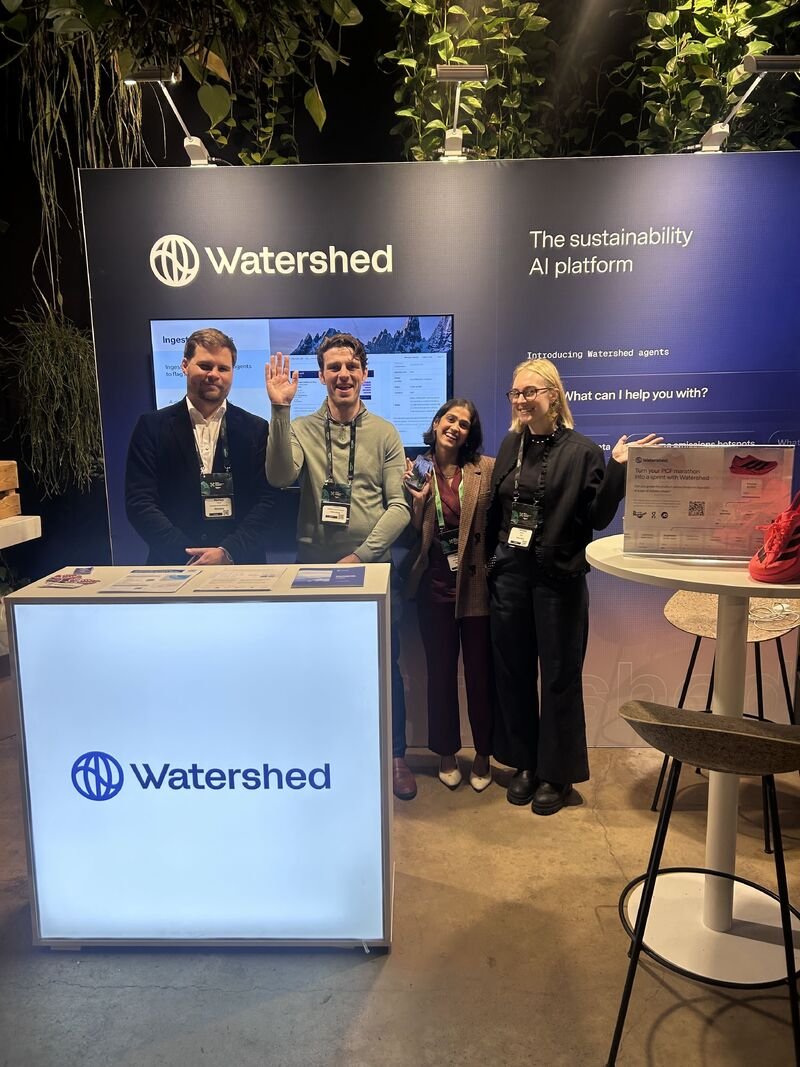
Three Former Stripe Employees Built a $1.8 Billion Carbon Accounting Company
The company is Watershed. It was started in 2019 by Christian Anderson, the CEO, Avi Itskovich, the CTO, and Taylor Francis. All three worked at Stripe before leaving to build software that measures and cuts corporate emissions.
Watershed's last announced round was a $100 million Series C in February 2024 at a $1.8 billion valuation, led by Greenoaks. Kleiner Perkins, Sequoia Capital, Elad Gil, Emerson Collective, Galvanize Climate Solutions, and Neo took part. It raised $70 million at a $1 billion valuation in 2022, led by Sequoia, after a Series A led by Kleiner Perkins in 2021. Data providers also list about $14.5 million more from a regulatory filing in December 2025, which Watershed didn't announce. It hasn't disclosed a current valuation.
A company's carbon footprint is hard to measure because the data sits in energy bills, supplier files, travel records, and spreadsheets. Watershed pulls it into one platform, applies a library of emission factors, and produces audit-ready reports for rules like California's SB 253 and SB 261 and the EU's CSRD. It also helps companies find savings and fund clean power projects. Customers include Airbnb, Carlyle, FedEx, Visa, Canva, Klarna, BBVA, and Spotify, and CDP uses it to report its own emissions.
In April, Watershed launched AI agents that clean and analyze sustainability data. It says the work they replace takes teams an average of five months, and that data-cleaning agents cut the time to usable data by 80% across test customers. This fall it announced collaborative agents, and it is preparing a unified AI platform for energy management and emissions. Forrester named it a leader in its 2026 sustainability software report.
On October 12, EY announced an alliance with Watershed. EY's US sustainability team will combine its advisory and implementation work with Watershed's platform to help clients measure scope 1, 2, and 3 emissions and product-level footprints. On September 10, Watershed and AdAstra Sustainability announced plans to open-source the pipeline behind Orbae, a land use change emissions dataset, through Watershed's Cornerstone data initiative. A land sector standard from the Greenhouse Gas Protocol means companies must measure land use change emissions starting January 1, 2027.
Watershed's AI Fellowship runs through November 19. It is an eight-week program for sustainability professionals, and fellows include employees from Anthropic and Thermo Fisher. One customer, Hain Celestial, replaced a £10,000 consultant engagement with a two-day AI workflow, according to Watershed.
Anderson says sustainability work will become more automated and action-oriented over the next few years.
🐦⬛🧠 recipe for homemade mac&cheese :
One layer of Noodles, one layer of butter, one layer noodles, one layer of cheese add milk put in oven and that’s how you make homemade slop.
Chilly night, warm bowl! 🌶️🥣 Hearty Beef & Bean Chili: thick and rich, simmered low and slow, then piled high with cheddar, sour cream & green onions. Easy, cheap, and warms you to your toes. Cornbread or crackers? Recipe in the comments 👇 #MAHA
He started @LiquidInTech with four employees.
By September 2025, it employed more than 5,000 people in over 30 countries.
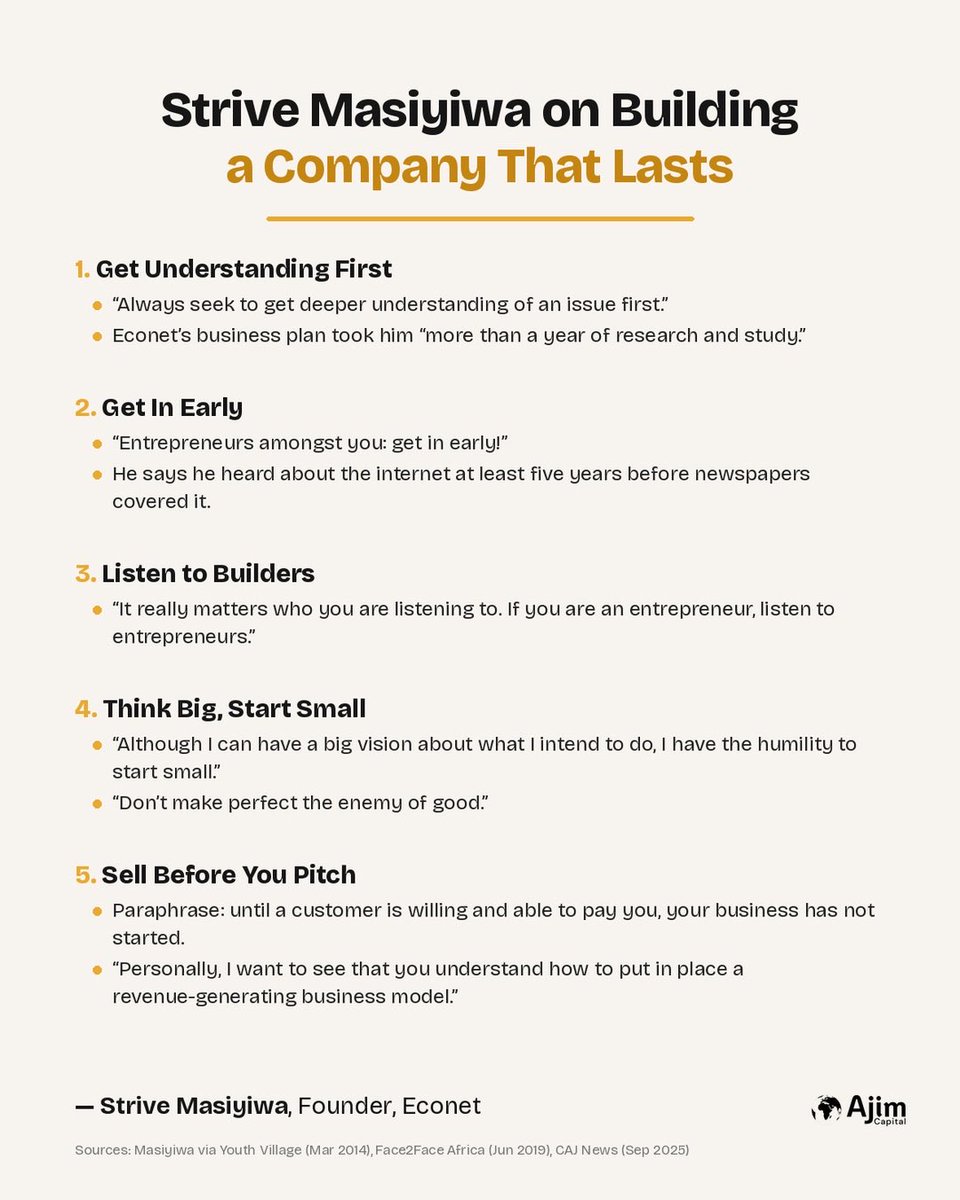
That's Strive Masiyiwa, the Zimbabwean who founded Econet.
His rule: “Although I can have a big vision about what I intend to do, I have the humility to start small.”
His lessons on building a company that lasts:
> Get understanding first.
> Get in early.
> Listen to builders.
> Think big, start small.
> Sell before you pitch.
“Don't make perfect the enemy of good.”
Brunch for today!
Eating here in Kanto Freestyle again. I’m having Honey Garlic Chicken and Ham, Bacon, Mushroom Omelette. 🤤😍
Eat or Pass? jk 😛😂
Kain tayo! 🫶
I worked with a solo founder building a suite of apps. His most promising app had revenue, but he was blocked on talking to users.
We contacted the internal block: tension in his face, reasons to not reach out, and fear of putting himself out there, of being seen, judged, and of someone telling him he's doing it wrong.
This client has a young daughter, so I prompt him to imagine her coming to him with these feelings and fears. How does he respond? With love, caring, and a sense of how much he likes her.
Can he offer this same response to the part of himself that holds these feelings and fears? He sits with it for a minute, and as soon as he does, the tension relaxes, and the fear is gone.
We explore what's opened up somatically: the boundary between his body and the rest of the world feels fluid. After some time, we circle back to the question of talking to users.
What's there now? Joy that people have been using the app. Curiosity about how to make the experience better for them. He sent outreach emails immediately after the session.
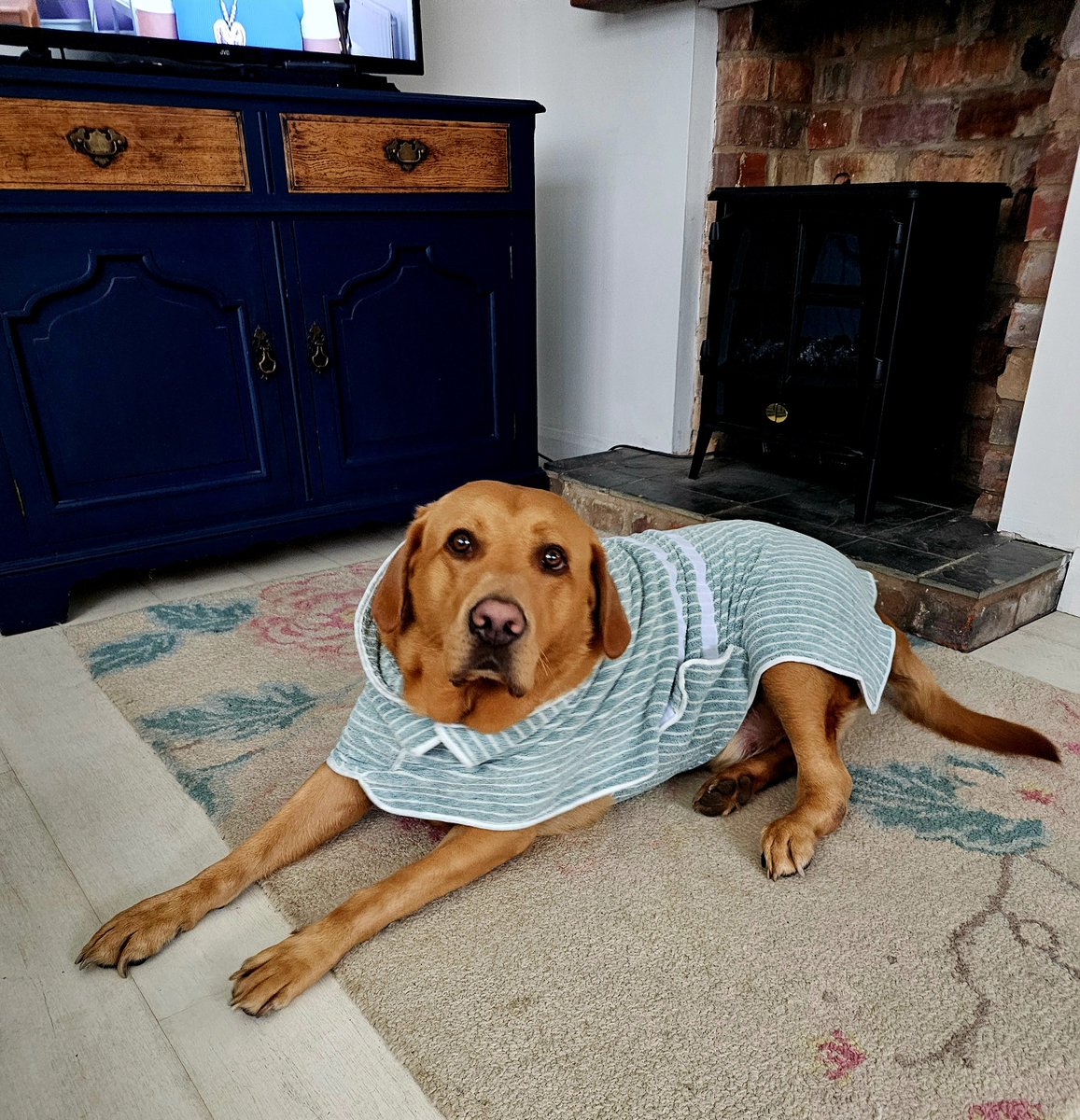
This is the face of a guilty labrador who against orders dived straight in to the boating lake on his first day of the holiday. 🙈🙈
#Baileydaily#Baileysdailyadventures ⛱️
Steve Jobs once said, "A players hire A players, but B players hire C players."
In a large company, that slide can take years. In a small startup, it can happen in a matter of months. Early stage startups should have the least tolerance for mediocrity. It's easier said than done, but if a culture of high standards is established at the top and consistently reinforced across the organisation, it can increase the odds of success by an order of magnitude.