Our initial results from our $NBIS 2027 modeling are pretty shocking. We really think the street is getting this wrong by one of the largest margins we've ever seen.
Pulling in a lot of recently announced colocation and greenfield capacity.
2027 and 2028 demand environment is looking very certain with the larger owned sites beginning to come online in chunks.
A lot of commentary from GTC Berlin is changing how we look at and model near term and long term capacity allocation.
We think there are real cases where prepayments could pay almost 100% in GPU cost in exchange for lower end of the spectrum revenue per MW pricing (still very high in 6-12 month contracts).
Don't underestimate the importance of this pricing power as capital needs are set to explode higher over the coming years.
Additionally, in light of recent price action and to celebrate the first full year of Northwise Premium and memberships we are considering a sale for new signups.
Members have full access to all of our price targets across the AI infra buildout, our full downloadable models, our full data center tracker features and integrated modeling, as well as both of our portfolios (flagship and newer active growth strategy)
Let me know if there's an interest in this and we will make it happen.
Expect an update and new report soon on Nebius in 2027 before Q3 earnings.
@AIMarketMinute@InvestNorthwise Noted! Will send out a notification with the new report. Free account members on the site will get the code in the newsletter!
Our initial results from our $NBIS 2027 modeling are pretty shocking. We really think the street is getting this wrong by one of the largest margins we've ever seen.
Pulling in a lot of recently announced colocation and greenfield capacity.
2027 and 2028 demand environment is looking very certain with the larger owned sites beginning to come online in chunks.
A lot of commentary from GTC Berlin is changing how we look at and model near term and long term capacity allocation.
We think there are real cases where prepayments could pay almost 100% in GPU cost in exchange for lower end of the spectrum revenue per MW pricing (still very high in 6-12 month contracts).
Don't underestimate the importance of this pricing power as capital needs are set to explode higher over the coming years.
Additionally, in light of recent price action and to celebrate the first full year of Northwise Premium and memberships we are considering a sale for new signups.
Members have full access to all of our price targets across the AI infra buildout, our full downloadable models, our full data center tracker features and integrated modeling, as well as both of our portfolios (flagship and newer active growth strategy)
Let me know if there's an interest in this and we will make it happen.
Expect an update and new report soon on Nebius in 2027 before Q3 earnings.
When I think about NVIDIA $NVDA's inference opportunity, I start with the work someone wants an AI system to finish.
A single task can require the model to read context, generate a response, call a tool, inspect the result and try again. The tool's own execution is separate from the model calls around it. Caching can also reduce repeated work.
That makes a count of user prompts a weak measure of the computing behind an AI product. A more capable service can use more inference per task while still saving the customer time or money.
I find that a more useful way to think about demand for NVIDIA's systems and the capacity sold by Nebius $NBIS and IREN $IREN. The economic question is whether the completed task is valuable enough to pay for all the work needed to finish it.
A higher earnings-per-share forecast can come with less cash left in the company. I want both numbers in front of me when judging a buyback.
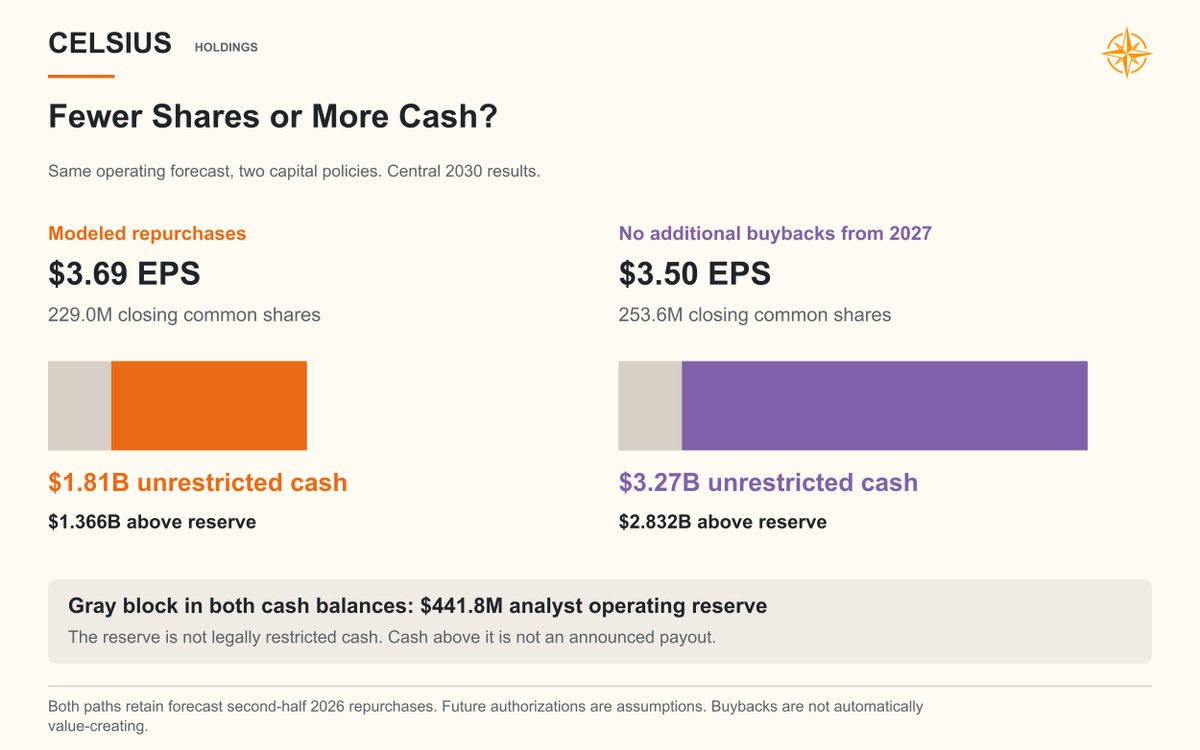
For Celsius $CELH, Northwise's 2030 operating forecast produces $3.69 in normalized common EPS with the assumed repurchases, or $3.50 if additional buybacks stop from 2027. The second path finishes with about $1.46 billion more cash. The underlying operating forecast is the same.
That makes the lower EPS much less troubling to me than it looks on its own. The company has retained money it otherwise would have spent buying shares. Whether repurchases are the better choice depends on the price paid and what else that cash could earn.
These future buybacks still require board authorizations. I would judge the operating progress first, then ask whether management is using the resulting cash well.
Full Northwise analysis: https://t.co/e5yO6UWnYn
Customer prepayments help $IREN build sooner. They also give customers a claim on future service.
When that service is delivered, part of the invoice is settled with credits instead of fresh cash. The money arrived earlier and helped pay for equipment.
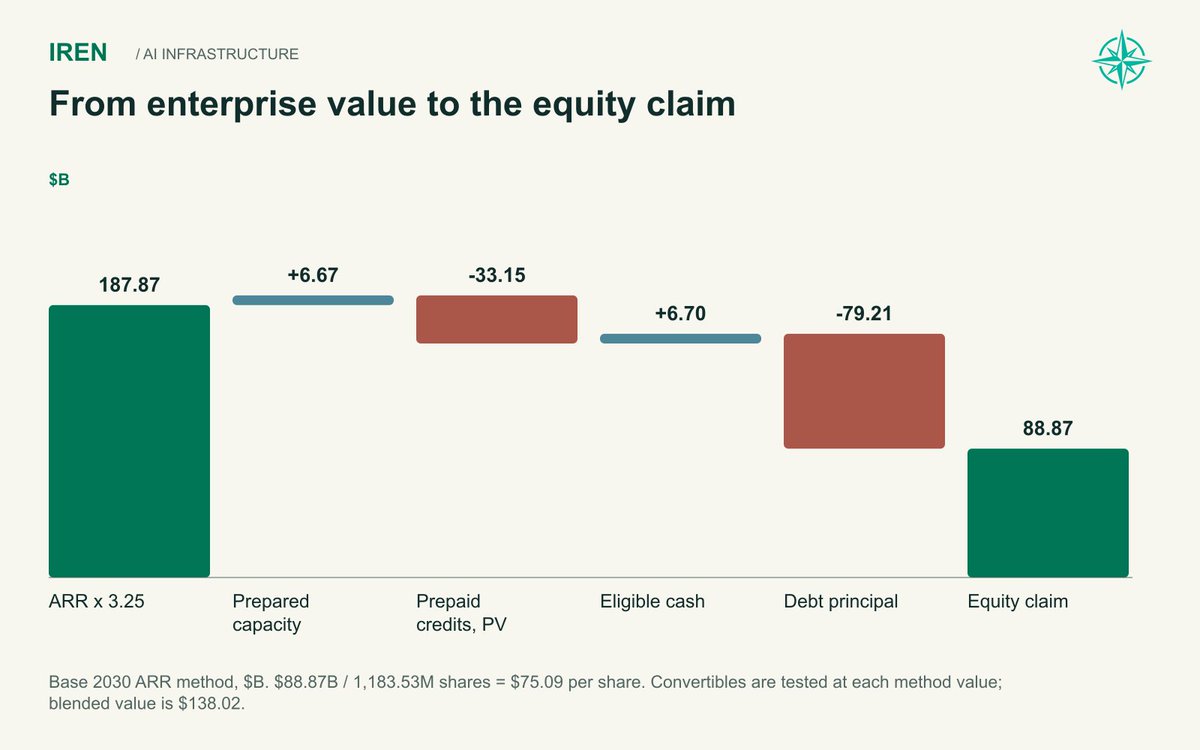
That is why I subtract the remaining prepaid-service obligation when moving from business value to shareholder value. Debt has to be accounted for too, before dividing the equity claim across the shares.
The chart shows that bridge for the ARR method in our Base 2030 case. It is one valuation method within the report, rather than the final blended target. The business can become enormous while the claim belonging to each share remains much smaller.
The legal-settlement section of the Meta $META report is a good example of how a few large numbers can give the wrong impression when added together.
The August agreement described roughly $12.7B of guaranteed payments, $5.3B of conditional payments and an expected $10B accounting charge. The charge is not another $10B cash payment on top of the settlement.
I would follow three schedules: when the expense enters earnings, when cash is due and when the required product changes take effect. Each answers a different question about the business.
A known settlement makes part of the cost easier to forecast. It still consumes cash, and it does not remove exposure to future legal events. That is how the October 9 model treats it.
I have been doing some thinking on $NBIS management commentary coming out of GTC Berlin this week.
I think many are hyper focused on the announcement that Nebius plans to bring online a GW of Vera Rubin capacity in 2027. (this is obviously very exciting news for the company.
However, I see it as highly unlikely that this is the only capacity Nebius will be bringing online with the pricing power that other chips are still retaining and with demand remaining insatiable across the board.
Nebius not only appears ready to shatter 2027 ARR and capex expectations, but also potentially capacity expectations as well.
If AST SpaceMobile $ASTS eventually delivers 99% availability in a market, I would still want to know what happens during the missing 1%.
Consider two hypothetical networks. One loses service for a single 14-minute stretch each day. The other drops out 48 times for 18 seconds. Both have approximately 99% daily availability, but they can feel very different when someone is trying to finish a call or load directions.
This is why I separate the existence of satellite coverage from the continuity of a usable session. Satellite geometry, signal quality and handoffs can all affect what the customer experiences. The 99% example is an illustration, not an AST performance claim.
I see real value in filling coverage gaps with an ordinary phone. My confidence in recurring customer demand will rise as evidence shows which everyday tasks the service can reliably complete, across whole sessions and under realistic conditions.
Could $IREN lease its powered buildings to another operator if owning the compute became less attractive?
It is a useful option, but its value depends on when the decision is made.
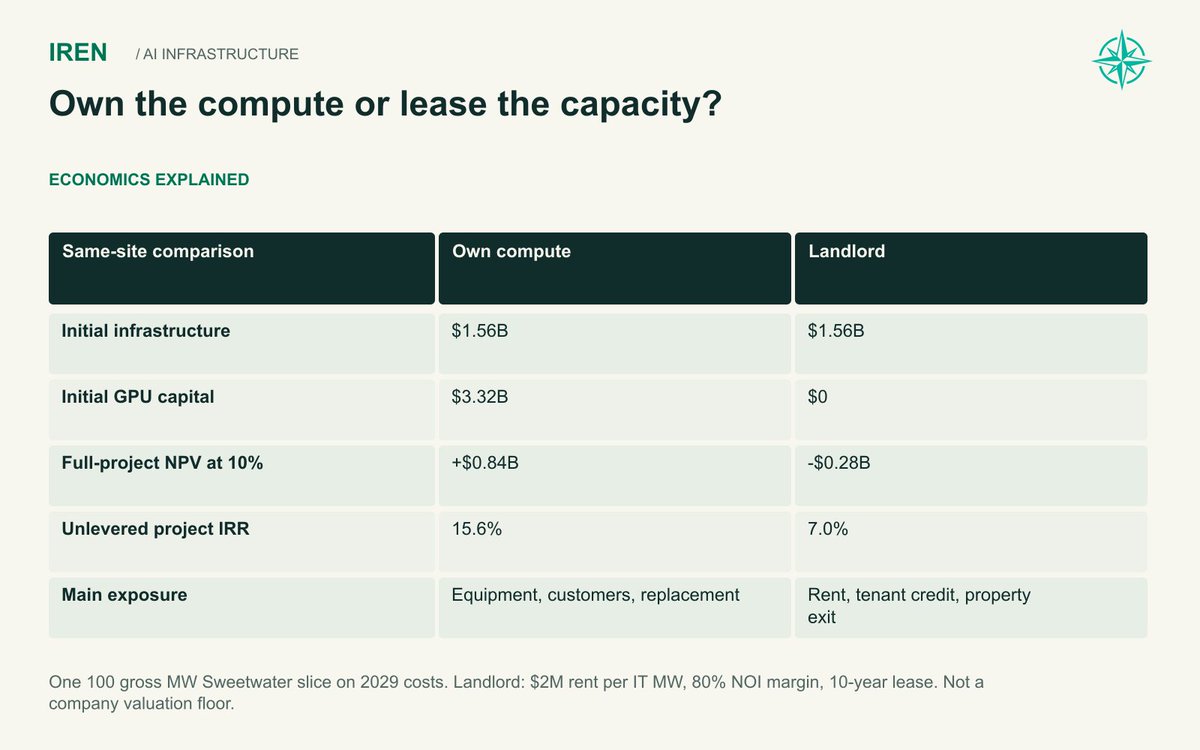
In our comparison of one 100 MW Sweetwater slice at 2029 costs, owned compute earns a 15.6% project return. A landlord lease at the assumed rent earns 7%. Once the shell is already paid for, leasing looks better as a decision about the remaining capital.
That distinction matters. A sensible way to use an existing building does not establish that the original construction investment earned enough, or create a guaranteed floor under the shares.
The Pepsi partnership helps Celsius $CELH get its energy drinks into stores across the country. When I think about what that reach is worth to a common shareholder, I have to follow the earnings through the partnership too.
Pepsi owns preferred shares that receive a regular dividend and also participate in earnings before conversion into common stock. A larger consolidated profit therefore has to be allocated before calculating what belongs to ordinary shareholders.
In Northwise's 2030 forecast, about $1.05 billion of normalized net income leaves roughly $866 million for common shareholders after those preferred claims. The participation amount is an earnings allocation, not a second cash dividend.
I remain interested in the growth opportunity after allowing for those claims. This is also why I want the ownership terms beside the revenue forecast: they determine how much of a successful business reaches each share.
Remember that we have continued to reiterate our view that $NBIS ARR will likely come in double current street estimates (maybe more)
Price action over these weeks has nothing to do with the current demand environment or continued rapid execution from management.
Due to popular request to bring our 2030 models in closer before earnings, we will be dropping our full year 2027 Nebius model and targets soon.
We were the first to view hyperscaler deals as anchor contracts for financing and that Nebius should be modelled through a capacity first ground up view point.
If you follow street estimates and models, the vast majority now use that same framework to model Nebius and they continue to adjust their near and long term capacity forecasts to the numbers we were publishing as early last year.
We may not have the distribution of some of the big banks, but we have thousands of pages of reports and thousands of hours of research that is now aiding the street to catch up.
Most of these analysts reactively adjust their models to replicate short term price action, meanwhile our forecasts have only been revised up as Arkady and the team continue to execute at a higher level that we could have imagined.
We aren’t bothered by corrections, we research and display our conviction publicly, even as our targets grow farther apart from near term valuations.
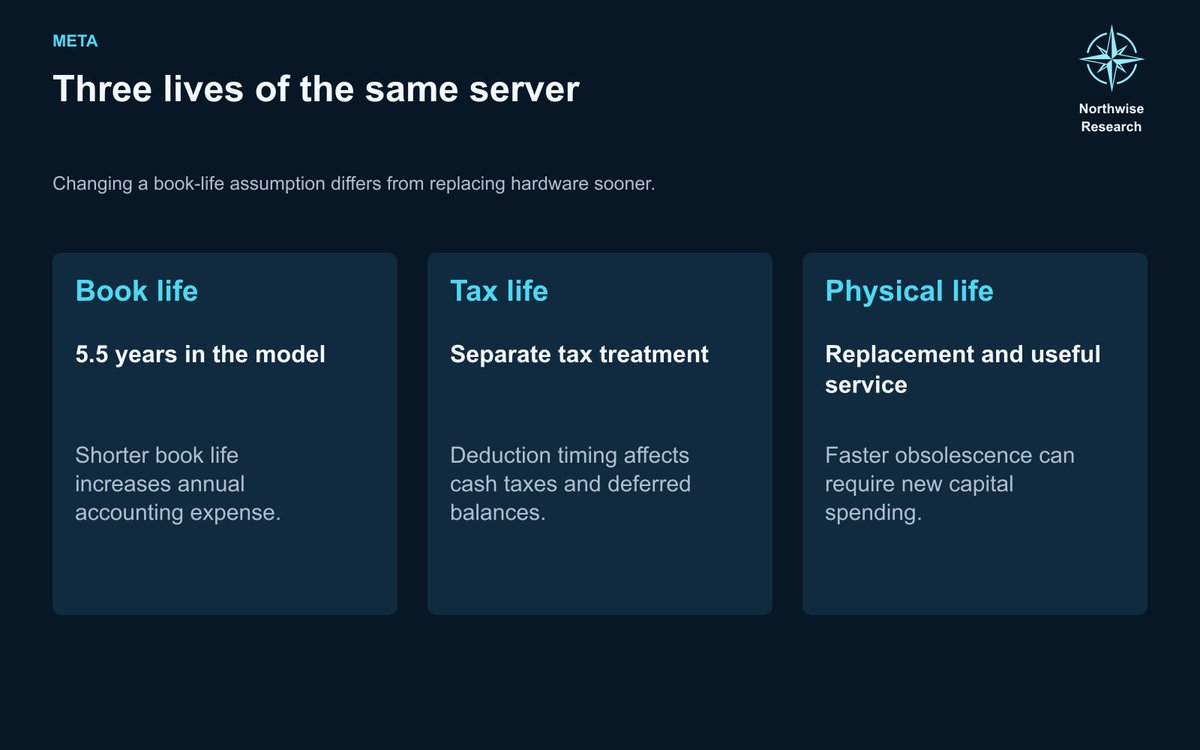
When someone says Meta $META's servers may have a shorter useful life, I want to know which clock they mean.
Recognizing equipment costs over fewer years increases annual accounting expense. Replacing the equipment sooner requires another cash purchase. Tax deductions follow their own schedule.
The October 9 model uses a 5.5-year book life. For me, the harder question is how long each generation can do useful work at an acceptable cost. A depreciation assumption cannot guarantee that the hardware will earn enough before it needs replacing.
I would be careful drawing conclusions about NVIDIA $NVDA from a rising rack price alone. AI data centers can run out of usable power before they run out of space for racks.
Take a hypothetical $4M rack using 160 kW and a $10M rack using 400 kW. Both cost $25M per megawatt of IT power. The sticker price is 2.5 times higher, but so is the power requirement.
For an operator such as Nebius $NBIS or IREN $IREN, I want to know what that megawatt can earn after the full system is installed. The arithmetic does not prove equal performance or profitability. It shows why the rack count and price need a common denominator before they tell us much.
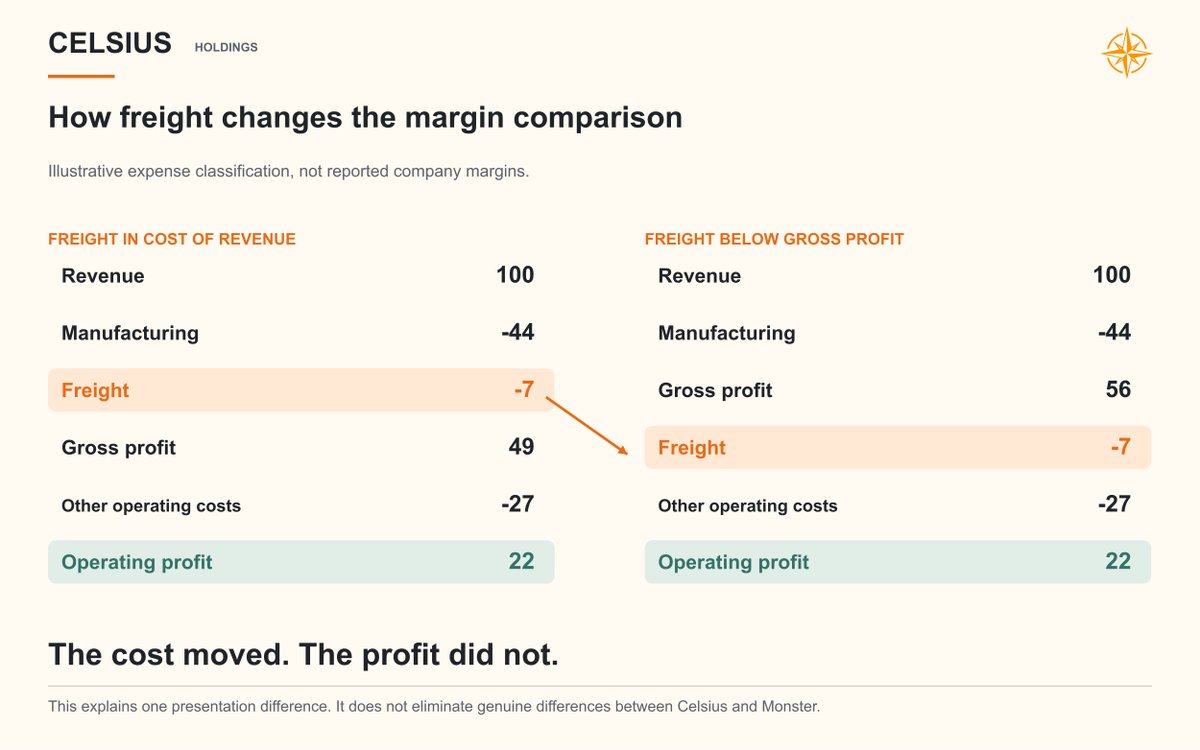
I would be careful about giving Celsius $CELH credit for closing the gross-margin gap with Monster. The energy drink companies put freight in different places on the income statement.
Celsius includes outbound freight in cost of revenue. Monster reports distribution expense below gross profit. In the chart's hypothetical example, that change alone moves gross margin from 49% to 56%, with operating profit unchanged.
I would count cheaper manufacturing, better truck routes and more productive marketing as progress. Before putting a margin improvement into a forecast, I want to identify the business decision that actually earns it.
I've been adding to $NBIS during this correction because I think the market is still underestimating the business Nebius is building. The demand matters enormously, but so does the question of who pays for the infrastructure needed to serve it.
That is why I've spent so much time on the asset-light program.
Nebius wants partners to fund and own the data centers and GPUs while it provides the cloud platform, operating standards and customer access. If that works, growth can reach beyond what Nebius can finance on its own balance sheet. Partners supply the heavy capital, and Nebius earns a fee from making their infrastructure useful to customers.
I see that as essential to the longer-term investment case. It could reduce the capital Nebius has to supply for each increment of growth, preserve funding for its own campuses, and add a higher-margin stream of platform revenue. Over time, more of the business could depend on the value of the software and service, with less revenue growth tied to another enormous hardware purchase.
Our conditional 2030 Base case shows what that could mean: about $11.2 billion in annual asset-light revenue, $7.5 billion in adjusted EBITDA, and $4.5 billion in cash available to Nebius after taxes, reinvestment and liquidity needs. That is roughly a 67% adjusted EBITDA margin for the segment. These are modeled outcomes that require strong execution. Management has not guided to these figures, and more than half of our simulated portfolios landed in the lower outcome band.
This connects directly to what I've been discussing recently: higher revenue potential from new hardware, faster deployment through brownfield sites and colocation, and a software stack that gives customers more reasons to choose Nebius. Asset light adds another way to capture that opportunity, provided the economics also work for the partners supplying the capital.
The fee is where the hard questions start. Owners still have to earn an acceptable return after financing and replacing their hardware. Nebius has to keep delivering enough value to justify its share. I wanted to understand how those incentives affect the size, timing and cash generation of the business.
Our new report, The Cloud Someone Else Pays to Build, works through that question in detail, with a separate 2030 asset-light model and 15 exhibits.
Management has provided limited concrete specifics on the program. This is an assumption-driven framework, and I expect us to develop and revise it repeatedly over the next several quarters as contracts, fees and project delivery become clearer.
The entire report is free. The companion Excel workbook is Premium and sits alongside our existing 2030 company model, which remains available.
Full report in the first reply.
Someone could use Meta $META's Muse on a phone, through glasses and on another device while paying for one subscription.
That is the first thing I would check in a forecast built around device shipments. How many devices reach a new customer, and how many give an existing customer another way to use the same service?
The October 9 Base model assumes 75% of Muse-enabled device users already belong to the organic user base. Devices still help: they add an estimated 4.76M paying users by 2030, including existing users who become more willing to pay.
I like the hardware case better when it explains how convenience changes behavior. Counting every device as a new subscriber would skip the part that actually needs to be proven.
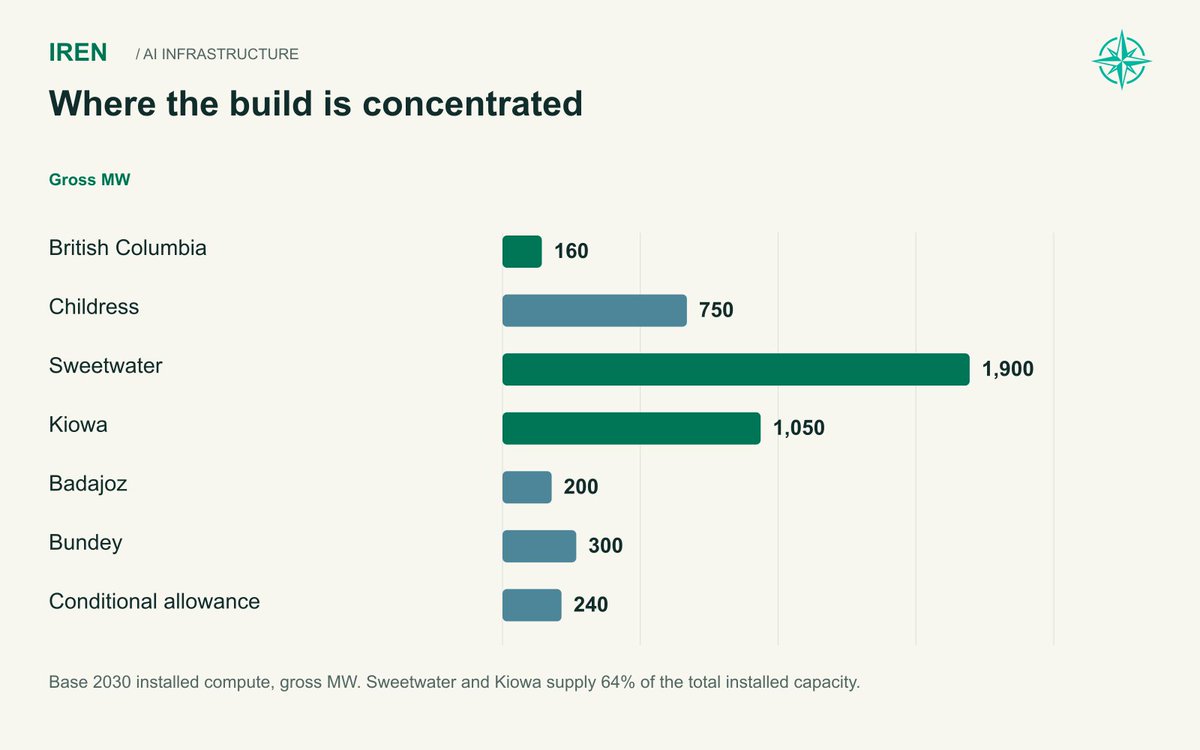
The site names I keep coming back to in our $IREN forecast are Sweetwater and Kiowa.
Together they account for about 64% of Base installed compute at the end of 2030. That makes their delivery and customer acceptance disproportionately important to the result.
A company-wide capacity headline can obscure that concentration. I would rather understand progress at the sites carrying most of the forecast than treat every announced megawatt as equally close to earning.