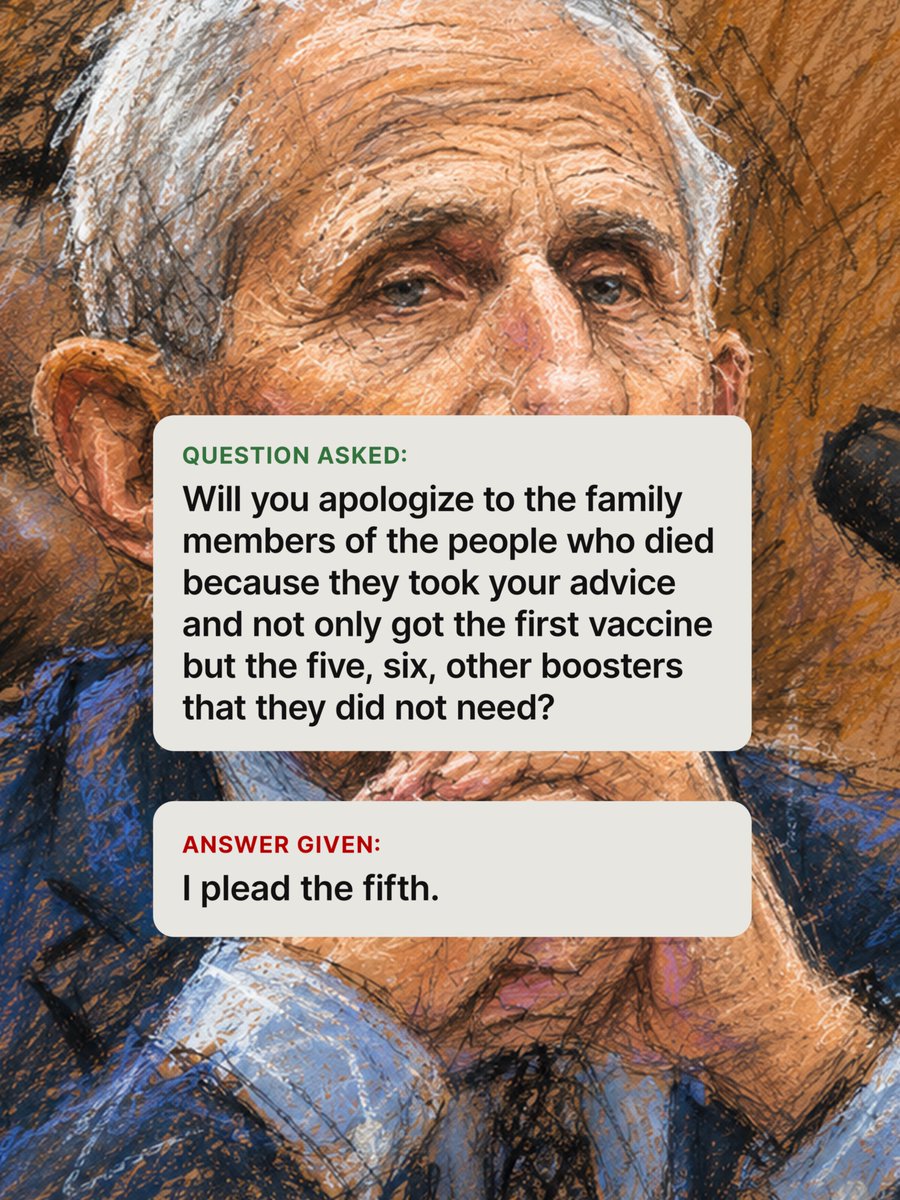
No testimony.
No explanations.
No answers.
Only the Fifth Amendment.
What this did, it showed the American people who he was.
The hearing wasn’t the trial. It was the exposure.
The investigations have begun.
Russian collusion.
The 2020 election.
Fauci.
The deep-state network.
What looked forgotten may have been under investigation the entire time.
Correctional Services Minister Pieter Groenewald says he stopped a bread tender where taxpayers were paying
R24.50 per loaf to a contractor who didn't even own a bakery. The contractor was subcontracting the bread for about R15 and pocketing around R1 million a month.
Groenewald launched a plan to make prisons self-sufficient by building internal bakeries. Now inmates bake their own bread for about R8 per loaf, and prisons are 97% self-sufficient.
Listen carefully …. Coronavirus research teams took the bodies of aborted babies and sowed their tiny fingers and scalps into the backs of mice, which then grew baby hair.
They were not and are not the “good guys”
🇿🇦SOUTH AFRICA’S R6.1 TRILLION DEBT BILL‼️
South Africa has borrowed another US$1.5 billion from the World Bank, approximately R24.7 billion, to support reforms involving electricity, freight transport, water and sanitation.
This is the fourth World Bank Development Policy Loan since 2022. It is not ring-fenced for a particular power station, railway line or water-treatment plant. It is general budget support released after government meets agreed reform conditions.
This latest loan did not create South Africa’s debt crisis. It merely adds another R24.7 billion to a debt story that has developed across every administration since 1994.
WHAT GOVERNMENT INHERITED
The democratic government did not inherit a debt-free country.
At the end of the 1993/94 financial year, gross national government debt stood at approximately R185 billion, equal to around 48% of GDP.
Most of that debt was domestic. The outgoing government had also agreed to repay the remaining US$4.5 billion covered by foreign-debt arrangements originating in the 1985 debt crisis.
That was the starting balance. What followed belongs to every administration that governed after it.
WHO ACCUMULATED THE DEBT?
• 1993/94 — Approximately R185 billion, or 48% of GDP. This was the debt inherited in 1994.
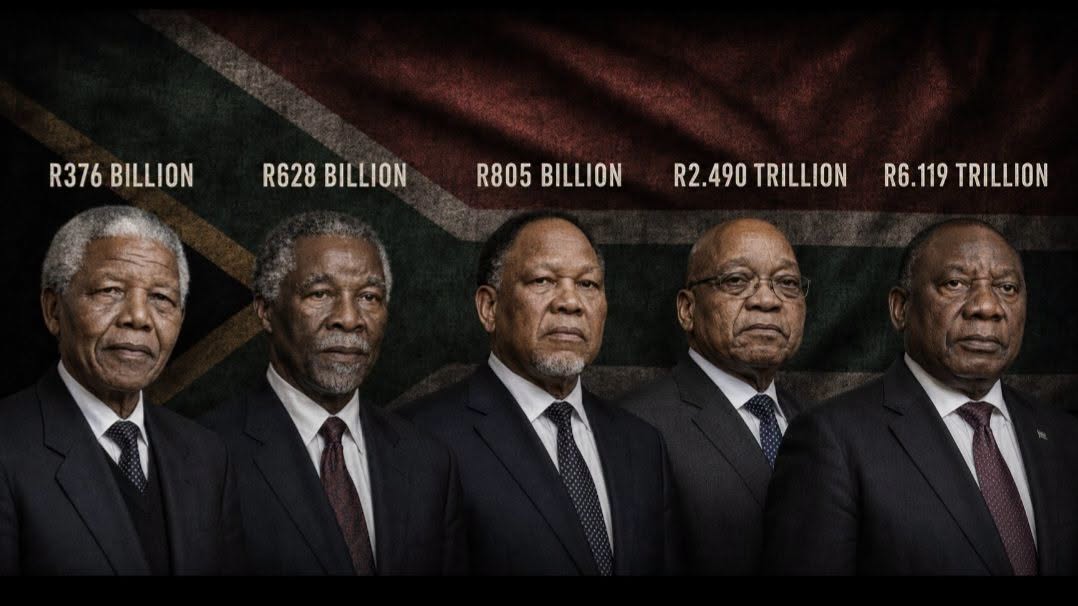
• 1998/99 — Approximately R376 billion, or 49% of GDP, under Mandela.
• 2003/04 — Approximately R510 billion, or 36% of GDP, under Mbeki.
• 2007/08 — Approximately R628 billion, or 27% of GDP, under Mbeki.
• 2008/09 — Approximately R805 billion, or 30% of GDP, during the Mbeki/Motlanthe transition.
• 2012/13 — Approximately R1.366 trillion, or 40% of GDP, under Zuma.
• 2014/15 — Approximately R1.799 trillion, or 41% of GDP, under Zuma.
• 2017/18 — Approximately R2.490 trillion, or 49% of GDP, during the Zuma/Ramaphosa transition.
• 2019/20 — Approximately R3.261 trillion, or 57.1% of GDP, under Ramaphosa.
• 2020/21 — Approximately R3.936 trillion, or 70.1% of GDP, under Ramaphosa during COVID-19.
• 2021/22 — Approximately R4.277 trillion, or 67.7% of GDP, under Ramaphosa.
• 2022/23 — Approximately R4.765 trillion, or 70.4% of GDP, under Ramaphosa.
• 2023/24 — Approximately R5.259 trillion, or 73.9% of GDP, under Ramaphosa.
• 2024/25 — Approximately R5.694 trillion, or 77% of GDP, during the Ramaphosa/GNU transition.
• 2025/26 — Approximately R6.119 trillion, or 78.9% of GDP, under Ramaphosa and the GNU.
• 2026/27 projection — Approximately R6.326 trillion, or 77.3% of GDP, under Ramaphosa and the GNU.
Under Mandela, debt almost doubled in rand terms, although it remained close to the same proportion of the growing economy.
Under Mbeki, debt continued increasing in rand terms, but stronger economic growth and improved revenue reduced the debt burden from around 49% of GDP to approximately 27%. This was the strongest period of debt consolidation after 1994.
The direction changed after the 2008 global financial crisis. Persistent budget deficits, weak growth, public-sector compensation, failing state-owned companies and rising interest costs drove debt steadily higher.
Under Zuma, gross debt increased from approximately R805 billion in 2008/09 to R2.490 trillion by 2017/18.
Under Ramaphosa, it increased from approximately R2.490 trillion to R6.119 trillion. COVID-19 caused the largest single-year increase, but the debt had already reached R3.261 trillion before the pandemic. Another R2.183 trillion was added after the worst COVID-19 financial year.
COVID-19 accelerated the crisis. It did not create it.
WHO LENT US THE MONEY?
South Africa did not borrow R6.1 trillion from one bank, one government or one country.
At March 2026:
• Domestic government debt: Approximately R5.490 trillion
• Foreign-currency government debt: Approximately R628 billion
• Total gross government debt: Approximately R6.119 trillion
Almost 90% was raised by selling domestic government bonds, Treasury bills and other financial instruments.
For every R100 invested in domestic government bonds during 2025:
• R25 was owed to foreign investors.
• R22.50 was owed to pension funds.
• R20.20 was owed to banks and similar monetary institutions.
• R23.70 was owed to investment funds and other financial institutions.
• R7.50 was owed to insurance companies.
• Approximately R1.10 was owed to other investors.
Foreign investors alone held approximately R1.065 trillion in rand-denominated government bonds. Describing these bonds as domestic debt does not mean every creditor is South African. It means the debt was issued inside South Africa, principally in rand.
Direct foreign lenders include the International Monetary Fund, World Bank, New Development Bank, African Development Bank, German KfW Development Bank, French Development Agency and the Government of Canada. International pension funds, banks, insurers, hedge funds and asset managers also hold South African government bonds.
Government therefore owes money not only to identifiable foreign institutions, but indirectly to millions of people through pensions, investments, insurance funds and bank deposits.
WHAT DO WE HAVE TO SHOW FOR IT?
Borrowing can be justified when it creates power stations, railways, ports, dams, roads and water systems that expand the economy and generate value for decades.
That is not what the national outcome shows.
South Africa extended electricity and water connections, delivered some housing, expanded social assistance and employed more public servants. Yet connections were expanded without adequately maintaining the systems behind them, housing demand still runs into millions, and social grants and government salaries remain recurring expenditure rather than productive assets capable of repaying debt.
After increasing gross national debt by approximately R5.934 trillion:
• Eskom required repeated bailouts and government debt relief.
• Freight rail and ports became obstacles to economic growth.
• Passenger rail infrastructure was allowed to collapse across large areas.
• Water interruptions, leaking networks, failing treatment works and sewage pollution became national problems.
• Municipalities developed enormous infrastructure and maintenance backlogs.
• Businesses and households increasingly pay privately for electricity backup, security, healthcare, education and transport after already paying taxes.
• Economic growth remained too weak to support the expanding debt.
Government can point to expenditure. What it cannot demonstrate is anything approaching R5.934 trillion in additional productive capacity, reliable infrastructure and economic growth.
We are now borrowing again to repair electricity, railways, ports, water and sanitation systems that previous taxation and previous borrowing were already supposed to build, operate and maintain.
THE INTEREST BILL
The R6.119 trillion is only the capital still outstanding.
Before government can spend money on policing, hospitals, schools, roads, water systems or infrastructure, it must service the debt accumulated by previous budgets.
Debt-service costs increased as follows:
• 2019/20 — R204.8 billion
• 2020/21 — R232.6 billion
• 2021/22 — R268.1 billion
• 2022/23 — R308.5 billion
• 2023/24 — R356.1 billion
• 2024/25 — R385.8 billion
• 2025/26 — Approximately R420.6 billion
• 2026/27 projection — Approximately R432.4 billion
During 2025/26, debt service cost taxpayers approximately:
• R35.1 billion every month
• R8.1 billion every week
• R1.15 billion every day
• R48 million every hour
• R800,000 every minute
That is principally interest and the cost of servicing the debt. It does not repay the entire R6.119 trillion capital balance.
When bonds and loans mature, government frequently borrows again to repay or refinance them. The old creditor is paid, a new creditor takes their place and the debt continues.
This is how a country can pay hundreds of billions every year without substantially reducing what it owes.
HOW LONG WILL WE BE PAYING?
South Africa’s debt has no single final repayment date.
The latest World Bank loan is approximately R24.7 billion and runs for 15 years. Government receives a three-year grace period on capital repayments, but “grace” does not mean free money. The debt exists immediately, interest is charged according to the agreement, and repayment of the capital has merely been postponed.
Government also has major foreign bonds extending decades into the future. Using approximately R16.50 to the dollar simply to illustrate their present rand value:
• Approximately R23.1 billion matures in 2032.
• Approximately R33 billion matures in 2036.
• Approximately R28.9 billion matures in 2037.
• Approximately R16.5 billion matures in 2046.
• Approximately R26.4 billion matures in 2052.
• Approximately R24.7 billion matures in 2054.
• Approximately R28.9 billion matures in 2055.
These bonds alone represent approximately R181.5 billion in capital at today’s illustrative exchange rate, before adding decades of interest. The eventual rand cost could be considerably higher if the currency weakens before repayment.
Even when those bonds mature, the national debt may not disappear. Government routinely issues new bonds and raises new loans to repay maturing obligations. The old creditor is settled, another creditor takes their place and the repayment date moves further into the future.
This is no longer temporary borrowing with a clear end. It has become a rolling national obligation, passed from one budget to the next and from one generation of taxpayers to another.
We are servicing debt accumulated by the governments before us. Our children will inherit the debt being created today, and their children may still be servicing the loans and replacement bonds used to postpone its final repayment.
The people authorising today’s borrowing may be long gone.
Generations of taxpayers will still be paying for it.
THE AUDIT FINDING
The ANC-led government inherited approximately R185 billion in gross national debt in 1994.
By March 2026, that had become approximately R6.119 trillion. By March 2027, Treasury expects it to reach approximately R6.326 trillion.
South Africa is now paying more than R1.15 billion every day largely in interest and debt-service costs, while the capital remains and government continues borrowing.
That money cannot simultaneously repair water systems, employ police officers, maintain roads, rebuild railways or improve hospitals. Taxpayers must first pay for yesterday’s expenditure before funding today’s needs.
The problem is not simply that government borrowed.
The problem is that borrowing repeatedly exceeded the productive capacity created with the money.
Economic growth remained weak, essential infrastructure deteriorated and the tax base did not expand sufficiently to carry the burden.
We are borrowing more than the country can comfortably support, while producing far too little evidence that the expenditure is building a stronger and more productive South Africa.
The debt remains.
The interest grows.
The infrastructure must still be repaired.
Our children will inherit the repayments, and their children may still be servicing bonds issued to cover money being spent today.
Written by Shaun Schutte
28 July 2026
White House releases a website documenting whatever we have been saying for 6 years 🔥
Covid was Manmade Bioweapon.
Social distancing and mask rules were made up.
People who exposed this were censored by diffrent Govts and Big Tech Companies.
This should be the biggest news story on the planet right now.
Rand Paul Goes SCORCHED EARTH on Dr. Fauci in FLAMES ON Opening Statement
-Fauci knew COVID came from a Chinese lab
-Funded gain-of-function research
-Directed officials to delete incriminating emails
-Knew masks weren't effective
-Lied under oath
-Declared "I am the science"
Fauci's pardon won't protect him if he lies to Congress today.
When Nelson Mandela was inaugurated in 1994, South Africa's national finances were in remarkably good shape.
The Rand sat at R3.50 to the US Dollar, and both a South African passport and an average middle-class income carried real weight internationally.
Government debt stood at just 13.5% of GDP, the state owed almost nothing to foreign creditors, handing the new democracy complete fiscal independence and enormous room to invest in building a strong, modern state.
Skip ahead to 2026. Following years of state capture, cadre deployment, and repeated bailouts of failing state enterprises like Eskom and Transnet, that debt to GDP figure has climbed past 75%.
South Africa now spends more on servicing its debt than it does on healthcare or law enforcement.
Rather than channeling that borrowed money into factories, schools, or infrastructure like high-speed rail, the funds went largely toward inflated salaries for politically connected insiders, while the country's physical infrastructure was left to decay.
Today’s episode will be positively explosive.
Might even free a young man who is being wrongly framed for the murder of Charlie Kirk.
Note the people who sold you Fed slop. They are going to have a terrible, terrible week.
🚨 BREAKING NEWS: Senator Nancy Schaefer Exposed it. Then She was Dead! 🚨
“All 50 states are involved
in government-subsidized child trafficking.
It is the largest and most pervasive child trafficking ring in the history of the world.”
Federal bonuses for removing kids.
Adoption incentives written into law.
Hundreds of thousands of children investigated… most never found to be abused.
Thousands missing from the system every year.
She named the machine.
She lost her seat.
Then she and her husband were found dead.
Official story: murder-suicide.
Many still ask: why?
Why does the system get paid more when children are taken than when families are kept together?
Why do so many “protective”
removals leave kids worse off?
Who really benefits when
a child becomes a number
and a paycheck?
The truth doesn’t care
if it’s convenient.
Share this before
they bury it again.
Read through
the responses,
engage Thoughtfully,
ask Questions,
challenge ideas Respectfully,
and contribute to
Meaningful,
productive
Discussion.
Let me know
what You think,
and SHARE THIS
so that others
may do the
same!
Tag 5 friends
that need to see this.
Quote post this
with Your thoughts.
Bookmark for later
to see what others thought.
And if
You're not
already following
@TrueOnX...
What the
absolute heck
are You doing?!
Please spread this survey FAR and WIDE so that it's seen by every Gov't official!
Do you want Arrests, Military Tribunals & Punishment for all involved in Covid crimes against humanity, those involved in chemtrails & ALL traitors to the Republic in the Media and our Gov't?