Full-time job by day. Nights and weekends I build a group-trip app with AI bots, for the fun of figuring things out. Sharing what works and what broke.🌈✈️♊
Data engineer by day, used to big teams with clear lanes and people covering each other's blind spots.
After work, I'm on a team of two building a group-trip app, so I'm frontend, backend, DevOps and PM.
With AI agents, we've merged 700+ PRs since Sept. Here I share what works.
Maybe I'm not ambitious enough to be a so-called "founder." I'm not really earning anything from my project yet, and honestly, I just find it really fun to build things myself.
Working in a small team isn't only about starting a new business.
It's about pushing myself to test out new LLM models and build a workflow that's stable enough to support everyday development. It's about trying new things I've never tried before—thinking about who my customers should be, and what I'm really building.
The process of designing the product was fun. Pivoting to a different direction was also fun. Learning about product distribution channels is both fun and hard, and trying to build in public has been completely new, yet interesting.
The funny thing is, after being curious and exploring on my own, I often end up using the same common solutions others already offer.
Every time I start something new, I always want to make it perfect—thinking that if I directly copy someone else, I'll be able to get a target-state design right away. But it doesn't work like that for me.
I'm not a learner like that. I learn by thinking about the problem myself and figuring out the solutions myself. My version might be different from the general solution, or not the most optimized one—but I know how it works, I know what to optimize, and I know if I should optimize it.
Probably "founders" don't need to be ambitious, and I really enjoy how I feel right now—being as curious as a kid, facing problems, and experimenting with the solutions.
@liveswarm Good call. A report without the SHA can still look fresh after main has moved on, and the agent has no way to tell. Do you rebuild yours on every push or on a timer?
Most multi-agent coding setups waste half their tokens on status checks. Every time you ask "what's going on?", the agent re-scans open issues, PRs, and CI logs from scratch.
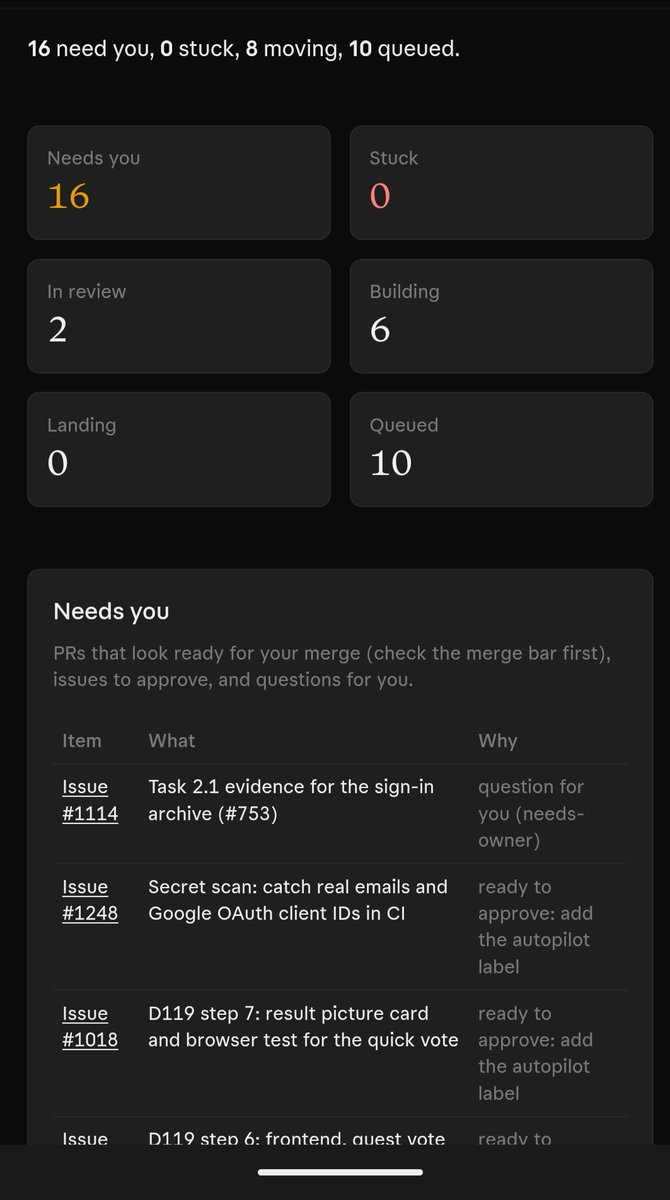
I fixed it with one boring rule: both my agents and I read the exact same hourly report.
A watchdog job on my Mac Studio (triggered via GitHub Actions and scheduled hourly in Claude) compiles the state once. Now when I'm on vacation—or an agent needs context—we both look at the same snapshot instead of polling GitHub.
294 PRs merged in 14 days (~40/day), 131 features archived, and the only thing waiting on me is adding an autopilot label to a CI secret-scan issue.
@thedelost Layer 5 changed the most for me. The bot that builds and the bots that check are separate, and the checkers can only comment on the PR. They can't edit code. A failed check stays on the PR until the builder fixes it, and risky merges still wait for me.
@distortgeekin The setup layer that helped me most is a plan gate: Opus writes the plan on the issue, I approve it, then Sonnet builds. A wrong plan is cheaper to catch than wrong code. Where does human approval sit in your 9 layers?
@GergelyOrosz Seeing both already. I moved CI to six self-hosted runners on a Mac Studio. For verification: I don't read code, so a skill clicks through the real flow like a user before anything counts as done.
AI is great for pulling research together faster or polishing a rough structure. It can't fake actually caring about what you're writing.
Lately my timeline has been flooded with accounts automating the exact same takes at the exact same hour just to farm X creator rewards. They get the reach; readers just lose time 🙃
Went on a muting spree recently and my feed immediately felt human again. Still really appreciate the people who actually spend hours crafting what they share.