Running with this:
If the Schwarzchild observer sees anything coming at them from low radius, that thing is coming from the WH region. So, in a sense, this observer sees only the white hole. But, if they were to consider which object (the white or black hole) is contemporaneous
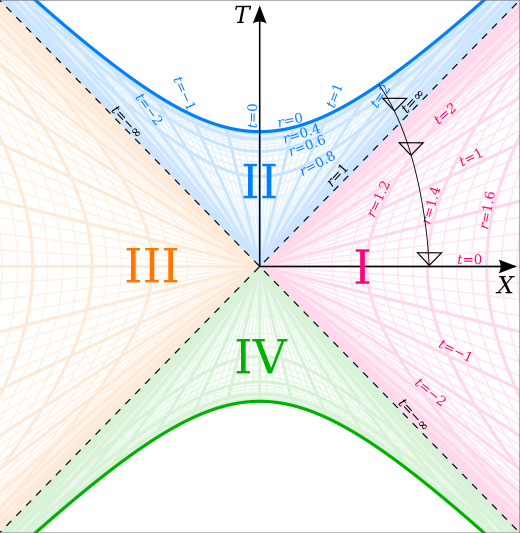
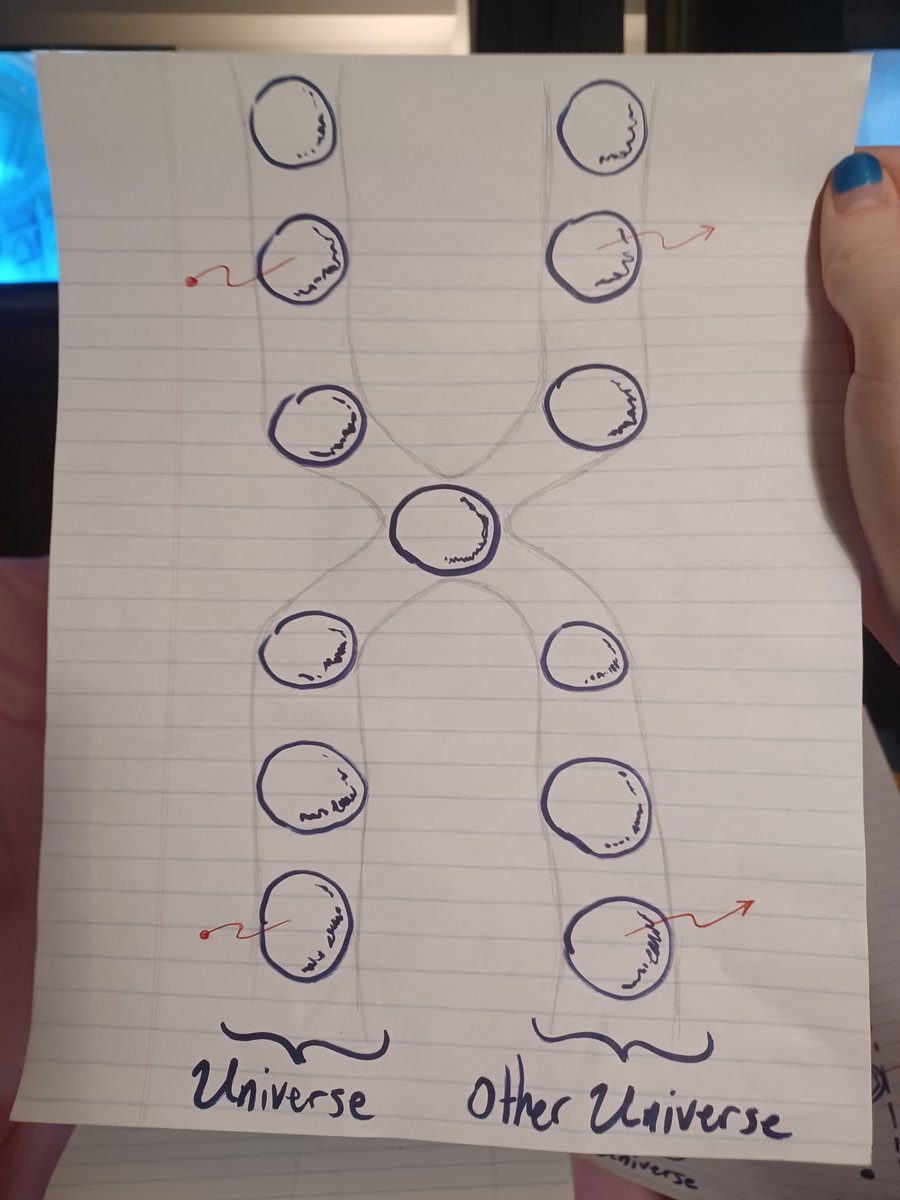
notice that the Nexus of Time (all the bubbles in my doodle, technically) is outside the Schwarzchild patch. In fact, the KS diagram gives the impression that this Nexus lies on *every* Schwarzchild time slice. This suggests to me that the Killing field is zero there?
@dibiagioandrea You are right. I don't know if this was worth saying. But I need to build some intuitions about the spacetime. I guess its always safer to ask only what a particular person sees; i.e., which null curves they meet in which order along their worldline.
@TimHenke9 I'm using a vague notion that certain coordinates are 'suitable' to an observer or vice versa, and this doesn't really make sense, so neither does my train of thought here.
But conversely, I don't exactly know what your concern is, that the horizon is labeled (r,t) = (1, infty)?
@TimHenke9 so presumably, anyone born in the middle of spacetime, using coordinates for which their worldline is (t,0,0,0), gives finite coordinates to both holes. (every comment in this whole thread comes with '?')
@Unsubstantive Wiki tells me a stationary spacetime has a killing field which is merely *asymptotically* timelike. So Schwarzchild is stationary, but it doesn't mean what i thought.
Ok back to the Kruskal-Szekeres diagram. Recall that a whole spherical degree of freedom is being supressed. If I try to reintroduce this DoF via doodle, we get this doodle:
@TimHenke9 Makes sense. The upshot is that I have absolutely no confidence anymore that this is true:
https://t.co/ibLrOyCMBg
I thought it would be nice if the infinities in Schwardchild's coordinates were attributable to him being infinitely remote, but well that doesn't really matter.
@TimHenke9 so presumably, anyone born in the middle of spacetime, using coordinates for which their worldline is (t,0,0,0), gives finite coordinates to both holes. (every comment in this whole thread comes with '?')
Okay here's another question. Does it require acceleration (ultimately, toward lightspeed) to prevent falling into the BH?
I notice that a timelike curve which avoids the BH must asymptote to the 45°. However,
Ok back to the Kruskal-Szekeres diagram. Recall that a whole spherical degree of freedom is being supressed. If I try to reintroduce this DoF via doodle, we get this doodle:
@TimHenke9 is there not a geodesic travelling away from the BH with "escape velocity"? Slowed by its gravitational influence, but so as to only reach 0 speed 'at infjnity'?
I am currently on leave from my PhD program, and I am trying to limit the degree to which I am thinking about math or physics, but anyways I wanted to revisit GR because I am confused about White Holes.
I am too scared to take the coordinate diagram very serious. Does two curves being asymptotically tangent *in a coordinate system* mean that their velocities are approaching equality?