In this Online Article, Lauren K. Hirsh (UChicago Law '24) argues that courts today should consider whether interference with an auction by directors and officers ultimately leads to a better substantive result that benefits shareholders.
https://t.co/3pz0QvFIMA
Congrats to our 17 members graduating this weekend, 8 of which doing so with Honors! Thank you for your work with the Journal, and best of luck in the future!
Venture DAOs are reshaping the venture capital landscape by introducing an innovative approach to startup financing. In this article, Ivan Fan (JD '23) delves into the distinct characteristics of these decentralized funding mechanisms.
https://t.co/El78hkqsEW
Scott Andrzejewski '24 provides an overview of the legal claims contained in antitrust complaints filed against Ticketmaster regarding ticket sales for Taylor Swift's "Eras" tour. #antitrust#businesslaw
https://t.co/D5oiLJmFOG
Professor Allen Ferrell (@Harvard_Law) discusses how approaches to calculating ‘fraud on the market’ 10b-5 damages have evolved from the 1970s to the present in his article, Hidden History of Securities Damages.
https://t.co/QRUWLd9fTC
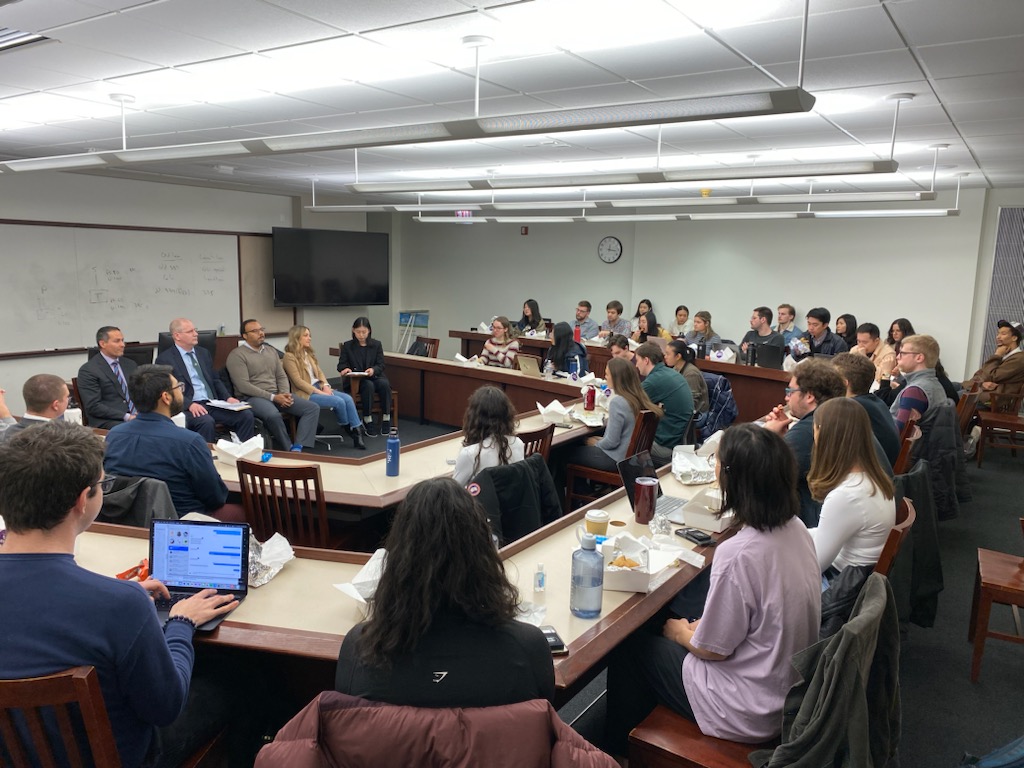
Thank you to our sponsors @lathamwatkins , @BTLawNews , @CooleyLLP , and @PaulWeissLLP for joining us today for our second installment of our Quarterly Professional Development Series, “How to Succeed as a Litigation Summer Associate” at @UChicagoLaw
Professors Albert Choi (@ProfAlbertChoi, @UMichLaw), A.C. Pritchard (@UMichLaw), and Stephen J. Choi (@nyulaw) propose and examine a novel mechanism to improve the securities class action system: allowing a company’s shareholders to vote on class actions.
https://t.co/Hq904ruKel
The article primarily focuses on the policy and legal issues surrounding FTX’s recently withdrawn proposal for a non-intermediated, non-mutualized, and margined clearing model.
In our newest online post, Joshua Nathanson '23 discusses the feasibility of recent proposals to eliminate intermediaries in U.S. futures markets.
https://t.co/DCruzAHWTp
The article focuses on five corporate research areas: (i) takeover policy and rules; (ii) contractual freedom in corporate law; (iii) state competition in the provision of corporate law rules; (iv) efficiency and distribution in corporate law; and (v) corporate purpose.
Professor Lucian Bebchuk (@Harvard_Law) discusses the relationship between his work and Frank Easterbrook and Daniel Fischel’s writings in his article, Competing Views on The Economic Structure of Corporate Law, available in our inaugural issue. https://t.co/RhAAR0N1M8
Awesome insights by our Executive Comments Editor, Laryssa Bedley, on how membership on Business Law Review made her successful in her search for the right law firm.
@UChicagoLaw@lathamwatkins
https://t.co/SlL4TXbC51
The Article argues that Easterbrook and Fischel failed to contend with the real-world realities that allow investors to profit by shifting distributions and political power to themselves, while shifting costs and risks to workers, creditors, consumers, and taxpayers.
The Win-Win That Wasn’t, by Professor Aneil Kovvali (@AKovvali, @IUMaurerLaw) and former Delaware Supreme Court Chief Justice Leo E. Strine, Jr. (@pennlaw) is available online and in print in Volume 1 of the University of Chicago Business Law Review. https://t.co/X2ejRLTGZK
The Article challenges Easterbrook and Fischel’s assertion in The Economic Structure of Corporate Law (1981) that making societally important corporations govern to the whims of the stock market is a win-win for investors, other corporate stakeholders, and our society as a whole.
Finally, it considers the role of the shareholder proposal rule in offering a mechanism for shareholder debate over corporate purpose. The Article is available online and in print in Volume 1 of the University of Chicago Business Law Review.
Professor Jill E. Fisch’s article, Purpose Proposals, explores how the shareholder proposal rule, Rule 14a-8, may serve as a tool for repurposing the corporation. https://t.co/eaF0GaalHA
The Article provides the first analysis of purpose proposals. It presents data on the introduction of these proposals and the extent to which they have commanded shareholder support. It interrogates the justifications for the proposals offered by their proponents.