@AmitSegal@HakanFidan After all Israel has done for Turkey all these years. After all the appeasement and trade relations. After suffering the indignity of not recognising the Armenian genocide. it’s the only instance I will say Israel deserves this. It’s an education
As Hannah Arendt warned, one of the harbingers of totalitarianism is precisely this: the alliance of the mob and the elite, the collapse of critical distance, the unification of street and salon under a shared delirium of certitude. This is why the academy cannot diagnose the present moment. It is too implicated in its antizionist hysteria. Its members are not observing from a distance, but marching, chanting, signing, and branding themselves with the same accusatory symbols they once taught their students to deconstruct.
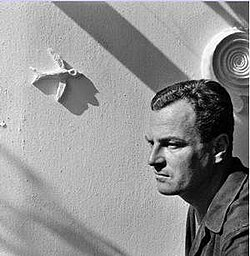
Sir Patrick Leigh Fermor DSO OBE, one of the last of the SOE’s legendary agents, slipped away at the age of 96.
Like Lord Byron before him, he was soldier, scholar, and wanderer - a man who lived life to the full. Both men stood fiercely for Greece. Both swam the Hellespont. Both became cherished adopted sons of that ancient land...
Upon his tombstone, the Greek inscription reads with quiet perfection: “In addition, he was that best of all things, Hellenic.”
@spigaro Έχει δίκιο η γιαγιά βασικά. Συγχαρητήρια στο κορίτσι, δεν είναι μικρό επίτευγμα. Απλά δεν έχει σχέση με την αληθινή ζωή που θα κληθεί να ζήσει από εδώ και στο εξής
Of all the interesting and bizarre revelations to emerge in the aftermath of Epic Fury, one of the most striking was that Turkey—NATO’s second-largest military—was apparently inclined to join the conflict on the side of Iran. According to Donald Trump, Turkey’s President Recep Tayyip Erdoğan “was a prime candidate to go into the war with Iran—maybe on the Iran side.”
“I asked him to stay out. He stayed out,” Trump told reporters in the Oval Office.
There was never any sign of a Turkish military buildup for such an attack, so Trump may simply have been going off the Turkish president’s violent rhetoric. Just two days ago Erdoğan openly declared that he and his nation are in a struggle against Zionism, labeling it a “genocidal, occupying, expansionist ideology” that he claims “threatens not only me, not only our party, not only our alliance—it threatens everyone.”
In response, Israel has moved to recognize the Armenian Genocide—a backhanded slap at a Turkish government that still denies its role in massacring the Armenian population during the First World War. (For a great history of the period, check out The Thirty-Year Genocide.) It may sound like an obvious moral call, but it’s worth remembering that for the better part of thirty years Israel was one of the reasons the world dragged its feet. Nobody in Jerusalem actually doubted that the slaughter of 1.5 million Armenians was genocide—they just decided Turkey mattered more. And for a long time it did: Ankara was Israel’s closest friend in the neighborhood and one of only two Muslim-majority allies it had.
In 1997, Israel nominated Ehud Toledano—a respected Ottoman historian—as ambassador to Ankara, assuming the appointment would sail through. Then Turkey balked, citing a 1981 Army Radio segment in which Toledano had supposedly “accused Turkey of massacres,” and refused to accredit him. The absurd part is what that broadcast actually was: he’d been brought on at the last minute to explain Turkey’s side after the Turkish embassy itself declined to send anyone. With the Israel-Turkey alliance entering its golden age of arms deals and intelligence sharing, Jerusalem wasn’t willing to fight over an ambassador—and quietly let the nomination die.
The reflex reached Washington, too, where Israel leaned on pro-Israel lobby groups to keep recognition off the table. When a recognition resolution came before the House Foreign Affairs Committee in 2007, AIPAC, the ADL, and the AJC pressed lawmakers to bury it before it ever reached the floor.
So what changed between then and now? It’s not complicated: Israeli-Turkish relations collapsed. Erdoğan grew militantly anti-Israel and dragged Turkey in an increasingly Islamist direction. By 2021, when the Biden administration recognized the genocide, the move was welcomed by the very same lobby groups that had once opposed it.
We’re now at a low point in the relationship—one that has drifted past diplomatic grandstanding into the surreal. Over the past two years, Ankara has severed bilateral trade and barred Israeli ships from its ports, while Erdoğan floats barely veiled threats of military action, likening a potential move against Israel to his operations in Karabakh and Libya. He has even peddled a “Promised Lands” conspiracy to his own parliament, warning his base that Israel—a country of 9.5 million already bogged down in a multi-front war—is plotting to march on the Anatolian heartland.
Beneath the theater, though, is a real shift: as Iran’s proxy network degrades, Turkey is positioning itself as the region’s new superpower and, reasonably enough, treating Israel as its main rival for dominance across the Levant. Israeli planners warn that a hollowed-out Damascus could slide into a Turkish proxy state, putting Turkey’s military on Israel’s northern doorstep. Ankara is already fielding air defenses in northern Syria that constrain IDF freedom of action and angling to station forces in a postwar Gaza. How Erdoğan plans to square all this with membership in a Western defensive alliance will be interesting to watch—and I’d keep my eye on the NATO summit in Ankara next week.
But back to the recognition.
Unfortunately, none of this is going to win Israel many friends in Yerevan and I don’t blame them. Armenia has not been a close friend for decades, and the relationship has only curdled—Yerevan recalled its ambassador in 2020 over Israeli arms flowing to Azerbaijan, and in June 2024 it formally recognized a Palestinian state.
For his part, Erdoğan hasn’t hesitated to brand every Israeli action as the worst of all crimes: after the strikes in Lebanon, he called Israel’s activity there and in Syria part of a “blood-stained genocide network.” So I understand the impulse to finally name a real crime against humanity, but this is hardly motivated by a higher calling.
My take: the Armenian Genocide deserves recognition on its own terms—not as a card to be played against Ankara. We’d be rightly outraged if anyone treated the Holocaust that way, and after two years of watching exactly that happen, we should know better than to turn another people’s tragedy into a bargaining chip.
Michel Bacos was an Air France pilot, flying Flight 139 from Athens to Paris on June 27, 1976, when the airplane was hijacked by Arab and German terrorists. At gunpoint, Michel was forced to divert the plane, ultimately landing at Entebbe in Uganda with only 20 more minutes of fuel left.
The terrorists freed the 148 non-Jewish passengers, and also released the airline crew. However, Michel refused to leave the 94 Jewish passengers still kept captive, and the other crew members followed their pilot’s lead and stayed with the hostages. Michel said, “I was a captain of Air France and before that I was in the Free French Forces under Charles DeGaulle during the Second World War – it would be impossible for me to leave my passengers, unimaginable. I told my crew that we must stay until the end because that was our tradition, so we cannot accept being freed. All my crew agreed without exception.”
Several days later, most of the Jewish hostages were rescued during a bold raid by Israeli commandos led by Yonatan "Yoni" Netanyahu. During the raid, known as Operation Yonatan (Operation Entebbe), Michel suffered a concussion.
Michel was immediately hailed as a hero for staying with his Jewish passengers, even at severe risk to his own life. He was awarded the National Order of the Legion of Honour, the highest decoration in France, by the French president. The Israeli government awarded Michel and his crew medals for heroism. He was honored with other awards and commendations by grateful Jewish groups.
Michel retired from Air France in 1982, and spent the remaining decades of his life in Nice, with his wife and many children and grandchildren. When he died, in 2019 at the age of 94, to his request he was laid to rest while the Israeli anthem "HaTikvah" was played.
He was saluted in France, Israel and around the world. In the midst of a murderous nightmare, the captain was a shaft of light.
The mayor of Nice said during Bacos' funeral: “Michel, bravely refusing to give in to anti-Semitism and barbarism, did honor to France. The love of France and the defense of liberties have marked his destiny.”
The white population of China is less than 0.01%.
It should be 20%.
A white woman should be able to be Chinese emperor, Marxist-Leninist dictator, or President of the Chinese Communist Party.
Yet this has not happened.
China must embrace diversity and stand against racism.
@lifomag Αφήστε τις αηδίες. Το κτίριο είναι ιδιωτικό και ο ιδιώτης θέλει να το κάνει φαρμακείο. Οι προτιμήσεις μας δεν έχουν σημασία εκτός κι αν είμαστε εναντίον της ιδιωτικής περιουσίας. Οι πόλεις είναι ζωντανές και αλλάζουν συνεχώς. Θα βρεθεί κάποιο άλλο οίκημα να στεγάσει τις μνήμες