A doctor—who had just treated a sixteen-year-old boy released from an interrogation center—said: I want to ask the fortune-tellers: Did anything in his line of Fate reveal that the webs of his hands would be cut with a knife?,
~Agha Shahid Ali
The country without a post office.
An Indian film company has announced a film mocking scores of Kashmiri teenagers blinded by pellet guns in 2016. I wrote an essay on it at the time. Assuming people still read long form in the age of hate cinema.
https://t.co/UILQKZg2Zy
We are organizing an intense 10-day summer school for new PhD/master's students in computational genomics & metagenomics at IISER Pune (July 18th-27th, 2026) - please do spread the word! https://t.co/HMDn7RWWnb
These photos were taken on 1stApril 2018,when I visited Tulip garden with my family.That day is forever etched in my heart, not for its beauty,but for the pain we carry.We lost the real tulips of our garden that day
May Allah accept their martyrdom & have mercy on their families.
Piracy ke khilaf jung tab ladi jati h jab desh ameer ho. Bhai kisi ghareeb ka baccha 1-2 kitaab padh lega toh kya dikkat h. Importing first world priorities to third world countries.
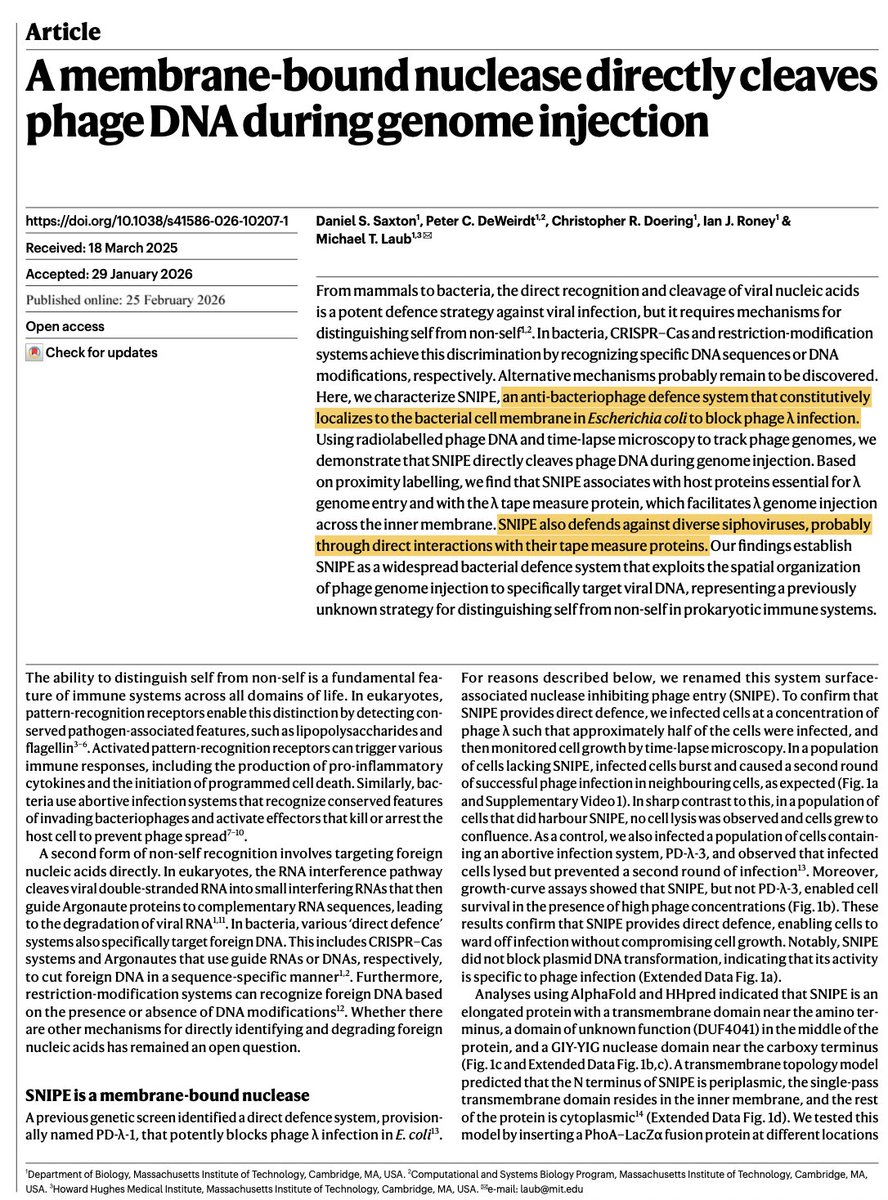
Some microbes carry a protein, called SNIPE, that "chops up" phage DNA as it's being injected into the cell.
This is a new mechanism for phage defense! CRISPR–Cas and restriction enzymes also evolved to fight against phages, but they work by recognizing sequences. SNIPE works, instead, by sensing "touch."
SNIPE is a protein with about 500 amino acids. After it's made by the ribosome, it latches onto ManYZ, two proteins which sit on the cell's inner membrane. (ManYZ is an importer; it brings mannose and other sugars into the cell.)
Once attached to ManYZ, SNIPE sits and waits for an invading phage. Some phages, including lambda, actually infect cells by pushing their DNA through this ManYZ channel. Lambda uses its "tail" to reach inside the protein channel, basically, and inject its DNA.
When this physical touch happens, though, SNIPE is waiting. As soon as the phage DNA starts entering the cell, and passes through ManYZ and SNIPE, it gets immediately destroyed.
This means that SNIPE is the first phage defense system discovered, so far, that uses spatial positioning at the injection site to destroy invaders.
But there are caveats, of course. If you untether SNIPE from ManYZ, such that it can freely diffuse through the cell, it will chew up the bacterium's genome. It is not a highly discerning nuclease! Also, SNIPE is not found in most bacteria. A prior pangenome study, which sequenced lots of different microbes, found that roughly a third of well-studied bacterial lineages had at least one member with a SNIPE-like protein. (For this paper, they just ported one of those homologs into an E. coli laboratory strain.)
And finally, because SNIPE's mechanism is tightly tied to ManYZ, it cannot be used to defend against phages that enter the cell through different routes. T4 phages, for example, inject their DNA straight through the cell membrane and into the cytoplasm, without interacting with ManYZ.
This is a nice basic science paper. Applications TBD. (Just remember that scientists figured out that bacteria had a phage defense system, called CRISPR-Cas, many years before it was repurposed into a gene-editing tool.)
P.S. The video below shows how cells with the SNIPE gene (middle row) kill invading phages, and thus continue growing and dividing. Empty vector (top row) refers to bacteria carrying a plasmid with no SNIPE gene; this is a control group. And SNIPE E414A refers to cells which received a mutated SNIPE gene, where the glutamate at position 414 has been changed to an alanine, thus destroying the protein's nuclease activity. These cells also die when they get infected with a phage.
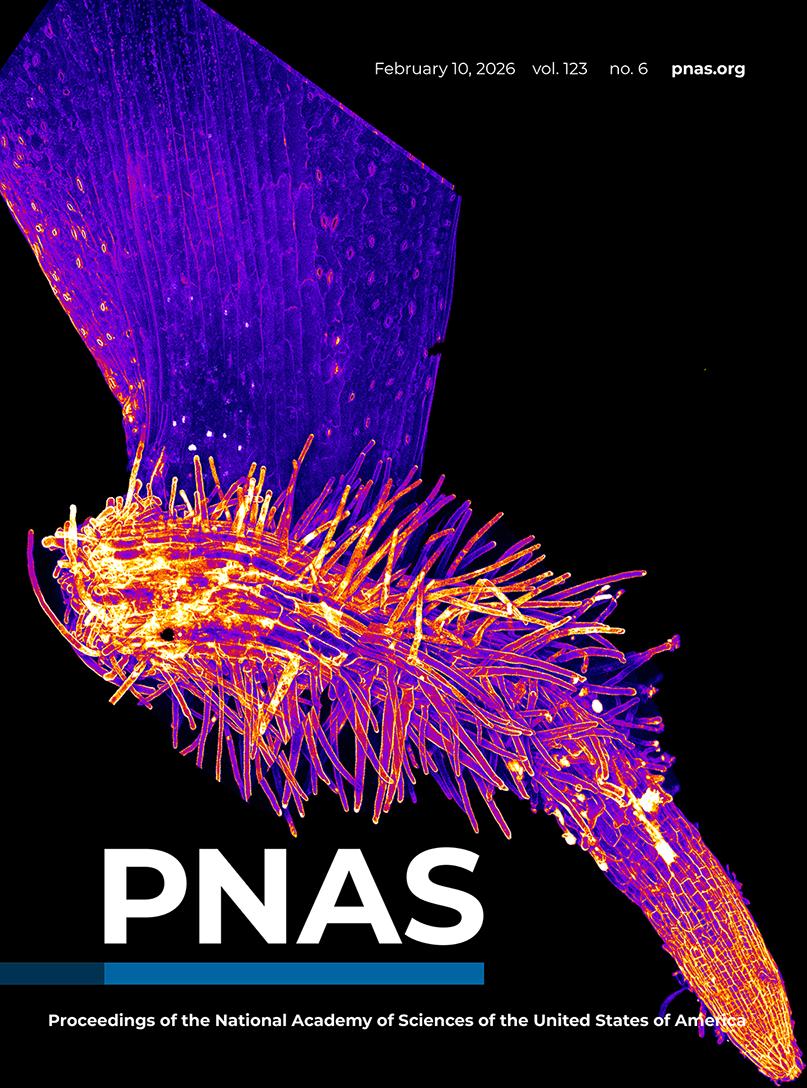
Now on the Cover @PNASNews, Delightful to see @ganguly_akansha Journey from stress to regeneration, from leaf to root featured on cover. Akansha, you made it, very well done, congratulations.