I’m significantly older than you. I started coding in the late 60s. My current strategy is to not read any of the code written by my agents. That’s the only way I can take advantage of their productivity. What I do instead is to surround the agents with extreme constraints. Unit tests, gherkin tests, QA procedures, quality metrics, mutation testing, test coverage, and a plethora of others. In the end, I have very high confidence in the code they produce because they’ve had to run the gauntlet of all of my constraints and tests.
China open-sourced a peanut-sized OCR that parses entire 100-page PDFs in one shot..
It's called Unlimited-OCR. Only 3B params. Runs locally.
Every other OCR tool chops your doc into pages and loses the thread. this one reads the whole thing in a single pass.
→ One-shot "long-horizon" parsing (32K context window)
→ Multilingual, out of the box
→ 93% on the standard parsing benchmark (+6 over baseline)
→ <0.11 error rate past 40 pages
→ Runs 100% locally on your own hardware
→ Works with Transformers, vLLM, SGLang, Docker, Ollama, llama.cpp
Traditional cloud OCR (Textract, Google Vision, Azure Doc Intelligence) costs $1.50–$15 per 1,000 pages.
This runs on your machine. For free. Forever.
Baidu built it explicitly to push DeepSeek-OCR one step further. Already at 1.9M downloads on Hugging Face and most people have no idea it exists yet.
100% open source.
Özellikle "Odyssey filmine gideceğim ama hikâyeyi hiç bilmiyorum" diyenler için iyi bir başlangıç videosu: Odysseus'un çileli hikâyesinin baştan sona felsefi derinliğiyle birlikte anlatımı, Luc Ferry'den.
Çok eskiden yayınladığım bu videonun çevirisini bugün tekrar elden geçirdim. Yeni versiyonu daha derli toplu oldu.
İyi seyirler :)
BAŞYAPIT BİTTİ....
Bilimkurgu tarihinde 12 Monkeys kadar her sezon üstüne koyarak giden, ilmek ilmek ördüğü o devasa paradoksu finalde bu kadar kusursuz, açık kapı bırakmadan ve duygusal olarak paramparça ederek bağlayan çok az dizi vardır bence.
What people call "illegal distillation":
Paying proper API fees to use an AI, asking it a massive set of questions, and then combining the answers into a structured dataset.
Am I the only one who fails to see anything wrong with this?
I just built my own coding harness, just like Claude Code. (100% open-source)
A harness is the code wrapped around an LLM. The model only decides the next step, and the harness handles everything else, planning, tools, memory, and safety.
In simple words model acts as the brain and the harness provides the hands.
A coding harness is that same wrapper pointed at a codebase. It turns a plain text generator into something that reads files, edits code, runs tests, and fixes real bugs.
Here's everything that went into mine:
- the core agent loop
- file tools that double as external memory
- planning for long-running tasks
- subagents that work in their own context
- sandboxed execution in a throwaway VM
- human-in-the-loop approval
- persistent memory and checkpointing
The whole thing is built on CrewAI, a 100% open-source framework.
I also wrote an article on this. It covers everything that goes into building a coding harness, the agent loop, planning, subagents, sandboxing, memory, and checkpointing, built step by step.
The article is quoted below.
NVIDIA, son nesil 5 Çin yapay zekâ modelini ücretsiz kullanıma açtı.
Kredi kartı yok.
Abonelik yok.
Tek ihtiyacınız olan şey, tüm modellere erişim sağlayan tek bir API anahtarı.
Üstelik maliyet: 0 dolar.
Erişebileceğiniz modeller:
→ DeepSeek V4 Flash: Ultra hızlı çıkarım (inference) için.
→ MiniMax M3: Tak çalıştır kodlama asistanı olarak.
→ Qwen3.5 397B: Gelişmiş muhakeme gerektiren görevler için.
→ Kimi K2.6: Yapay zekâ ajanları ve uzun iş akışları için.
→ GLM 5.1: Günlük kullanım için güvenilir genel amaçlı model.
Her model için ayrı abonelik ödemeniz gerekmiyor.
Mevcut iş akışınızı veya kullandığınız araçları değiştirmenize gerek yok.
OpenAI uyumluluğu sayesinde vendor lock in sorunu yaşamıyorsunuz.
Başlamak 2 dakikadan kısa sürüyor:
https://t.co/HyUpCNtO8I adresine girin.
Hesap oluşturup doğrulayın.
NVAPI Key oluşturun.
Base URL olarak https://t.co/bZcT7jhVgH adresini ayarlayın.
İstediğiniz modeli seçin ve kullanmaya başlayın.
Desteklenen modeller:
• MiniMax AI → MiniMax M3
• Qwen → Qwen3.5 397B A17B
• Moonshot AI → Kimi K2.6
• Zhipu AI → GLM 5.1
• DeepSeek → DeepSeek V4 Flash
İpucu:
→ Hız için DeepSeek V4 Flash
→ Zor muhakeme görevleri için Qwen
→ Yapay zekâ ajanları için Kimi
→ Günlük kodlama için MiniMax M3
En dikkat çekici kısmı ise şu:
Tek bir ücretsiz API anahtarıyla NVIDIA kataloğundaki 100’den fazla yapay zekâ modeline erişebiliyorsunuz.
Dakikada yaklaşık 40 istek sınırı, çoğu geliştirici ve kişisel proje için yeterli seviyede.
GPT ve Claude ile rekabet eden 5 gelişmiş model, tamamen ücretsiz kullanılabiliyor.
Kaydedin. Kullanım limitleri değişmeden ücretsiz API anahtarınızı alın.
📢 Özgür Özel:
⭕ "Ben Hulusi Akar’a demiştim ki 'Sana silah arkadaşların hakkını helal etmiyor'. Bana dava açmıştı, 7 yıl önce 500 bin lira, tarihin en büyük tazminat davası.
⭕ Biz o davayı kazandık. Davayı kazanan avukat Hüseyin Can Güner"
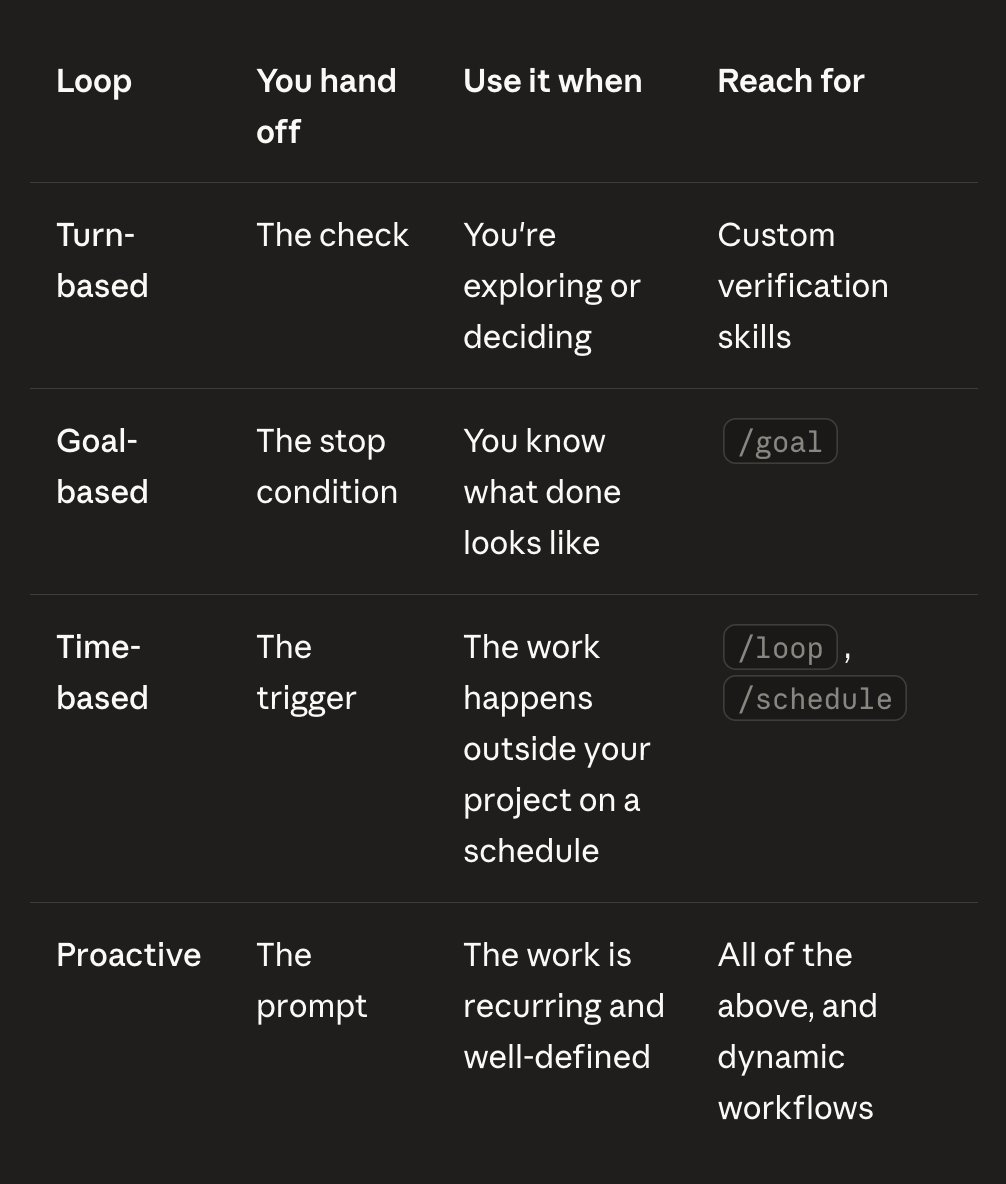
the four types of agent loops.
loop engineering keeps getting talked about as one thing. it's actually a choice between four structures, and each one fits a different kind of task.
it means designing the system that steers the agent, instead of steering it yourself move by move.
that system always answers two questions. what starts a run, and what decides the work is done.
in a hand-run session you answer both yourself, every single time. each loop type moves more of that into the system.
here's each type, what triggers it, and when to reach for it.
1) turn-based.
triggered by a user prompt. the agent gathers context, acts, and checks its work inside a single turn, then a human reviews the output and writes the next prompt.
use this when requirements are still forming and every output changes what you'd ask for next.
2) goal-based.
triggered by a /goal command carrying success criteria and a budget, like "get the homepage Lighthouse score to 90, stop after 5 tries." when the agent tries to stop, an evaluator model checks whether the goal is met, and a no sends it back to work.
use this when the outcome is measurable but the path there isn't worth your attention.
3) time-based.
triggered by a clock. an interval fires, the agent runs a fixed prompt like "check the PR, fix CI," then waits for the next tick. /loop runs on your machine, /schedule moves it to the cloud so it survives a closed laptop.
use this for recurring work where the task is known in advance and only the timing repeats.
4) proactive.
triggered by an event or schedule with no human present. a routine watches a channel, and when something needs handling it spawns a workflow with a triage agent, a fix agent, and a reviewer that adversarially judges the work before the task closes.
use this for standing responsibilities where you can't predict what will come in, only that something will.
each type hands off one more job than the last. turn-based keeps both with the human, goal-based automates the checking, time-based automates the trigger, and proactive automates both while deciding the workflow shape at runtime.
so the mapping question isn't which loop is most advanced. it's whether your task is exploratory, measurable, recurring, or standing.
the more you hand off, the less you babysit.
I wrote the full breakdown on loop engineering. the article is quoted below.
Olvídate de los vector databases.
Tencent acaba de open sourcear tencentDB agent Memory: memoria a largo plazo real para cualquier agente de IA, corriendo 100% local sobre sqlite.
Sin pinecone.
Sin apis en la nube.
Sin tener que repetir todo cada sesión.
Resultados reales:
- Hasta 61% menos tokens
- Precisión en PersonaMem: 48% → 76%
- Cero dependencias externas
- Todo funciona con SQLite plano
En vez de comprimir tu historial en embeddings opacos que fallan cuando más los necesitas, construye una pirámide semántica clara:
L0 Conversación → L1 Átomo → L2 Escenario → L3 Persona
El estado corto plazo se resume en un grafo Mermaid que entra directo en el contexto del agente. Los logs detallados se guardan en disco y puedes volver a ellos al instante usando el `node_id`.
Sin compresión con pérdida. Todo queda en archivos Markdown legibles que puedes abrir y revisar cuando quieras.
Ya tiene más de 8.5k estrellas.
100% open source (MIT).
Enlace en los comentarios 👇
Stop collecting 100 ridiculously long Claude guides.
I've already mapped it for you. Here is how:
1. Go to Claude (desktop app).
2. Pay for the $20/month plan. I pay $100. Worth it.
3. Claude is 4 tools: Chat, Cowork, Code, Skills.
4. Most people never leave Chat. Big mistake.
5. My skill is free to download at https://t.co/psB7XxB2Y4.
6. The download link is in the welcome email.
1. Chat → think out loud. Get an answer. Fast.
☑ Quick rewrite, fast question, brainstorm.
☑ Research mode: It sends agents to dig the web.
☑ Connect your Gmail. Ask questions to your inbox.
☑ Give it goals instead of simple tasks.
☑ The biggest trick: don't prompt better. End your prompt with "ask me questions first, using the AskUserQuestion tool."
2. Cowork → hand off the whole job.
☑ 5+ mini-Claudes plan, search & build.
☑ Use Skills + Projects. Instead of folders & files.
☑ Build it in Cowork, export to Google Drive.
☑ The money rule: never send a follow-up. Every "no, I meant..." makes Claude re-read the entire chat. Edit your original prompt instead.
3. Code → build software in plain English.
☑ This is what "vibecoding" actually is.
☑ Create an empty folder just for it.
☑ Turn on "bypass permissions"
☑ Connect Netlify + Supabase. Your site goes live.
☑ It's not for getting rich. It's for handing your dev team a clickable version so they stop guessing.
4. Skills → teach Claude once. Reuse forever.
☑ Any task you repeat weekly = a Skill.
☑ Claude recognizes the task & fires the Skill.
☑ Stuff it with your best posts, SOPs, or 30 PDFs.
☑ Skills save you money without burning tokens.
☑ Already in a great chat? Click the chat name → "make it a skill." Done.
I collected my favorite Skills into one library.
It's free in my welcome email: https://t.co/psB7XxB2Y4
Skill or Project? The 5-second test:
☑ Can you teach it to a person → Skill.
☑ Is it one client or campaign → Project.
☑ The real magic: your Skill, running inside a Project
♻️ Repost this to help others use Claude better.
Grok 4.5 might be the BEST model to run inside Hermes or OpenClaw RIGHT NOW.
I've been sleeping on Grok to be honestNot anymore.
It's more than 60% cheaper than Opus 4.8 and lands around $2.49 per task versus ~$12 for Fable in Claude Code. And it's fast.
So what happens when you give Hermes + Grok 4.5 its own email, its own phone number, its own debit card, and access to every tool you use?
You pretty much get an AI co-founder.
Everything you need to know about Grok 4.5 + Hermes below.
Full episode is available to watch at @startupideaspod ( thanks @nickvasiles for coming on)
I slept on Grok. Not sleeping on it anymore.
Watch
This GitHub repo is gold for anyone running Claude Code/ Codex / Any coding agent at all. My usage limits almost last double since I started using this.
An open source context layer that stops your agent from reading 40 files to answer one question. No API key, no billing, no rate limit tiers.
Benchmarked against Claude Code baseline: 27x token efficiency, 36% lower cost, 89% fewer file reads, 49% fewer tool calls. Every number is reproducible, the harness is in the repo.
3.5k+ stars. 50k+ pip installs, 30+ contributors, works with Claude Code, Cursor and VS Code out of the box.
pip install repowise and point it at your codebase.
Google acaba de soltar un curso de solo 1 hora sobre Ingeniería Agentiva que destroza a la mayoría de cursos de pago 🔥
Timestamps:
00:00 → Cómo construir tu primer agente de IA
08:24 → Memoria de agente (corta, persistente y larga)
28:34 → Bucles agentivos y agentes de larga duración
40:04 → MCP vs API (esto solo ya vale la pena)
1:00:22 → Sistemas multiagentivos
En 60 minutos aprendes más que en 10 cursos pagos. Míralo hoy. Luego lee el artículo y construye un sistema agentivo que se auto-mejora solo.
¿Lo vas a ver ahora o lo guardas para “después”? 👀
Ücretsiz Grok 4.5'i deneyebilirsiniz.
Mac'te: Çalışmak istediğiniz klasöre sağ tık → "New Terminal at Folder" deyin. Açılan terminale bunu yapıştırın:
curl -fsSL https://t.co/Gh4G9zwYxV | bash
Windows'ta PowerShell açıp bunu yapıştırın:
irm https://t.co/eNA2CoeiiA | iex
Sonra "grok" yazın, X veya Grok hesabınızla login olun ve ücretsiz kullanın.
You don't understand how BIG this is.
Anthropic just published the 4 ways to make Claude Code work without you.
Everyone on X has been arguing about what a "loop" actually is.
The team that built the tool just gave the official answer: an agent repeating cycles of work until a stop condition is met.
Only 4 types exist, and each one hands off a different piece of your job:
→ Turn-based: hands off the checking. Skills verify the work end to end
→ Goal-based: hands off the stop condition. /goal keeps it going until done is DONE
→ Time-based: hands off the trigger. /loop 5m fixes your PR while you work
→ Proactive: hands off the prompt itself. It runs while you sleep
Prompting was the skill of 2025. Designing loops is the skill of 2026.
Bookmark this.
OpenScience duyuruldu. Claude Science'a açık kaynaklı alternatif. GPT, DeepSeek, Claude dahil tüm büyük modelleri destekliyor, 250'den fazla araştırma becerisi var. Kendi altyapında çalışıyor, verilerin sende kalıyor.
https://t.co/U3XNSpUo5x
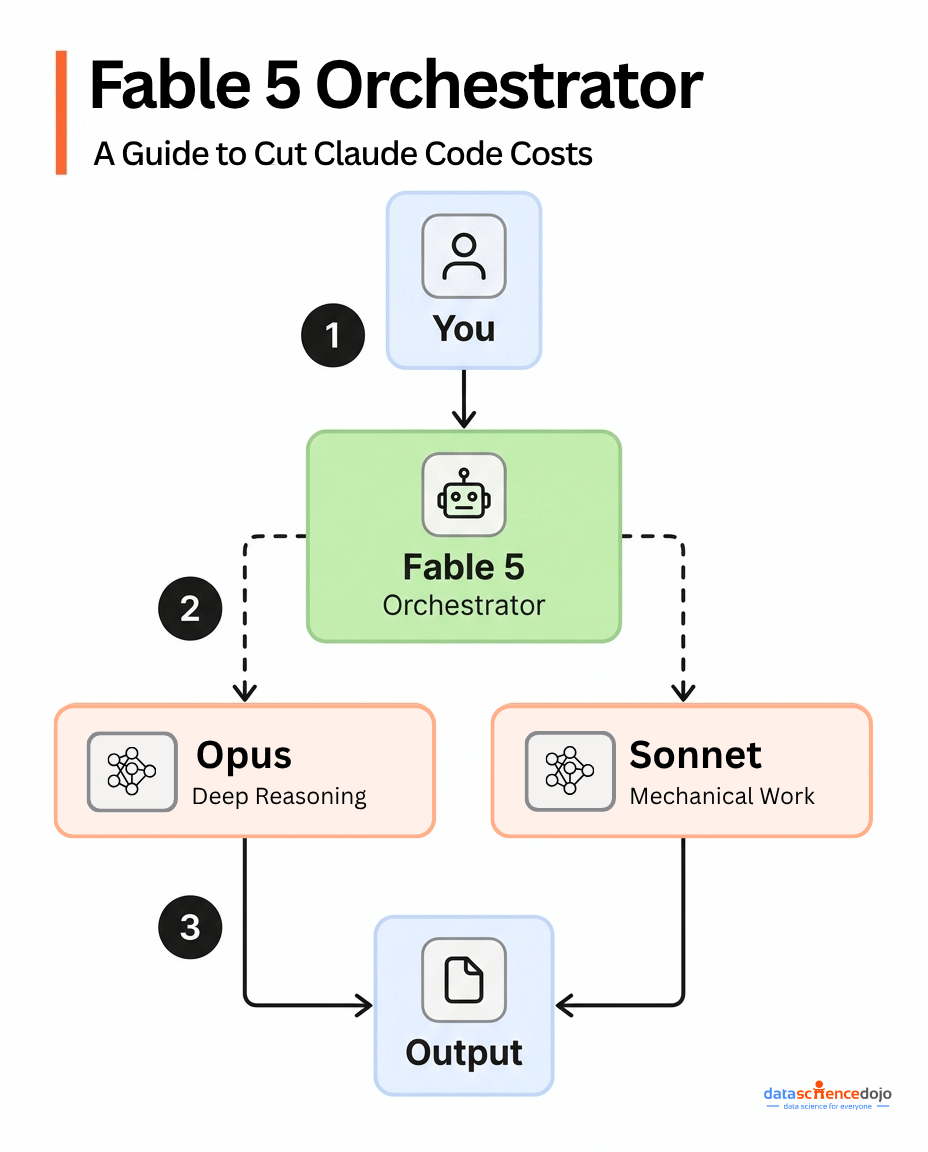
💲Fable 5 is Anthropic's most capable model, and it's priced like it, running well above Opus 4.8 and several times Sonnet 5.
Run an entire Claude Code session through it, planning down to boilerplate and test formatting, and you're paying frontier rates for work a cheaper model handles identically.
The fix isn't cutting Fable 5 out. It's cutting it down to what it's actually good at.
Set Fable 5 up as an orchestrator instead of a single-model worker:
🔹 It plans and decomposes the task, deciding what needs real judgment
🔹 A subagent pinned to Opus takes architecture, debugging, algorithm design
🔹 A subagent pinned to Sonnet takes boilerplate, tests, formatting
Setup is two subagent configs and one CLAUDE. md file, Anthropic models only, no third-party tooling.
We wrote up the full setup, the exact frontmatter fields, and the failure modes to watch for. Link in the article👇
#ClaudeCode #Fable5 #AIEngineering #LLMOrchestration #AgenticAI