The world has lost a mind whose work guides us every day.
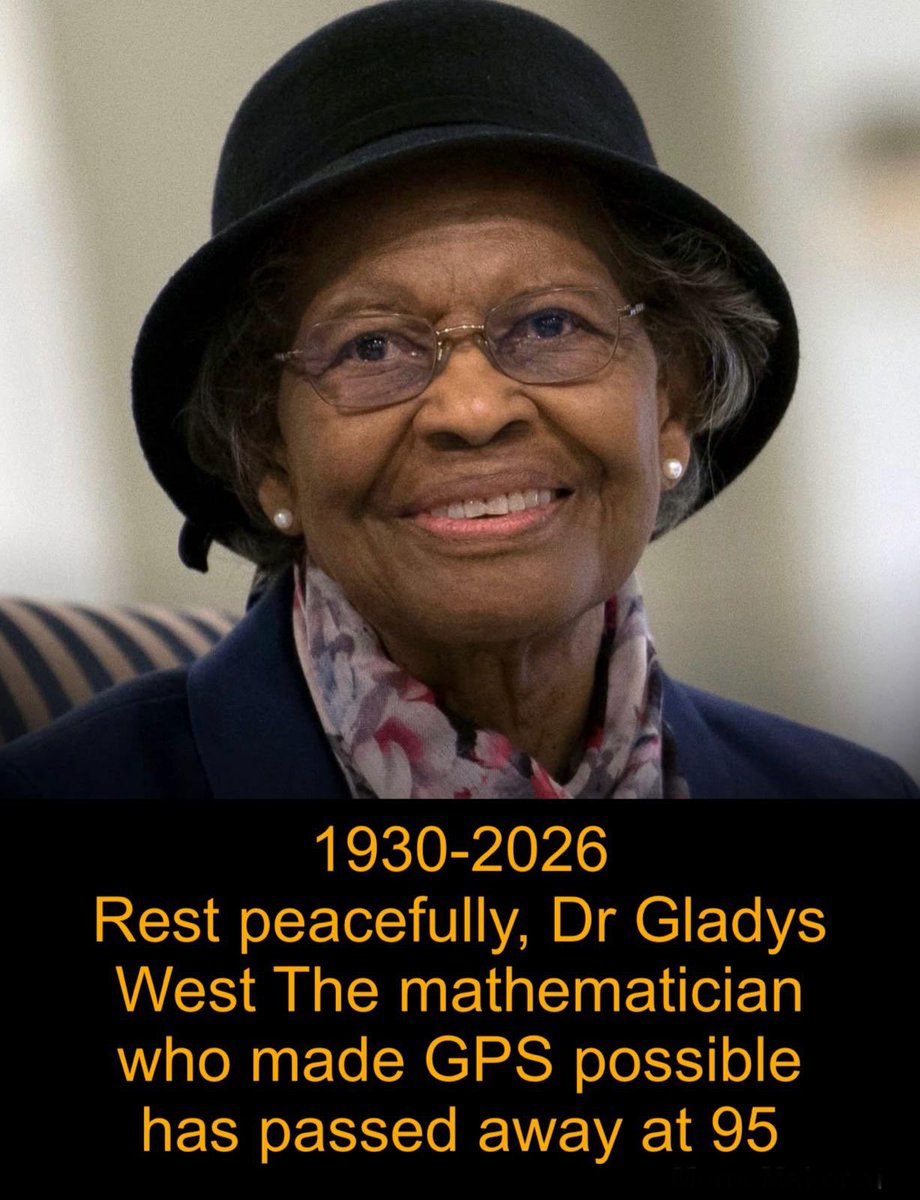
Gladys West, a pioneering mathematician whose contributions helped make modern GPS possible, has passed away at 95, peacefully on January 2026, surrounded by family and friends.
West’s mathematical models of the Earth’s shape became a critical foundation for satellite navigation, allowing precise positioning anywhere on the globe. Her work helps guide everything from airplanes and ships to smartphones and emergency services, though she once joked that she still preferred using paper maps.
Born in 1930 in rural Virginia, West grew up in the South, working on her family’s farm and walking miles to a one-room schoolhouse. She originally planned to study home economics, but discovered a love for geometry that led her to pursue mathematics. A scholarship took her to Virginia State College, where she earned her degree and later a master’s in mathematics.
In 1956, she joined a U.S. Navy research facility in Dahlgren, Virginia. Over a 42-year career, West worked with early computers to develop algorithms that accounted for the Earth’s irregular shape, gravity, and tidal forces, refinements that were essential for accurate satellite positioning.
Without the mathematical groundwork she helped establish, the global navigation systems used today would not function as they do.
For most of her career, West’s contributions remained largely unknown outside scientific circles. Later in life, she received major honors, including induction into the U.S. Air Force Hall of Fame and the Prince Philip Medal.
She inspired generations of scientists and mathematicians.
‘Cleave’ can refer to splitting something apart.
‘Cleave’ can also refer to the uniting of two things.
…what?
A word that is also its own opposite is called a ‘contronym.’
I have been studying the book of Second Kings this month, and I discovered something very interesting from a very unpopular story in chapter 10 and it taught me some very vital lessons I think you need to see.
In 2 Kings 10:32, the Bible says God began to cut Israel short. And the land that was taken first by the Syrian King Hazael was the land east of the Jordan, occupied by the tribes of Reuben, Gad, and half of Manasseh.
Now, why this is interesting and significant is that in the book of Numbers chapter 32, the Israelites were proceeding to the Promised land in Canaan to possess it, but these tribes and their leaders told Moses that they were not interested in going up to the promised land. They said they were comfortable there and it was good for their livestock. Moses was completely mad at them and it took so much back and forth before Moses eventually agreed to let them have the land.
These three tribes settled early, and it cost them later. They chose what was easy instead of what was promised. It made sense at the time. The land looked good. It felt practical. But comfort became compromise. And years later, that same “good enough” decision turned into their biggest vulnerability. That is how settling works, it does not hurt immediately. It just limits you slowly. What you excuse today becomes what drains you tomorrow. God may allow you to stop short, but the future will always expose the cost of not pressing for more.
This goes far beyond Bible geography. It speaks to our lives. Many of us have settled. In marriage, we manage red flags because we are tired of waiting. In careers, we stay where we are comfortable instead of where we are called. In academics, we stop learning because we feel “okay” already. In relationships, we tolerate what drains us because it feels familiar. But no one changes the world from their comfort zone. Growth and glory always requires movement.
So let 2026 be the year we press for more. More depth, discipline and courage. Take that certification course. Apply for that Master’s. Start that business idea you keep postponing. Leave rooms you have outgrown. Step into what God is calling you into, even if it scares you. Because the promised land is never found where it is most convenient. It is found where faith decides not to settle.
The safest way to travel is by plane. Do you know why?
Because they crash.
A few months ago, I learned a concept called Black Box Thinking which is a system that defines how entire industries respond to failure.
In aviation, when a plane crashes, they don't just look for who to blame.
They find a device called a Black Box, retrieve the data, and then ask what went wrong with the system.
And there is a reason for this.
To explain this, there is a famous story of a crash involving an Asian airline years ago.
When investigators listened to the recording from the black box, they found the engine didn't just fail on its own, the junior pilot actually noticed a mistake.
But because of a cultural hierarchy in Asia that demanded absolute respect for elders, he didn't question his senior pilot.
Instead, he hinted and spoke softly and the plane crashed.
That tragedy changed aviation safety forever.
It moved the focus from "Who made the mistake?" to "Why did the system allow this mistake?"
As we stand on the 29th of December, looking back at 2025, I want you to adopt this strategy of Black Box Thinking.
Most of us look at our failures this year and feel shame.
We hide the crash, and blame the economy, government, or something that does not exist.
But Black Box thinking demands a harder question: "How did I contribute to this problem?"
Did I stay silent when I should have spoken up?
Did I rely on motivation instead of a system?
Did I ignore the data because of my ego?
Don't bury your failures of 2025.
Open the box and analyze it.
Because that is the only way to fly safer in 2026.