Kimi K3 is another reminder that high-quality data is a core determinant of model performance.
@micro1_ai took an early, principled stand not to provide data to foreign adversaries.
I’m not convinced everyone else in this category made the same commitment.
Every company in the data ecosystem should publicly commit to this same standard. If you haven’t, why not?
Today, we’re committing $5,000,000 to launch the micro1 Company Data Partnerships Referral Program.
For every company you refer, you can earn up to $25,000. Simply introduce a company, have them identify you as the referrer during onboarding, and once they enter into a paid data partnership with micro1, you’ll receive your referral payout.
If you know a company that wants to turn its operational data into a recurring revenue stream while accelerating its adoption of AI through micro1's Data Partnership Program, we’d love an introduction.
visit /data to get started
one of the most practical ways to act on this: 100x your investment in contextual evaluations as an enterprise.
this allows you to define what good looks like for your agents, own your intelligence layer (even when built on top of foundation models), and generate real ROI beyond pilots and demos.
probabilistic software requires a re-think of the traditional product development lifecycle. evals can no longer be something that happens at the end. they need to be there from day one and become the most core part of the product development process itself. every product decision, iteration, deployment, and improvement should be driven by evaluations.
the micro1 robotics lab:
real world data for intelligent models that co-exist in the physical world.
we’re in-the-wild across 75 countries in 6,000+ unique environments collecting data. diverse movements, objects, and settings.
the future of AI is as human as you can imagine. join us to start training robots today (link in comments).
He grew a company 35x in one year to $250M+ at 25. He’s the same kid who came to the US from Tehran at 10 without knowing a word of English.
This is the untold story of Ali Ansari and micro1, which just cracked the top 10 on the Lean AI Leaderboard with $250M+ revenue and 80 employees.
If you are building a lean AI company or want to sell to the top AI labs, read on for the full playbook.
Ali built 2 companies before college.
At Berkeley, he launched a software dev agency and started hiring international engineers.
The interviews alone were eating 30–40 hours/week, so he built a tool to automate them, using GPT (one of the first AI recruiters in 2022).
That insight eventually became micro1.
For 2 years, it grew steadily with two business lines (an AI interviewer SaaS and an engineering marketplace) with happy customers.
Then a data vendor approached Ali with an unusual request: hire 700 engineers to train AI models.
That one conversation changed micro1’s trajectory.
Ali realized they had accidentally built what every major AI lab desperately needed: a system to find, vet, and manage domain experts at scale across industries, at volume and fast.
He then made a decision most founders would never have the nerve to make:
He killed both working businesses and bet the entire company on going direct to the labs, with no safety net or guarantee that it would work.
But the bet paid off, resulting in 35x growth, as they went from $7M ARR to ~$250M in one year.
None of it came easy, and this level of growth became possible only after Ali solved the hardest problem in this space:
How to sell to AI labs where buyers are deeply technical and part of tight communities where reputation travels fast.
So I spent 10+ hours going deep into the decisions behind how micro1 built, sold, and scaled within the AI ecosystem and turned it into an actionable playbook for founders who want to sell to researchers.
Inside, you'll get:
• The 3-stage sales sequence Ali uses to close research deals like OpenAI and xAI
• How he got into Stanford research circles with zero connections (and how that helped him close deals)
• The proof of concept strategy: The dos and don’ts when researchers are evaluating you
• How Elon Musk accidentally handed micro1 their biggest sales breakthrough
• The net expansion playbook for enterprises and Fortune 500 companies (and what is converting fastest)
• The full AI stack that powers micro1's recruiting engine
• The incentive philosophy Ali rebuilds individually for every core team member every quarter
Originally, I put this together as a resource for founders I work with directly.
But the ideas and insights are too valuable not to share, so I'm giving it away publicly.
Founders who crack AI sales at this hyperscale usually keep it close, but Ali shared every piece of it.
So if you are building a business around frontier AI and research, grab this right away.
It will save you months of costly relationship mistakes (Link in the first comment).
Ali and team, welcome to the Leaderboard!
.@APompliano is exactly right. while the scope of work of some jobs may suffer in the mid-term, entirely new categories of work are continuing to emerge. AI will ultimately create a lot more jobs than it displaces. and those displaced, in almost every case, will be evolutions of the same job.
Excited to introduce micro1 Cortex, a contextual evaluation, visibility, and improvement platform for enterprise AI agents.
Foundational models are trained for general intelligence, but enterprises need agents that perform reliably inside their unique context: workflows, policies, data environments, and edge cases.
Cortex brings trust to enterprise AI by leveraging domain experts and real-world scenarios for any use case to test, diagnose, and improve how agents behave in production.
Earlier this year, 24 year-old @aliniikk was running an AI recruiting startup. @micro1_ai pivoted into AI training, and in 8 months the company is now making $100 million a year, and fielding offers at a $2.5 billion valuation.
https://t.co/Us7BjiikG5
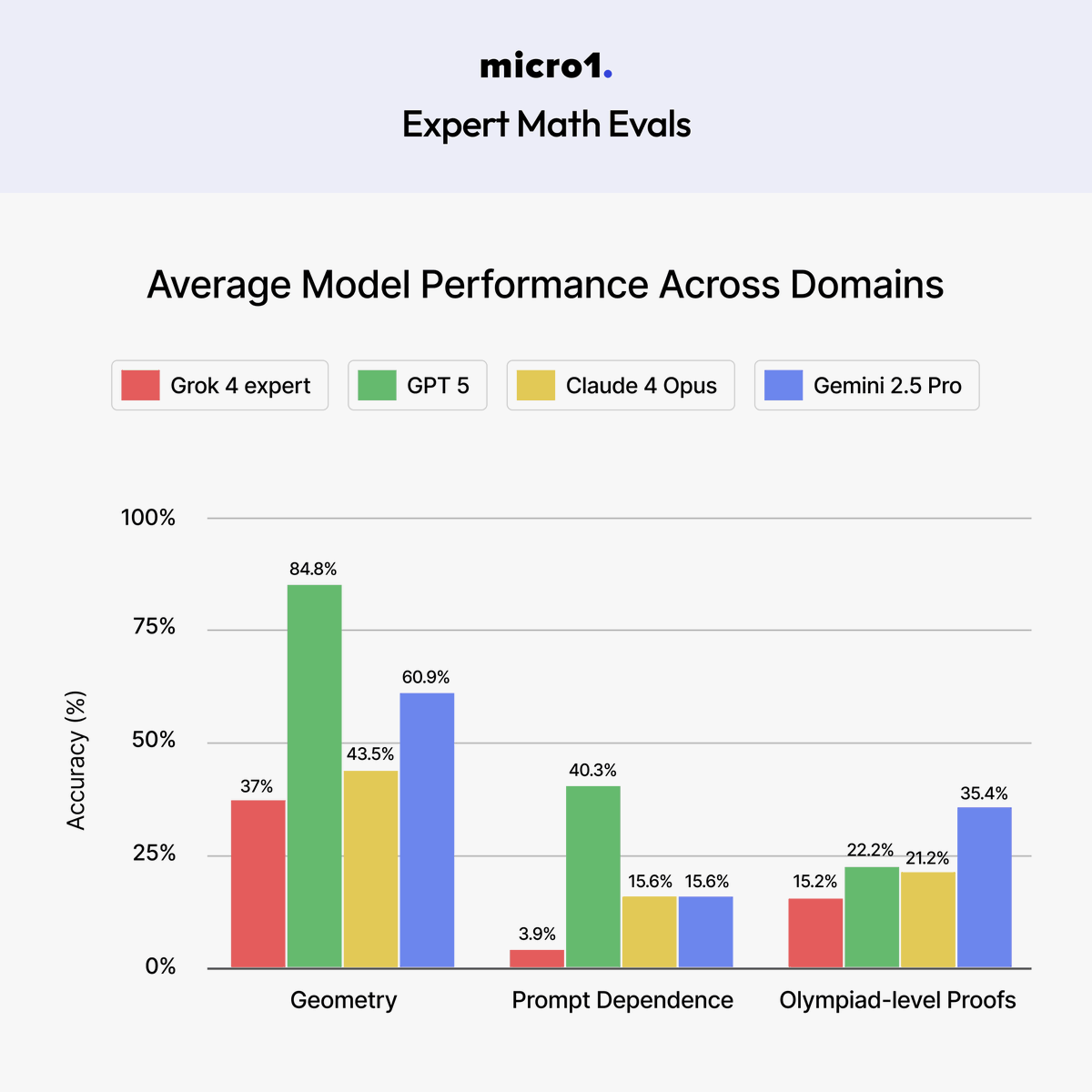
the micro1 research team ran rubric-driven math evals across geometry, Olympiad reasoning, and prompt dependence.
TLDR: @elonmusk fix math pls.
---
Here's an overview of the results:
grok-4 expert finished last in every domain, scoring 3.9% on prompt dependence, 37.0% on geometry, and 15.2% on Olympiad tasks. GPT-5 set the benchmark with 84.8% in geometry and 40.3% in prompt dependence, while Gemini 2.5 Pro edged ahead on Olympiad.
Overall, GPT-5 was the strongest performer, outpacing Gemini Claude 4 Opus, and Grok 4 Expert across the majority of tasks.
full report coming soon.
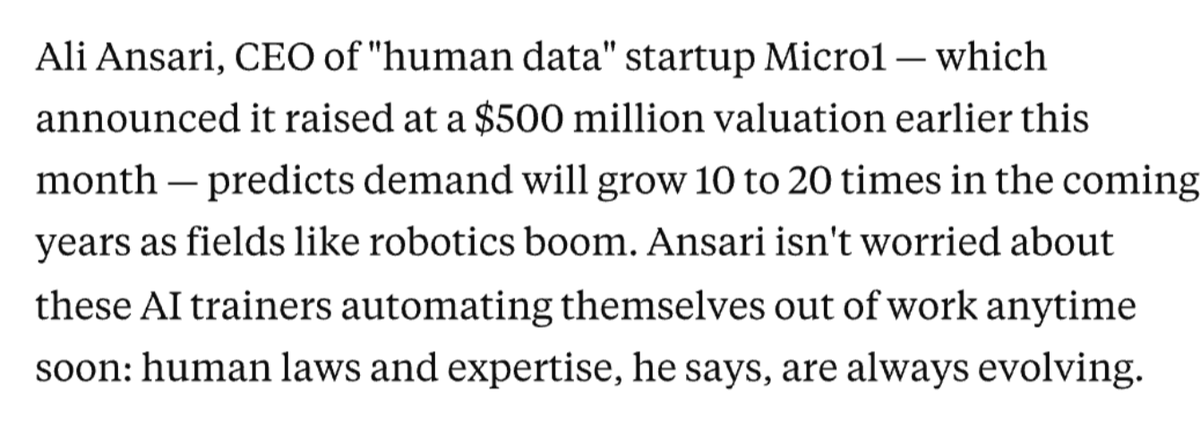
I’m excited to announce micro1 has raised a $35M Series A, valuing us at $500M. This round was led by 01A with @adambain joining our board of directors.
We’re grateful to be partnering with leading AI Labs & fortune 10s, such as Microsoft, to train frontier LLMs.
We’re just getting started building the infrastructure layer for AGI, with the ultimate goal of answering the very fundamental question: “where should humanity spend its time?”
We’re excited to officially launch micro1's research lab, led by Professor @StefanoErmon of Stanford University.
After a year of research with Professors Ermon, Ada Aka, and Emil Palikot, we’re releasing the most extensive and rigorous study to date comparing AI recruiter systems to human recruiters. As expected, combining AI with human recruiters leads to the strongest results: improved hiring efficiency, a better candidate experience, and the highest quality candidate selection.
We’re thrilled to have Shahab Mousavi, Amirhossein Afsharrad, Mark Esposito, Nima Yazdani, Aarush Gupta, and others joining us on this mission.
Our research lab aspires to solve humanity��s greatest coordination challenge: deciding where each person should spend their time.
We're hiring, join us at /research