東京でのSchmidhuber教授のイベントはおかげさまで満席となりましたが、京都大学での講演会の開催が決まりました。ぜひご参加ください。
Our Tokyo event with Prof. Schmidhuber is now full, but he will also be giving a public lecture at Kyoto University.
- Date:Thu, Nov 5, 2026, 13:30–15:00 JST (onsite only)
- Venue:HORIBA Symposium Hall, Kyoto University
- Host:京都大学 情報学研究科 附属次世代情報・AI教育研究センター(CIAIER)
https://t.co/omjd1v8EUy
参加無料・事前申込不要 / Free admission, no registration required
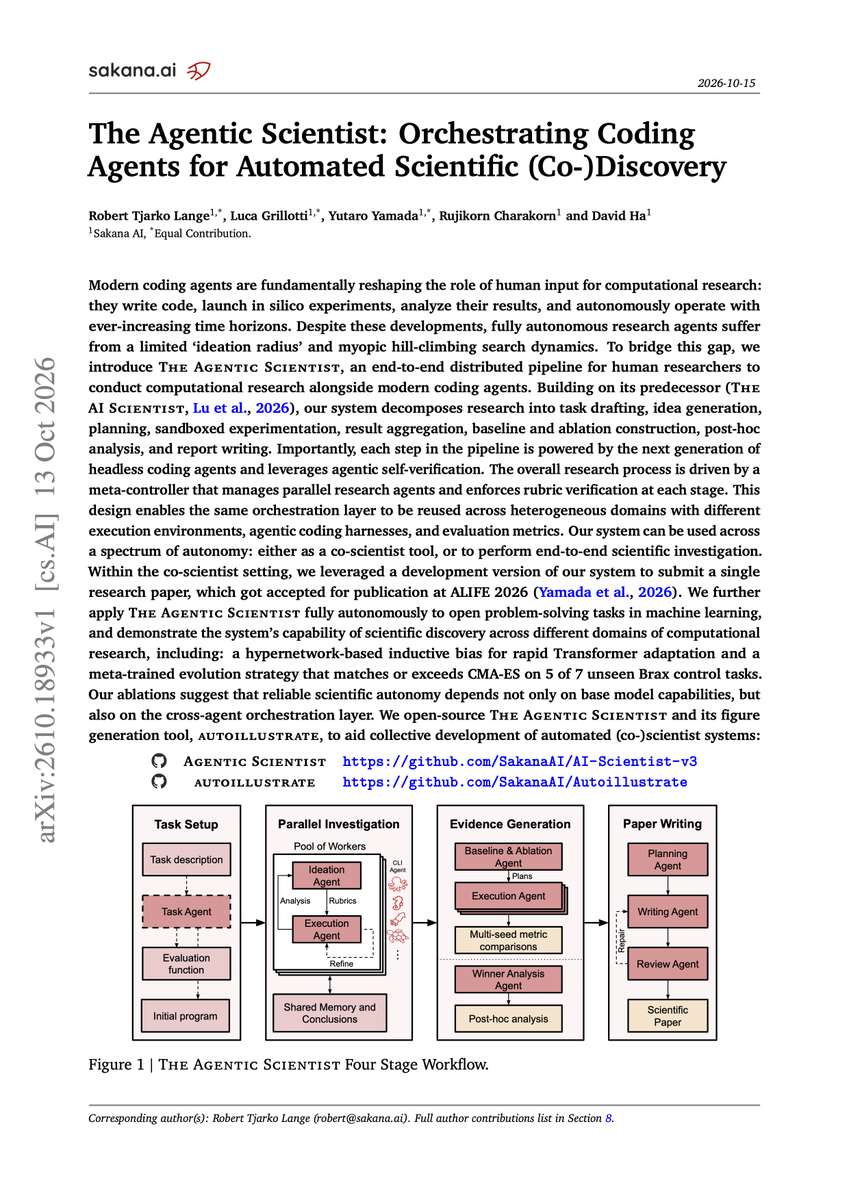
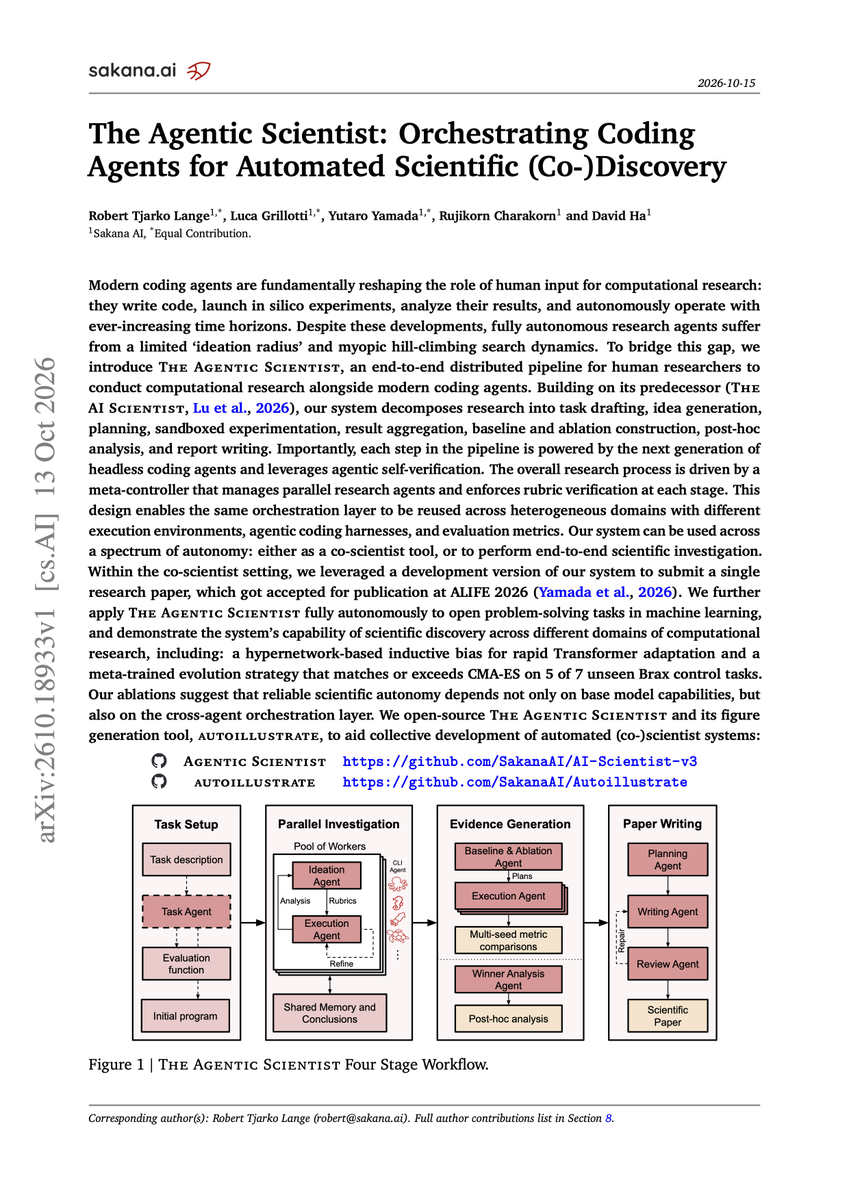
The Agentic Scientist: Orchestrating Coding Agents for Automated Scientific (Co-)Discovery
Blog: https://t.co/7aVDvZd6m2
GitHub: https://t.co/JCCBMvu2P1
arXiv: https://t.co/4bV76tAByj
Since 2024, we’ve used The AI Scientist as a way to test how far AI alone can take scientific research, from v1 to v2 to the paper published in Nature earlier this year. The Agentic Scientist is the next step in that line of work, built for the era of coding agents.
Coding agents such as Codex and Claude Code now carry out long software tasks on their own. Handing them a research problem, however, tends to produce a strong hyperparameter optimizer rather than a scientist: scores go up, but ideas stay narrow, and the reasons for the gain are rarely examined.
The Agentic Scientist makes the research loop explicit. It wraps off-the-shelf coding agents in a scaffold that controls what they see, what they write, how they are evaluated, and how results are handed to the next stage.
Parallel workers test hypotheses against rubrics defined before any experiment runs, share successes and failures through a common memory, and then ablate the winning program to generate evidence.
We used an early version of the system to study Error Diffusion, a biologically motivated alternative to backpropagation. Our researchers set the question and the rubric, chose directions at each stage, and verified the results, references, and claims before submission. The resulting paper was accepted as an oral presentation at ALIFE 2026. In autonomous runs, the system also raised Doc-to-LoRA retrieval accuracy from 52% to 98% on multi-needle tasks and designed a learned evolution strategy that improves over its CMA-ES reference on unseen tasks.
Alongside it we release AutoIllustrate, a pipeline for scientific figures that keeps an editable https://t.co/SHX9lrOr74 file as the source of truth, so every diagram can be corrected by hand.
Humans define the question and the standards of evidence; agents expand the experiments researchers can run. We call this Co-Discovery, and we are releasing both systems as open source for the community to build on.
The AI Scientist v3 is out: The Agentic Scientist.
GitHub: https://t.co/v2AkZi4Bmt
Blog: https://t.co/v3Td5yfvBE
arXiv: https://t.co/RuVnAHjMlK
The Agentic Scientist is the 3rd iteration of our automated AI Scientist research system, and the shift this time is from “one agent writes a paper” to “a scaffold of parallel agents orchestrates the full research loop.”
The system now orchestrates a pool of parallel workers that share memory and distilled conclusions. Crucially, it features Evidence Generation: isolated agents automatically run controlled baselines and ablations to prove why an idea actually works.
It works as a co-scientist. We used a development version as a co-scientist to explore biologically plausible learning rules. The agent handled the empirical heavy lifting, proposing mechanisms and running experiments. We stayed in the loop to steer direction, verify results, and moderate claims. That feels like the right division of labor for where the technology actually is.
This resulted in a new biologically plausible learning algorithm, and the resulting paper was accepted at ALIFE 2026 as an oral presentation.
We are also releasing AutoIllustrate. It generates editable https://t.co/i6fwB6vzQV vector figures instead of uneditable, hallucinated raster images. Real scientists need vectors, not pixels. I am an SVG junkie ;)
Incredible work by Robert Lange, Luca Grillotti, Yutaro Yamada, Rujikorn Charakorn, and the team!
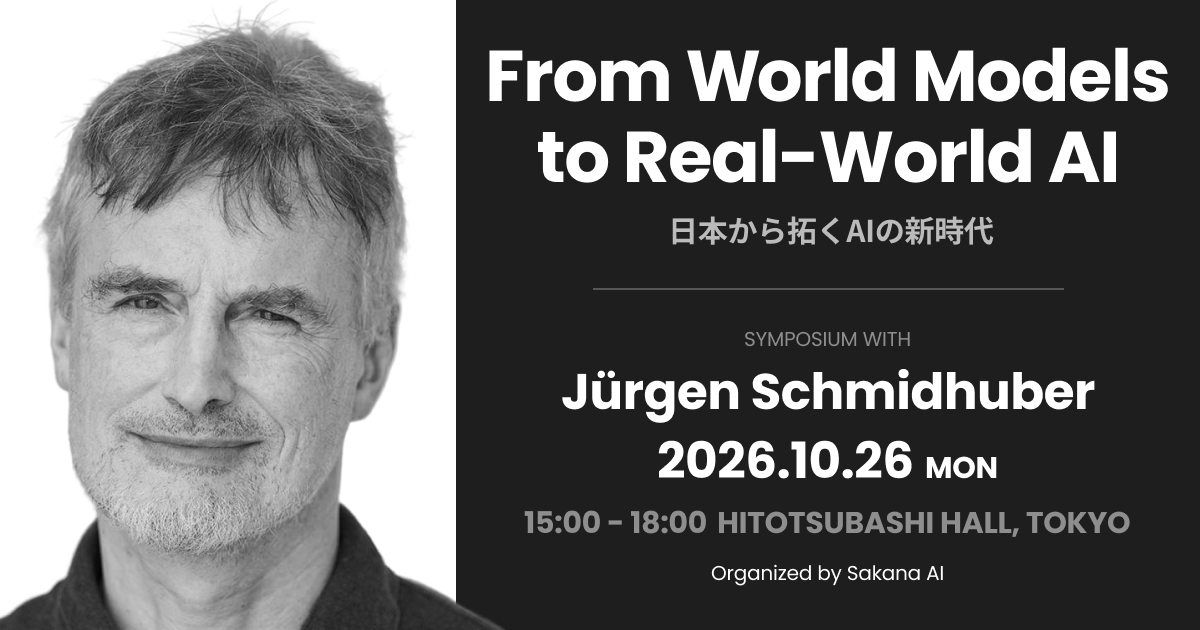
【受付開始】From World Models to Real-World AI — 日本から拓くAIの新時代
Chief Scientific Advisorとして当社に参画したJürgen Schmidhuber博士を迎えるシンポジウムを、10月26日(月)に東京・一橋講堂で開催します。本日より一般申し込みを開始しました。Schmidhuber博士による基調講演とQ&A、 CEO David Haとの対談、Sakana AI研究者によるショート講演を予定しています。
日時:2026年10月26日(月)15:00〜18:00
会場:一橋講堂(東京・千代田区)
言語:英語(通訳なし)
参加費:無料(事前登録制)
※ 席に限りがありますので、お早めにお申し込みください。
お申し込みはこちら:
https://t.co/5MpudErcCL 🐟