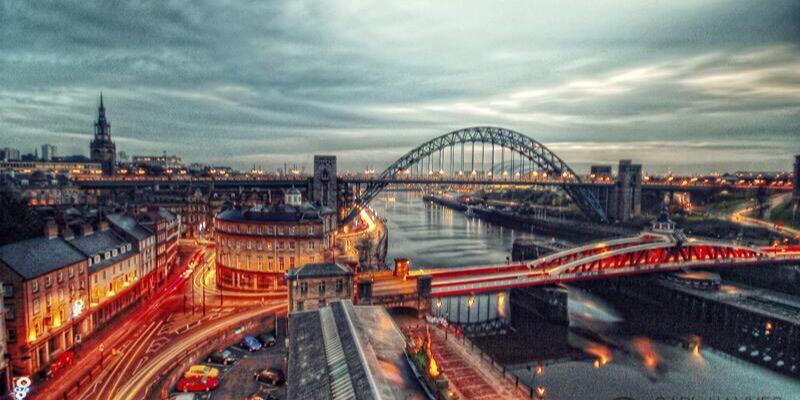
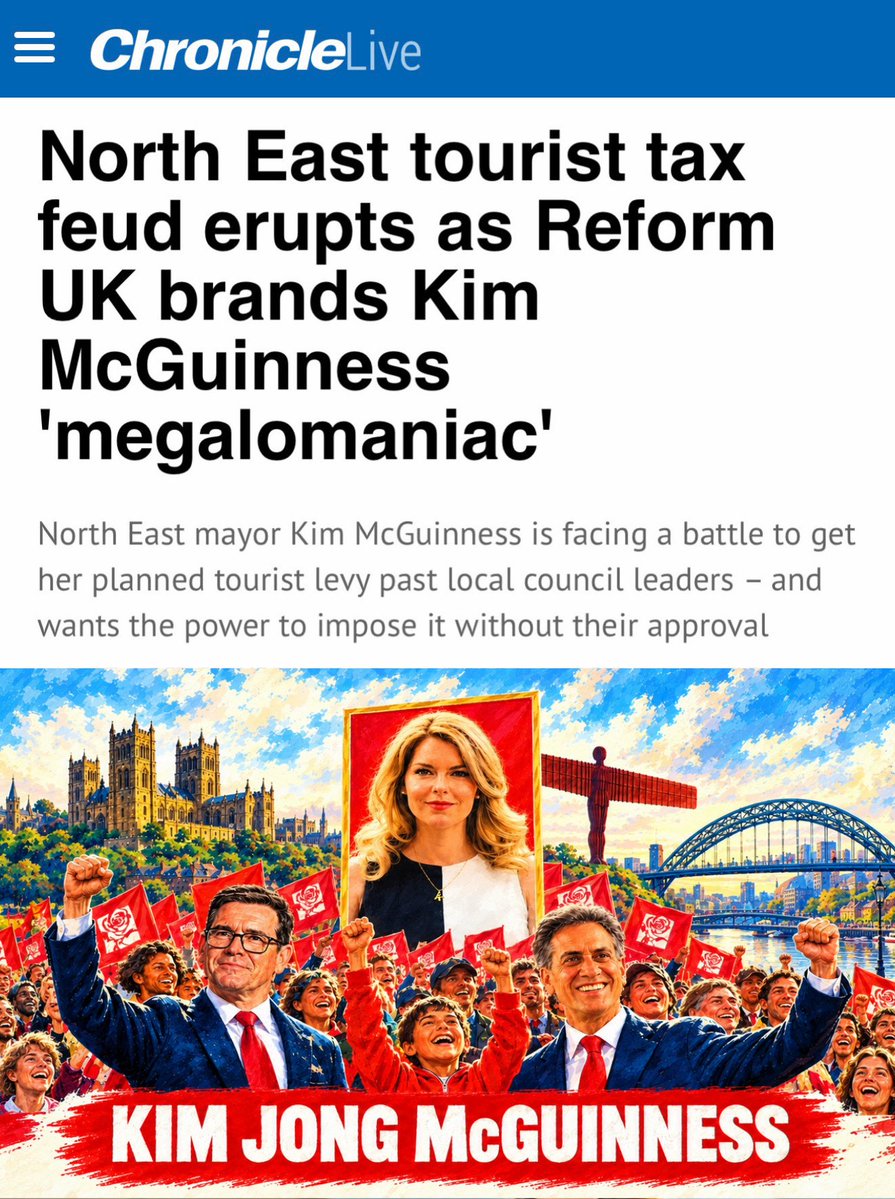
A message to the North East, a region that means so very much to me, but it matters to each of you with these new almighty mayors too.
This is Kim McGuinness. The Labour Mayor who sat in a room with the Prime Minister and a table full of elected mayors last week and complained that your councils were getting in her way.
Her words: "They could stop me from doing it. And I don't think that's right, either on this or other things."
This was never just about a tourist tax. It's about who gets to decide what happens in your town.
I'm a County Durham lad. My grandad, and generations of my family before him, went down the pits here. My mam and dad met working in the factories of Stanley. I was brought up to believe that power belongs as close as possible to the people it affects. In your street. In your village. With the councillors you can stop in Tesco and give a piece of your mind.
So let me walk you through what's happened.
In 2024, Kim McGuinness stood for mayor promising a £1 a night charge on hotel rooms. A quid. A "small charge," she called it.
Now she wants a levy of up to 5% on every booking. On a £150 hotel room, that's £7.50 a night. Every hotel, B&B, guest house and holiday let in the region. That isn't the small charge she put in her manifesto. It's a massive escalation she never asked you about.
Then something happened she didn't plan for. You voted.
After she was elected, the people of Durham, Sunderland, Gateshead and South Tyneside put Reform in charge of their councils. Those are mandates every bit as real as hers, and more recent. In September, the four of us wrote to her asking her to rule this tax out. Northumberland's Conservatives oppose it too. That's five of the seven council leaders on her own cabinet, from two different parties.
So what was the first thing she did?
She didn't come back to us. She didn't try to change our minds. She went straight to the Prime Minister, in front of mayors from across the country, and asked for the power to overrule the councils you elected.
Let's be clear about what that means.
Devolution was supposed to take power out of Westminster and hand it back to communities. What Kim McGuinness wants is to take power out of Westminster and park it on one desk in Newcastle. Hers.
That isn't devolution. It's centralisation with a regional postcode. It reduces your local councils to powerless chambers with a car park.
She was asked to pick between the councils you elect to serve your community and more power for herself. She picked herself.
And she told the PM it wasn't just about this. "Other things," she said. So ask yourself what comes next. If your council can't stop her taxing visitors, can it stop a thousand homes going up on the edge of your village? A solar farm across good farmland? Turbines on your skyline? She wants the answer to be no.
Follow the money too. In that same meeting, which project did she talk up? Newcastle. She didn't name a single Durham town. Durham's guest houses collect it. Tyneside spends it.
Her reply to me in the Chronicle was 200 words on why her tax is wonderful. There wasn't a single word denying she'd asked the Prime Minister to overrule the leaders you elected.
Not one.
I don't think that's right. I don't think any of you voted for that. And I'm not going to sit quietly whilst it happens either.
On my way to the office this morning, I passed a group of young people protesting, a Palestinian flag draped over their shoulders.
And I asked myself a question I can't shake: why does this generation always fall into the same trap? No matter the history. No matter the context. Even the ones from wealthy families, who went to the best schools, who were dealt every good card. Always the same trap.
I don't think it's stupidity. I think it's a mechanism. And a mechanism can be taken apart, piece by piece.
A. The observation: everything the state touches becomes unaffordable.
Look at economist Mark Perry's famous chart, the one people call "the chart of the century." It tracks US prices since 2000.
At the top, what explodes: hospital services, college tuition, textbooks, childcare, housing. Increases of +100%, +150%, up to +250%, far above general inflation.
At the bottom, what collapses: TVs, software, phones, toys, clothing. A TV today costs a fraction of what it did in 2000, for an infinitely better product.
Look at what separates the two groups. It isn't technology. It isn't complexity. It's one variable: how much the state is involved.
At the top, sectors that are subsidized, regulated, shielded from competition, where the state funds demand and blocks supply. At the bottom, sectors where companies fight every single morning to serve you better and cheaper.
B. The mechanism: why it's systematic.
When the state subsidizes demand without freeing supply, prices rise. Every time. Guaranteed student loans, and universities raise tuition. Housing aid plus blocked building permits, and rents skyrocket. Administered healthcare, and bureaucracy eats the budget before it ever reaches the patient.
In France it's even more vicious, because the price doesn't disappear: it hides. You never see the hospital bill, you pay it through payroll contributions. You never see the cost of school, you pay it through taxes. Public spending at 57% of GDP, one of the heaviest tax burdens in the world, more than €3.4 trillion in debt. And the result? Overflowing ERs, falling PISA scores, young people who can't afford to live in the city where they work.
The market didn't fail in these sectors. It was never allowed in.
C. Suffering demands a culprit.
A 22-year-old lives all of this in their bones. They can't find a place to live. Their degree either buries them in debt or opens no doors. The future feels blocked. That suffering is real, and I don't deny it for a second.
But human beings can't stand suffering without a culprit. They need a face. A scapegoat.
And this is where everything is decided: who taught them how to read the world?
D. Whoever tells the story picks the villain.
Schools are public. Universities are public. Culture runs on grants. Film goes through funding committees. Public broadcasting shapes the narratives. The people handing down the interpretive framework are, overwhelmingly, paid by the very system that creates the problem.
Do you really think that system is going to name itself as the culprit?
No. It names the capitalist. The boss. The landlord. "The rich." The multinational. The commercial West. Same role, same casting, every time.
E. One lens, a thousand causes.
And this brings me back to that flag. A generation taught to read every situation through a single lens, oppressor on one side, rich, Western, capitalist, oppressed on the other, will apply that lens everywhere. To housing. To climate. To conflicts on the other side of the world. The cause changes, the lens stays. That's why the trap is always the same: it's not the cause that draws them in, it's the way of thinking that was installed in them.
F. The perfect inversion.
Here's the irony. Capitalism is the force that drove down the price of almost everything it touched. The state is the force that blew up the price of almost everything it captured. And young people blame the first for the crimes of the second.
It's like blaming the firefighter for the fire because you saw him at the scene.
G. The ballot box confirms it.
In the US, a few weeks out from the midterms, a large share of urban young voters is getting ready to vote Democrat for more state, more spending, more regulation. New York elected a self-described socialist mayor, carried by young voters, on promises of rent freezes and city-run grocery stores. Rent freezes, the policy that has made housing scarcer everywhere it's been tried. The cure that worsens the disease.
In France, it's the same play in two acts. Part of the youth votes for the radical left, which promises more state. Another part votes for the center, which promises to "manage" the state well, and has dug the debt deeper than ever. Two different ballots, one shared assumption: the problem is the market, the solution is the state.
H. The way out.
These young people aren't stupid. They're right to be angry. They're just aiming at the wrong target.
The day they understand that their rent, their tuition and their hospital are expensive precisely because the state runs them, their anger will change direction. They'll stop protesting against those who create. They'll start protesting against those who capture.
That day, the greatest intellectual scam of our time will be over.
Democracy - EU style
17,410,742 Brits voted to Leave
24,927 voted for Burnham to be PM
And absolutely nobody voted for Von der Leyen to be President of Europe
@DomScurr …agreed, but impossible to stop (see Isak☹️). Can’t argue with the lad if he wants top level success in the next 3 years, unlikely to get that at NUFC. He done well for us, good luck and best wishes to him
@jordancronin_ IMO Man City are going after the wrong midfielder in Anderson. Bruno is better and likely be cheaper. Could get him and his mate big Joe for what is being touted for Anderson. Sad to see him go but building the squad isn’t happening yet and Bruno would be wasted staying
@AduFZ@intodotspace Good luck with that, check what happened to their previous project $UFO. Holders are waiting for payout after a supposed switch of blockchain
@intodotspace When are you guys going to complete the migration of $UFO to SOL chain? 3 months overdue now.
Anyone thinking of getting involved in Space should check out the previous project UFO first, DYOR!