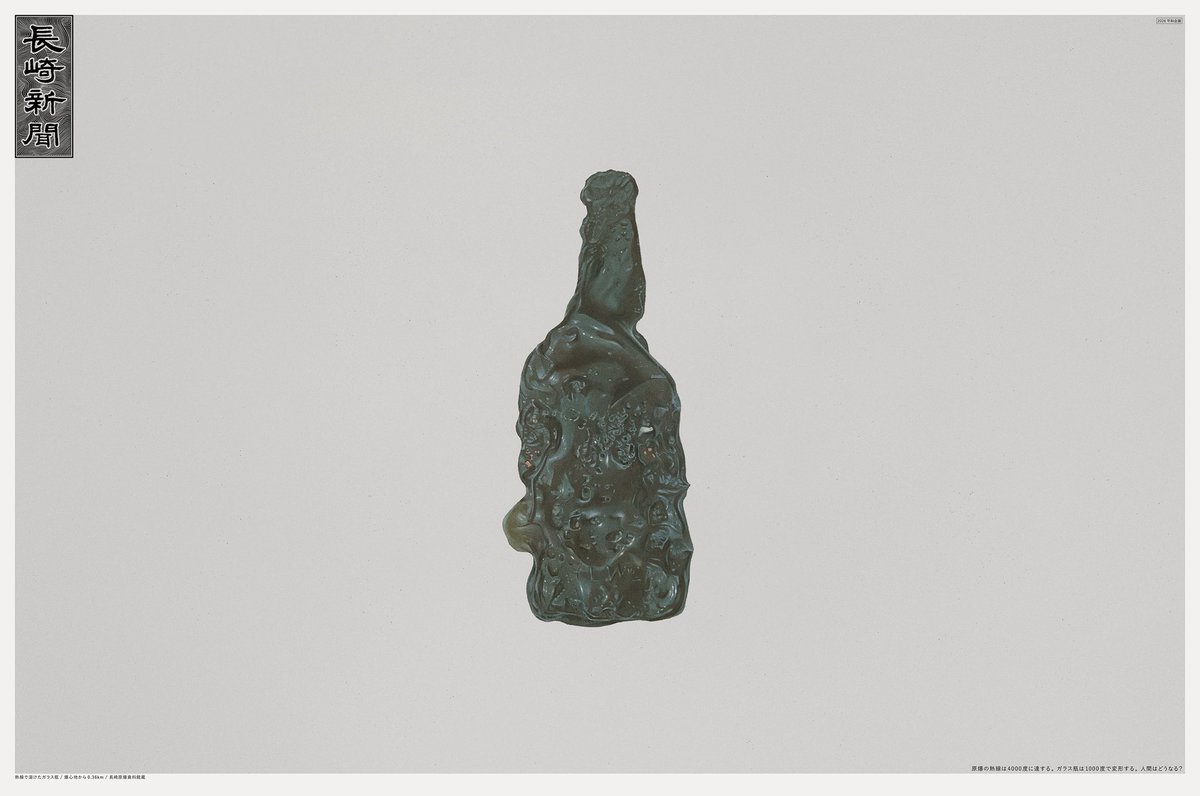
本日8月9日付け長崎新聞に掲載された広告です。
81年前、長崎で人間に何が起こったのか?世界中のみなさんに知っていただきたいと思います。
I’d like to share an advertisement published in today’s Nagasaki Shimbun.
We want people around the world to know what happened to human beings in Nagasaki 81 years ago.
--------------
人間はどうなる?
長崎に投下された最新兵器が、
一瞬にして日常を破壊する。
4000度の熱線を浴びた
台所のガラス瓶は変形する。
町を焼き尽くす炎のなかで
少女のお弁当は炭となる。
爆風による10トンの圧力で
家や工場は押しつぶされる。
そのとき、
人間はどうなる?
皮膚はどうなる?
眼球はどうなる?
背骨はどうなる?
内臓はどうなる?
細胞はどうなる?
あれから81年。
テクノロジーはさらに進化した。
その技術で、人間はどうなる?
のこされたものが、
無言で問いかけてくる。
What happens to a human being?
The most advanced weapon of its time was dropped on Nagasaki.
In an instant,
everyday life was destroyed.
Exposed to heat reaching 4,000°C, a glass bottle in a kitchen was deformed.
In the flames that consumed the city, a young girl’s lunch was reduced to charcoal.
Under ten tons of pressure from the blast, homes and factories were crushed.
In that moment,
what happens to a human being?
What happens to the skin?
What happens to the eyes?
What happens to the spine?
What happens to the organs?
What happens to the cells?
Eighty-one years have passed.
Technology has advanced far beyond.
With that technology,
what happens to a human being?
What remains says nothing.
And yet, it asks us everything.
"I am one of the survivors of the atomic bombing of Nagasaki. At the time, I was 13 years old, at home, around 3 kilometers east of ground zero.
It was August 9, 1945. I suddenly heard the buzzing sound of a bomber jet, and was soon after engulfed in a bright, white light. Surprised, I ran downstairs and got down on the floor, covering my eyes and ears with my hands. The next moment, an intense shock wave passed through our entire house. I have no memory of that moment, but when I came to my senses, I found myself under a large, glass sliding door. It was a miracle that none of the glass was broken, and I was somehow spared injuries.
Three days later, I sought out the families of my two aunts who lived in the area near the hypocenter. It was then that I saw the full devastation of the bombing of Nagasaki. Walking with my mother, we went around a small mountain. Reaching a pass, we looked down in horror. Blackened ruins spread out as far as the port of Nagasaki, some three kilometers away. Urakami Cathedral, the largest brick church in the East, had collapsed to the ground, leaving no trace.
All the houses along the path, down to the foot of the mountain, were burnt to the ground and corpses lay scattered around them. Many people who were badly injured or burned, but still alive, were left unattended, with no help whatsoever. I became almost devoid of emotion, somehow closing off my sense of humanity, and simply headed intently for my destination.
I found the charred body of one aunt at the remains of her house, 400 meters from the hypocenter, along with the body of her grandson, a university student.
The other aunt’s house had collapsed and become a pile of wood. My grandfather was crouched down, on the brink of death, with severe burns all over his body. My aunt had been severely burned, and died just before we arrived. We then cremated her remains with our own hands. My uncle, who was initially mostly unharmed, had left the area to seek help. Yet we later learned that he had collapsed at a rescue station, and died after suffering from a high fever for a week. Thus, one single atomic bomb transformed five of my relatives, so mercilessly, taking all of their lives in one fell swoop.
The deaths I witnessed at that time could hardly be described as human deaths. There were hundreds of people suffering in agony, unable to receive any kind of medical attention. I strongly felt that even in war, such killing and maiming must never be allowed to happen."
80 years ago a nuclear bomb was dropped on Terumi Tanaka's city of Nagasaki, Japan, killing an estimated 70,000 people. Today Terumi is 93 years old but nuclear weapons still threaten our world. Terumi tells his story to remind us of the inhumane suffering survivors were forced to endure and to secure the abolition of nuclear weapons, which must not be allowed to coexist with humanity.
Watch Terumi Tanaka's full testimony at https://t.co/kmKf2dXVQv