Professor of behavioural genetics with my own twins. I mix behaviour and genetics @unitartu and @mcgillu to understand obesity. I also mix global music as a DJ.
📢I'm setting up a new team at the @humantechnopole in Milan. We have several openings in AI applied to nationwide health data, biobank-scale -omics.
Milan is a beautiful city and at @humantechnopole is top notch.
You can find post-doc positions here: https://t.co/42CYaFNX0Z
People keep asking what the Soviet occupation actually cost the Baltic states. You don't have to imagine it. There's a control group, and it's sitting right across the gulf.
In 1938 — the last full year before the war — Estonia and Finland had essentially the same GDP per capita. Two small nations, same sea, neighboring languages, the same starting line. By some rankings Estonia was even slightly ahead. Heritage FoundationX
Then history split in two.
Finland fought the Winter War and kept its independence. Estonia was occupied, annexed, and folded into a planned economy. Same decade, opposite roads.
Fifty years later:
🇫🇮 Finland — ~$24,000 per person (1992)
🇪🇪 Estonia — ~$2,800
An eightfold gap — from an identical starting point. Not because Finns worked harder. Not because Estonians were less capable. One country was free to build. The other was told what to build, for whom, and at what loss.
The wages say it even more cleanly: in 1938 Estonian purchasing power was just 4% below Finland's; by 1988 it was 42% below. That cliff is the occupation, drawn in numbers.
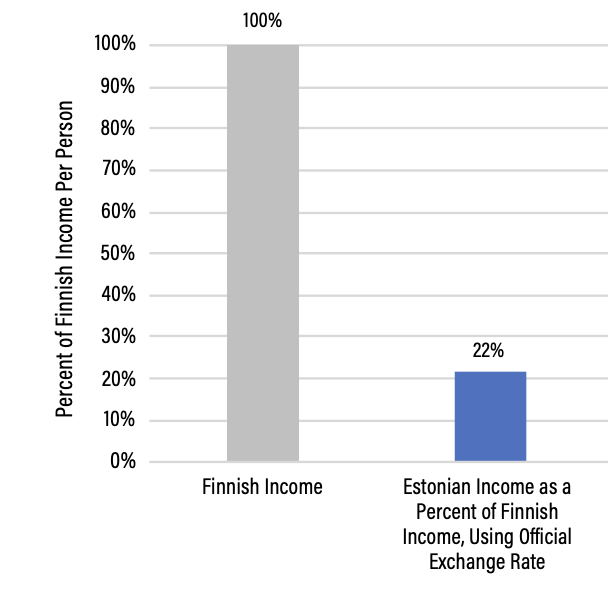
And here's the part that ends the argument. Set free for a single generation, Estonia has already clawed back to roughly four-fifths of Finnish income. A gap that took 50 years to open is closing in 30. That's the proof it was never about us — it was the system imposed on us.
There's a cost that never shows up in GDP, either. No occupation means no cattle cars to Siberia. No murdered and exiled intelligentsia. No decades of settlers moved in to outnumber the natives — which means the very "Russian-speaking minority" Moscow is now parading before the ICJ wouldn't exist at anything like that scale. The grievance Russia is litigating is one it manufactured itself.
So no — we don't wonder what we lost. We can see it from the ferry.
And free at last, it's what we're finally becoming again. 🇪🇪🇱🇻🇱🇹
I hadn't been following the Gino vs Harvard drama once it became obvious Gino was guilty, but this from Harvard's latest filing is nuts. They imaged the laptop at the start of the investigation, so they caught her when she made a fake, backdated file with "data" from her research
This paper led by @SabrinaGClemens went back and reanalyzed task-fMRI data and incorporated more than a decade of subsequent cognitive testing. Individuals who were unimpaired, but later developed dementia, had greater evoked activity at baseline. https://t.co/y2VYdQvxS3
Up to age 60, adult brain volume completely dominated by stable individual diffs. At 80 yrs, up to 50% reflects differences in change. Interpretation: 1) We change similarly up to 60. 2) Group comparisons often not reflecting changes. @Edvardosg@LCBC_UiO https://t.co/ZX8oNW7Bb0
The golden years of AirBNB were a temporary arbitrage on depreciation.
There was a universe of beautiful well-maintained properties and hosts that had not been worn down by short term guests.
And the AirBNB hosts didn’t properly estimate the cost of depreciation to maintain that standard, so costs were irrationally low
That era fundamentally cant return, it was a temporary arbitrage opportunity
There was once a supply of fairly pristine unused space and now there’s not
If a space does manage to hit the 2014 standard, it must charge a lot more to fight depreciation
And at that point a hotel is generally better
This preprint and accompanying browser provide another fantastic resource for exploring causal biology, with genotype–phenotype associations for both common and rare variants across 3,602 traits in the All of Us cohort (N=392,030)!
Our intelligence services reported receiving data, including from American and European partners, about Russia preparing a strike with the Oreshnik missile. We are verifying this information.
We are seeing signs of preparation for a combined strike on Ukrainian territory, including Kyiv, involving various types of weaponry. The specified intermediate-range weapons could be used in such a strike. It is important to act responsibly on air-raid alerts, starting this evening. Russian madness truly knows no bounds, so please protect your lives – use shelters.
Second, we are drawing the attention of our partners in the United States and in Europe to the fact that the use of such weapons and the prolongation of this war also sets a global precedent for other potential aggressors. If Russia is allowed to destroy lives on such a scale, then no agreement will restrain other similar hatred-based regimes from aggression and strikes. We count on a response from the world – and on a response that is not post factum, but preventive. Pressure must be put on Moscow so that it does not expand the war.
Third, we are preparing our air defense as much as possible, and we will respond fully justly to every Russian strike. We have given permission for a parade, but Russia has no permission for madness. This war must be ended – we need peace, not some missiles satisfying the sick ambitions of one individual. I thank everyone helping to protect lives. Once again, please take care of yourselves and use shelters tonight.
Great new genomic resources for inflammatory bowel disease (IBD) from the International IBD Genetics Consortium
1⃣The largest to date IBD GWAS in 125,992 cases & 1.2M controls showing 619 independent signals at 420 IBD regions accounting for 77–80% (!) of SNP-based heritability
In some very real sense, Ozempic was invented in 1990. Pfizer ran the human trials and just never published them.
They showed it lowered blood glucose in diabetics, slowed gastric emptying, and killed hunger; the same 3 things that make Ozempic work today.
The joint venture agreement said internal data stayed internal, and that was that. Pfizer killed the program in 1991. The reasoning, as far as I can tell, was that nobody would ever want an injectable diabetes drug besides insulin.
So, the license went back to the hospital in Boston that held the patents.
Novo picked it up in 1992 and spent the next two decades building liraglutide, then semaglutide.
It's insane that data sat in a filing cabinet for 30+ years.
I only know this because Jeffrey Flier, one of the Harvard scientists in the room, finally wrote it up. He's in his late 70s and didn't want the history to die with him.
This makes you wonder what else is in those filing cabinets.
Ozempic could've existed 27 years ago.
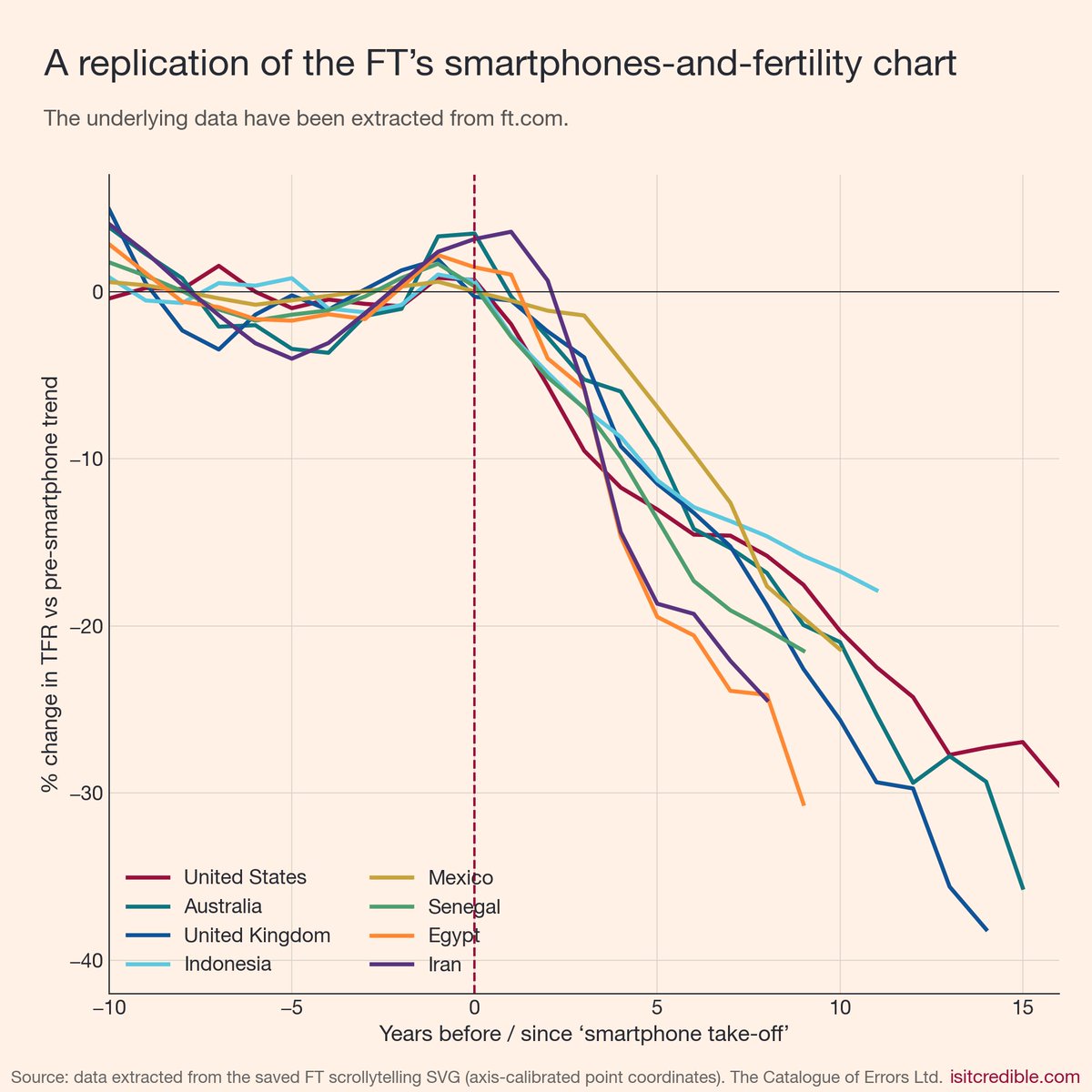
By extracting the data from the @FT's smartphones-and-fertility chart, I was able to replicate it and reverse engineer how @jburnmurdoch may have calculated it.
Seatbelts on. 1/7
Forthcoming in the JEL: "Social-Science Genomics: Progress, Challenges, and Future Directions" by Daniel J. Benjamin, David Cesarini, Patrick Turley, and Alexander Strudwick Young. https://t.co/bpb2MELKM7
Very excited about this preprint that we just posted! It introduces the Genomic-Relatedness Matched Association (GRMA) study. It’s an extension to family-based GWAS that uses extended relatives beyond only siblings in diverse-ancestry data with very little bias.
Here are my four GWAS lectures of ~20 minutes each for the International Statistical Genetics Workshop 2026.
They're part of the broader workshop curriculum but also work as standalone lectures covering the basics of GWAS from the ground up.
Videos are below 👇🏽
We gained exclusive access to Ukrainian cyberwarfare specialists and front line intelligence officers for our new @thetimes documentary, The Starlink Hack That Fooled Russian Forces... 1/
Too many threads on going on, so going to try to consolidate.
I don't think anyone objects to the core principle nominally at play here that if you put science out into the world, you are responsible for that work. This is what science is. I don't want to get distracted by questions of authorship or how responsibility is apportioned amongst authors - that's an orthogonal issue.
The expectation that you can trust the scientific outputs (and I'm intentionally broadening this beyond papers) of others is really a defining feature of science as a collective endeavor. And obviously, if a paper contains hallucinated references, fake citations, placeholder text, or obvious autogenerated junk, it’s hard to argue the authors exercised even minimal scholarly care.
People have tried to paint me and the others who have expressed concern about the new arXiv policy as somehow questioning this. We're not. To me something deeper shift is represented by that move, and I think it warrants at least acknowledgment - and IMO deeper discussion.
The value of preprint servers to the research community comes from them being fast, open, effectively unfiltered, and agnostic about correctness. A lot of great science is published first on arXiv and other preprint, and so is a lot of science that is poorly executed and often poorly presented. Since the existence of the later doesn't devalue the former, it's a bargain most people are happy with.
One of the things that kept this model afloat was the fact that producing a paper required some non-trivial effort, and therefore people inclined to produce works that could en masse disrupt the ecosystem could not actually produce them at scale.
AI has obviously shattered any remnant of connection between things that look like papers and scholarly output and effort (mind you, I think this is a good thing, but that's also a somewhat separate topic). **But the response to it has also broken something.**
arXiv (and other preprint servers) have always had to impose some kind of screening to keep out obviously inappropriate stuff, and I think most of us agree that asking "Is this an actual work of science?" before posting something is a reasonable thing for a preprint server to do (provided that the definition of what a work of science is is intentionally fairly broad).
However, the new policy is explicitly changing that bargain. The question is no longer "Is this a relevant scholarly work?" Rather it is becoming "Can we trust this authorial process?".
That is a HUGE shift.
Look, I understand why moderators feel existential pressure - the system isn't architected in infrastructure, processes or modes of use with a massive flood of AI-generated papers.
But there are some real risks in the new direction.
1) The thing that makes preprint servers different from (and better than) journals is that there is no gatekeeping. The new policy threatens this. Once moderation becomes about inferring authorial integrity, the boundary between “quality control” and “editorial policing” gets blurry. The fact that one of the 'punishments' is to force people to go through peer review before posting to arXiv (an idea too absurd to even mock), suggests that current leadership has a comfortable relationship to journal peer review that makes the risk that arXiv will become a journal in every meaningful sense more of a risk.
2) “Incontrovertible evidence” sounds, well, incontrovertible, but moderation systems take on a life of their own via various forms of procedure, precedent and social signaling. Today it’s hallucinated references. Tomorrow it could become stylistic mimicry. Slippery slope here.
3) The policy misdiagnoses the real problem. As I've said elsewhere, the issue is not “AI use” but the system that leads people to think it will benefit them to push slop onto arXiv. LLMs may amplify the negative effects of metric-driven academia, but they didn't create it.
To me we are at a fork in the road moment.
There is a world within our grasp where an alignment of preprinting and AI actually breaks the toxic stranglehold that traditional publishing has on science. A world where actual communication (not the facsimile of it we have today) takes place between people, between machines and from people to and from machines, around data and ideas in science.
But there is also a world where the preprint servers we love collapse in fear and a lack of imagination into irrelevancy and we lose to moment. I'm not saying this policy itself will cause that. But I am saying that it's not a good sign.