“El lujo es vulgaridad”
La frase se volvió popular por una canción de los Redondos.
Pero antes fue prólogo, cuento, entrevista, conversación y mirada ética.
Borges la escribió, la narró y la dijo con distintas formas.
¿La exploramos juntos?
Abro hilo. 🧵
A few years ago, I found some of my mom’s menu plans from around 1980 in an old steno pad. She cooked breakfast, lunch and dinner for my father daily. As they got older, he would take her out on Saturday nights for dinner and a movie… religiously.
La última sobre Borges y mi hijo. Ahora que recuerdo bien, otro libro que Rodrigo también se llevo de mi biblioteca fue "Borges Profesor: Curso de Literatura Inglesa en la Universidad de Buenos Aires", publicado por @LumenEdit en 2020, una edición de 536 páginas (un dato nada pueril como explicaré) que consiste en las versiones mecanografiadas de unas clases que Borges dictó en la @UBAonline en 1966. No resulta gratuito el dato del número de páginas, como mencioné, porque el año pasado Sudamericana publicó "Curso de literatura inglesa y norteamericana. Universidad de mar del Plata, 1966", un libro de 480 páginas. ¿Se trata de las mismas conferencias? ¿Otra versiones de las mismas clases? Habrá que revisar uno y otro libro para comprobarlo. Felizmente, conozco bien el libro que se llevó mi hijo y podré salir de la duda. En todo caso, el segundo libro ya está en mi lista de compras de julio. Definitivamente.
👉https://t.co/POYbxZ9LeM
👉https://t.co/I12izukL4r
Медаль «За взятие Берлина».
Medal "For the Capture of Berlin".
June 9, 1945.
The Medal "For the Capture of Berlin" is a state award of the USSR .
It was established by the Decree of the Presidium of the Supreme Soviet of the USSR of June 9, 1945, "On the establishment of the medals 'For the Capture of Budapest,' 'For the Capture of Königsberg,' 'For the Capture of Vienna,' and 'For the Capture of .'"
The medal was designed by artist A. I. Kuznetsov .
The award was established to commemorate the capture of the capital of Nazi Germany, which occurred during the final stages of the Great Patriotic War to the medal's statutes, it was awarded to Soviet soldiers who directly participated in the assault on Berlin, as well as to the organizers and leaders of combat operations during the capture of the city
According to various sources, approximately 1,100,000 people were awarded the Medal "For the Capture of Berlin . "
On April 19, 1945, the Chief of the Red Army's Rear Services, General of the Army A. V. Khrulyov, gave the Technical Committee of the Main Quartermaster Directorate the task of developing projects for medals for the capture and liberation of cities outside the USSR .
The first sketches for the medal "For the Capture of Berlin" were presented as early as April 24, 1945, when the battle for the German capital was in full swing.
A total of 116 sketches were submitted to the competition to determine the appearance of the future award.
On May 3, the engraver of the Technical Committee, V. N. Andrianov, began producing the first samples in metal, based on the best of the submitted designs . As noted by the historian and phalerist V. A. Durov , the names of the medals were discussed at length.
"But in the end, they came to the general conclusion that the medals in honor of the liberation of the Slavic capitals from the Nazi yoke would bear the inscription 'For Liberation,' and the remaining medals – 'For Capture,'" the researcher wrote .
"Artists, inspired by the great victory, tried to express as vividly as possible in their drawings the significance of the capture of Berlin as a stronghold of Hitlerism," wrote V. A. Durov .
Thus, the artist E. M. Romanov included the image of the Order of Victory in his sketches .
A. I. Kuznetsov, who had already participated in the development of a number of Soviet orders and medals, presented several versions.
"In one of the projects, he depicted a Soviet soldier trampling on a swastika, in another - three Allied flags - the Soviet in the center and the flags of the USA and Great Britain on either side as a sign of military cooperation in the joint fight against fascism.
Below are crossed keys as a symbol of the capitulation of the capital of Nazi Germany," Durov described Kuznetsov's sketches .
The artist Kiselev put forward a design for a medal that depicted Soviet tanks passing with fluttering flags against the backdrop of the Brandenburg Gate .
In connection with the decision to place only an inscription on medals for the capture of enemy cities, one of the sketches by the artist A. I. Kuznetsov was adopted as the final version.
The design contained only the words "For the capture of Berlin" and the date of the city's fall .
By the decree of the Presidium of the Supreme Soviet of the USSR of June 9, 1945, the medal "For the Capture of Berlin" was established simultaneously with three others: "For the Capture of Budapest" , "For the Capture of Königsberg" , and "For the Capture of Vienna" .
The document was published in the weekly publication "Vedomosti of the Supreme Soviet of the USSR" in issue No. 34 .
Thus, the medal "For the Capture of Berlin" became one of seven Soviet awards established for the capture of cities located outside the pre-war territory of the USSR.
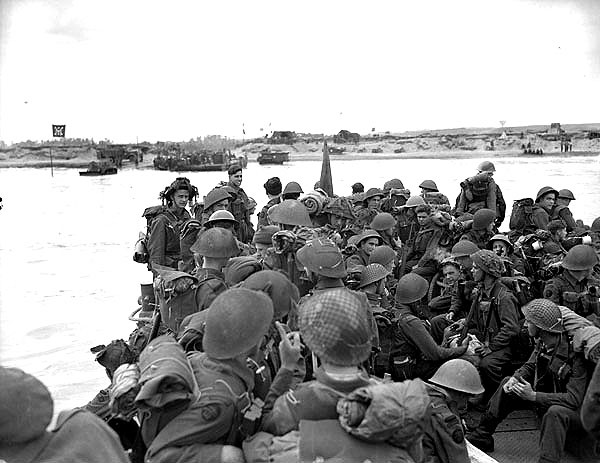
Reinforcements on Omaha in front of the cliff of Colleville sur Mer sector Fox Red. In the foreground, a GI has passed a life belt around his ammo boxCredit