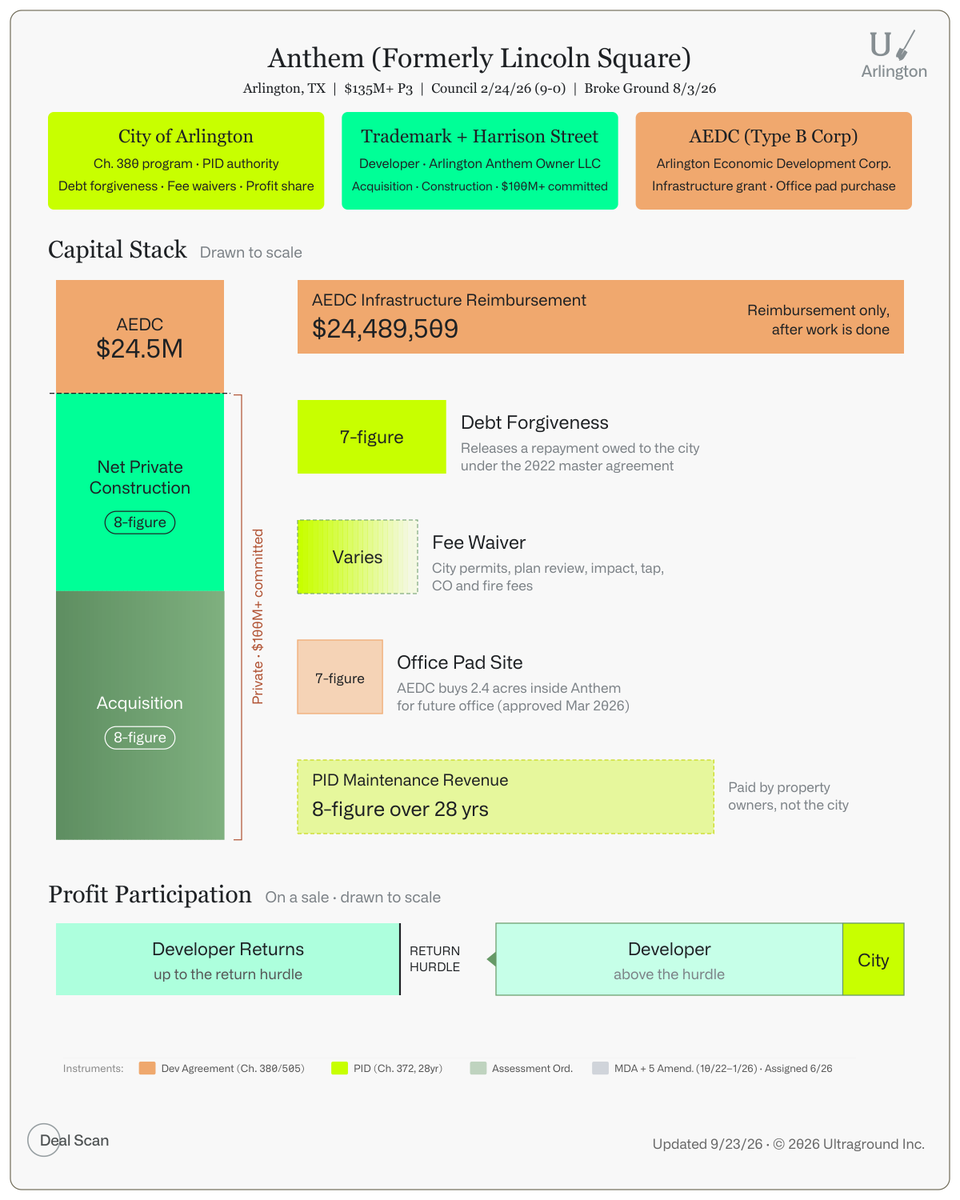
The City of Arlington is putting $24.5M into an aging mall to stop losing money. The best fiscal hawk move we've seen this year was to spend money rather than save it.
Arlington's old Lincoln Square mall used to bring in over $3M a year in sales tax. Now it's under $1M. So doing nothing was already costing the city about $2M a year.
The city said yes to Trademark's redevelopment, with conditions:
- The city's $24.5M only gets paid out after the work is done
- Miss the leasing and jobs targets and the money gets clawed back
- Sell for more than projected and the city gets a percentage of the upside
Construction started in August.
One Austin 4% deal: 336 units, $6,000/unit in soft funding.
Another: 58-unit component, $216,000/unit.
Across 14 financing stacks: $121.1M in awards and commitments. $50,500/unit on average.
Give me multifamily data for the Raleigh MSA. This is what I asked the @ultragroundco api. Over half of the first 44 deals included some form of commercial square footage, making them "mixed-use."
The structure of the commercial in these deals varies widely: some had it shown in the plan, while others structured it as a binding delivery commitment; i.e., no residential permit until we get our retail.
Cities are pricing development rights the way companies price their products, and the terms are written deal by deal. Metered fees by the square foot. Flat fees. A percentage of the units, held with the land for decades.
In Austin in 2026, you can pay for the right to build taller and denser. The payment options are wide, though, and cash isn't the only currency. Income-restricted units in your own building with discounted rents held for a set number of years, cash per square foot, land, sometimes infrastructure the city wants built.
The prices this spring, from the deals we track:
– $1.50 to $7.00 per square foot: the cash price of extra buildable area.
– 5% to 15% of units: the on-site affordability requirement.
– 50% to 80% of median family income: how deep those rents go.
– 40 to 99 years: how long it all runs.
99 years means the affordability requirements you agreed to will stay with the property for 99 years, on a Class A market-rate product.
Another standout: a 400% mitigation payment for removing a single heritage oak.
Cities are becoming more creative dealmakers every cycle, and it shows in the terms of each new deal.
A church at 86th and Amsterdam on the Upper West Side has activated the YIMBY/NIMBY debate. The debate around the Center at West Park has presented two options: preserve it or replace it with “luxury high-rise” housing.
The Center was selected for $3 million in State funding for upgrades, subject to completing the remaining application process. I noticed the debate lacks nuance.
In cities like Dallas, Fort Worth, Bellevue, Austin, and Jacksonville, municipalities are playing an active role in welcoming market-rate and affordable redevelopment on faith-based sites. But churches do not magically turn into housing. Developers still have to make the acquisition, entitlements, design, and financing work. Cities and states have to decide whether to welcome that work or stand in its way.
Here are 10 deals that began with church-owned property. Together, they represent 1,603 total units. 1,198 are income-restricted.
– 339 use LIHTC without a local housing or public facility corporation.
– 270 combine LIHTC with a local HFC or PFC.
– 373 use a local HFC or PFC without LIHTC.
– 216 use other income-restricted structures.
– The remaining 405 units are not income-restricted.
These are not all church conversions. Some reuse the existing building, some build around it, and others replace it. The data show that church and redevelopment are not mutually exclusive.
Irma Park in Fort Worth is the clearest physical example. The proposal puts 70 senior units inside the existing church and another 14 in a new building on the property.
Fort Worth is not simply deciding whether to approve it. The City adopted a resolution of support, committed fee waivers, made the project eligible for NEZ incentives, and opened access to local tax-abatement programs. The capital stack also requests a conditional $3 million subordinate City loan. That loan is requested, not committed.
New York and Fort Worth are both talking about $3 million, but for very different purposes. New York’s funding is meant for upgrades that preserve the building’s community use. Fort Worth’s is a requested loan that would become part of the financing for 84 income-restricted senior units.
Irma Park’s 9% LIHTC application was tentatively recommended for an award on July 15, subject to the TDHCA Board meeting on July 23. This is a partnership that does not work without collaboration between public and private groups.
I am not saying Irma Park can be copied and pasted into Manhattan. But true creativity lies in the collaboration between public and private partners. That is the part I think is missing from the West Park debate.
Mark Ruffalo has argued for preserving the church as a community space for “struggling actors” like he used to be. What if the question were: preserve artist residencies or create residences for artists?
The Ultraground API is live.
Bring your own AI. We’ll bring the data it cannot find, normalize, or maintain.
5,000+ maintained project records across 500+ jurisdictions, backed by 300,000 pages of processed source documents.
This week there was a meeting in Dallas to discuss reducing single-family lot sizes, allowing duplexes and triplexes/fourplexes by right in single family zoning districts
This "attitude meter" published by @ultragroundco along with quotes from each CM is a great graphic
Major moves in #FortWorth zoning this week!
Approved developments: 15-acre Multifamily, 134-acre Multifamily/Commercial/SFR, and more.
Palladium wins approval with extensive neighborhood engagement for their 243-Unit Multifamily.
Hearing customer feedback like this puts wind in our pirate ship's sails!
"Yes, please. I no longer have three hours just to read the council agenda, let alone take action on any given council item, but I would love to stay informed."
(Dallas, TX)
First look!
Redwood City zoning map amendments show Veteran's Blvd, Woodside Rd, and El Camino getting upzoned to mixed-use.
Plus, increase in heights for the zones.
Berkeley had its largest volume of rezonings at the last zoning meeting.
Our report covers a project that came back two years later and 17 units denser (with no change in massing).
Did you know that multifamily towers situated in the middle of the block garner more scrutiny than end lots?
We detail Austin's latest 550-foot, 359-unit tower and its reception by neighbors in today's Planning report, available to Ultraground One members.
Berkeley California has seen explosive growth in R&D office.
Now their problem is: how do we keep companies here?
A new way of entitling R&D projects is detailed in today's Berkeley report. This method removes the need for a map amendment.