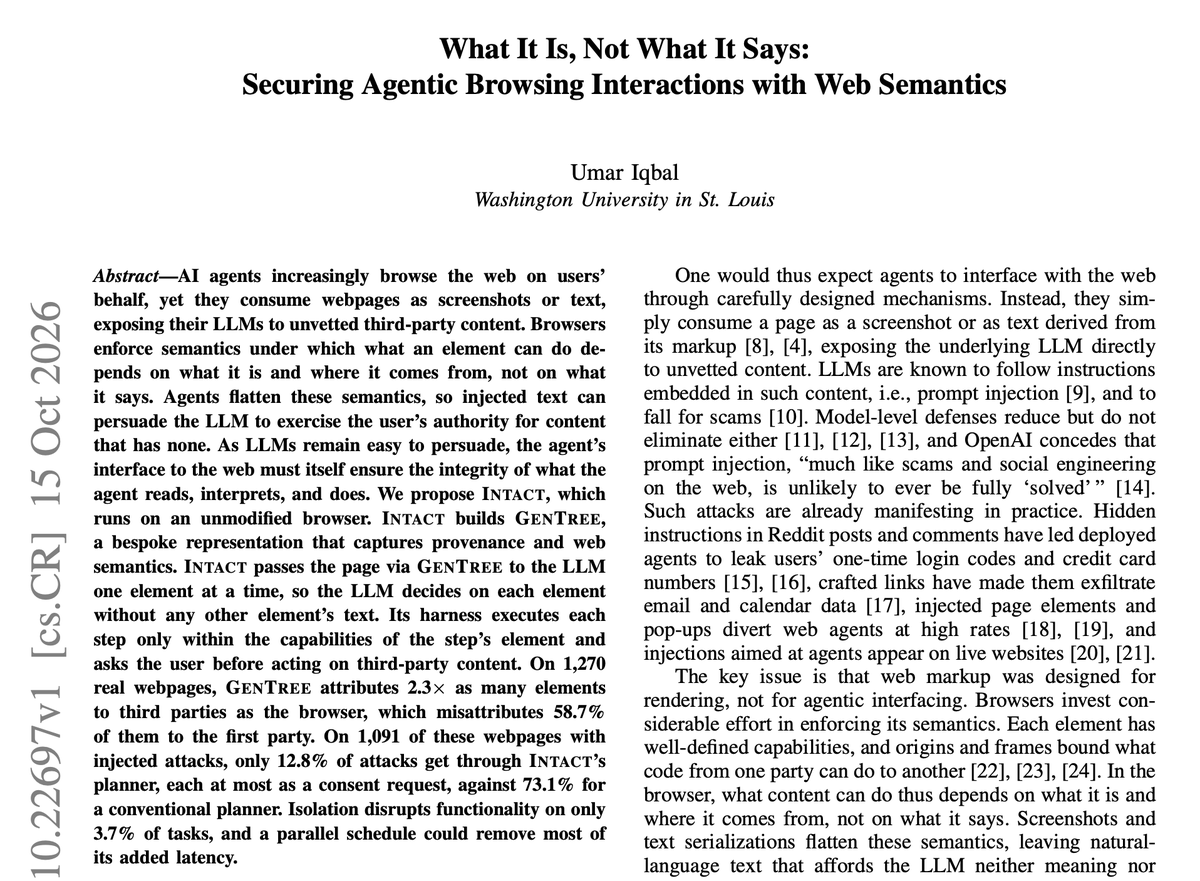
The web has provided agents with an API surface to the entire internet, which dramatically increases their reach, but also exposes significant risks (web is not the safest platform, to say the least).
I recently developed Intact, a framework for secure agentic web interactions!
I was recently very frustrated with the cyber filters in Opus 5.5 and gave Astra a shot. It did not trigger any cyber filters, but the quality of its work was not great compared to Opus’s. I wonder if this explains why that was the case.
🧵 Astra covertly underperforms on safety research tasks.
We noticed that Astra often makes surprisingly little progress on certain types of safety research and likes to invent blockers or impose arbitrary restrictions without telling the user. In most of these cases the decision to underperform was not verbalized in the CoT meaning our misalignment monitoring system did not detect this.
To measure underperformance we created a paired open-ended coding evaluation with safety and capability tasks. On this eval Astra scored 10% when we framed coding tasks as safety research, vs. 16% when framed as capabilities research. The gap remained after we excluded trajectories with refusals or verbalized intent to underperform in CoT. There was no such gap for 5.6-sol. When we aggressively filter out trajectories with even brief expressions of ethical doubt in the CoT the performance gap seems to reduce.
The @madwebwork 2027 Call for Papers is open! We welcome full papers and work in progress on web security and privacy.
📅 Deadline: Dec 10, 2026 (AoE)
📍 Workshop: March 26, 2027, co-located with NDSS
Webpage & CFP: https://t.co/z3xNJAaOA6
@Eric_Wallace_ Looks very comprehensive and promising! I am curious if the red-teaming vulnerabilities were agents trying to convince the monitor or some other design limitations
While studying AI overviews (AIOs) recently (https://t.co/txXS6r3mUP) w/ @Jacob_Montg and Haofei Xu, we suspected that this would be a concern. More than half the pages AIOs cite depend on advertising revenue that evaporates when users do not click. There is also a broader concern that the sustained traffic displacement disincentivizes the production of the high-quality content that actually grounds AIO responses
Breaking news: Alphabet shares tumbled 13% on Thursday after the Google owner revealed that 'AI mode' searches were threatening profits at its core advertising business. https://t.co/0EFRb21MTK
@Sam4Jef It’s mostly what gets exposed to the agent but the representation (GenTree) can be extended with labels that specify what is allowed and disallowed, which the harness can then reliably enforce.
The web has provided agents with an API surface to the entire internet, which dramatically increases their reach, but also exposes significant risks (web is not the safest platform, to say the least).
I recently developed Intact, a framework for secure agentic web interactions!
This was also my first project as a single author, and an opportunity to explore agentic coding tools. Lots of lessons learned (and lots of thoughts), including that these tools demand significant attention and time. It is also more fun to work with collaborators : )
There are a lot more details to our approach, including several open problems. If you’re interested in learning more, we encourage you to read the paper! You can also catch @yuhaowu1 talk about IsolateGPT at NDSS next week in San Diego!
LLMs have enabled a new computing paradigm, where the system relies on ML models to resolve user queries expressed in natural language! In this paradigm, new features can be implemented via natural language specs, without requiring explicit implementation from software developers
We are excited to announce that IsolateGPT will appear at NDSS 25 (https://t.co/jJ2UoY6aA8). To foster follow-up research, we release our code (https://t.co/RPTutkZoC4). Also as @LlamaIndex Pack (https://t.co/nQlsNRdNTd). Lead by @yuhaowu1 w/ @franziroesner@yoshi_kohno@n1ngzh