If you’re into finance and economics, do yourself a favour: listen a lot to Tinubu’s views on finance and economy. No one comes close.
I have about 40 clips of him on finance.
He’s a genius in finance, leadership and economics.
Also, consider doing an MBA; it will help!
Professor Bola Ahmed Tinubu delivering a lecture, years ago, in Chicago on Financial Autonomy and Breakthrough, Exemplary Leadership using Mr Lear of the Lear Jet(now Bombardier) as a Case Study.
Enjoy this class👇
SIMON KOLAWOLE: “Tinubu could have expressly admitted that reforms indeed bring pains but that in due season, we will reap if we faint not. Good things take time. Nothing is called gold until it passes through fire. I do not think Tinubu talked rudely to the bishops, but the subsequent response of his supporters did not help matters. It is the duty of the government and its agents to sell Tinubu’s policies to the people without being argumentative or confrontational. I do not think they needed to respond to Onaiyekan at all — or in the tone with which they did. There is no doubt that Tinubu is cocksure he is on the right path in charting a course for the economy, but he owes Nigerians assurances at every turn.”
https://t.co/UGcRIXm1XA
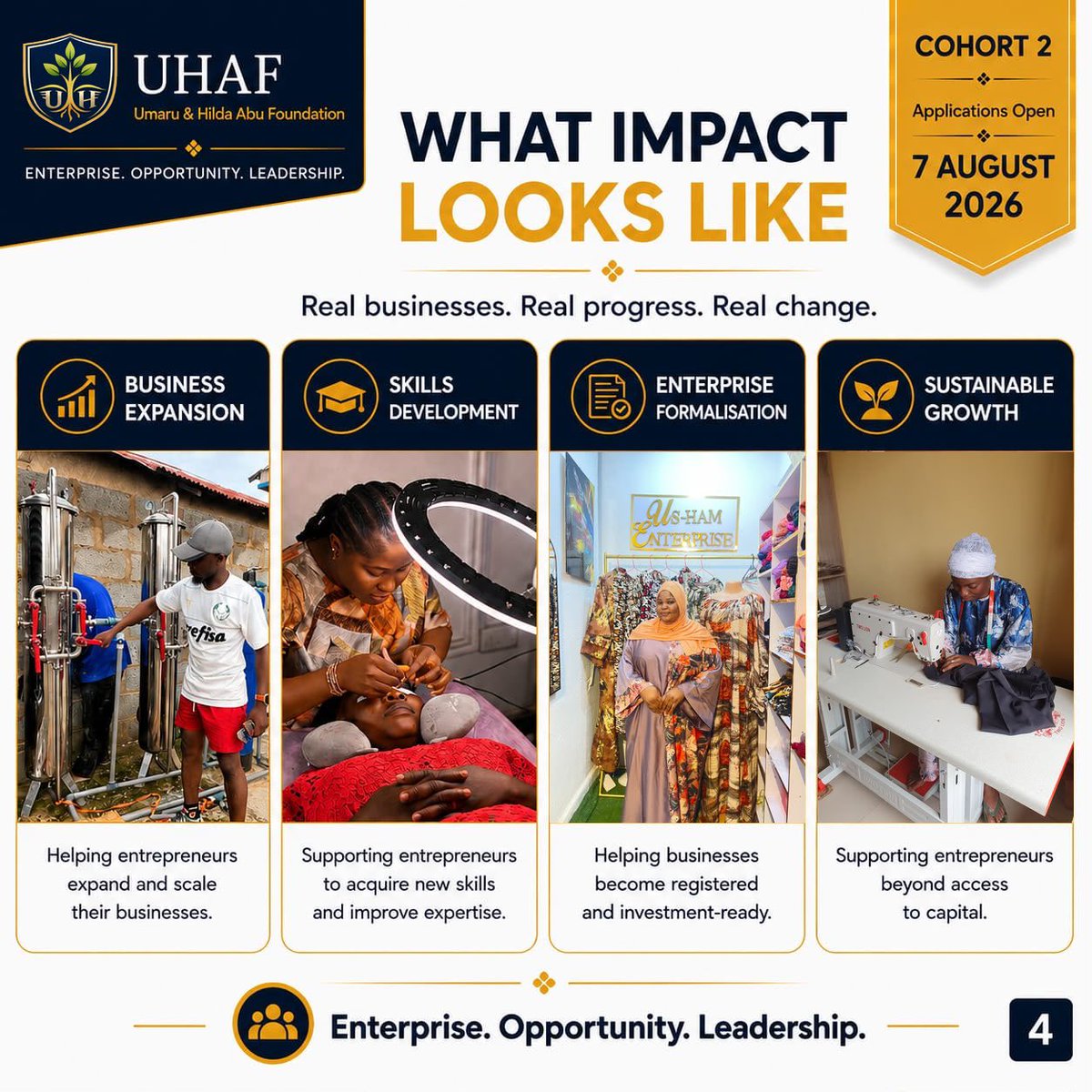
THE UHAF COHORT 2 APPLICATIONS ARE NOW OPEN!
Are you a young entrepreneur (18–40) in Abuja or surrounding communities? Scale your business with key support from the UHA Foundation!
What you get: Up to ₦1,000,000 in interest-free loans Free business formalisation & registration
"Cardinal Onaiyekan's Arise News interview also reflected a familiar error that many ideological and professional critics make. They often assume that only critics speak truth to power, while everyone around a leader is either unwilling or incapable of doing so. It is an attractive narrative, but it is rarely true".
- @TheTope_Ajayi
Cardinal Onaiyekan's Abuse of Clerical Privilege
By Temitope Ajayi
There is something fundamentally inappropriate about Cardinal John Onaiyekan granting a television interview to offer his own account and interpretation of what transpired during the private meeting between the Catholic Bishops' Conference of Nigeria and President Bola Tinubu. It is, in my view, an abuse of clerical privilege.
The bishops requested an audience with the president. He granted the audience graciously. They presented, as was their right, a catalogue of the country's economic, social, and security challenges as they saw them. Except for their grudging acknowledgement of the benefits of NELFUND, they were dismissive of the other great things done by the administration. The bishops were notably acerbic in their submission, but the president listened to them patiently and responded.
That should ordinarily have been where the matter rested. None of the issues raised by the bishops is beyond scrutiny or rebuttal. Their assessment is neither scripture nor an article of faith. It is a perspective, and perspectives can be challenged with facts and evidence.
President Tinubu did exactly that, responding point by point to the issues they raised. On the bishops' demand for the return of schools to their owners, the President was surprised that such an issue could be tabled before him, as it is a matter for the states to resolve, in line with our constitution. So, he asked the bishops to take the matter to the governors and reminded them he returned mission schools in Lagos State when he was governor.
The President argued that the bishops’ characterisation of the country's current condition was incomplete and, in several respects, inaccurate. He pointed to measurable progress on the economic, social, and security fronts. He did not pretend that Nigeria's problems had disappeared. He acknowledged that significant economic and security challenges remain. His point was that the country has emerged from "a dark tunnel", that his administration has laid the foundations for recovery and that the next phase is to ensure the greatest number of Nigerians feels the gains.
What the clerics often overlook in these interventions is that governing a country is fundamentally different from shepherding a church. In a democracy, every interest group, including the Catholic Church, has every right to demand more from government. That is part of democratic engagement.
But the president of a nation of more than 200 million people is required to make difficult choices every single day. Those choices involve competing interests, limited resources, and imperfect options. They will inevitably disappoint some constituencies. There is no president, whether Tinubu or whoever succeeds him, who can wave a magic wand and make Nigeria's accumulated problems disappear overnight.
It is easy to compile a list of national problems. It is far more difficult to acknowledge the disasters that have been averted. Whatever anyone thinks of President Tinubu's policies, it is impossible to ignore the fiscal crisis he inherited and the measures taken to pull the country away from the edge of a financial cliff. Even the bishops themselves should recognise that one tangible consequence has been the restoration of greater fiscal stability across many states.
Countless civil servants and pensioners who, for years, endured unpaid salaries and pensions are now receiving them more regularly. That was certainly not the reality in many states from around 2014. Even about four years ago, 27 state governments struggled to meet even their most basic obligations. Many of those civil servants and pensioners are themselves parishioners in Catholic churches.
They know, from lived experience rather than official pronouncements, that there has been real relief in the regular payment of salaries and pensions. While this does not erase the discomfort many Nigerians still face, it is wrong to dismiss or ignore those improvements casually.
So when President Tinubu reminded the bishops of these facts during the meeting, he was not, as Cardinal Onaiyekan later suggested, being aloof or dismissive. He was presenting evidence to support his argument that the country is not standing still. A disagreement over facts should not be interpreted as arrogance.
The same applies to security. The bishops declared that Nigeria is bleeding. The President thinks otherwise. President Tinubu did not deny the seriousness of the security situation. Rather, he acknowledged the challenge while outlining the gains recorded by the Armed Forces and intelligence agencies across different theatres of operation.
As Commander-in-Chief, he receives operational briefings, intelligence assessments, and battlefield reports unavailable to the general public. The bishops, like other Nigerians, rely largely on media reports and public information. That does not make the President infallible, but it does mean he possesses information unavailable to the generality of the people. It is, therefore, legitimate for him to argue that the overall picture is more nuanced than newspaper headlines sometimes suggest.
Cardinal Onaiyekan's Arise News interview also reflected a familiar error that many ideological and professional critics make. They often assume that only critics speak truth to power, while everyone around a leader is either unwilling or incapable of doing so. It is an attractive narrative, but it is rarely true.
What truth does anyone really need to tell President Tinubu that he does not already know? As president, he has multiple channels for feeling the pulse of the country. He reads an average of 10 newspapers every day. He watches television, including discussion programmes, to gauge public opinion. He receives daily security, social, and economic intelligence reports from various arms of government, reports that are prepared for decision-making and are not sugar-coated. In a meeting earlier in the week, he still referenced a very harsh and largely uninformed opinion piece written by Dr. Chidi Amuta in his last Sunday Thisday Newspaper column.
Beyond that, he has friends and associates embedded in the social fabric of the country, drawn from different regions, professions, and political persuasions, who serve as informal sounding boards. Against that background, the suggestion that President Tinubu somehow needs only the Catholic Bishops to acquaint him with the truth is an overreach. They are an important constituency, but they are by no means the exclusive custodians of the national mood or the nation's conscience.
To assume that criticism delivered publicly is the only form of truth-telling is to misunderstand how government works. Presidents are exposed daily to competing advice, conflicting intelligence, uncomfortable assessments, and hard realities. Presidents are constantly confronted with information, much of it unpleasant. The real question is not whether they know the truth but what choices they make in response to it.
The Catholic Bishops discharged what they considered their moral obligation by presenting their concerns to the president. President Tinubu, for his part, accorded them respect by granting them an audience and responding to every issue they raised. That exchange reflected the civility expected in a constitutional democracy.
Reciprocity should have dictated that the confidentiality and dignity of that engagement be preserved. As such, it was inappropriate for one of the participants to emerge almost immediately on national television to provide his own version of what was essentially a private conversation with the president. Clerical office carries privileges, but it also imposes obligations. Among the qualities the Scriptures require of bishops are temperance, maturity, self-restraint, and the wisdom to remain above needless public controversy. Those virtues become even more important when dealing with matters of state. Public influence should be exercised with discretion, not by converting privileged access into a platform for post-meeting commentary.
-Ajayi is Senior Special Assistant to President Tinubu on Media and Publicity
Cardinal Onaiyekan's Abuse of Clerical Privilege
By Temitope Ajayi
There is something fundamentally inappropriate about Cardinal John Onaiyekan granting a television interview to offer his own account and interpretation of what transpired during the private meeting between the Catholic Bishops' Conference of Nigeria and President Bola Tinubu. It is, in my view, an abuse of clerical privilege.
The bishops requested an audience with the president. He granted the audience graciously. They presented, as was their right, a catalogue of the country's economic, social, and security challenges as they saw them. Except for their grudging acknowledgement of the benefits of NELFUND, they were dismissive of the other great things done by the administration. The bishops were notably acerbic in their submission, but the president listened to them patiently and responded.
That should ordinarily have been where the matter rested. None of the issues raised by the bishops is beyond scrutiny or rebuttal. Their assessment is neither scripture nor an article of faith. It is a perspective, and perspectives can be challenged with facts and evidence.
President Tinubu did exactly that, responding point by point to the issues they raised. On the bishops' demand for the return of schools to their owners, the President was surprised that such an issue could be tabled before him, as it is a matter for the states to resolve, in line with our constitution. So, he asked the bishops to take the matter to the governors and reminded them he returned mission schools in Lagos State when he was governor.
The President argued that the bishops’ characterisation of the country's current condition was incomplete and, in several respects, inaccurate. He pointed to measurable progress on the economic, social, and security fronts. He did not pretend that Nigeria's problems had disappeared. He acknowledged that significant economic and security challenges remain. His point was that the country has emerged from "a dark tunnel", that his administration has laid the foundations for recovery and that the next phase is to ensure the greatest number of Nigerians feels the gains.
What the clerics often overlook in these interventions is that governing a country is fundamentally different from shepherding a church. In a democracy, every interest group, including the Catholic Church, has every right to demand more from government. That is part of democratic engagement.
But the president of a nation of more than 200 million people is required to make difficult choices every single day. Those choices involve competing interests, limited resources, and imperfect options. They will inevitably disappoint some constituencies. There is no president, whether Tinubu or whoever succeeds him, who can wave a magic wand and make Nigeria's accumulated problems disappear overnight.
It is easy to compile a list of national problems. It is far more difficult to acknowledge the disasters that have been averted. Whatever anyone thinks of President Tinubu's policies, it is impossible to ignore the fiscal crisis he inherited and the measures taken to pull the country away from the edge of a financial cliff. Even the bishops themselves should recognise that one tangible consequence has been the restoration of greater fiscal stability across many states.
Countless civil servants and pensioners who, for years, endured unpaid salaries and pensions are now receiving them more regularly. That was certainly not the reality in many states from around 2014. Even about four years ago, 27 state governments struggled to meet even their most basic obligations. Many of those civil servants and pensioners are themselves parishioners in Catholic churches.
They know, from lived experience rather than official pronouncements, that there has been real relief in the regular payment of salaries and pensions. While this does not erase the discomfort many Nigerians still face, it is wrong to dismiss or ignore those improvements casually.
So when President Tinubu reminded the bishops of these facts during the meeting, he was not, as Cardinal Onaiyekan later suggested, being aloof or dismissive. He was presenting evidence to support his argument that the country is not standing still. A disagreement over facts should not be interpreted as arrogance.
The same applies to security. The bishops declared that Nigeria is bleeding. The President thinks otherwise. President Tinubu did not deny the seriousness of the security situation. Rather, he acknowledged the challenge while outlining the gains recorded by the Armed Forces and intelligence agencies across different theatres of operation.
As Commander-in-Chief, he receives operational briefings, intelligence assessments, and battlefield reports unavailable to the general public. The bishops, like other Nigerians, rely largely on media reports and public information. That does not make the President infallible, but it does mean he possesses information unavailable to the generality of the people. It is, therefore, legitimate for him to argue that the overall picture is more nuanced than newspaper headlines sometimes suggest.
Cardinal Onaiyekan's Arise News interview also reflected a familiar error that many ideological and professional critics make. They often assume that only critics speak truth to power, while everyone around a leader is either unwilling or incapable of doing so. It is an attractive narrative, but it is rarely true.
What truth does anyone really need to tell President Tinubu that he does not already know? As president, he has multiple channels for feeling the pulse of the country. He reads an average of 10 newspapers every day. He watches television, including discussion programmes, to gauge public opinion. He receives daily security, social, and economic intelligence reports from various arms of government, reports that are prepared for decision-making and are not sugar-coated. In a meeting earlier in the week, he still referenced a very harsh and largely uninformed opinion piece written by Dr. Chidi Amuta in his last Sunday Thisday Newspaper column.
Beyond that, he has friends and associates embedded in the social fabric of the country, drawn from different regions, professions, and political persuasions, who serve as informal sounding boards. Against that background, the suggestion that President Tinubu somehow needs only the Catholic Bishops to acquaint him with the truth is an overreach. They are an important constituency, but they are by no means the exclusive custodians of the national mood or the nation's conscience.
To assume that criticism delivered publicly is the only form of truth-telling is to misunderstand how government works. Presidents are exposed daily to competing advice, conflicting intelligence, uncomfortable assessments, and hard realities. Presidents are constantly confronted with information, much of it unpleasant. The real question is not whether they know the truth but what choices they make in response to it.
The Catholic Bishops discharged what they considered their moral obligation by presenting their concerns to the president. President Tinubu, for his part, accorded them respect by granting them an audience and responding to every issue they raised. That exchange reflected the civility expected in a constitutional democracy.
Reciprocity should have dictated that the confidentiality and dignity of that engagement be preserved. As such, it was inappropriate for one of the participants to emerge almost immediately on national television to provide his own version of what was essentially a private conversation with the president. Clerical office carries privileges, but it also imposes obligations. Among the qualities the Scriptures require of bishops are temperance, maturity, self-restraint, and the wisdom to remain above needless public controversy. Those virtues become even more important when dealing with matters of state. Public influence should be exercised with discretion, not by converting privileged access into a platform for post-meeting commentary.
-Ajayi is Senior Special Assistant to President Tinubu on Media and Publicity
I thought FIFA boss Gianni Infantino was a force for good in football.
I was wrong.
The shameful Balogun fiasco was bad enough, but his greedy, tawdry attempt to flog off the World Cup is beyond the pale.
He must go.
Businessregistration support Financial management training Expert mentorship
4/4 Don’t just dream it. Build it. Grow it. Impact lives.
Mark your calendar: August 7th Apply at: https://t.co/TSmxCoQNMk
#UHAF#Cohort2#Grant#Funding#NigerianEntrepreneurs
The countdown begins! UHAF Cohort 2 applications officially open on August 7, 2026.
We’re providing up to ₦1,000,000 in interest-free funding, business registration, financial training, and mentorship to help you scale!
Here is what we achieved in Cohort 1
2/4 In Cohort 1
Great to visit @premierleague HQ and learn about the importance of Nigeria to the world’s most watched football league through its incredible 🇳🇬 talent & millions of fans!
I no fit wait make @IpswichTown lift this trophy again! 🚜🚜🚜
This is a serious matter. You see that PO’s “I cut the grass” comment eh?
What he appeared to say and what he actually was saying are continents apart.
He wasn’t saying cutting grass on a University campus was his achievement - he was saying he met a bush, leveled it, and built it into a University campus.
But of course, in love, war — and politics — all’s fair. PO’s people would do the same thing (if not worse) to someone they didn’t like, who said the same thing.
There’s zero room for any context or nuance. Just noise and heat and distortion.
For me there’s something bigger at play here - and it’s sobering and disturbing. How easily video clips can be so misleadingly shared/positioned for (mis)interpretation.
Let’s put politics aside for a second. Is anyone not worried about this downhill path we’re tumbling along. The long term effect beyond the ‘gotcha’ of social media.
You only need to listen to the 30 seconds immediately after PO says “I cut the grass” to know what he meant, what he was trying to say.
We will spend 48 hours on this, the gloaters will gloat, the defenders will defend. Until the tables turn. And trust PO’s people to ‘do their own back’, LOL.
Tomorrow when we all start lamenting about fake news and misinformation and disinformation — let us remember our part in it, all in the name of politicking.
The other point is that PO (and this applies to all politicians as well) will need to do better at picking his words very carefully lol. You can’t be flippantly saying ‘I cut the grass’ in this politically charged environment when what you mean to say is that you built something from scratch.
Congratulations on your appointment, Your Excellency @PeteVowles Nigeria is a country of immense complexity, rich history, remarkable resilience, and extraordinary diversity. No single book can capture it fully, but the collection below offers a well-rounded introduction to its history, politics, society, and the personalities who have shaped its trajectory.
1. A History of Nigeria
Authors: Toyin Falola & Matthew M. Heaton
The definitive single-volume history of Nigeria, from pre-colonial societies to the modern state.
2. There Was a Country: A Personal History of Biafra
Author: Chinua Achebe
A compelling personal and historical account of the Nigerian Civil War and its lasting impact on the nation.
3. My Life of Duty and Allegiance
Author: Yakubu Gowon
The memoir of Nigeria's wartime Head of State, offering a first-hand account of the Civil War, post-war reconciliation, and nation-building.
4. My Watch
Author: Olusegun Obasanjo
An insider's perspective on military rule, democratic transition, and governance.
5. A Journey in Service
Author: Ibrahim Badamasi Babangida
A reflection on one of Nigeria's most consequential and debated administrations.
6. Nigeria: Dancing on the Brink
Author: John Campbell
An excellent contemporary analysis of Nigeria's politics, economy, security, and foreign relations.
7. This House Has Fallen
Author: Karl Maier
An engaging account of Nigeria during the Abacha years, capturing both its challenges and resilience.
8. The Man Died
Author: Wole Soyinka
A powerful prison memoir that illuminates Nigeria's political struggles and the role of intellectual dissent.
9. The Story of the Nigerian Civil War
Author: John de St. Jorre
A respected historical account of the conflict that continues to shape modern Nigeria.
10. Democracy and Prebendal Politics in Nigeria
Author: Richard A. Joseph
A classic study of Nigeria's political system, patronage networks, and the evolution of democratic governance.
Suggested reading order: Begin with A History of Nigeria for historical context, then read There Was a Country alongside My Life of Duty and Allegiance to appreciate contrasting perspectives on the Civil War. Follow these with the memoirs of Obasanjo and Babangida before moving to Campbell, Maier, and Joseph for deeper insight into Nigeria's contemporary political landscape.
Together, these works provide a balanced understanding of Nigeria's history, governance, institutions, and the forces that continue to shape Africa's largest democracy.
I dare say: Welcome to God's own country.
I dey really excited say I dey move go Nigeria 🇳🇬
I'm on the night train to London to meet 🇬🇧 & 🇳🇬 leaders, experts and friends, & learn more about this incredible country.
Up for for recommendations of people to meet, books to read, food to try & music to listen to before I start. I'm told Peter Enahoro might be essential reading?
I’ve been to different parts of Italy but, funnily enough, never to “the eternal city.” So, I decided that it was a good destination to go and baby boy for a few days and visit the residence of il Papa.
I’ve been to various countries with rich historical legacies, but visiting a city that has been continuously inhabited for some 2,700 years was quite something.
The best thing about Rome, for me, is how the old has been seamlessly integrated with the new. You could be on a bog-standard street and the tour guide will just say “Beneath our feet is where Julius Caesar was stabbed 44 years BEFORE Christ.” And then you drive past the Colosseum to get to a restaurant and they casually tell you that it has stood there for nearly 2,000 years!
Our driver whinged about how much it cost to build the Supreme Court. He said he is sure that the Mafia has inflated the price by some 500%.
I told him that I didn’t realise that the Mafia were still active. He looked at me as if to say “Are you daft?” He then said “The Mafia controls EVERYTHING!”
He complained about how dirty Rome is and asked whether where I had come from was as dirty as Rome. I said it’s cleaner than Abuja but not as clean as London. He pointed to some men and women sweeping the streets and said “The Mafia make more money from street cleaning than they make from drugs, gambling and prostitution.” I felt like I was in a Mario Puzo novel about the 1920s.
Then I started to rationalise that serious corruption in Nigeria is actually like a Mafia set-up. I remembered what one senior Nigerian politician once said to me: “Don’t be confused by the alignments and realignments, the political family in Nigeria is one family.”
Anyway, on to the Vatican to go and baby boy with the Pope. I asked after him but they said traveled. I told them to let him know that Ezemmuo came.😂
Entering the Vatican, the Italians make great play of letting you know that you have left Italy and are now in a different country, with a different Head of State, its own army (the Swiss Guards), and its own Euro coins. No need to spoil the fun by asking why we didn’t need a Vatican visa or how many wars the 135-man Vatican army can fight.😂
The Vatican Museum was quite something. Artefacts from Egypt, Greece and different parts of Italy before Italy was unified. The tour guide said something interesting: “The Romans were geniuses at several things, including architecture and engineering, but not in religion or art. Everything beautiful in Rome came from elsewhere.”
Then, as we were about to enter the Sistine Chapel, they reminded us that it is a church. Men take off hats and caps. Women can keep them on but don’t have to cover their hair. No pictures or videos allowed. No taking! Shuuush! 🤫
Then, I was fortunate in this my lifetime to behold the genius of Michelangelo of Florence. It took him four years to paint the ceiling of the Sistine Chapel and another 5 years to paint “The Last Judgment” on the wall behind the altar of the chapel. He used the opportunity to sub all of his critics by depicting them as devils or other unsavoury characters. 😀
The Sistine Chapel brought a tear to my eyes sha. I wondered how God could give some people so much talent, and how they were able to use it in the praise and worship of His name.
The work took a physical toll
on Michelangelo. He is alleged to have said that he would prefer death to having to do it again.
Then, on to St Peter’s Basilica. It just makes you feel so small. You realise that some things are just bigger than you. You realise how tiny the Pope’s living quarters are, compared to the whole square. You are informed that you are one of 60,000 people who visit EVERYDAY!
You realise that, just like you, the Pope will die and be replaced by another. But also that the Holy Catholic Church, the bones of St Peter (the rock upon which God’s church was built) resting under the Vatican, and the Gospel of Christ will remain forever.
Peace be with you!
It is not Keir Starmer who is truly humiliated here - it is the British people.
The fact that you don’t seem to feel that says far more about how far you’ve fallen than about the situation itself.
Take a lesson from Giorgia Meloni and the Italians: rally around the leader and national pride.
Any self-respecting nation would do that instinctively...