@LynnwoodPD My wife heard the shots just after 10 pm, then the sirens. We are in the park nearly every day. There has been more vandalism and tagging of park buildings recently. Park entrances were still taped off this morning.
Eric Gilliam: "Many professors are expected to spend as much time as possible producing research that serves the academic literature."
https://t.co/4bYd83X6QP
I often think about finding solutions to problems as a way to further entrench the practices and technologies that have created the problems. Sort of like finding drugs to treat the side effects of drugs.
We often think about creating technology as finding solutions to problems.
This mindset is tempting -- solving clear problems is legible, justifiable, and worthy even if the effort fails.
An alternative approach is to think about technology as *creating new capabilities.*
1/
Bayh-Dole also requires contractors upfront a royalty free nonexclusive license to "practice and have practiced" (make, use, and sell) any subject invention. Government practice also would put pressure on unreasonable prices--the government would not need to pay such prices.
March in is a promise made by federal contractors that if a subject invention is not timely used with benefits available to the public on reasonable terms, then they will grant licenses or the government can grant licenses.
Everyone has forgotten the Bayh-Dole amendment of the 1980s, which gave the US govt 'march-in' rights -- to ignore patent exclusivity, and demand that the pharma outfit not gouge, and control price, if US govt had major funding in the drug develpment
Please read and RT the post that Twitter X and Facebook are censoring/downthrottling for no legitimate reason:
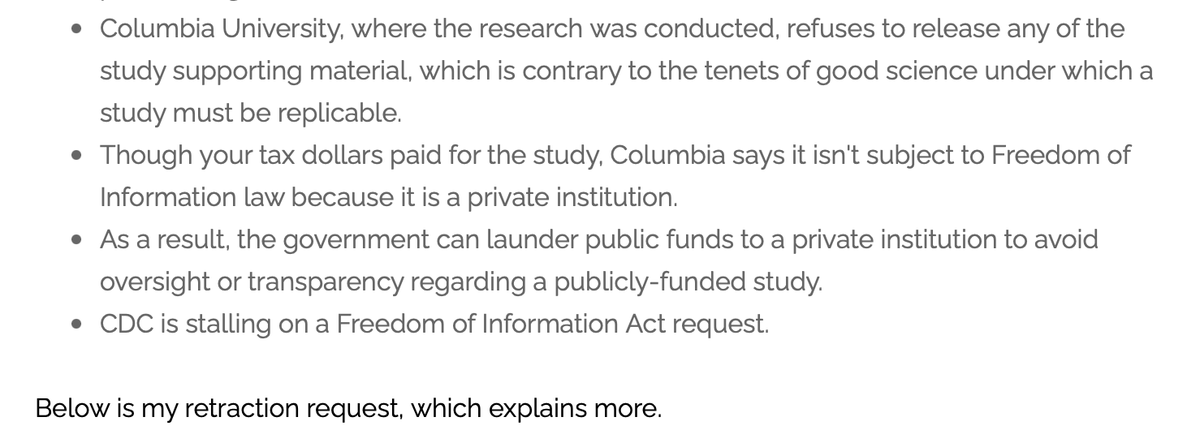
Scientists hide details of questionable taxpayer-funded pro-vaccine study (but I'm not going away) https://t.co/5hsBR4LtyT
CDC can launder your money thru a private institution like Columbia to publish questionable research and then keep study materials hidden because Columbia isn't subject to FOIA. What do you think of that?
@RepThomasMassie
https://t.co/5hsBR4LtyT
@SharylAttkisson@RepThomasMassie Restricted to data "that were used by the Federal Government in developing an agency action that has the force and effect of law": "the Federal awarding agency must request, and the non-Federal entity must provide, within a reasonable time, the research data . . ."
@SharylAttkisson@RepThomasMassie See 2 CFR 200.315(e). A non-federal party receiving federal funding is required in some instances to supply information so that the federal agency can comply with a FOIA request.
https://t.co/FZCe8ulCUv
As of today, there are about half a dozen books being sold on Amazon, with my name on them, that I did not write or publish. Some huckster generated them using AI. This promises to be a serious problem for the book publishing world. https://t.co/YXcMlJeTMV
@sesiegler@NIHFunding Just like universities demand "disclosure" of all faculty and post doc technology ideas--not just those patentable ideas made under contracts expressly requiring disclosure, but anything at all, patentable or not patentable, invention or not invention. Blurt it out, suckers.
Big pharma and VCs would then create small companies to harvest the funding. What if federal funding went to individuals, not organizations? Would individuals sell out just as readily?
What if the vast majority of @NIHFunding went to small businesses instead of academia?
What if the vast majority of @CDMRP funding went to small businesses instead of academia?
Why is the funding situation so ass backwards?
#musingsofCEOSara
@sesiegler@NIHFunding It is like federal agencies and pharma work together to use the patent system to entice independent inventors and startups to blurt out their ideas in advance of development, so those ideas can be acquired, co-opted, blocked, or neutralized.
Wasn't an article, was an anonymous opinion piece. Wasn't in The Economist but rather their Technology Quarterly. Showed nothing to connect Bayh-Dole activity with anything of economic significance. The Economist ran a real article two years later questioning Bayh-Dole.
"More than anything, [the Bayh-Dole Act] helped to reverse America's precipitous slide into industrial irrelevance."
This classic @TheEconomist article on #BayhDole, from 2002, shows how Bayh-Dole's impact has endured over decades! https://t.co/7bM8HPsPGu
@sesiegler@NIHFunding Even requiring research results go to the public domain does not get at the scores of patents to be had on every bit of "improvement." It is as if the concept of "the art" and improvements made within the art has been lost entirely.
@sesiegler@NIHFunding Right. So they get the funding, do the research, and then get bought by or flip the invention rights to the same old players. Everything with potential that can be bought gets bought.
@sesiegler@NIHFunding Back in the 1990s, federal agencies begged universities to get their faculty to start companies to go after SBIR funding. University capture of SBIR funding seems to have been a goal of the agencies.
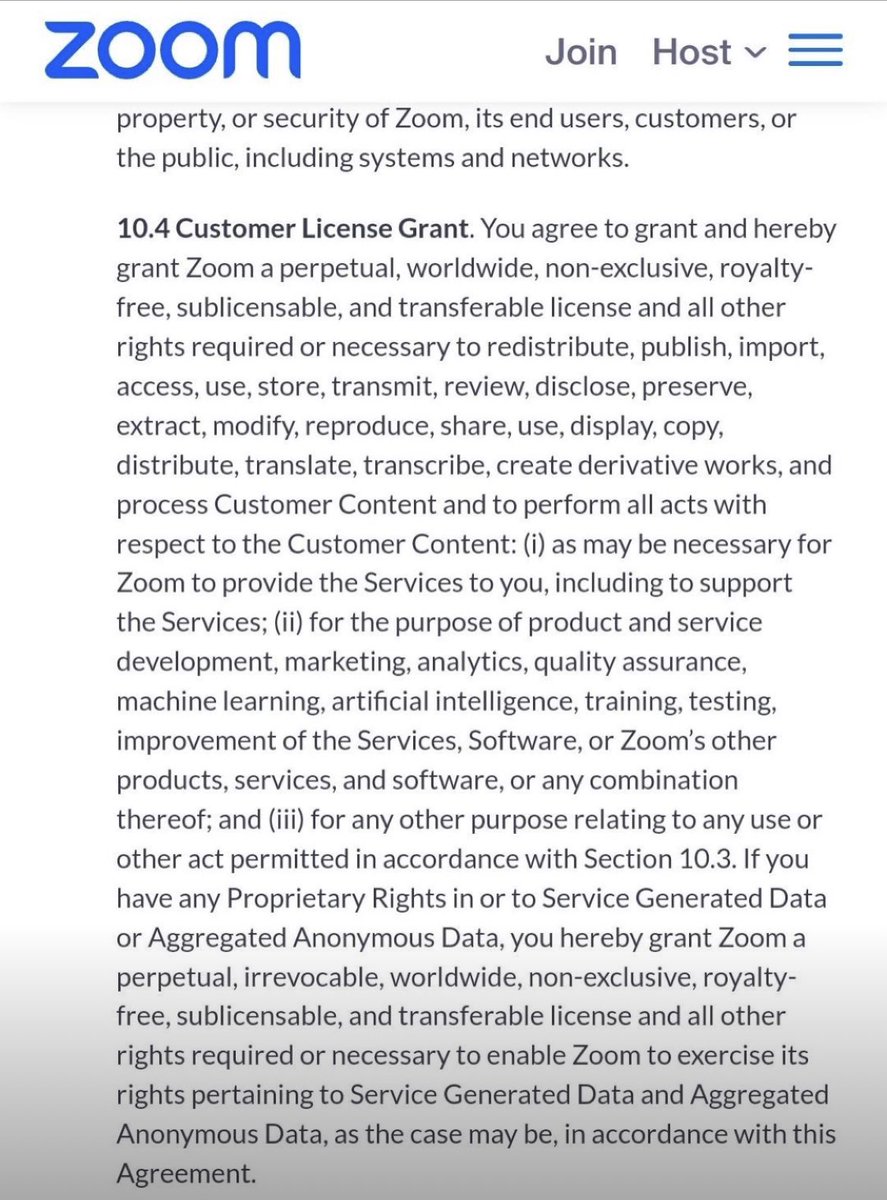
🚨Zoom in! Discuss confidential or proprietary information on #Zoom? It is time to look for a new platform. The terms of service now allow for machine learning and #AI and grant irrevocable rights to #zoom. This is especially relevant to those in #healthcare. #privacy@Zoom
Universities have no business proposing an empty set special case to rationalize "protecting" all inventions from use as an initial default action. The default must be patent without enforcement. Patent as notice. Patent to establish priority. Patent to contribute to the "art."
Universities have no business trying to "protect" inventions from use. When a faculty or student inventor chooses to protect an invention, they choose to be something other than a faculty member or student. Their choice. But a university cannot choose to stop being a university.
And it is an even more special case, because that one competitor has to sell at such a low price that it barely profits, otherwise the first company could recover its development costs from its own profitable sales. I suggest this is in practice an empty set special case.