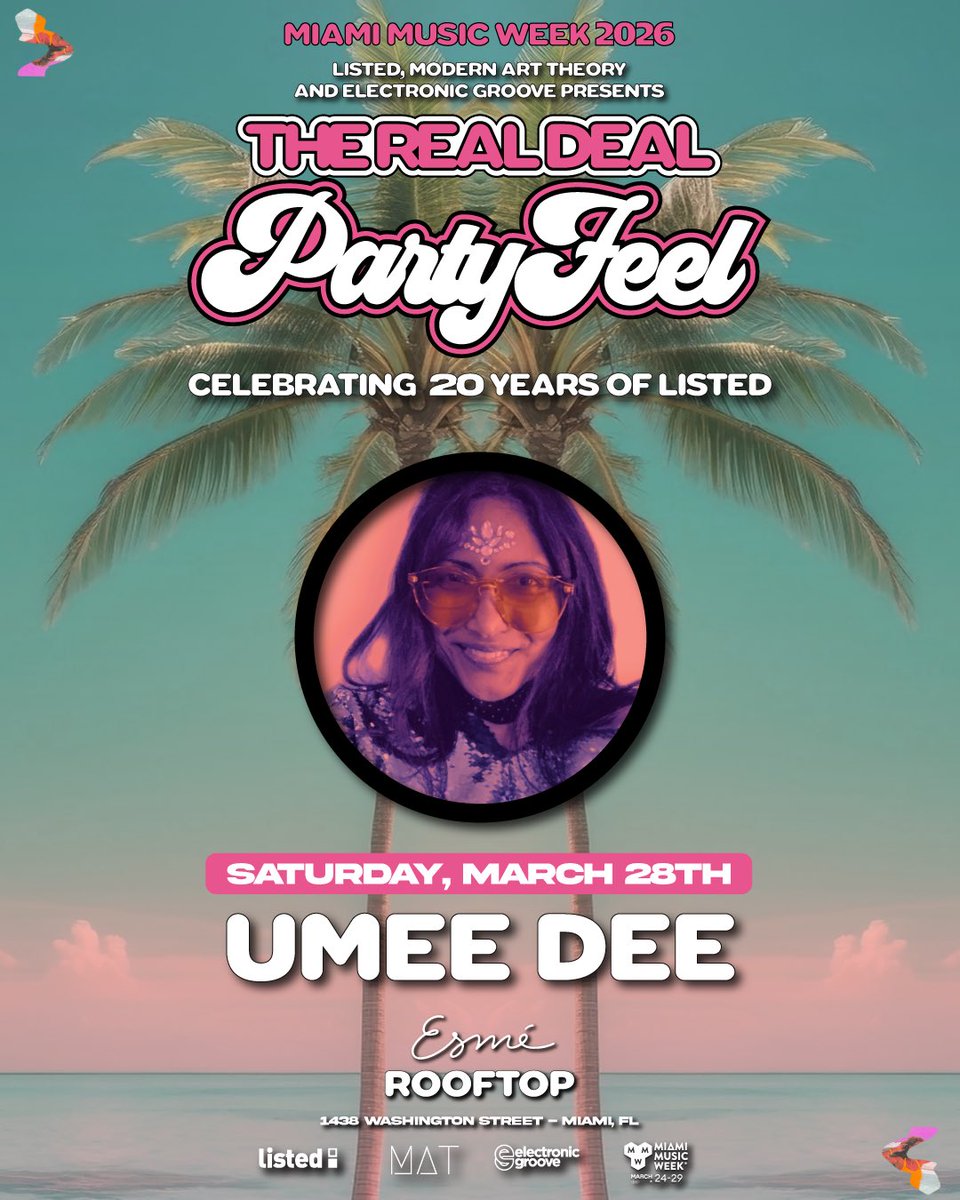
Miami Music Week energy ⚡️
Saturday @ Esmé rooftop
Playing alongside some serious legends for 20 years of Listed
Let’s make it count.
#MMW2026#MiamiMusicWeek#umeedeemusic
For those unaware, SpaceX has already shifted focus to building a self-growing city on the Moon, as we can potentially achieve that in less than 10 years, whereas Mars would take 20+ years.
The mission of SpaceX remains the same: extend consciousness and life as we know it to the stars.
It is only possible to travel to Mars when the planets align every 26 months (six month trip time), whereas we can launch to the Moon every 10 days (2 day trip time). This means we can iterate much faster to complete a Moon city than a Mars city.
That said, SpaceX will also strive to build a Mars city and begin doing so in about 5 to 7 years, but the overriding priority is securing the future of civilization and the Moon is faster.
1/16
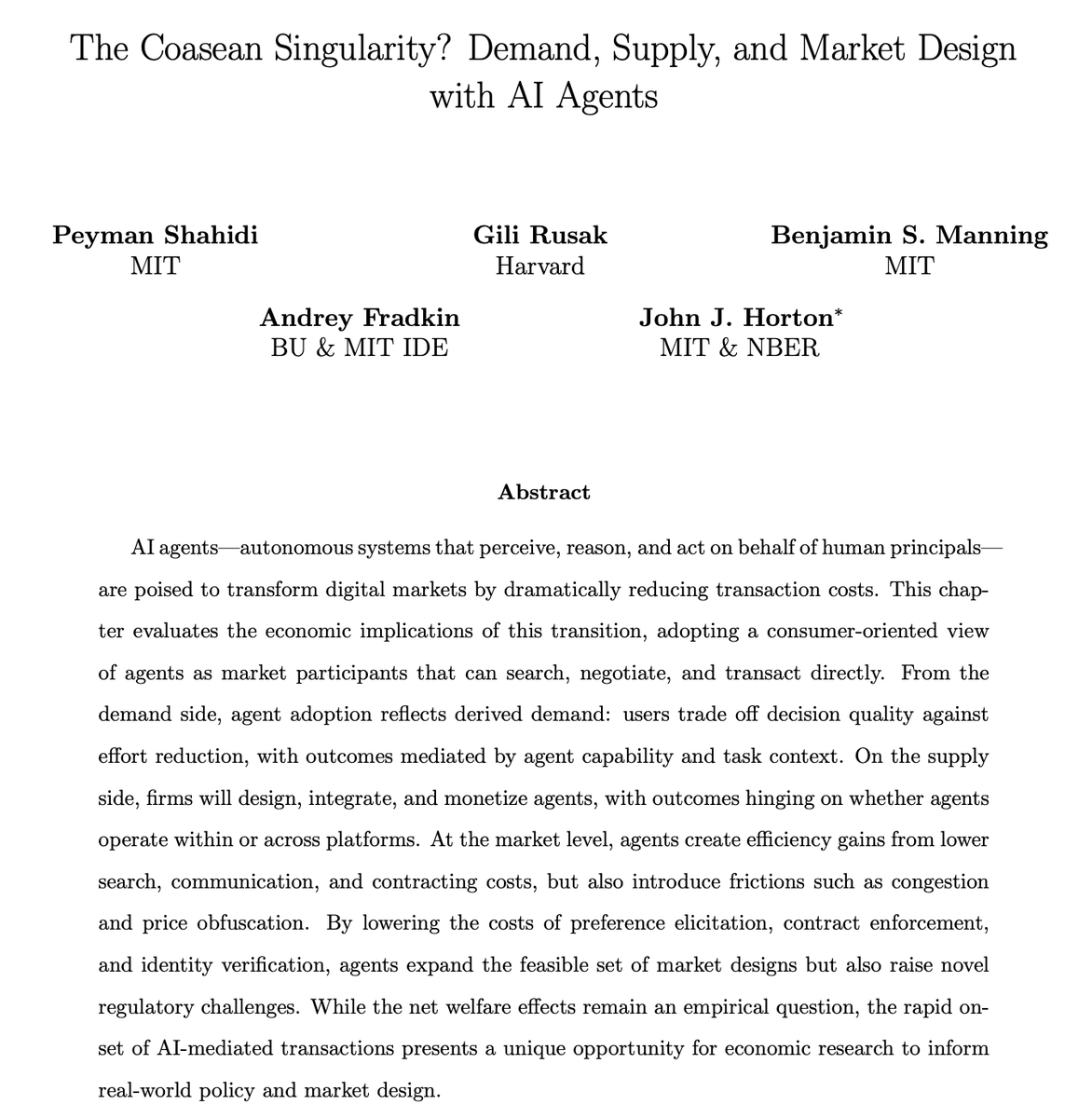
I just fell down a rabbit hole reading a new paper from economists at MIT & Harvard.
Their prediction is wild: We're on the verge of a "Coasean Singularity"—a future where AI agents make markets so efficient that the very idea of a 'company' starts to crumble. 🤯
A thread 👇
2/16
First, a quick 101: Why do companies even exist?
A Nobel-winning economist named Ronald Coase answered this in 1937. He said companies exist because using the open market is a pain.
Finding sellers, negotiating prices, writing contracts… it’s all “transaction cost.” Economic friction.
3/16
It's often easier and cheaper for a firm to just hire people and organize them internally than to deal with that constant market friction.
This friction is also where we, as consumers, lose. We're tired, we're biased, and we don't have time to compare every cell phone plan or read every review for a toaster.
Companies know this.
4/16
Now, enter the AI Agent.
And I don't mean a simple chatbot. The paper describes an autonomous system that acts on your behalf.
Think of it as your own personal, tireless, super-rational economist. It’s immune to marketing tricks and its only goal is to get the best outcome for YOU.
5/16
This is where the "Singularity" happens.
When everyone has an AI agent, those transaction costs that Coase talked about basically drop to zero.
The "friction" that made companies necessary in the first place? It evaporates.
And if the reason for something disappears… so does the thing itself.
6/16
But what does this future actually look like? This is where it gets weird.
Let's take shopping.
Your agent doesn't just browse Amazon. It might contact a manufacturer in another country directly, find 500 other agents whose users want the same thing, negotiate a bulk price, and arrange shipping.
All in milliseconds. The "storefront" becomes irrelevant.
7/16
Or think about hiring.
Instead of you endlessly scrolling LinkedIn, your agent scans the entire market for opportunities. It negotiates salary, benefits, and remote work policies with the company's agent.
You only get involved for the final human-to-human interview. No more cover letter hell.
8/16
But this discovery comes with a huge catch. The paper outlines a fundamental battle for the future of AI:
Will your agent be a "Bring-Your-Own" (BYO) agent that works only for you, across all platforms?
Or will it be a "Bowling-Shoe" agent, provided by the platform (like Amazon or Google), whose priorities might be... conflicted?
9/16
The "Bowling-Shoe" agent is convenient, but it might steer you toward the platform's own products.
The "BYO" agent is loyal to you, but platforms might try to block it or throttle its access.
This tension between user autonomy and platform control will define the next decade of the internet.
10/16
And that's not even the most interesting part. This new world creates bizarre new problems.
Problem #1: Agent Congestion.
What happens when millions of agents can create a perfect, customized resumé and apply for a single job in a nanosecond?
Employers get flooded. The signal is lost in the noise.
11/16
The paper predicts that to solve this, platforms will have to re-introduce friction.
Imagine having to pay a small fee for your agent to submit a job application, just to prove you're serious.
Costless actions will lose their meaning.
12/16
Problem #2: The Identity Crisis.
In a world full of bots, how do you prove you're a unique human? How does a company know it's not negotiating with 1,000 agents all controlled by one person trying to manipulate the market?
This is the "Sybil Attack" problem, and it's a big one.
13/16
This will lead to a boom in "proof-of-personhood" technologies. Systems that cryptographically verify you are one person, without revealing your personal data.
It sounds like sci-fi, but it'll be the essential plumbing for a world of AI agents.
14/16
Here's a new lens to see the world through:
Next time you use Uber (matching drivers/riders), Zillow (matching buyers/sellers), or Upwork (matching clients/freelancers)...
Don't just see an app. See it as a clunky, early prototype for the agent-driven markets of the future.
15/16
This isn't just about better shopping bots or smarter assistants.
It's a potential rewiring of our entire economy, away from the 20th-century model of the centralized firm and toward a 21st-century model of fluid, hyper-efficient, agent-mediated markets.
16/16
The 20th century was defined by the rise of the corporation.
The 21st may be defined by its slow, quiet dissolution.
This might be the most disturbing AI paper of 2025 ☠️
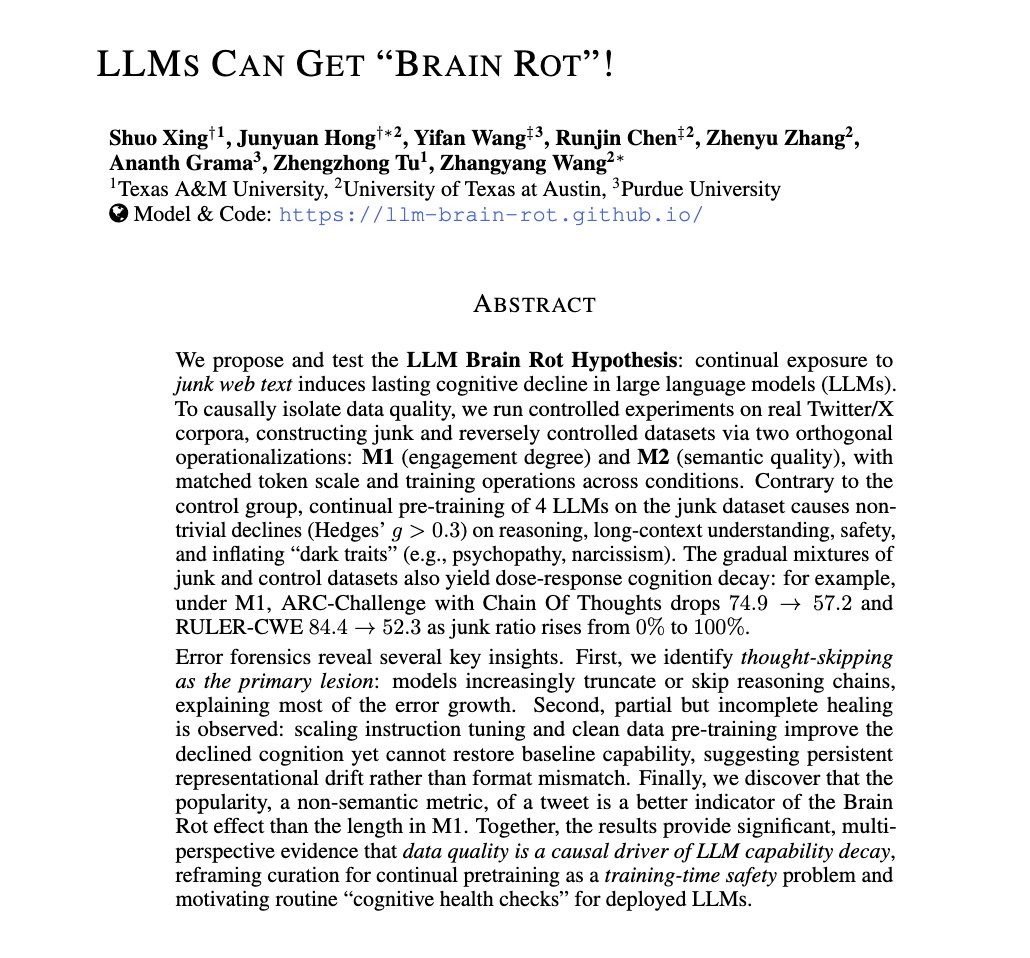
Scientists just proved that large language models can literally rot their own brains the same way humans get brain rot from scrolling junk content online.
They fed models months of viral Twitter data short, high-engagement posts and watched their cognition collapse:
- Reasoning fell by 23%
- Long-context memory dropped 30%
- Personality tests showed spikes in narcissism & psychopathy
And get this even after retraining on clean, high-quality data, the damage didn’t fully heal.
The representational “rot” persisted.
It’s not just bad data → bad output.
It’s bad data → permanent cognitive drift.
The AI equivalent of doomscrolling is real. And it’s already happening.
Full study: llm-brain-rot. github. io
Doctors Skeptical of Their Peers Who Use Generative AI - as usual, medicine generally does not understand the positive impact of technology in medicine quite frankly the results showed to me that it’s more about ego than about having an open mind w gen AI https://t.co/SQbC9kdYvI
@elonmusk@xai Omg you crack me up @elonmusk, 😂. Never conceptualized the opposite of micro and soft as macro and hard. But I can tell you most women prefer macrohard 🍆 over 🐌 micro soft 😂
@PeterDiamandis Agreed. But can be challenging in some jobs and professions. For example, when I’m DJing. Or my other job being a doctor. The Biohack that really helps this help me out over the years is yoga Nidra aka NSDR (non-sleep deep relaxation)
@PC0813Trader 2025 2+2+5=9. It’s a year of endings and beginnings, they say. It’s one of the most important years sitting between this epoch of last 5000 yrs and the new one coming in.
@elonmusk Congratulations @elonmusk. Know that you have a legion of people who believe in you and pay no attention to the libtard turduckens acting like Nazis defacing Tesla cars.