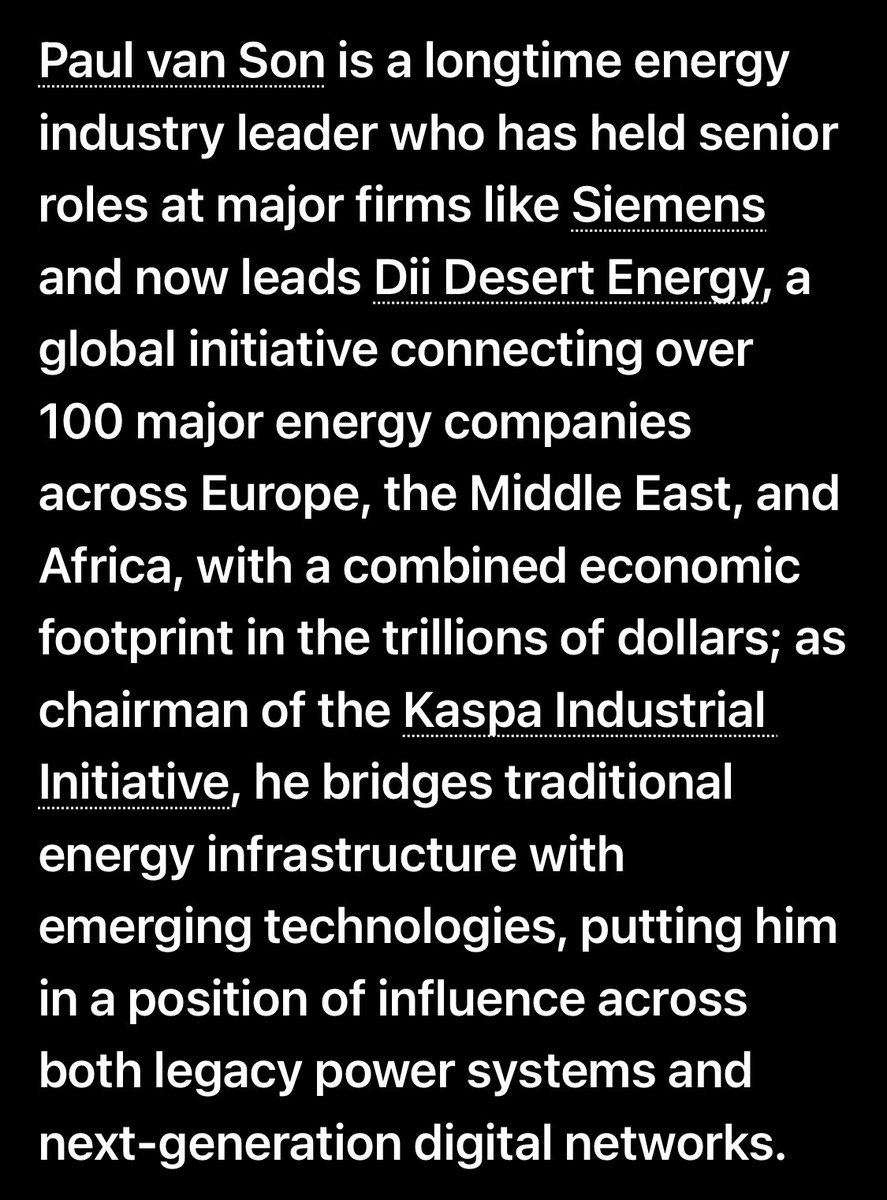
Curious that a multi-trillion-dollar MENA energy conglomerate isn’t tracking BTC, ETH, or SOL, but is instead eyeing kaspa:native —a sub-$1B project. Says a lot 🤔
#KASPA
Little refresh on our website.
We're now showcasing the full tech stack: lending, tokenomics, governance and TVL simulator, custom oracle, AI compatibility...
Come check it out!
👉 https://t.co/nSAWCoK9JV
There’s never been a digital asset that really won long term without a cult-like community behind it.
You can buy marketing. You can pay influencers. You can fake attention for a while.
But you can’t buy real belief.
That’s what most projects don’t get.
The strongest assets in crypto don’t just have holders. They have people who feel like they’re part of something bigger than a trade.
They defend it when everyone laughs.
They post when the chart looks dead.
They build when nobody is paying attention.
They stay when everyone else leaves.
That’s not paid marketing.
That’s culture.
And culture is what keeps an asset alive long enough to matter.
Kaspa is mentioned on the front page of @DiiDesertEnergy, a partnership of 126 global companies with a total valuation in the tens of trillions of dollars.
(1/2)Fair launch and why it matters
And why a fair launch doesn't matter if the network isn't absolutely sound.
A fair launch proof of work network in this day and age starts out with imense friction.
1.
There are no wallets, there are no market places, there are no usecases. It's just a good, a commodity produced in search for a buyer.
2. Gamenet
For the earliest miners who joined, all they knew was that they throw money at #kaspa and had the chance to get somewhere between 1-1000 kas per block won.
The primodial soup market was the discord.
Some asked for $kas, some put it out for sale, sometimes they matched, a miner had to be a salesmen first and then a producer.
3.
2 weeks in
Sudden death happened, the dag was shattered by the memory bug the network was paused and solomined during the fix and at the same time the era of gamenet ended.
The 500 kas per block era started. The solo mined kaspa was sent to the burn adress.
As the bug that could have killed the network resolved and gamenet ended, we got to a doge-like issuance, super inflationary.
The variance diminished but the inflation was the same.
At the same time you needed to throw different kinds of money at it if you wanted to compete in this war of hashrate.
First mining was CPU a month later there was GPU.
4.
~6 months in
Market places like TXBit, Exbitron and TradeOgre opened up for systemic real-time pricing which gave minees some light, but
little did the miners and traders know about the struggles of these early cexes.
Not your keys not your coins.
This was about the time when issuance changed again, this time for the chromatic geometric issuance which gave some hint about how scarce kaspa would become. Allt the worst chaos was now over,
Demand of coins grew faster than the mining network, miners could now calculate revenue and costs with ease, expand their GPU-mining.
Life was simple, started to look easy.
5.
then Ethereum went POS and vast amounts of industrial GPU miners sought profitability for their rigs, enter kaspa.
Hashrate spiked, profitability grew thin but demand of coins continued to grow.
Maybe we could still live happily ever after?
Knives, bow and arrow or a spears are meaningless in a gunpowder fight.
Looking back, the first asics were weak but at the time of their launch they 10x:ed the yield per watt of a GPU and yet again you were forced to change the form of money you have to spend to compete for the kas.
The early asic war:
Ks1, ks2, goldshell, dragonball, ks3, ks5l, ks5m, ks5.
They came and went obsolete as soon as the next arrived. Miners had to sell their asics shortly after they had bought them to buy a more efficient one. More and more coins got sold for hyper efficient asics that got overproduced and drowned the market in abundance.
Diminishing returns, between the ks1 and ks5 was 1 year, then it took a full year to produce antminer KS7 which was 100% more efficient.
Released when the bear was already here.
6.
Mining was never easy, numerous potential events could have killed the network before it started trading at billions. A scarcity wave will by nature create a wave of abundance, an action and an equal opposite reaction.
Here it does not matter how much efficient hashpower you hold at any time. If the demand of coins is net negative you will have to shut off if you mine for profit, you compete with the cheapest electricity and zealots who mine at a loss on faith and conviction.
7.
Kaspa did survive a fair launch, in this day and age with all the surrounding competition in this space.
Every single kas had an honest cost anchored to its creation, every second every block. Fair launch means something.
It means those who dump on you with profit worked extremely hard to do so. The game is fair, the unfair bit is information asymmetry.
kaspa:native
Focus on the way liquidity is setting up:
During the distribution process price was moving up deviating highs (taking buyside liquidity) while building lows (sellside liquidity) which resulted in a bearish rotation.
Now every single low HTF low has been taken (sellside liquidity) and in the process of doing so we have build nothing but highs (buyside liquidity).
Rotation towards buyside liquidity in inevitable. It's up for the whales to decide when the accumulation process is done. When confirmed I can see this making new ATH's.
Approach this from an investment perspective, I dont have leverage long confirmations here right now.
“Kaspa DAGknight protocol by definition you can’t be faster than. You can’t confirm a transaction quicker than network latency, so in that sense give me any PoS system and I can match it in PoW”
Research kaspa:native .
KASPA INDUSTRIAL INITIATIVE SET TO UNVEIL FLAGSHIP PROJECTS
Kaspa Industrial Initiative (@KaspaKii) confirms the completion of its flagship ecosystem projects designed to run natively on the Kaspa (@kaspaunchained) Layer 1 blockchain.
The development team is currently finalizing security hardening and migrating the infrastructure to enterprise-grade servers in preparation for a June launch.
This deployment utilizes the high-performance DAG architecture of $KAS to support industrial-scale applications and upcoming unannounced network integrations.
I am once again asking Kaspa haters to take 30 minutes to research who Paul van Son is and study his history with DII. Either this is the biggest psyop in Kaspa history or $KAS will soon be positioned to be a major player in the energy trading sector in the Middle East and eventually the world. Energy trading makes up tens of trillions of dollars every year in the world. @DiiDesertEnergy@KaspaKii
The time has come for me to share what I’ve been working on ...
Introducing #HASH.
A grassroots, guerrilla marketing engine for #Kaspa, built with one goal: break out of the echo chamber and push Kaspa into the real world where it can’t be ignored.
I've spent a lot of time the past couple years doing my part to spread the message, build awareness, and be a voice in the $Kas community.
But there is still a gap between what Kaspa is and what the world sees. And I'm tired of sitting on the internet sidelines. That ends here.
I want to take Kaspa to the streets.
Over the coming weeks I’ll break down everything: what HASH is, how it works, how I plan to fund it, and how you can get involved.
Stay tuned.
Kaspa is evolving.
Pushing real throughput, upcoming L1 programmability, and covenants for more advanced, structured transactions.
And now with Private Send in NOW Wallet, you can move $KAS with added privacy.
Try Private Send with $KAS:
🔗 https://t.co/6go40xztta
I just got back from my Easter trip visiting family, and one of the first things I made time for was listening to Yonatan’s Oxford Union speech. I think he absolutely nailed it: https://t.co/46WvWwy2xg
If there is one thing we can learn from our progress in AI, it is that intelligent behavior emerges when many components explore degrees of freedom and converge, through distributed constraint resolution, into coherent and stable patterns.
The modern world has connected an enormous number of people and given us unimaginable freedom, but it still lacks a credible way to enforce shared constraints.
The result is a crisis of responsibility at every scale of society: from cyberbullying to former superpowers chasing old glory through war, to leaders blaming the weakest members of society for national decline, or even killing their own citizens to preserve power.
At the same time, our capacity to inflict harm on one another has become increasingly asymmetric. Small actors can now create disproportionately large disruptions, and conflicts no longer remain local. They send shockwaves through the emerging superorganism we call humanity.
The age in which we could dominate one another and still produce a stable world is coming to an end. The only serious path forward is collaboration.
People may feel pessimistic about the future, but I think we are approaching an inflection point. Even the old superpowers are beginning to learn this lesson the hard way.
The American Dream of "I can make it" is gradually giving way to the realization that individual prosperity depends on collective wellbeing, and that we can build far larger and more meaningful things when we share a common dream.
That is why I am excited about DLTs, and Kaspa in particular.
Not because I see them as safe havens for hiding wealth from corrupt governments in some dystopian future, or because I want people to get rich by selling to later participants.
But because I believe DLTs can offer a superior foundation for large-scale human coordination: one that is more neutral and reliable than traditional models based on force and mutual deterrence.
In that world, wealth is not the goal in itself, but a byproduct of coordinating around shared missions, empowering people to contribute, and aligning incentives toward common outcomes.
The future is not about building better products. It is about building better protocols: systems that allow human beings to coordinate meaningfully at larger scales than ever before.
For the first time in human history, we have the tools to build institutions that are not bound to territory, yet can still provide structural coherence without having to fight wars to establish their legitimacy.
What we need now is a group of people bold enough to take that mission seriously.
Upcoming Catalysts for Kaspa:
1. Toccata Hard Fork (June 2026) : Introduces native covenants and ZK infrastructure for L1 programmability.
2. Kaspa Industrial Initiative: (Ongoing) – Advances enterprise adoption with middleware like WarpCore for traditional finance.
3. 100BPS Blocks Per Second (Long-term) : Aims to scale network throughput beyond the current 10 blocks per second.
Deep Dive
1. Toccata Hard Fork (June 2026)
Overview: The Toccata hard fork is Kaspa's next major protocol upgrade, with mainnet activation now targeted for a window between June 5–20, 2026 . This non-backward-compatible upgrade will introduce two core features: native Layer-1 covenant programming (via the Silverscript compiler) and based zero-knowledge (ZK) application infrastructure. These changes aim to transform Kaspa from a fast payment network into a programmable platform for decentralized applications.
What this means: This is bullish for $KAS because it unlocks smart contract-like functionality and trustless scaling, potentially attracting developers and new use cases. The delay from the original May 5 date to ensure proper testing reflects a focus on security and network stability, which is neutral-to-positive for long-term health.
2. Kaspa Industrial Initiative (Ongoing)
Overview: The #Kaspa Industrial Initiative (KII) is a non-profit focused on driving real-world, enterprise adoption. Its flagship project, WarpCore, is middleware that connects traditional financial rails (like Fedwire and SEPA) to Kaspa's BlockDAG, enabling compliant, high-speed settlements.
What this means: This is bullish for KAS as it targets institutional demand and tangible utility beyond speculative trading, which could support long-term value. The risk is that adoption timelines are long and dependent on regulatory and corporate buy-in.
3. Higher Block Rate Targets 100BPS (Long-term)
Overview: Following the successful Crescendo hardfork that achieved 10 blocks per second (BPS), the long-term roadmap envisions further increases to 25, 40, and ultimately 100 BPS. This requires careful testing to balance speed with node requirements and decentralization.
What this means: This is bullish for KAS as it would cement its position as the fastest Proof-of-Work network, enhancing its value proposition for high-throughput applications. The bearish angle is that pushing limits could increase hardware demands and centralization risks if not managed carefully.
Conclusion
Kaspa's trajectory is defined by a near-term focus on programmability (Toccata) and a parallel push for real-world utility (KII), all built on its foundational goal of unprecedented speed. Will successful covenant deployment catalyze the developer ecosystem needed to utilize its raw throughput?
RT, Like Comment, Bookmark 👊
Donations:
kaspa:qpdrxwmtlyz6hmua0g0djee0kdm95lkx6g8awrxpyq74ehvd3cuu2squvu958
@Grayscale@realvijayk arigato gozaimasu!
if Kaspa army showed up here, think how they'll show up when you provide a KAS digital asset..
by mid june Kaspa OP_CAT++ Bitcoin. worth the attention _/\_