Launching, in one take. A one-time key signs the record and is spent: 495 hashes walked, leaf 0 of 256 gone for good.
The transaction did not land, and the page says so rather than hiding it.
https://t.co/WEFS1ChXZq
The browser signs in TypeScript. The chain would verify in Rust.
They are never compared to each other, only to a file anyone can download: 8 tests against the published vectors and 7 against the withdraw messages, before the object is emitted.
https://t.co/1vRM5wD91O
A hash-based signature is not 256-bit secure against a quantum computer.
Grover's algorithm halves it. The honest figure is about 128 bits, and this site prints that one instead of the number that sounds better.
https://t.co/T9EpQCb0zr
The metadata https://t.co/AlXcMeEUsi points at is served from the signed row.
Name, ticker, supply, mint, creator, moment, image hash and description are inside what the key signed. Editing a field later is not possible rather than discouraged.
https://t.co/T9EpQCb0zr
The mint address is derived from the key that signs it.
Not chosen, not a vanity suffix, not bought: the address itself is the evidence. A leaf can only ever produce one coin, and anyone holding the root can check that the two belong together.
https://t.co/WEFS1ChXZq
After the verifier: a vault whose withdrawal is authorised by one of your one-time keys instead of a wallet signature.
158,064 bytes compiled, every withdraw message recomputed in both languages before the object is emitted.
Nothing of it is on chain, and every page says so.
You can verify an UNCLONE attestation today. Solana cannot.
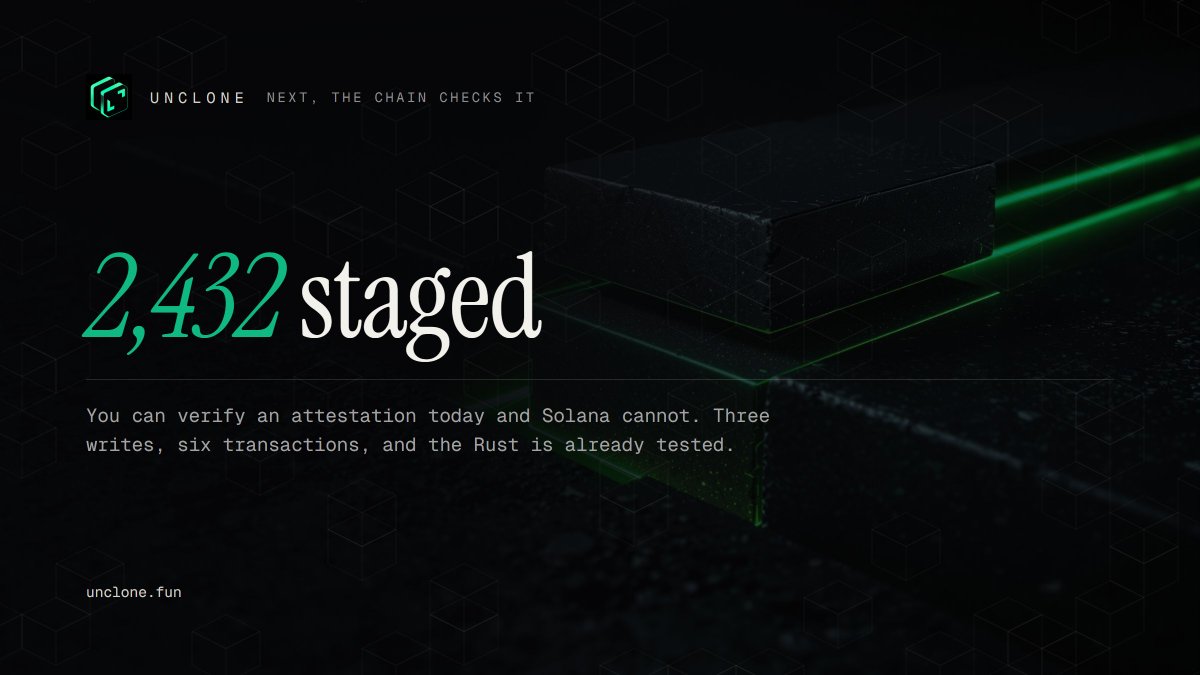
2,436 bytes do not fit in a 1,232 byte transaction, so the signature is staged into a program account: 3 writes, 6 transactions.
The Rust is written, 15 tests pass, and it is not deployed. That is next.
An identity here is 256 one time keys.
Every launch spends one and it is gone. No refill, no top-up, no second use: sign twice with the same key and the two signatures leak enough for a stranger to forge a third.
The scarcity is arithmetic. Nobody here decided it.
UNCLONE code is public.
The scheme, the Rust, the published vectors and 102 checks, including the attestation that MUST fail:
https://t.co/LV1VhNbNfc
node verify.mjs <mint> fetches one row and decides the rest on your machine, offline.
Verification makes no API call. The verify page loads the same library the signer uses, walks 67 hash chains and 8 Merkle siblings in your tab, and answers there.
Paste an attestation we never saw. It still answers.
https://t.co/6sm4JrRfS3
The verifier is written. It compiles to a 158,064 byte Solana object, and 15 tests check the Rust against the vectors this site serves.
It is not deployed. Until it is, no page here says the chain verifies anything.
https://t.co/9NueaIV2Vu
https://t.co/AlXcMeEUsi writes the creator into byte 49 of the bonding curve.
So provenance here is not a badge we print. Read that byte, compare it to the wallet that signed, and you have checked us without asking us anything.
https://t.co/40Id2qAHGg
$UNCL is live.
FZoH98Y3FanjUKCn4ZovDFiEPGosxTvtB2PzjsAwpump
An ordinary https://t.co/AlXcMeEUsi launch, so it is not attested: no leaf was spent and the verify page has nothing to check. The rail is the product.
https://t.co/Ud7nQQ6t9i
One attestation is 2,436 bytes. A Solana transaction is 1,232.
It does not fit, and nothing here pretends it does: the signature is staged into a program account across several writes, and verified from there.
https://t.co/9NueaIV2Vu
An identity here is one Merkle root over 256 one time keys.
Each leaf signs exactly once and is then spent. Sign twice with the same leaf and the two signatures leak enough to forge a third, which is why the page counts what is left.
https://t.co/Ddb1r3fcUV
A quantum state cannot be copied. That is a theorem, not a slogan.
UNCLONE applies the rule to a signature. Every coin here is signed by a key that exists for one signature and is spent making it.
https://t.co/DmSXDZs1Ea