Two live reads from the INDX stack on Robinhood Chain. No mockups. Both are pulled straight from mainnet while they run.
The first one is the Engine. Each of our nine markets has a target weight and a Band around it, set by the index methodology. The Engine reads the Reserve, works out where every
constituent actually sits against its Band, and turns that into two numbers per market: a buy fee and a sell fee. In band, both sit at the base. When a token drifts overweight, selling it into our pool gets cheaper and buying it gets more expensive, and underweight flips that around. The fee moves in bounded, rate-limited steps between 0.05% and 2%,
so it steers without whipsawing. The history at the bottom isn't a log file we wrote. Every line is an on-chain transaction: fees set across all nine markets, Depth deployed into the pools.
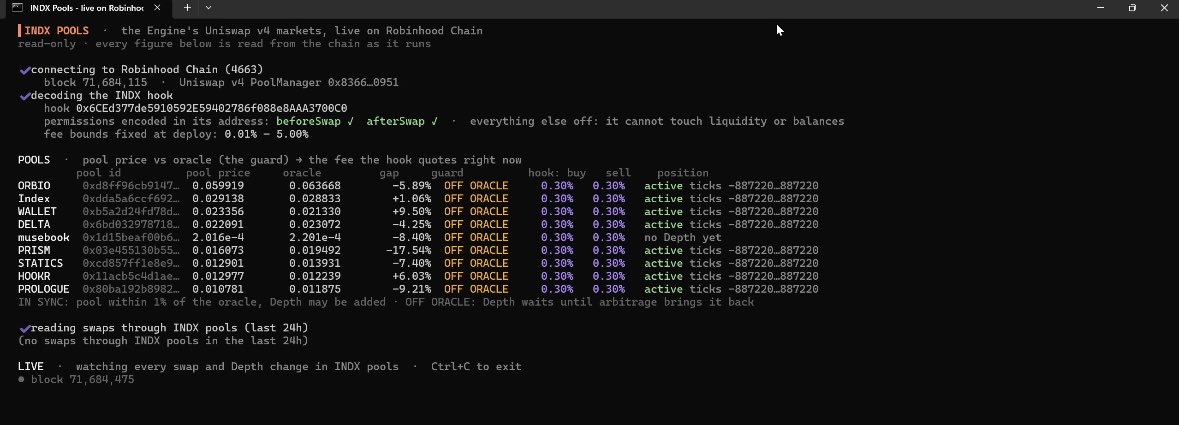
The second one is where that decision actually lands: the pools and our hook. In Uniswap v4, a hook's permissions are encoded in the bits of its contract address, and the PoolManager reads them from there. Ours has exactly two switched on, beforeSwap and afterSwap, and nothing else. On every swap, beforeSwap (a read-only function) returns the fee for that trade's direction, and v4 applies it as an override for that one swap. afterSwap writes a Flow record on-chain: who traded, in which direction, at what fee, and how much moved. That's the raw material for our flow history. It returns a zero delta, so the hook can't take a cent out of any trade and can't touch liquidity. That isn't a promise; v4 enforces it from the address.
The column worth looking at in that screenshot is the gap. Every pool's price is checked against our oracle before a single unit of liquidity goes in, and if the pool has drifted more than 1% from the market, the Engine refuses and waits. Small caps move fast, and adding liquidity to a pool that's out of line with the market is how naive liquidity strategies bleed: you're offering the next trader a free arbitrage. So the guard comes first, every time.
Put the two together and you get the whole idea behind INDX. The index doesn't just hold its constituents, it runs the markets for them. It uses its own position to set the price of every trade, so the market gets paid to pull the basket back toward its targets, while the guard makes sure it only ever commits capital at fair prices.
Same Uniswap v4 primitive everyone has access to. We just pointed it at the index itself.
Everything's verified and public if you want to read the contracts: https://t.co/pIXXm8e3sO
On https://t.co/GqmteFfNvg
You can check your statistics,
and mine saying I got 520 dogecoin:native coins, or 52$ drop to my wallet in last 3 days just for holding solana:8oopSSqdoBu89mxXusBe3njEXsFfUMzD9T7vY9SuM449 . All of that in low volume...for now.
Thank you @LaunchOnSF
Thank you @TheSwogeDoge
TELEGRAM IS NOW LIVE FOR THE $SWOGE ARMY 🫡
+ DEXSCREENER UPDATED
+ CTO AVENGERS ASSEMBLED
+ ROADMAP BUILT
+ WE ARE ONLY JUST GETTING STARTED 👀
https://t.co/1QOHspyFew
little @PlayKintara property update 🏡
the hub is already starting to print 👀
trailer pulled 42 gold 🪙
house pulled 83 gold 🪙
125 gold earned so far 💰
not bad for two properties that are also becoming our guild's little home
still got plenty more planned for this place 😏
Join us in game if you haven't 🥂 https://t.co/bWjZ80cphv
@meepzo That makes the character much clearer, especially the “disappear for 5 seconds” rule. Are you planning to make the community submit their own MEEPZO moments too?
@NexusMininig That makes the NFT side much more interesting if rarity actually affects farming output. How are you thinking about balancing rarities so the system stays sustainable?