"I hope more people collect art to appreciate it and live with it — and for that, we need more people willing to display digital art on devices in their homes.”
– Chris Coleman
We had the pleasure of speaking with @digitalcoleman for the last #CollectorsCorner column of this year on objkt MAG 💜🥂💫
A digital artist, educator, critical arts engineer, creative coder, and highly active collector on https://t.co/aYPHllkKYy, he shares his perspective as both a creator and collector of digital art — even before the emergence of NFTs.
Chris also discusses his collection with his wife, artist Laleh Mehran, which extends beyond digital art and NFTs, and offers insight into how they approach selecting future pieces.
🧵👇
GM
- why did you look at the sky ?
because they were making weird noises
- how weird ?
like a sing I've never heard before
- ever wish you could fly ?
wish I could sing.
"Flock of dark birds making weird noises" is a pixeldream about looking up.
8/11 ed
10 tez
more info >
How we almost bought the banana for $2.5m
The bloody war where a billionaire outbid us...
And my #1 lesson from it all (which may be good news for you)
1/ A full 3 weeks before the banana came up for auction, I mused in my newsletter about what might happen.
"Comedian" (as it's officially called), by Maurizio Cattelan... had caught the art world by storm when it debuted at Art Basel in 2019.
The work is an ed. of 3, with 2 artist proofs.
One is at the Guggenheim, the other in private hands, and the 2 APs lay with the artist.
5 years later, the only available version was making its triumphant arrival at auction.
In the days and weeks earlier, there was much chatter in collector circles.
Who would buy it?
Would there be a bidding war, or would this flop?
If it did sell, for what price?
And most importantly, who the hell would pony up $$ for a banana and duct tape!?
The day after I initially mused about the banana, I get a message from my friend @kukulabanze.
If you don't know Ryan, he’s one of the world's Top 200 Art Collectors (as ranked by @artnews), and the big brain who owns @beeple's 'Human One'
Anyways, Ryan tells me he has been on the trail of the Comedian for a while.
So when this particular edition of Comedian came up for auction, Ryan was excited.
He wanted to scoop it, and suggested we do it together.
Now, I’m not as plugged into the contemporary art world as some of you, so I’m trying to wrap my mind around what the work is in the first place.
So we get to talking and he makes a very interesting point…
He says it’s perhaps the most iconic work of the last decade.
I turn to my team, we ponder the question…
How many works are instantly recognizable by millions of people?
We all quickly agree… it’s in a league of its own.
So we decided to team up, in hopes of taking down the banana.
As auction day approached, there was much chatter.
@kdean tells me there are memecoin whales circling.
A contemporary insider I know tells me Chinese private museums may be bidding.
The estimate for the work was $1m -1.5m.
Auction day comes around, the energy is electric.
If we scoop this for 2 or 3m, I feel it could be one of the great art acquisitions of all time.
Auction starts.
Bids start firing.
Who are the bidders?
Could it be those memecoin whales Dean spoke of?
Or perhaps the private museums?
It matters not.
Bids were flying.
Online and in person.
And before we know it, the auction is past $5 million USD.
Yes, 5x the estimate.
That is before buyer’s premium!
And it lands at $5.2m…. Or $6.2m, with fees included.
This auction was so legendary, news of it made every major outlet.
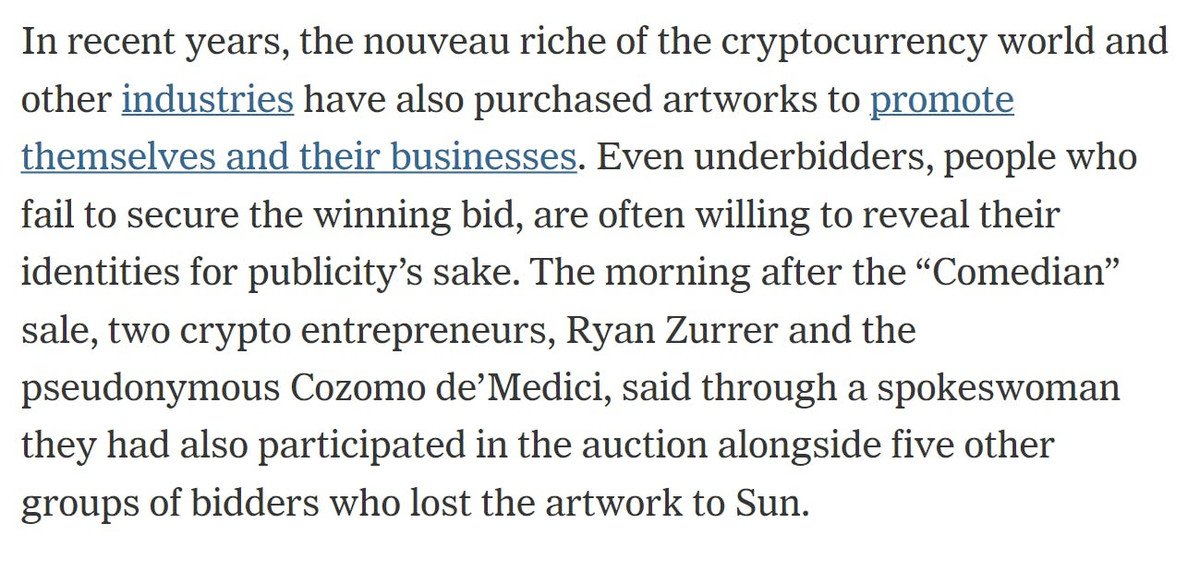
Even we, as the underbidder, received a snarky mention from @nytimes!
Quickly after the hammer fell, we are all scrambling to learn one thing:
Who bought it?
Turns out, the buyer was a crypto billionaire, @justinsuntron… who’s known to splash on culturally significant works.
My #1 lesson - and why it may be good for crypto art
I was sad to miss the banana...
But the attention around this work -- which consisted of merely a certificate, banana, duct tape and hanging instructions -- gives great tailwind to crypto art.
Why?
Because the frenzy around this auction showed clearly to the entire world...
How great fanfare can build around being the one to verifiably own an artwork.
Even if it can be copied... like the banana.
Or right-click saved, as with works of cryptoart.
As the great @XCOPYART asked, with his seminal work...
"Why would I own it, when I can right click and save?"
For many contemporary collectors, I feel this auction gave a similar ah-ha moment...
Why would I pay for it, if I can just buy a banana and tape?
The answer to some, is obvious (continued) 👇
Looking forward to a great space this week with experimental artist @canekzapata on glitch, AI and more💥 Come join @RoonerToon and myself for a fascinating convo from the bleeding edge! 🏴☠️☕️ https://t.co/UePu5wFaIG
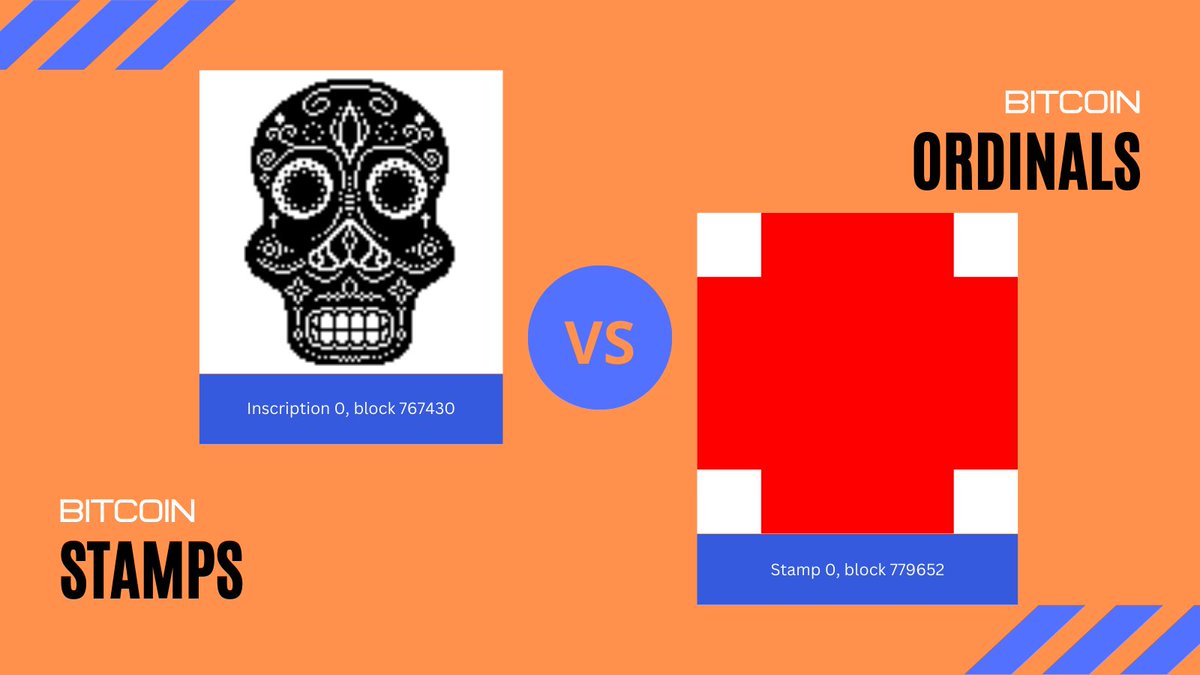
Bitcoin Ordinals vs Bitcoin Stamps. What are the key differences, can they be pruned, and how? Pros&Cons, explained like you are 5.
1) Ordinals store data in the witness section of a Bitcoin transaction, up to 4MB
2) STAMPS store data in the UTXO transactions, up to 7-8KB.👇💾
They are two different protocols and both achieve the same thing: securing data storage inside of the Bitcoin general ledger. They are both seen as an attack on Bitcoin L1 by the maximalist. Here is how they defer, in a lightly technical way. I will try to make it also visual.
The Bitcoin general ledger, aka the blockchain itself, lives in the nodes. We will get back to this part as it's fundamental to the Bitcoin blockchain itself and also to the longevity of these protocols. :)
Bitcoin Ordinal Theory protocol was firstly released in January 2023, by his creator @rodarmor. High level explanation of the framework: it's a simple numbering system which allows us to identify, track, and transfer in a first-in-first-out way every single satoshis. How? By simply assigning incremental numbers to individual sats, based on the order in which they were mined in a block. Clear enough? Feel free to re-read this paragraph. 🙃
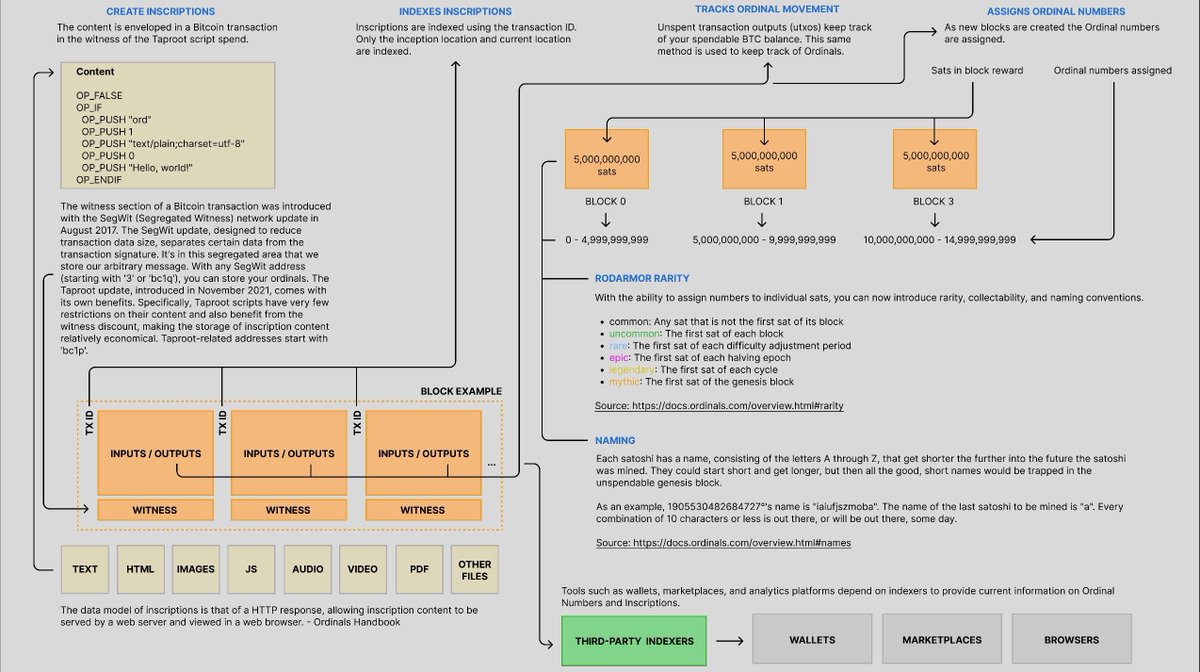
The numeric system solves the: what, where, from/to who, and when. We are now ready to take this to the next level, and talk about the how. How do we securely store arbitrary data onto the Bitcoin blockchain, within the Ordinal Theory protocol? The answer is, again, simple: inscriptions. They use the witness data portion in the transactions, embedded in each block. In this way it’s possible encode any arbitrary data into hexadecimal code, using the taproot script in the UTXOs (Unspent Transaction Outputs). In other fancy words, an inscription is literally an envelope used to store data in it, and safely move them around onto the blockchain. Infographic 👇below, by @ItsFranken.
The Bitcoin Stamp protocol was firstly introduced in March 2023 by @mikeinspace, to overcome one of the most critical drawback of Bitcoin Ordinal Theory: the possibility of data pruning. More on that later… High level explanation of the framework: they use a progressive numerical system embedded into the assets themselves, based on each transactions timestamps. The what, where, who and when do not really matter for Bitcoin Stamps. In other words it is just seen differently and in a more granular way. According to their creator, at the end of the day: ‘sats do not exist’. Now let’s move into the how.
STAMPS, using the Counterparty protocol, pushes the data directly in the transaction's description key. It’s a small piece of data included in each UTXOs. The envelope in this case is literally split into multiple tiny pieces that can be reassembled and reconstructed with (all) the transactions themselves. The data in this protocol are encoded in base64. To sum it up: Bitcoin Stamp assets are a set of multiple UTXO transactions. Contrary to Ordinals, the data are stored and split into multiple pieces, rather than in the witness data of a single transaction. Better to have a look at the below graph. 👇👇👇
Both protocols have pros&cons, let's dive deep into each of them. Starting with the latter: Stamps. The protocol preaches for making it close to impossible to prune its data, which is a major (existential) threat to any blockchain. In the case of Bitcoin Stamps, they adopt the meta-protocol of Counterparty: a Bitcoin side-chain active since 2014. They use the Bitcoin SegWit address format (starting with bc1q). The biggest PROs are related to the Counterparty protocol inheritance: you could use this protocol to either mint editions as well 1/1s. If you are familiar with the Ethereum smart contracts, despite this is not the same thing, the best analogy between STAMPS and ETH NFTs is the ERC-1155 standard.
Probably the biggest CONs are mainly related to the scalability and the cost to generate multiple outputs: each transaction description key have a data limit of approx. 80 bytes. Yes, you read it correctly: 1KB image must be split in dozen transactions. There it comes the maximum threshold of 7-8KB size limits. Also, only a handful of file formats are supported (JPG, GIF, PNG, or SVG). Everything above that size limit, would basically become nearly impossible to move or could potentially cause severe clogging of the blockchain. As an example: imagine changing a $100 bill into 400 quarter coins and have to carry them all with your bare hands.
Being Ordinals a slightly older and a bit more sophisticated protocol, the biggest PROs are about their scalability: recursion, parent-child provenance, delegation; are only few of the many possibility offered by the them. Another advantage which may also be view as a CONs, especially when compared to the other protocol, is that they are relatively cheaper by using a single witness data portion of a transaction. They require only one UTXO to be moved around. This UTXO will act as a pointer rather than a envelop like in the case of Stamps. They also have to rely on external indexers to keep the numeric system in order.
Now, some words about the data pruning: Bitcoin Ordinals are more easy to prune. Plot twist: this is a good thing for whomever is setting up a new node. Let's go deeper. What is a data prune and why is it bad? Basically, it is the removal of any kind of information previously stored onto the blockchain. It is a manual/automatic filtering of what is not considered essential to the transactions. The Bitcoin Ordinal's witness data portion of a transaction could be pruned. They are fundamentally easy to identify and ignore/remove. By whom? By a node.
On the contrary, Bitcoin Stamps are way more harder to prune, but not impossible. They use a 2/3 multi signature to create redundancy and keep the information stored in the individual UTXOs. Pruning a STAMP is technically possibile but not easy for a node operator. Saying that Stamps are harder to prune than Ordinals is objectively correct.
As of today there are almost 80 millions inscriptions (at this point if this is confusing, I have to apologise: an ordinal is not necessary an inscription) while there are almost 800 thousands Stamps. The market seems to have chosen which protocol is easier to use in the latest 18 months. However, it does not mean one or the other are inferior: they simply differ. Bitcoin Stamps can be "minted" on @Stampchain and bought/sold at @btcOpenStamp or @StampedNinja. Bitcoin Ordinals can be explored via @ord_io or @ordiscan_com and "inscribed" (which means mint) on @MagicEden or @trygamma, to name a few.
I hope you have now a much clear picture of the main differences between the two protocols. Before closing, I would like to emphasise what does it mean to run a node and why it's important (and easy). As I tried to technically highlight in this post, both Ordinals and Stamps rely on the general ledger. This is nothing else than ALL THE DATA STORED since Bitcoin inception. Block by block. Witness sections used by Ordinals and P2SH scripts used by Stamps, both co-exist in the SAME blockchain. Running a (full) node is a guarantee that the data will be preserved.