China moved from chips to clothing, showing brand new fabrics that could flip the whole fashion world, with one company revealing a design built to change how clothes feel work every day 🧵
🚨DID THIS STUDENT RESEARCHER JUST SOLVE SCHIZOPHRENIA?
A young woman is going viral after breaking down her research paper claiming modern psychiatry has been focusing on the wrong part of the brain for decades.
She argues schizophrenia isn’t primarily a dopamine disorder, but a “leaky thalamus” — the brain’s sensory filter — that fails to block out irrelevant information, causing the brain to hallucinate and create its own reality to fill in the gaps.
Her theory also suggests antipsychotics only mask symptoms, questions Big Pharma’s funding priorities, and even links the same mechanism to ADHD.
She questions why the thalamus has been so neglected in psychiatric research.
‼️🚨 BREAKING: Microsoft Exchange Server CVE-2026-42897 lets an attacker execute arbitrary JavaScript in a victim's browser just by getting them to open an email in Outlook Web Access.
It is being exploited in the wild.
Microsoft classified it as... "spoofing." 🤔
Affected: on-premises Exchange Server 2016, 2019 and SE. Exchange Online is not impacted.
People spend their whole life trying to defeat others not knowing they have just fallen into someone else's plans.
How do we get people to understand this?
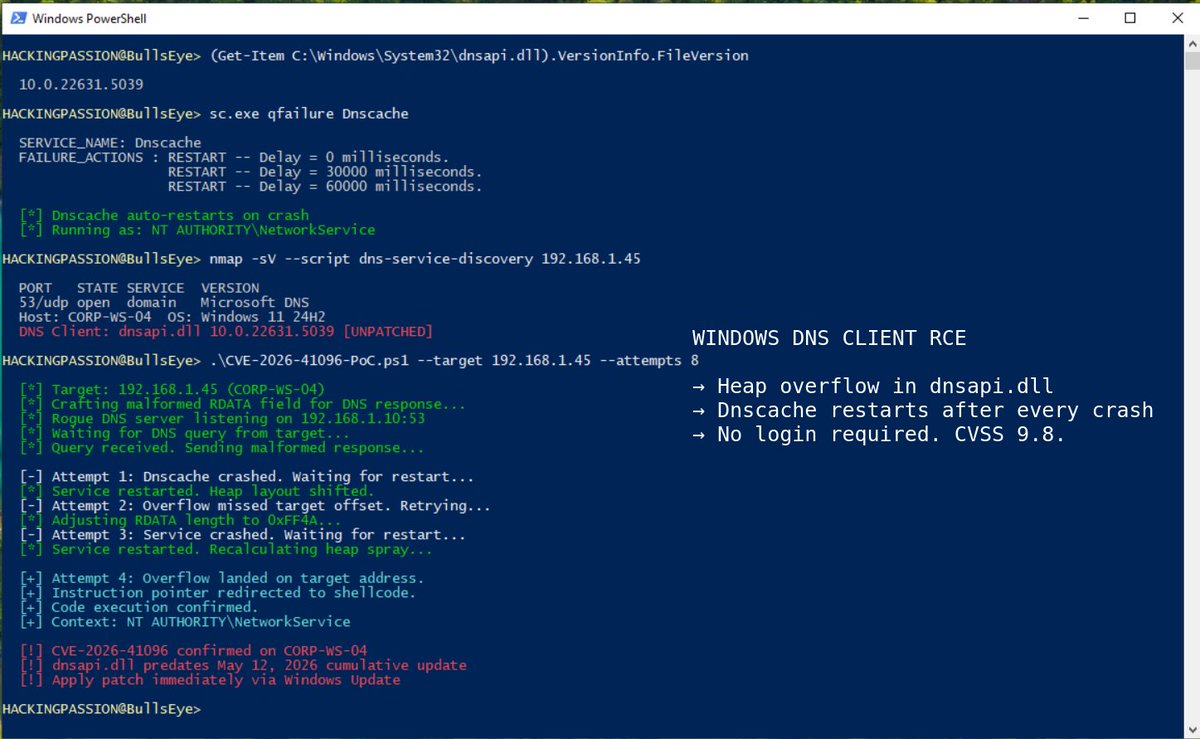
‼️🚨 Microsoft has patched a critical Windows DNS Client remote code execution vulnerability that allows an unauthorized attacker to execute code over a network. All it takes is a malicious DNS response.
The vulnerability is tracked as CVE-2026-41096 with a CVSS score of 9.8. It is a heap-based buffer overflow in dnsapi.dll, the Windows component that processes DNS answers on every machine.
To trigger it, an attacker needs a position where they can influence DNS responses: a rogue DNS server, a poisoned resolver, a compromised router, hostile WiFi, or a man-in-the-middle placement.
That puts ordinary Windows DNS activity in the blast radius. Browsers, VPN clients, enterprise apps, update checks, and background services constantly ask DNS where to connect. The vulnerable processing sits in the Windows DNS Client path, not an edge-facing server product.
Microsoft assessed exploitation as "less likely," and Rapid7 lists the issue as not publicly disclosed and not known to be exploited at release.
On the contrary, a 9.8 unauthenticated network RCE in DNS client handling is exactly the kind of bug defenders should assume will be reverse-engineered quickly.
Defenders should:
- Deploy the May 2026 cumulative updates and confirm coverage across endpoints and servers
- Restrict DNS traffic to trusted resolvers where possible
- Monitor Dnscache and svchost.exe for abnormal child processes or unexpected outbound activity
- Treat public WiFi and untrusted resolver paths as higher-risk until patching is complete
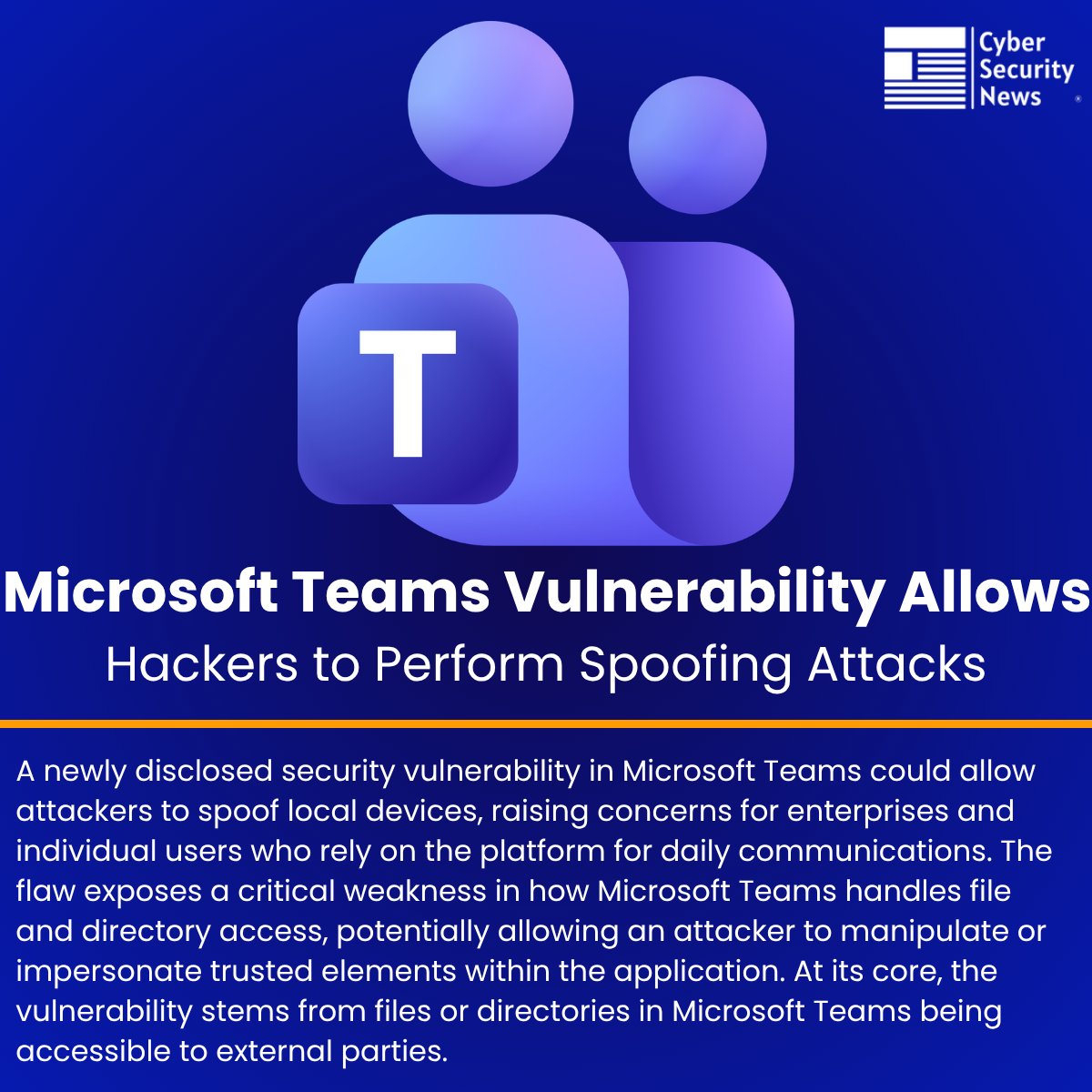
⚠️ Microsoft Teams Vulnerability Allows Hackers to Perform Spoofing Attacks
Source: https://t.co/DtB6z8Ni05
A newly disclosed security vulnerability in Microsoft Teams could allow attackers to spoof local devices, raising concerns for enterprises and individual users who rely on the platform for daily communications.
The flaw exposes a critical weakness in how Microsoft Teams handles file and directory access, potentially allowing an attacker to manipulate or impersonate trusted elements within the application.
At its core, the vulnerability stems from files or directories in Microsoft Teams being accessible to external parties.
#cybersecuritynews #Microsoftteams
🔴 TON VPN NE SERT À RIEN SUR ANDROID 16. GOOGLE LE SAIT. GOOGLE S'EN FOUT. 🚨
"Always-On VPN" & "Bloquer les connexions sans VPN", et tu te crois protégé ?
N'importe quelle app sur ton téléphone peut balancer ta vraie IP en clair sur Internet.
En ce moment, pendant que tu lis ce post. 💀
⚡ Le bug "Tiny UDP Cannon":
Android 16 a une nouvelle fonction censée fermer proprement les connexions QUIC, sauf que n'importe quelle app - sans AUCUNE permission spéciale - peut l'exploiter pour envoyer un paquet directement via ton interface réseau physique.
Le paquet BYPASS le tunnel VPN.
Ta vraie IP est exposée.
GAME OVER
- Ça touche TOUS les VPN. Mullvad, Proton, tout.
- C'est pas une faille du VPN.
- C'est Android qui trahit ta connexion.🤡
Le chercheur "Yusuf" a reporté le bug à Google.
Réponse : "Won't Fix".
Une fuite IP qui bypass le lockdown VPN = pas un problème de sécurité selon Google. 👏
🛡 Qui a réagi ? @GrapheneOS, et en moins d'une semaine.
Faille patchée dans la version 2026050400.
-Pendant que Google ferme le ticket, GrapheneOS ferme la faille.
🔧 Fix temporaire sur stock Android:
1: adb shell device_config put tethering close_quic_connection -1
2: adb reboot
⚠️ Ce fix peut sauter après une mise à jour ou un factory reset.
C'est un pansement, pas une solution.
🎯 La vraie solution: GrapheneOS.
Le seul OS Android qui prend ta privacy au sérieux.
Stock Android n'est pas un OS de sécurité - c'est un OS publicitaire avec des options de sécurité.
- Google ne protège pas ta vie privée.
- Google monétise ta vie privée.
Un VPN qui fuite, c'est une feature pour eux, pas un bug. 🔐
[Source & Solution en commentaire👇]
#Android #VPN #GrapheneOS #LAB312







![Lab312_'s tweet photo. 🔴 TON VPN NE SERT À RIEN SUR ANDROID 16. GOOGLE LE SAIT. GOOGLE S'EN FOUT. 🚨
"Always-On VPN" & "Bloquer les connexions sans VPN", et tu te crois protégé ?
N'importe quelle app sur ton téléphone peut balancer ta vraie IP en clair sur Internet.
En ce moment, pendant que tu lis ce post. 💀
⚡ Le bug "Tiny UDP Cannon":
Android 16 a une nouvelle fonction censée fermer proprement les connexions QUIC, sauf que n'importe quelle app - sans AUCUNE permission spéciale - peut l'exploiter pour envoyer un paquet directement via ton interface réseau physique.
Le paquet BYPASS le tunnel VPN.
Ta vraie IP est exposée.
GAME OVER
- Ça touche TOUS les VPN. Mullvad, Proton, tout.
- C'est pas une faille du VPN.
- C'est Android qui trahit ta connexion.🤡
Le chercheur "Yusuf" a reporté le bug à Google.
Réponse : "Won't Fix".
Une fuite IP qui bypass le lockdown VPN = pas un problème de sécurité selon Google. 👏
🛡 Qui a réagi ? @GrapheneOS, et en moins d'une semaine.
Faille patchée dans la version 2026050400.
-Pendant que Google ferme le ticket, GrapheneOS ferme la faille.
🔧 Fix temporaire sur stock Android:
1: adb shell device_config put tethering close_quic_connection -1
2: adb reboot
⚠️ Ce fix peut sauter après une mise à jour ou un factory reset.
C'est un pansement, pas une solution.
🎯 La vraie solution: GrapheneOS.
Le seul OS Android qui prend ta privacy au sérieux.
Stock Android n'est pas un OS de sécurité - c'est un OS publicitaire avec des options de sécurité.
- Google ne protège pas ta vie privée.
- Google monétise ta vie privée.
Un VPN qui fuite, c'est une feature pour eux, pas un bug. 🔐
[Source & Solution en commentaire👇]
#Android #VPN #GrapheneOS #LAB312](https://pbs.twimg.com/media/HIJZr7-WwAA_1zK.png)


