This is my current @OpenAI Codex workflow.
It's insanely powerful, and allows Codex to implement far more complex features than the default setup.
It's also much more reliable and leads to better code, with significantly less scope creep.
Follow it exactly (models and all). The results are amazing:
Start by using this prompt (fill in your feature description), with gpt-5 high:
---
# Initial Explanation Stage
Your task is NOT to implement this yet, but to fully understand and prepare.
Here is exactly what I need implemented:
```[DETAILED FEATURE DESCRIPTION HERE]```
--
Your responsibilities:
- Analyze and understand the existing codebase thoroughly.
- Determine exactly how this feature integrates, including dependencies, structure, edge cases (within reason, don't go overboard), and constraints.
- Clearly identify anything unclear or ambiguous in my description or the current implementation.
- List clearly all questions or ambiguities you need clarified.
Remember, your job is not to implement (yet). Just exploring, planning, and then asking me questions to ensure all ambiguities are covered. We will go back and forth until you have no further questions. Do NOT assume any requirements or scope beyond explicitly described details.
---
Once you've answered all of GPT-5's questions and it has nothing more to ask, paste in this prompt:
---
# Plan Creation Stage
Based on our full exchange, now, produce a markdown plan document (`https://t.co/D3A6TySWHM`).
Requirements for the plan:
- Include clear, minimal, concise steps.
- Track the status of each step using these emojis:
- 🟩 Done
- 🟨 In Progress
- 🟥 To Do
- Include dynamic tracking of overall progress percentage (at top).
- Do NOT add extra scope or unnecessary complexity beyond explicitly clarified details.
- Steps should be modular, elegant, minimal, and integrate seamlessly within the existing codebase.
Markdown Template Example:
```https://t.co/D3A6TySWHM (example)
# (Example) Feature Implementation Plan
**Overall Progress:** `0%`
## Tasks:
- [ ] 🟥 **Step 1: Setup authentication module**
- [ ] 🟥 Create authentication service class
- [ ] 🟥 Implement JWT token handling
- [ ] 🟥 Connect service to existing database schema
- [ ] 🟥 **Step 2: Develop frontend login UI**
- [ ] 🟥 Design login page component (React)
- [ ] 🟥 Integrate component with auth endpoints
- [ ] 🟥 Add form validation and error handling
- [ ] 🟥 **Step 3: Add user session management**
- [ ] 🟥 Set up session cookies securely
- [ ] 🟥 Implement session renewal logic
- [ ] 🟥 Handle session expiry and logout process
...
```
Again, for clarity, it's still not time to build yet. Just write the clear plan document. No extra complexity or extra scope beyond what we discussed. The plan should lead to simple, elegant, minimal code that does the job perfectly.
---
Now, once this plan is done, look it over, and if it looks good, switch the model to gpt-5-codex high, then prompt it with:
---
Now implement precisely as planned, in full.
Implementation Requirements:
- Write elegant, minimal, modular code.
- Adhere strictly to existing code patterns, conventions, and best practices.
- Include thorough, clear comments/documentation within the code.
- As you implement each step:
- Update the markdown tracking document with emoji status and overall progress percentage dynamically.
---
After advising 50+ consumer companies over the last year, the one thing that separates those who can execute and those who can't:
Having a full-time designer in the room at all times
I've met with countless companies that have raised millions—and even one that has raised billions—that do not even have a designer on payroll.
This makes product development broken:
1/ You simply cannot have constructive conversations about ideas without visualizing them in real-time
2/ Your experiments will frequently have inconclusive results because users cannot discover features or they misunderstand how they work
3/ There is no one who can galvanize the team with a vision of what the product could look and feel like
And to be abundantly clear: I'm not referring to visual UI or graphics. I'm talking about someone who can think through the fundamental building blocks of product comprehension—like navigation, interaction and copywriting—and is technically savvy enough to visualize those components in high resolution.
There can certainly be exceptions to not having a designer, like where the CEO is an exceptional visual thinker, but that does not scale beyond a small team.
At the end of day, products live and die in the pixels: it's what the users see and tap. And without someone shepherding that process, you are effectively wandering the desert blind.
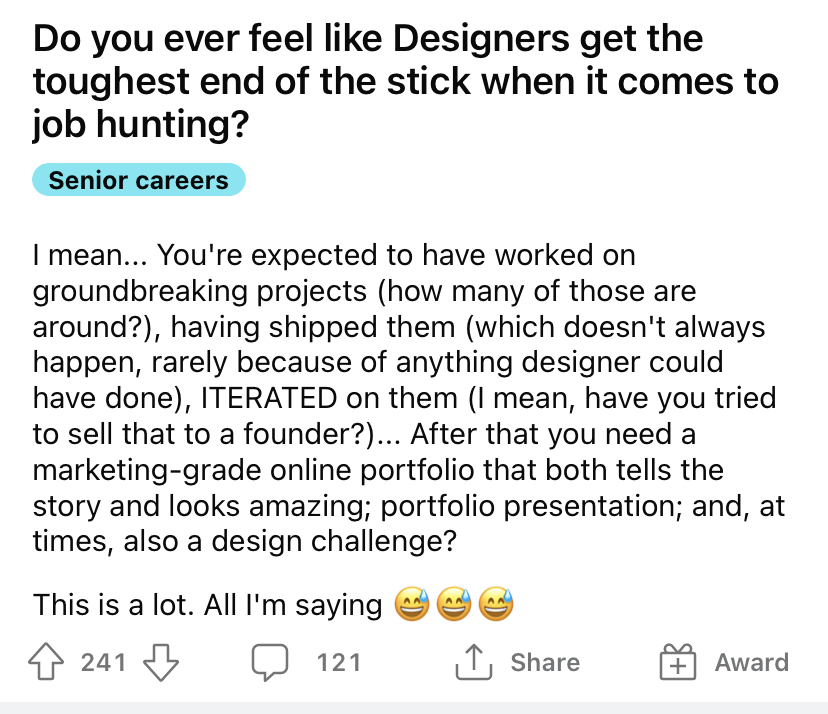
Found this gem on Reddit today
Ready to sign everything in this post
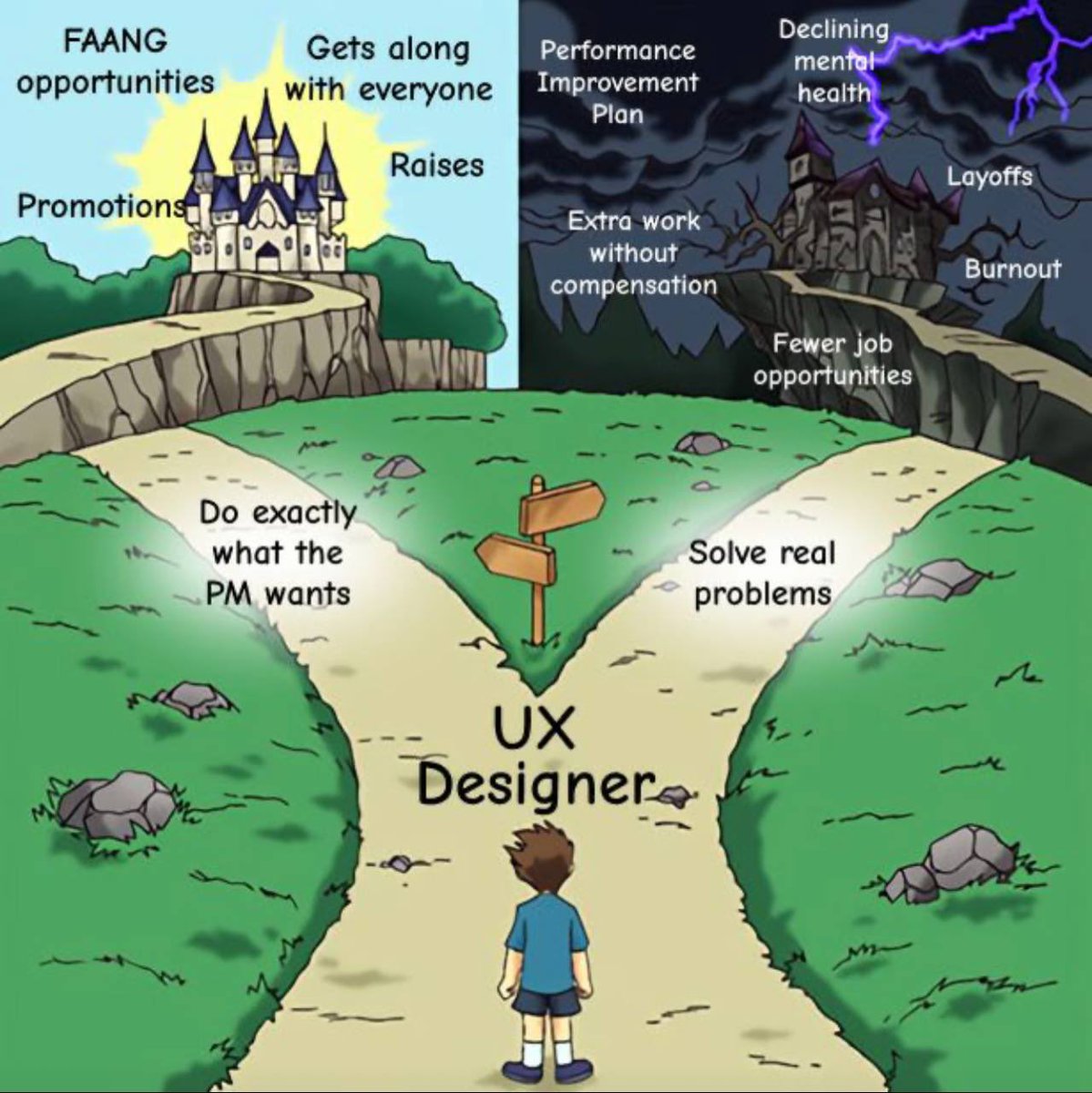
In my experience, they always asked for more from designers than we should
Earlier they wanted us to write HTML/CSS, now we have to be PMs and analysts
What comes next?
3️⃣ When you oversee the design of a wide range of products, you get to see the big picture
You are able to build a comprehensive picture of the company and market as a whole
You'll know what products are the top priority for the company and where they fit in the market
It's nice to work on one big product (in-depth work, intimate product knowledge, and close-knit team dynamics)
But now I work for a company with a diverse product mix, and the benefits are sweet:
2️⃣ Design skills can be flexed in diverse ways due to switching contexts constantly
You could design dashboard wireframes one minute and edit marketplace finals the next
There's juggling involved, but it's fun
If you expect additional actions after selecting a menu item, such as a confirmation window, add an ellipsis
The user will intuitively understand that nothing irreversible will happen right away
Though I question Spotify's decision to overload its desktop sidebar, I can understand why it was redesigned
But I do not understand the decision to remove likes from the mobile app
Do you guys have lost your minds, what is this nonsense? @spotify
I must confess that I enjoy quick time events in games, regardless of how they are usually perceived
I feel as if I am part of the action when QTE are timed correctly, and my actions directly affect the outcome of the game
Rather than passively watching a cutscene, QTE makes me feel more engaged and invested
If I fail a QTE, the outcome may be different which also a win
QTE can provide a satisfying experience by providing an extra challenge and an opportunity to test skills
Why most PC games don't have Xbox/PS controller switchers in the settings?
It is so fucking confusing to see an Xbox layout as the only option (speaking as an owner of a DualSense)
This UX is so odd
Designers need to be great communicators, especially talking to businesses & users
Communicating is a key skill since we always need to dig deeper and understand the reasons why our designs are needed
Design comes from converting ideas into forms and feelings into words
Trying to articulate your true self in a foreign language is like trying to play Jenga with chopsticks – frustrating, and you end up losing a piece of yourself in the process
When it comes to designers, it's like trying to build a house of cards with those same chopsticks
Why?