Really interesting (and worrying) polling on French pensions
The electorate estimates that for every pensioner we have 6 workers.
In reality it's 1.8/1... Even in 1960s we weren't close to 6/1.
Melenchon's supporters think its 13/1.
We’re sharing a solution to the Navier-Stokes Millennium Prize Problem, one of the deepest problems at the frontier of mathematics.
The proof was produced by a group of agents, using an OpenAI next-generation model significantly more capable than GPT-6 Astra.
The problem concerns whether the description of smooth three-dimensional fluid motion modeled by the Navier-Stokes equations can break down. It has remained unresolved for roughly 90 years.
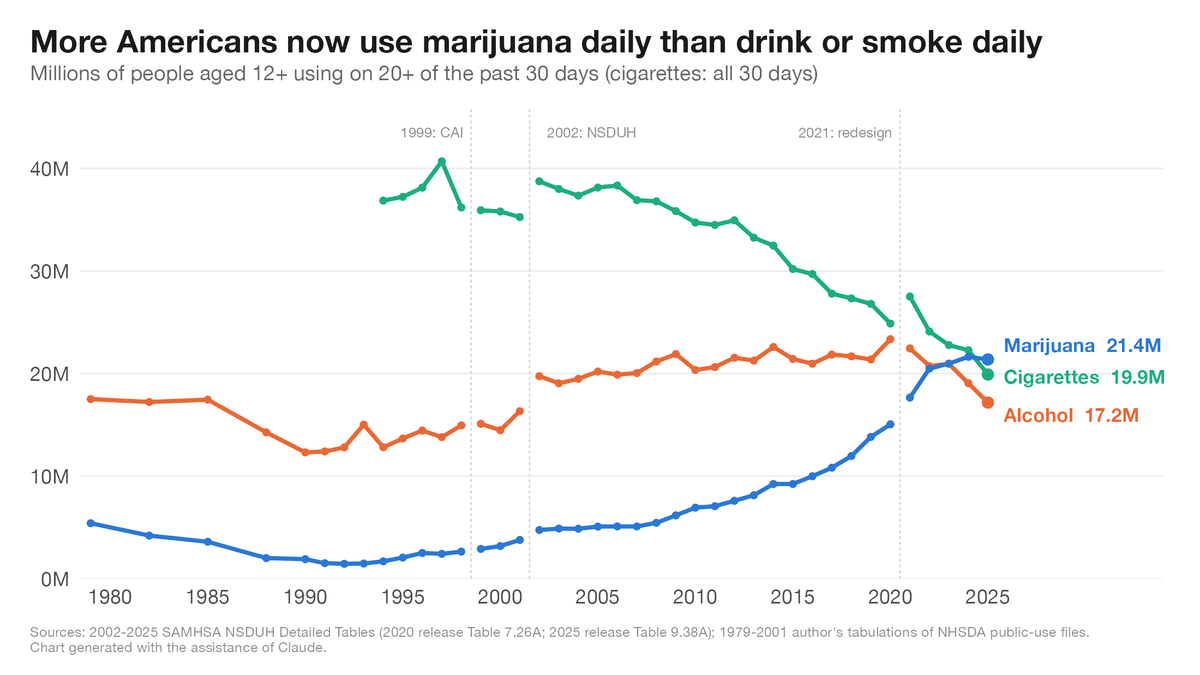
It's official: pot is a more popular daily drug than alcohol or cigarettes.
New data[1] from the federal National Survey on Drug Use and Health show that for 2025:
* 21.4M daily/near-daily marijuana users
* 19.9M daily/near-daily cigarette users
* 17.2M daily/near-daily alcohol users
2025 is the first time on record that marijuana is the most popular daily-use addictive product.
[1]See table 9.38A here: https://t.co/rUWtObNbFQ
The birth-rate collapse isn’t just about money, housing, or women choosing careers. The sharper diagnosis: fewer couples. Across the world, young people still say they want kids. But they socialize less, partner less, commit less – and become parents less. Smartphones didn’t make us infertile. They may have made us lonelier. The fertility crisis is really a bonding crisis. https://t.co/DSi1emv0HU
That's an interesting chart. Young men have stayed similarly conservative for over 25 years, while young women have drifted much further left.
Why such a divergence? What has changed for young women that hasn't changed for young men?
Bret Weinstein just said something that won’t leave my head:
For the first time in 300,000 years of human evolution, we removed the cost from the single biggest reward nature ever invented — sex and pair-bonding.
Reliable birth control + abortion = you can now cash the evolutionary lottery ticket without paying the 20-year mortgage of pregnancy, diapers, sleepless nights, and college funds.
Result? An entire generation of 18–35-year-olds walking around with the energy, libido, hormones, and protective instincts that evolution spent millions of years calibrating for child-rearing… but with zero actual children. That energy didn’t disappear. It got redirected.
Heather Heying’s observation is brutal: young women especially began treating ideologies the exact way evolution wired them to treat babies. Climate change, social justice, whatever the cause of the month is — it gets defended with literal mama-bear ferocity, the same neurochemistry that once guarded a toddler from predators now guards an abstract idea from wrong think.
And now Elon is promising the second shoe is about to drop: AI-driven abundance will make money as “free” as sex became in the 1970s. Both of evolution’s primary carrots — mating and resource acquisition suddenly cost almost nothing.
Weinstein’s ice-cold question: When producing and protecting actual children is no longer the central organizing principle of adult life… and when creating wealth is no longer required for status, security, or attracting a mate…What is left to give a human life direction, meaning, and structure?
Are we about to become a species that invents bigger and bigger dragons to slay just to feel alive? Or do we drift into total listlessness? This 3:52 clip is genuinely haunting.
Watch it all the way through, then tell me — honestly — does this explain the absolute intensity we’re seeing in culture right now, or is Bret completely missing something?
Real answers only. Quote-post if it hits you in the chest like it hit me.
As Orwell wrote: "It was always the women, and above all the young ones, who were the most bigoted adherents of the Party, the swallowers of slogans, the amateur spies and nosers-out of unorthodoxy."
4. AGI timeline is 2027-2034
@ylecun's exact words: "3-5 years to get world models working. Then scaling until human-level AI... within a decade or so."
But it won't come from scaling LLMs.
It's a bit emotional for me to talk about this, but I will say that Len posted pseudonymously on the cypherpunks list constantly, including at least one fleshed-out and long-lived handle, and even I didn't know what it was https://t.co/l5t1yGwGcP
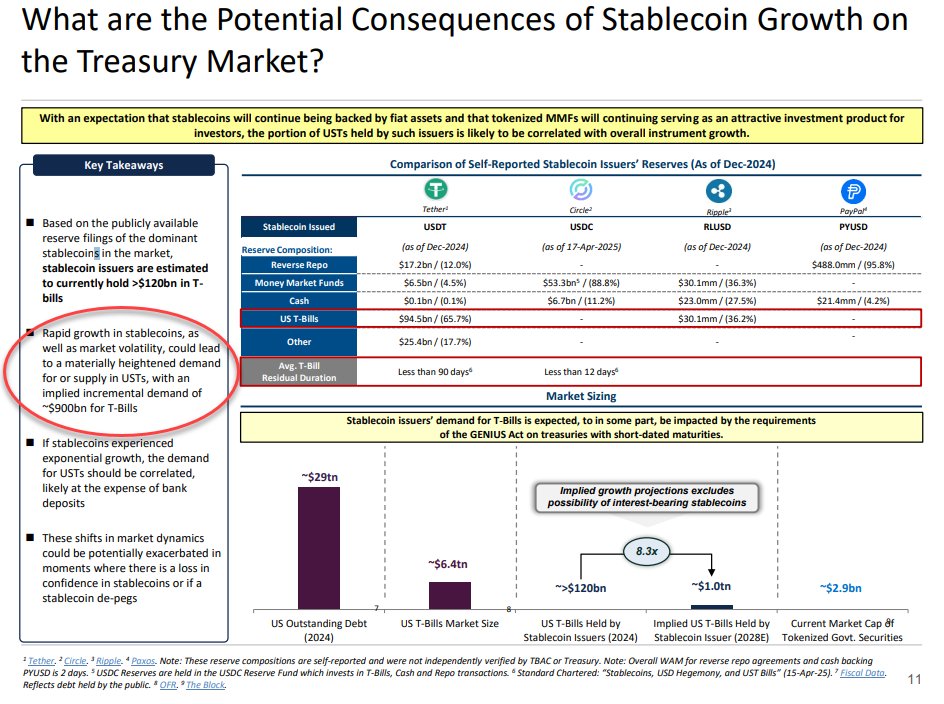
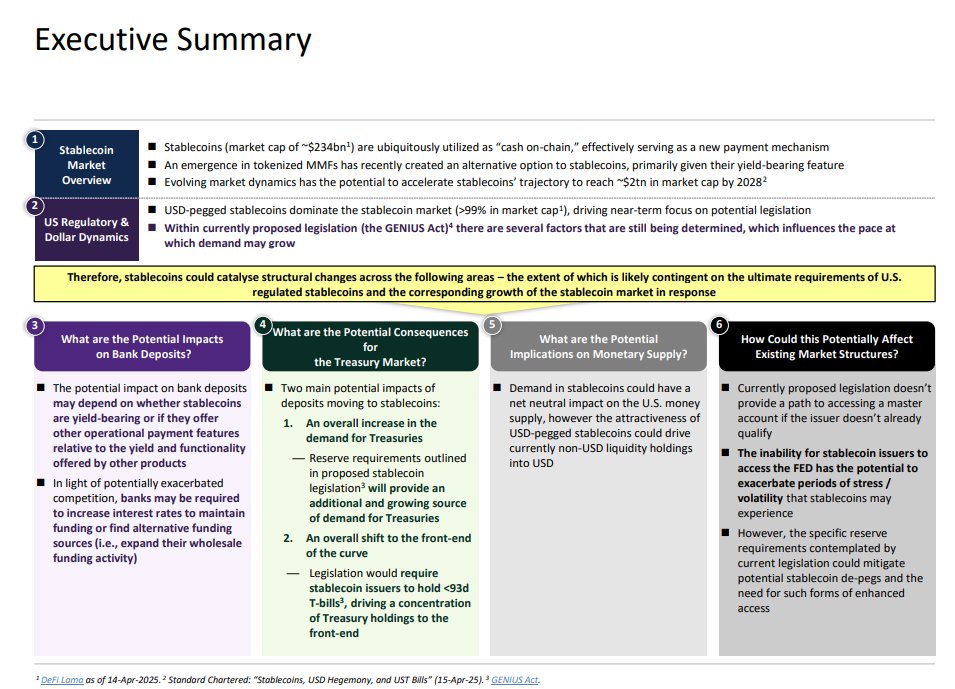
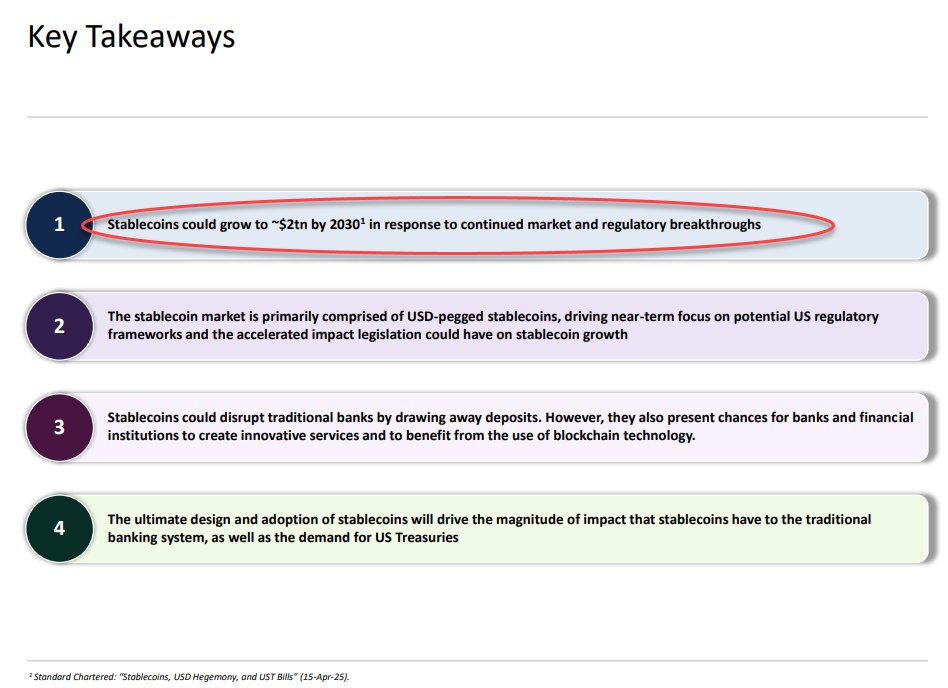
For the first time ever, the Treasury Borrowing Advisory Committee discusses stablecoins as a "new payment mechanism" and a potentially huge source of demand for US T-Bills.
Key observations:
1. Stablecoin issuers currently hold >$120bn in T-bills
2. Rapid growth in stablecoins could lead to incremental demand of ~$900BN for T-Bills (size of Bill market today is $6.4TN).
3. If stablecoins experience exponential growth, demand for USTs should be correlated, likely at the expense of bank deposits
4. Stablecoins could grow to $2 trillion by 2030 in response to "continued market and regulatory breakthroughs."
5. Stablecoins could disrupt traditional banks by drawing away deposits.