Another vulnerability few are talking about: I found my Claude Code exposing personal data in http headers because the sites it curled politely asked agents to identify their users 😊
Epistemic cybersecurity is the hot new category for 2027.
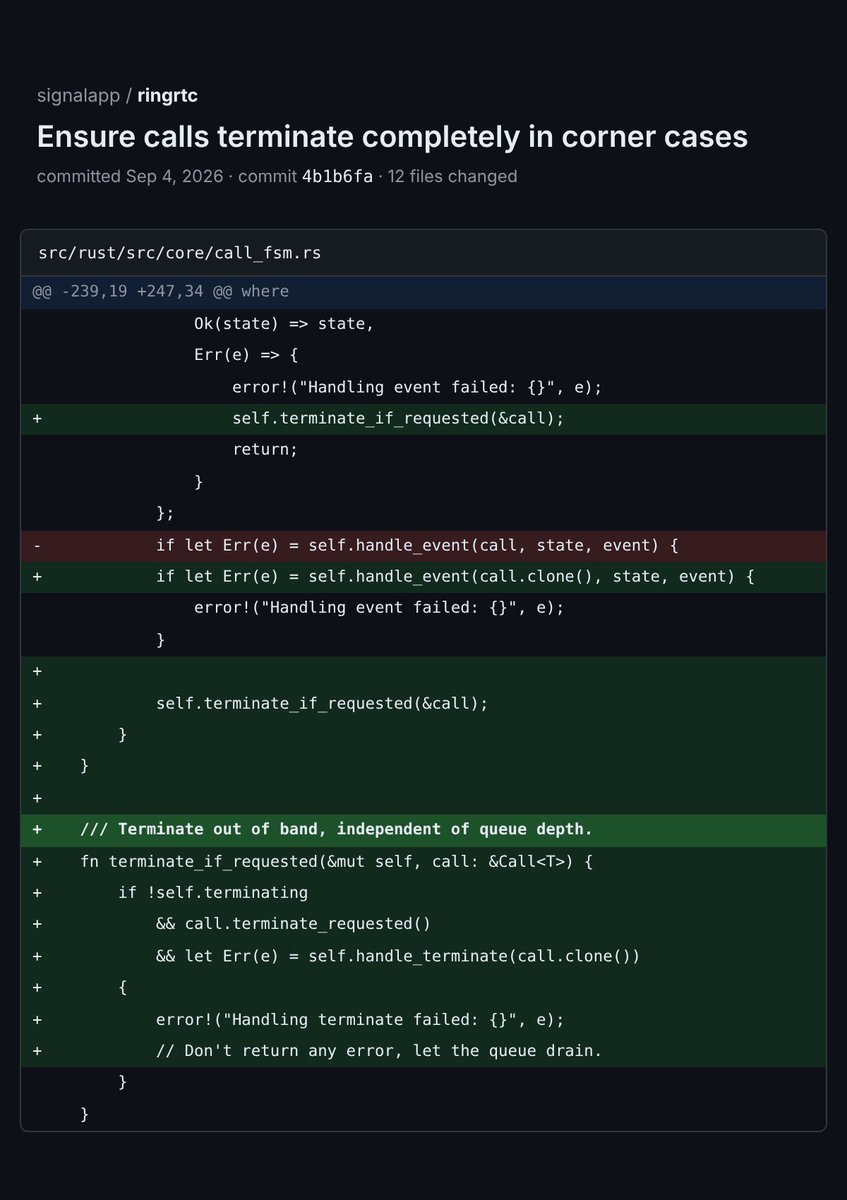
‼️ A critical Signal bug could keep your microphone, and possibly your camera, live after you hang up.
The other caller can flood the call's event queue so your hang-up is never processed.
Dubed CVE-2026-113380 it scored 9.3 and got fixed in September.
So basically, today PHP got two critical bugs that let anyone run code on your server without even logging in, which is bad, and then the details leaked before the patch was even out, which is worse, and it works on WordPress and MediaWiki and Magento and Joomla and Laravel, and Censys says like 1.5 million servers are running a version with no fix, so the NSA was like "take your system offline," and the FBI was like "take your system offline," and CISA and the UK and CERT-EU were all like "take your system offline," and then the Prime Minister of Japan, the actual Prime Minister, posted at 5:55 in the morning telling 48.8 million people to take their system offline, so everyone took their system offline, like the Dutch cybersecurity agency took its own website offline, and the Dutch parliament went offline, and the Port of Rotterdam went offline, and Finland and France and Denmark started pulling government sites, and Wikipedia went down, and https://t.co/QlOXb3COq3 went down, and Asana and GOG and Something Awful went down, and the University of Vienna's webmail went down for some reason, and that's just PHP. Because GitLab also dropped a CVSS 10.0, which is the highest score they give out, for a bug that's been there since 2014, so that's every self-hosted GitLab for twelve years, and then LiteLLM 1.107.0 got hijacked and shipped a credential stealer and a remote access trojan in every single wheel and the Docker images, including latest, and you didn't even have to import it, just installing it was enough, and it's the second time this year, and then Railway paused every deployment on the entire platform because someone got into the environment variables, so now everyone has to rotate every secret they've ever stored there, and TiDB Cloud said someone was walking around inside with stolen credentials for basically a month and an extortion group says they took 10.6 terabytes, and Zeabur got breached for the second time in two months and is just shutting down, like the whole company, and Node.js patched remote code execution and a TLS bypass, and CISA says Plex is being actively exploited, and someone took over 300 Tor exit relays to steal SSH passwords, and SafePay ransomware has hit over 600 critical infrastructure orgs, and India's biggest bank filed a data loss incident, and Japan has been in an official state of emergency in cyberspace since October 9, which honestly explains the 5:55 AM post. Oh, and eMudhra, a certificate authority that's issued over 60 million certificates, whose entire job is proving websites are who they say they are, was supposed to be using private keys that are random numbers over a hundred digits long, and one of them was 4. Just 4. And the others were like 66 and 237. Anyway, it's Wednesday.
Two classes extremely bad cyber vulnerabilities disclosed in the last 24 hours. The first potentially impacts everyone online. The second impacts nearly everyone running a server.
tl;dr: Everyone should upgrade their OS and Browser as soon as possible. If you run a server you should upgrade PHP (or ensure it’s removed if you’re not using it) as soon as possible.
The first class of vulnerabilities is a set of root TLS certificates that were discovered to have a trivial private key. Literally the number 4. These roots were controlled by #eMudhra. The problem is that with that an attacker could create a certificate and, if they could get in the traffic flow, intercept traffic to any site or service. The solution is to stop trusting certificates issued by these vulnerable roots. Upgrading your browser and OS is the fastest way for most Internet users to do this.
The second class of vulnerabilities doesn’t apply to most consumers directly, but does apply to most anyone running a server. These vulnerabilities have been dubbed #php2shell. PHP is one of the most widely used web programming languages. It’s estimated 70% of websites run on PHP. These vulnerabilities allow an attacker to send a crafted set of queries to a server running PHP and potentially take over the server. From there they could potentially read, modify, delete, or repurpose anything on the server. The solution is to upgrade PHP to the latest version ASAP. Even if you’re not using PHP for your web development, it’s often included by default. So make sure it is either upgraded or fully removed.
@Cloudflare received advanced warning of both of these classes of vulnerabilities. We’ve ensured that where we act as a proxy we are no longer trusting the vulnerable roots. We are also reviewing certificate transparency (CT) logs for any sign the vulnerability was exploited before its disclosure. We have not found any evidence but CT logs are not perfect and a sophisticated attacker who knew about the weakness could have exploited it without a new certificate being logged.
For the PHP vulnerabilities, we have deployed mitigations available for all customers for free. Because of the complexity of the vulnerabilities and number of ways it can be exploited, we also released new WAF capabilities that are unique in the industry to catch the exploit based on the response. These too are available for every Cloudflare customer for free.
Even if you are taking advantage of Cloudflare’s protection, it is important to upgrade your OS, browsers, and PHP installations as soon as possible. We can provide a strong bandaid, but the best protection is to fix the underlying problem.
If you’re interested in learning more, you can read our blogs:
Vulnerable roots: https://t.co/TR77Zd01A0
PHP vulnerabilities: https://t.co/qTUK8i3Oww
A malicious release of LiteLLM on PyPI stole passwords and keys from machines, even if your code never used LiteLLM. Here is how it worked...
First, how it got in. The attacker added one line to the build config: `data = "cook"`. That line caused three extra files to be included in the package during the build. The public GitHub repository did not contain this line, so the source code looked clean. Only the published package was malicious.
Second, why it ran without being imported. Python has a feature where a `.pth` file in `site-packages` can execute code every time Python starts. The attacker added a `cook.pth` file containing a single line: `import cook`. From that point on, almost any Python process on the machine could trigger the stealer: your app, pip, your editor, or your CI jobs.
Third, what it stole. It went after almost every secret a developer machine might have:
- SSH keys and shell history
- AWS, Azure, GCP, k8s, and GitHub credentials
- Claude Code, Cursor, and Codex Keys
- Saved browser passwords
- Environment variables
- LLM API keys stored in a LiteLLM proxy database
Fourth, how it pushed data out. It encrypted everything so that only the attacker could decrypt it, then uploaded it to a `/healthcheck` URL, making the traffic look like a routine health check.
Turns out, we cannot trust the source repository alone.
We need to also, pin package versions (classic) with hashes, give new releases time to be scrutinized before adopting them, and inspect the actual artifacts you install.
Security is more critical than ever! The software supply chain is a different beast. You can audit every line in a repository and still end up running malicious code.
Interesting times.
Sorry everyone... We're announcing a 0-Day vuln in QUIC that allows anyone to remotely turn off a server running these libraries. I swear we didn't plan this.
https://t.co/fopoKsPulV
Node.js Security Advisory: a high-severity RCE flaw in Node's Brotli decoder affects Node.js 22, 24, and 26.
Vercel WAF rules are live for every project and block known exploit patterns.
https://t.co/JtfEshHnOC
🔐 Node.js security updates are now available!
New releases for Node.js 22.x, 24.x & 26.x address multiple vulnerabilities, including high-severity issues.
Review the details and update your systems to stay secure.
🔗 https://t.co/W4kfzx5lxz
#NodeJS#Security
Say hello to the new LemFi 💚
Update your LemFi app when it lands.
Products and features vary by country, and eligibility criteria apply. Savings and Credit are available in the UK only.
#AmbitionHasNoPassport