CA: 2HtV53atUksEpPCQCFP65aQ4E9fBGjY93eVLsavopump
This is not a regular memecoin.
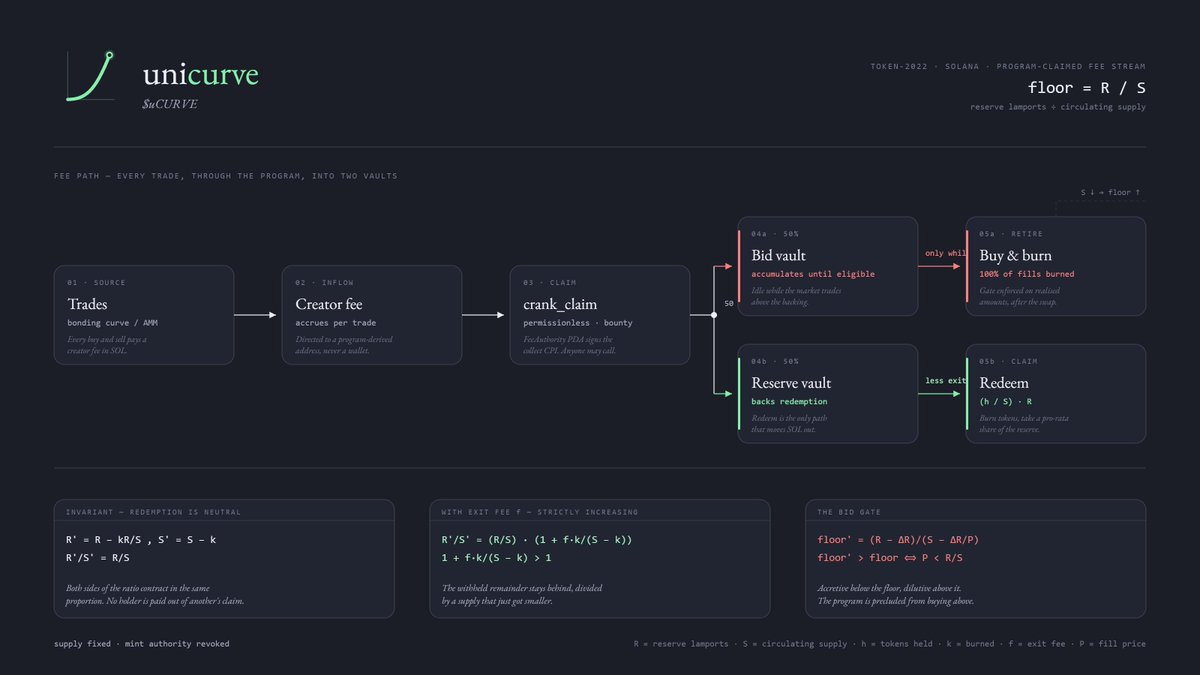
Behind it runs an on-chain program that routes every creator fee into two mechanisms: 50% grows the SOL reserve backing the circulating supply, while 50% funds below-floor buybacks that permanently burn every token acquired.
More trading adds more backing. Buybacks reduce supply. Together, they continuously raise the fully backed market cap and create a floor that only ratchets upward over time.
Program: https://t.co/WtFLbqtwCJ
Start here if you are new to how $uCURVE works.
An onchain program is code that controls how the mechanism operates. Instead of buybacks, burns, and reserve allocations being handled manually, each action follows rules written directly into the program.
For $uCURVE, creator rewards generated by trading are routed into that system.
50% grows a SOL reserve backing the circulating supply.
50% funds buybacks that only execute when the market trades below the backed floor.
The floor is calculated by dividing the SOL held in reserve by the amount of $uCURVE still in circulation.
When the program buys below that floor, every token acquired is permanently burned. This leaves more SOL backing fewer tokens, allowing the floor to ratchet higher over time.
The market price remains free. The program governs the mechanism underneath it.
47 SOL is currently sitting inside the program, waiting to be deployed through future reserve allocations and below-floor buybacks.
Execution timing is randomized, so the next claim and buyback cannot be easily predicted or front-run. When the conditions are met, the program routes the funds, buys $uCURVE from the open market, and burns everything it acquires.
No manual timing. No discretionary execution. Just onchain logic waiting for the right moment.
The site reads your $uCURVE balance against the SOL reserve held by the program and calculates the amount you can redeem at that moment.
Your claim is simply:
your $uCURVE balance / circulating supply × SOL reserve
You can redeem your share directly through the program. The $uCURVE you return is permanently burned, and the corresponding SOL is released from the reserve to your wallet.
A 3% exit fee stays inside the reserve, so each redemption leaves fewer tokens sharing proportionally more SOL. That means holders who remain are not diluted when someone exits. The backed floor per token stays intact and can increase.
So after connecting, you can view your live redeemable value and claim the SOL backing your position onchain.
https://t.co/mMMehNKIUs
One of the biggest limitations of AMMs is that they only define how a token trades. The programmable logic around fees, supply, buybacks, and backing still usually lives outside the market.
Fees leave the system, supply remains untouched, and any buybacks or reserve management depend on promises made by a team.
That logic should live inside the program.
When fee routing, conditional bids, burns, and redemptions are enforced onchain, the market no longer depends on someone choosing to act. The rules execute automatically, every transaction is verifiable, and the mechanism keeps running for as long as the token trades.
@Uniswap made liquidity programmable.
The next step is building the infrastructure for programmable token markets on solana.
Another onchain buyback and burn is complete.
Creator rewards were used to buy $uCURVE from the open market, and every token acquired was permanently removed from circulation once the transaction confirmed.
The floor continues to rise as more SOL enters the reserve and supply contracts. There is still roughly 37 SOL in fees sitting inside the program, waiting to be routed through future reserve allocations and below-floor buybacks.
The program is running exactly as designed.
Buyback:
https://t.co/bgGGLuGupj
Burn:
https://t.co/kTx8KRiQkr
Seen a few questions about the nature of buybacks and burns.
Everything runs through the onchain program. Creator rewards are claimed automatically, routed into the reserve and buyback legs, and any $uCURVE acquired below the floor is burned as soon as the transaction confirms.
Claim timing is randomized so the next execution is harder to predict and less exposed to front-running. There is no person choosing when to buy, how much to deploy, or when to burn.
What @Uniswap v4 hooks brought to Ethereum was the ability to make pool behavior programmable.
We are bringing that same idea to solana, not by changing how a pool trades, but by attaching onchain logic directly to the token itself.
Creator rewards can grow reserves, trigger conditional buybacks, burn supply, and enforce redemption rules automatically.
This is what programmable token mechanics look like on solana.
Fourth onchain buyback complete.
Creator rewards were converted into $uCURVE on the open market, and every token acquired was permanently removed from circulation through the program.
Each completed cycle leaves more SOL backing fewer tokens, pushing the onchain floor higher without manual intervention.
Buyback:
https://t.co/Ez3JjcBq6r
Burn:
https://t.co/gPRCgqhzU3
We just created a new way to change the mechanics behind a memecoin through code running onchain. Fees, buybacks, burns, reserves, redemptions, and supply rules can all be enforced by the program.
The program will be open sourced so anyone can study the mechanism, build on it, or implement their own programmable logic around a token.
This is what happens when the token itself becomes programmable.
Third onchain buyback confirmed.
Creator rewards were used to buy $uCURVE from the open market, and the tokens were permanently burned once the transaction cleared.
Three cycles in. More backing enters the system, circulating supply keeps falling, and the onchain floor continues to ratchet higher.
Buyback:
https://t.co/zhgZvfJX3T
Burn:
https://t.co/Copp7vevBe
Second onchain buyback confirmed.
The program used creator rewards to buy $uCURVE from the open market, then permanently burned the tokens once the transaction cleared.
Another cycle completed. More SOL backing the system, less $uCURVE in circulation, and a higher onchain floor over time.
Buyback:
https://t.co/tLjIVVPZmg
Burn:
https://t.co/BAjUf0FER0
For the first time, programmable logic is running directly behind a @pumpfun memecoin.
This is only possible through an onchain program. The rules are not promises or manual actions. They are code running at the contract level, automatically routing creator rewards, growing the SOL reserve, executing below-floor buybacks, and burning the tokens acquired.
The market trades freely. The mechanism underneath it keeps running.
Creator rewards are claimed at randomized intervals to make each execution harder to anticipate and reduce opportunities for front-running.
Once a below-floor buyback clears, the acquired $uCURVE is routed through the onchain program and permanently removed from circulation as soon as the burn is confirmed.
The program claims, buys, verifies, and burns.
Program IDL: https://t.co/WtFLbqu4sh
Dex paid.
For the first time, you’ll be able to watch a @pumpfun memecoin’s onchain floor ratchet upward in real time as creator rewards grow the SOL reserve and below-floor buybacks permanently reduce supply.
The mechanism is live. Now the chart gets to prove it.
First buyback + burn executed by the onchain program.
What you’re looking at is the first @Uniswap v4-style fee hook attached to a @pumpfun memecoin, designed to raise its onchain price floor over time while permanently reducing the circulating supply.
More creator rewards increase the SOL backing. Every below-floor buyback removes more $uCURVE from circulation.
tx: https://t.co/Eqk6m8gwov
burn: https://t.co/SFKQuWfnKR
If you still don't understand how $uCURVE works, here's the simplest explanation:
Every trade generates creator rewards.
-> 50% is added to a SOL reserve backing every $uCURVE in circulation.
-> 50% funds buybacks that only execute below the onchain floor, permanently burning the tokens they acquire.
More creator rewards increase the reserve. More buybacks reduce supply.
The floor behind $uCURVE is designed to ratchet upward over time.
Until now, there has been no way to attach custom logic directly to a token on solana.
@Uniswap v4 introduced hooks, allowing you to attach custom logic to a token’s lifecycle. We wanted to bring that same idea to solana.
Introducing https://t.co/XwZWKM5vSm, the first @Uniswap-style fee hook on solana. Every creator fee is automatically routed by an onchain program and allocated in two directions:
-> 50% is added to a SOL reserve backing every circulating token
-> 50% becomes a standing buyback that only executes below the token’s onchain floor
The floor is simply:
SOL reserve / circulating supply
As fees accumulate, the reserve grows. If the market trades below the floor, the program buys tokens from the open market and permanently burns them.
Holders can also redeem at any time for their proportional share of the reserve.
More trading adds more SOL to the reserve, while below-floor buybacks permanently reduce circulating supply. Together, those two forces create a ratchet effect: more backing, fewer tokens, and a floor that can only move higher.
That means the token’s fully backed market cap rises over time as more volume passes through the system.
Program:
https://t.co/WtFLbqtwCJ
https://t.co/XwZWKM5vSm