Together, Waymo and @Uber are making all-electric, fully autonomous delivery a reality. Starting today, @UberEats Eats customers in the Metro Phoenix area may get matched with a fully autonomous Waymo car to get the items they crave. https://t.co/A3CcuGN8gM
Our first two white papers are now available including @GallaudetTim's paper titled "Beneath the Surface: We May Learn More about UAP by Looking in the Ocean." You can read it here on our website: https://t.co/NTMflhJb1O
BREAKING NEWS:
FREEDOM OF INFORMATION ACT PAYDIRT:
JOINT CHIEFS OF STAFF WORLDWIDE UNIDENTIFIED ANOMALOUS PHENOMENA REPORTING PROCEDURES (MAY 19, 2023)
By Douglas Dean Johnson
On May 19, 2023, the Joint Staff (J3, Operations; J36 Homeland Defense Division) of the Joint Chiefs of Staff disseminated to all unified military commands worldwide a set of uniform procedures to be followed for gathering data and reporting on contemporary military encounters with Unidentified Anomalous Phenomena (UAP), using a detailed standard reporting template.
I have now obtained a copy of that Pentagon message. I believe that its detailed contents are being made public here for the first time (if the GENADMIN message has previously been published, that publication has not come to my attention).
The message was designated as "GENADMIN Joint Staff J3 Washington DC 191452ZMAY23 Unidentified Anomalous Phenomena Reporting and Material Disposition." It was disseminated as "Controlled Unclassified Information," or "CUI."
Journalist @BrandiVincent_ referred in passing to the existence of this message in a DefenseScoop article dated August 30, 2023 ("Hicks takes direct oversight of Pentagon’s UAP office; new reporting website to be launched"). I promptly asked Pentagon press officer Susan Gough to release a copy to me, but Gough replied, "I cannot provide a copy of the message to you, as it contains information that’s not publicly releasable."
On August 31, 2023, I filed a FOIA request for the GENADMIN message. The Department of Defense Freedom of Information Division has now released the 9-page document to me (response letter dated March 15, 2024, received by me on March 18), with only minimal redactions. After redacting my personal information, I am now making the complete FOIA release available at the link below. (The image merely shows the first page of the document; click on the link to download the complete PDF.)
INITIAL OBSERVATIONS
Among the noteworthy aspects I see in the May 2023 Joint Staff communication:
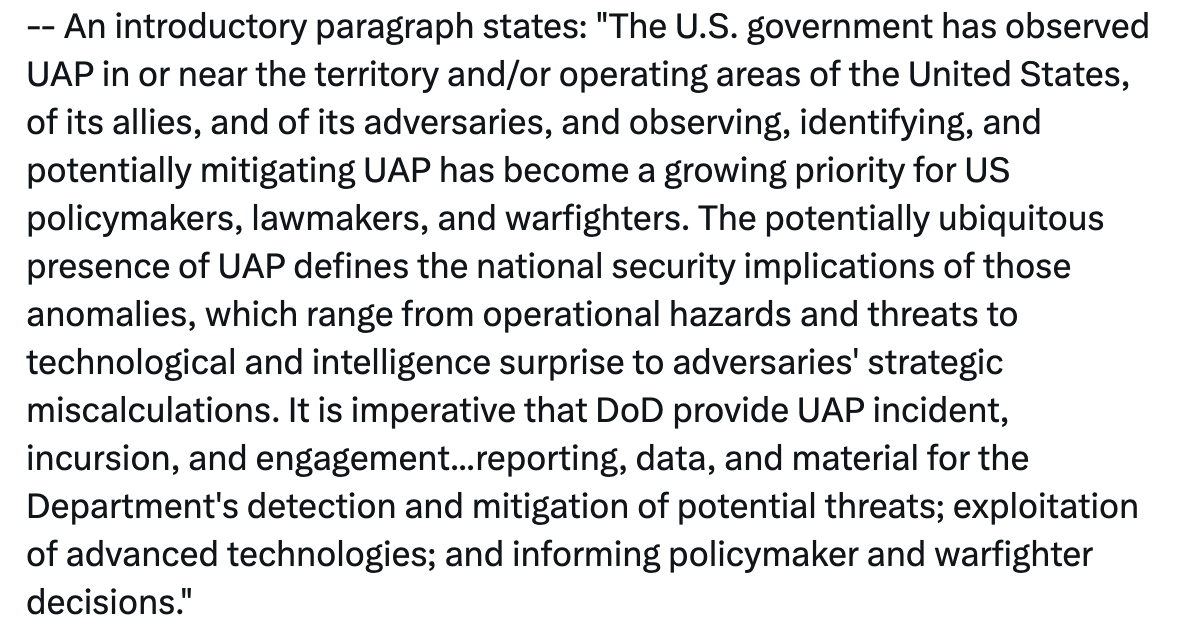
-- An introductory paragraph states: "The U.S. government has observed UAP in or near the territory and/or operating areas of the United States, of its allies, and of its adversaries, and observing, identifying, and potentially mitigating UAP has become a growing priority for US policymakers, lawmakers, and warfighters. The potentially ubiquitous presence of UAP defines the national security implications of those anomalies, which range from operational hazards and threats to technological and intelligence surprise to adversaries' strategic miscalculations. It is imperative that DoD provide UAP incident, incursion, and engagement...reporting, data, and material for the Department's detection and mitigation of potential threats; exploitation of advanced technologies; and informing policymaker and warfighter decisions."
--Reports on UAP incidents are to be transmitted upwards with 96 hours, but any "UAP engagement reports" within 12 hours. A "UAP engagement is a kinetic or non-kinetic response to a UAP, intended to deny, disrupt, or destroy the phenomenon and/or its object(s)."
-- The ultimate nexus of collection and analysis of these reports is the All-domain Anomaly Resolution Office (AARO).
-- The reporting procedures in the Joint Staff message apply only to detections or encounters "that demonstrate behaviors not readily understood by sensors or observers...[that] include but are not limited to phenomena that demonstrate apparent capabilities or material that exceed known performance envelopes." The UAP reporting procedures described in this directive do NOT apply to "incidents, incursions, and engagements by identifiable, non-anomalous phenomena (e.g., sUAS and other capabilities or materials that do not exceed known or predicted performance envelopes);" such incidents will instead "continue to be reported through established processes and mechanisms."
-- The reporting matrix seeks 11 categories of information-- among these, any UAP-displayed "anomalous characteristics/behaviors (e.g., no apparent control surfaces, extreme acceleration/direction change, detection by certain sensors but not others)," and any "UAP effects on equipment (e.g., mechanical, electrical controls and weapons systems and whether persistent or transitory").
-- AARO will coordinate the handling of any UAP "objects and material of incidents, intrusions, and engagements," but "recovery and transfer of identifiable, non-anomalous items of foreign origin...continue to be managed by the DoD FMP [Foreign Material Program]."
-- The military commands are to "enable deployment of special sensors within the AoR [area of responsibility] for the detection, observation, and identification in sensitive areas, and during testing or deployment of special capabilities."
ADDITIONAL CONTEXT
On its website, AARO calls the military reporting system defined in the May 2023 GENADMIN "Current Operational UAP Reporting." In a briefing for selected journalists on March 6, 2024, AARO Acting Director Tim Phillips said that AARO is receiving "approximately...anywhere between 90 and a 100-110 a month" through such channels.
Phillips also told the journalists, "We're trying to work out the command and control, the mechanisms on how other government entities can report UAP incidents to us. We've received a number of reports from Department of Homeland Security and their aircraft reporting to us that we follow up on."
As for civilian pilots, the AARO website states, "AARO receives UAP-related Pilot Reports (PIREPs) from the Federal Aviation Administration."
The UAP reporting system for contemporary military-associated UAP events, as set forth in the May 2023 Joint Staff message, is separate and distinct from the AARO "secure reporting" system for receiving reports "from current or former U.S. Government employees, service members, or contractor personnel with direct knowledge of U.S. Government programs or activities related to UAP dating back to 1945," which is accessible through a portal on the AARO website.
AARO does not yet employ any system for receiving UAP observation reports from the general public.
(The image below merely shows the first page of the Joint Staff message; click on the link to download the complete PDF.)
https://t.co/g8bvlkuR9T
It was an honor to have you author this in our series. Put together with other organizations like ASA, Limina, SCU, and Archives of the Impossible (among others), the community is well on its way to populating the academic literature with thought provoking data and foundational research.
Oh… and happy birthday Rear Admiral Gallaudet!
Very important new FOIA from @ddeanjohnson shows how - in defiance of @DoD_AARO's disinterest - the @DeptofDefense Joint Chiefs are taking #UAPs now very seriously indeed.
It is my honor to author the first @_SolFoundation white paper, this on on transmedium #UAP and unidentified submerged objects (USOs). https://t.co/cAQ13Anw2c
Remember when Rep @RepMattGaetz spoke last year about a @usairforce military pilot sighting of an anomalous object? Well, there are FOIA'ed documents now released on that event - and there's a video the military is declining to release. More from me tonight about this 'Apollo spacecraft' sighting on @EVargasTV and @ChrisCuomo https://t.co/AgggmbpIIR
Air Force Releases Details About 2023 UAP Sighting First Brought To Light By Congressman Matt Gaetz
"The image was of something that I am not able to attach to any human capability, either from the United States or from any of our adversaries." - Matt Gaetz
The FOIA documents reveal a declassified summary of the event, which describes the lead UAP as resembling an “Apollo spacecraft” in size and shape, with an “orange-reddish” illuminated bottom and a “three-dimensional cone shape” top composed of “gunmetal gray segmented panels.”
The pilot managed to gain radar lock on the UAP and obtain a screen capture of the object, while the remaining three were only detected by radar. Notably, upon approaching within 4,000 feet of the lead UAP, the pilot’s radar malfunctioned and remained disabled for the rest of the mission, with post-mission investigations failing to conclusively diagnose the fault.
Link to full article in the next post below.
EGLIN AFB UFO
On January 26, 2023, a U.S. Air Force pilot gained radar lock on and then observed visually a UAP traveling at about 16,000 feet, which the pilot likened to an "Apollo spacecraft" in size and shape, with an 'orange-reddish' illuminated rounded bottom and the top section 'a three-dimensional cone shape' comprising 'gunmetal gray segmented panels.' On closing to within 4,000 feet, the plane's radar failed. A video related to the incident remains classified.
h/t Abbas Dharamsey (@aboss)
h/t @RepMattGaetz
”There was a freedom of information act request that was answered by the Pentagon and they said that Bigelow Aerospace had extraterrestrial crash recovery in their facility there”
Richard Lang on @GoodTroubleShow#ufox#uapX#ufotwitter#uaptwitter
IMO...
If you have technology that is non-human in origin, you should not be able to keep it to yourself for the sole purpose of making money off of it via reverse engineering. That's selfish. Knowledge of such tech could change the world.
Rep. Andy Ogles on UAP technology
“They seem to have some sort of propulsion technology that’s unknown to man as we understand it. What does that do to the energy sector?”
“Huge implications across the economic scale.”
https://t.co/VV2yOtqvq8
#ufox#ufotwitter#ufo#uap
Classified Briefing with Alleged Video of Alien Bodies
“We can confirm that we received a briefing with Rep. Luna. We have no comment on the contents of that briefing at this time,” - a spokesman for Rep. Matt Gaetz
"[The Gang of Eight] are the people in Congress that are aware of all the information. So that should sink in. These are the people that are read into everything." ~Nell
Part 1 - Lightly edited transcript of Karl Nell's SOL lecture, plus Q&A.
Karl Nell - Colonel, U.S. Army (Retired) - Former Deputy Chief of Staff, U.S. African Command
~~~
Nolan: After talking to Karl for seven months, it’s been surprising the amount of thought that went into the verbiage in the Schumer/Rounds amendment.
Karl Nell: “Sincerest thanks to Garry and Peter and SOL for putting this together. It’s really a combination of decades of work of all the people in the audience, and other folks, that have brought us to this stage. Also thank also to @danielsheehan45 and his @NewParadigmInst, coming at this from the philosophical and ethical perspective as well.
“I think @dwpasulka had a great point where she said, ’It’s almost this emergent properties that come out of a collaboration. In some sense, Schumer is sort of an example of this. Some people ask, 'Where does this Schumer thing come from?' And maybe I can touch on the a little bit because I think it's really an example of what she was talking about. This sort of emergent... And sometimes, this collaboration isn’t necessarily even overt. It’s one group inspires another group to do certain things. There’s a dynamic there.
What is the Schumer Amendment (SA)?
"Ten years ago, probably, there SA would have been viewed as UAP/UFO disclosure. The SA seeks to very clearly clarify what the scope is of their problem set and what they’re trying to do about it. Probably, the recognition really oughta go to some silent few on The Hill, in terms of the full-time staffers that really were seeing this thing through. But the thing that enabled that to happen was a lot of the work that’s happened out here in the audience and out here in the community, that enabled and set the conditions for the staff to have the confidence to move forward to implement this type of legislation. Obviously, with the Majority Leader (@SenSchumer) and a complete bipartisan coalition doing this to make that happen.
“What are these, sort of, emergent factors that happened? Well, I think Leslie Kean’s (2017 NYT) article…was a key, sea-state change in precipitating the removal of a lot of the stigma that surrounded this topic. And, of course, coincident with that, the work of @ChrisKMellon and @LueElizondo in getting those videos released and adding their names and reputations to the topic to move it forward. So certainly, that was a key incident. The next piece was, I would argue, the David Grusch, @uncertainvector, David Fravor testimony before Congress. Again, lowering the threshold and making this topic respectable and incentivizing some discussion about it.
The Timeline
“The approval of the SA was maybe a day after that (Grusch, Graves and Fravor) hearing (July 26th). So I don’t think those are necessarily synchronized. The work for Schumer was going on in the background, but all these contributive factors were lowering that threshold for making this acceptable.
"If you look at the folks who are actually supporting this, you got two folks on SASC (@SenGillibrand and @SenatorRounds), you got two on SSCI (@SenatorHeinrich and @SenMarcoRubio). You’ve got complete bipartisanship, right? You got Rounds and Schumer that are sponsors. But, of course, you got Senator Gillibrand and Senator Rubio, from the left and the right, supporting it. And you got Senator Heinrich and @SenToddYoung .
“And the other interesting takeaway from this, is there’s two people that are sponsoring this bill that are on the Gang of Eight (Rubio and Schumer). So the Gang of Eight was really a concept that got created out of the Church commission when there was intel oversight concerns back in the 60s and the 70s where there were activities going on that Congress was not aware of and that were, essentially, illegal. And so there was a structure put in place such that certain key members of Congress would be legally entitled to hear about all information that pertained to the equities of Title 10 and Title 50.
"And so that created this concept of The Gang of Eight, which is: The Majority Leader and The Minority Leader in the Senate. The Speaker and The Minority leader in the House. And then the ranking and chairs of each of the Intel Committees. So that’s eight folks. So these folks are the people in Congress that are aware of all the information. So that should sink in. There are two people that are sponsoring this in Congress that say we need this legislation because things aren’t working right, and these are the people that are read into everything.
“A lot of times, when you get legislation, it’s either driven by lobbyists, frankly, or you gotta read the whole thing and you’re wondering, ‘What the heck were these people thinking when they wrote this? Like, why did they do this?’
“Well, in this case, the Senators put into the bill the exact reasons why they were doing the bill. And this is like, Section 2 of the legislation. This is a summary. But essentially, what they’re saying is...
"We wanna preserve and centralize all records related to this topic. They feel that it’s more important to pull these records out of the individual controlling authority’s possession and integrating them together in the national archives, is more important than having to distribute it and decentralize control of the records. That's the number one thing.
“Number two, there’s a presumption of disclosure. So that doesn’t mean that we’re gonna think about whether the stuff should be made available, it means that there’s the presumption and there’s gotta be an argument against if they’re not gonna be disclosed. So it’s very significant.
“The third thing is that this legislation’s needed to create an enforceable, accountable and deterministic process for this to happen. In other words, this isn’t gonna happen by itself, it hasn’t happened yet, and so, overt, explicit measures need to be taken in law, in order to cause this to happen. And the amendment is very specific on the mechanisms that are gonna be used to do that.
“The fourth piece is, and, a lot of people in the audience probably know, the Freedom Of Information Act kind of doesn’t work. The government kind of knows it doesn’t work. In some cases, that’s kind of good, from their perspective. But even given noble intent, Freedom of Information is very bureaucratic and very administratively onerous, and it’s not really very effective.
“But the fifth piece here, is even more interesting. And this is, again, in the amendment verbatim. And this is a Declaration of Congress, right? So they’ve researched this, and they've declared that some UAP records are exempt from mandatory declassification review under the Atomic Energy Act (AEA) of 1954. So, unlike the UK and some other countries, in the U.S. there is a mechanism to declassify classified information and the records undergo a review every so often. Usually, twenty-five years or so, but it depends on the specific information. So there’s some subset of records that the Congress has found, evade this mandatory declassification review and they are stating that that is due to the Atomic Energy Act of 1954. So you can imagine some of the, sort of, historical background that might have precipitated that, post-WW II, Manhattan Project, sightings going on at that time, and using that same security apparatus for this topic. So that’s a very significant finding that Congress is putting out there for folks that are paying attention.
“The sixth piece, and probably one of the most important from the perspective a free society, is that Congress has determined that there’s not proper oversight over this information. And that’s sort of implicit in the fact that the Gang of Eight have not been read into what’s happening and they’ve only found that out through whistleblower and other testimonies. And many of this is closed-door, and non-public. But the other point about this, which is very mature and very gratifying, and again, I think, links to what Diana was saying about this sort of collaboration and emergent way of working. The legislative branch is not making themselves the antagonist of the executive branch. The legislation explicitly states that, ‘Hey, legislative branch (pretty sure he meant, ‘Hey executive branch… ~Joe), you’re in the same boat we are. Neither the Executive nor the Legislative has proper oversight over this problem, and that’s explicit in the legislation.
“And the seventh piece is like, why do we care? Well, we care because we can’t do open, scientific research and we care because we’re concerned about technological surprise. And we’re concerned about the public interest and the public good. And so the legislation’s explicit about all of that. So it’s very important. And I’d encourage anybody to go look at Section Two of the legislation and read the verbatim what they’re saying here.
“So what’s actually the scope? And so this is probably a good point to talk about terminology. So, a lot of the stigma has been removed by, sort of, changing terms of reference. So we went from UFO/flying saucer/ET, to UAP. And so, UAP is probably a more accurate term, right? It’s a phenomena. And that can be a range of things from metaphysical, to psychosocial, to nuts and bolts, to religious, to consciousness. There’s a whole range of things. So this was actually really helpful in a sort of an intentional ambiguity to allow consensus to occur around a topic, at the same time as we’re removing historical stigma.
“In candor, that’s actually allowed legislators to come together in NDAAs 2021, 2022 and 2023, to make progress on the topic. But I think a lot of folks would agree that the problem comes in when you actually want to address what the underlying issue is.
“So, if you look at what AARO is doing, for instance, what problem are they actually solving? UAP is so broad, even in an operational sense, it could be, probably, four different problems. It could be the air trash/range-safety problem that Ryan Graves has highlighted so effectively. It could be the intel-surprise problem of the China balloon, if you will. It could be foreign-strategic reconnaissance, or it could be unknown unknown. Or it could be technological surprise. So those are a range of problems that are all kind of different in how you would address them.
“Range safety and air-space deconfliction is a Joint All-Domain Command and Control problem. It’s a real-time safety issue. The intel surprise issue is a national security defense issue. The technological surprise issue is a R&D issue. And we’re not even getting to the potential, metaphysical/consciousness/other aspects of the problem.
“So what the Schumer amendment does is they try to, basically, reverse the trend of expanding the scope of the term, to narrow it down to a hardcore where progress can now be made in this next phase. And then perhaps, as we make further progress, we can identify other areas of approach that might actually then be more efficacious to expand the definition.
“So let me read here what the actual legislation says so we know specifically what they intended with Schumer.
“UAP is any object operating or judged capable of operating in outer space, the atmosphere, ocean surface, or undersea, lacking prosaic attribution due to performance characteristics and properties not previously known to be achievable based upon commonly understood principles of physics. And you can see the six observables there that have been made so popular by Lue Elizondo. So, the term prosaic attribution is gonna redefined here in a minute. But, what we’re basically saying is, this stuff is the unknown unknown category, and that’s what we’re talking about when we’re talking about disclosure.
“So the other term of reference that’s important to understand is TNO - Temporarily Non-attributed Object. And there’s a huge distinction between these, and Schumer makes this explicit. So, TNO is a class of objects that temporarily resist prosaic attribution by the initial observer, due to environmental or system limitations associated with the observation process, but that nevertheless have a known, accepted human origin. So TNO is the stuff that you mistake at the time of observation but you later figure out like, what it is.
“So if you look at [Project] Blue Book - depending on the statistics you wanna use - the 94% or the 80% of what they spent their time on was TNO. It was all explainable. The residual 6% or 20% - depending on which statistics you’re using - that’s the UAP. So the legislation is focused on UAP. That’s the main takeaway.
“I’ve got a couple of slides on the Executive summary. So what’s the mechanics of this Legislation? So we already said that we wanna centralize the records. So, where we centralize the records is at @USNatArchives, so the archivist has got a role in this process. But they’re also owners of the records. They're people that generated the records - organizations in government - and they're people that happen to have records that they may not have generated.
"So these are called government offices. These government offices are obligated to identify and transmit these records to the archivist. They’ve gotta identify which records are UAP records, based on how the legislation’s written, and they’ve gotta transmit those to the archivist. And the legislation gives them 300 days to do this.
"So, nobody necessarily trusts that that’s gonna happen, and @GallaudetTim's talk, I think, outlined and highlighted, perhaps, the fact that the government isn’t a monolith, right? You’ve got a lot of different opinions going on, a lot of different organizational, dialectic and dynamics going on, and a lot of different agendas.
“And so, as we said earlier, there’s gotta be an enforceable and accountable process. So the central tenet of the Schumer amendment is to create this UAP Record Review Board. And so this is very much analagous to what was done in the JFK assassination records act of 1992 where an independent board was set up to review those records.
“But this legislation differs from that in several significant ways…
“Number one, obviously, the problems are different, right? So, in that case, it was more of a retrospective and an historical understanding, and there’s a finite set of records. Our problem here: It’s an ongoing problem, records are continuing to be generated into the future and there’s this, obviously, technological surprise concern. There’s an immediacy to this.
“So this Records Review Board that’s created is to consist of nine folks, and we’ll get into the composition of that. But that board is gonna have certain authorities to review what these offices submit. So, the going-in position is: If it’s UAP records, it’s gotta get disclosed. If the office doesn’t want to disclose, they gotta make a case on why they don’t want to disclose. That case comes to the board, and the board adjudicates that and recommends to the President.
“The oversight for this board is held in the Senate Homeland Security and Government Accountability Committee and in the House Committee on Oversight and Government Affairs.
“The other part of this is…unlike JFK, there’s the issue of materials.
“And so, there’s a couple of other terms of art in here, TUO and NHI. People are somewhat familiar with those, perhaps. Non-Human Intelligence. So, biological evidence of NHI, that’s been talked about in open hearings. And Technology of Unknown Origin.
“So, the Schumer Amendment that directs the federal government to exercise Eminent Domain over those. And then this board is to adjudicate whether the stuff actually is TUO and NHI and whether it should be postponed or disclosed. And we’ll get into some of the ramifications of that in a minute.
"So how’s this board gonna do this? They’re gonna develop a plan. And this is a big difference from the JFK legislation. So this plan, for all records that they deem need to be postponed, for whatever reason, has gotta indicate a benchmark-driven process with specified occurrences and timeframes for downgrading, review and declassification for everything that’s postponed. And then this plan supersedes all previous declassification guidance that may have been applicable to this material. That’s extremely important. That’s different than the JFK… The JFK was basically like, should we postpone or not? OK. And then it gets kicked down the road if they say postpone. Schumer basically says, ‘If you’re postponing, you gotta tell me exactly what you gotta do to release it in a benchmark-driven plan.’ And then this plan, basically, becomes the declassification guidance going forward.
“Now the point is that the President, ultimately, has the sole and non-delegable authority. So Congress can’t impinge upon presidential executive authority. So the President makes the ultimate decision based on these recommendations, but once the recommendation is made, they’re either immediately disclosed, or it’s postponed, as we said, and the decision’s put into the federal register within fourteen days. So the President has to provide a reason to the board on what his decision is, both classified and unclassified. The unclassified reason gets published, publicly, within fourteen days.
“The other point here is that, all the records are to be disclosed within 25 years of the date of creation, unless the President deems otherwise.
“Congress has authorized the appropriation of $20 million to to this.
“So these are terms of reference in the legislation.
“Non-Human Intelligence, at least 18 times cited in there. Any sentient, intelligent non-human life form, regardless of nature or ultimate origin, that may be presumed responsible for UAP - based on the earlier definition - or of which the federal government has become aware.
“Legacy Program - All Federal, State, and local government, commercial industry, academic, and private sector endeavors to collect, exploit, or reverse engineer technologies of unknown origin or examine biological evidence of living or deceased non-human intelligence that pre-dates the date of the enactment of this Act.
“Prosaic attribution. You remember this was in both of those terms, UAP and TNO. Prosaic Attribution - Having a human (either foreign or domestic) origin and operating according to current, proven, and generally understood scientific and engineering principles and established laws-of-nature and not attributable to non-human intelligence.
“So UAP = non-human, TNO (Temporarily Non-Attributed Objects) = Human
“Technology of Unknown Origin (TUO). This is very important for the Eminent Domain clause: Any materials or meta-materials, ejecta, crash debris, mechanisms, machinery, equipment, assemblies or sub-assemblies, engineering models or processes, damaged or intact aerospace vehicles, and damaged or intact ocean-surface and undersea craft, associated with unidentified anomalous phenomena or incorporating science and technology lacking prosaic attribution, or known means of human manufacture. So that’s what Eminent Domain applies to. It’s reasonably specific, I would say. (laughter)
“So this is The Board. So there are nine members of the board. Seven of those positions are specified explicitly: Executive Director, National Security Official, Foreign Service Official, Scientist (or Engineer), Economist, Professional Historian, Sociologist.
“How were these (positions) determined? They were determined to align with the instruments of national power. Historically, the instruments of national power are Diplomatic, Military and Economic. There was a revisions of that over time that added Information into that and created this concept called DIME.
(Diplomatic Informational Military Economic)
https://t.co/v5KvDdz3XW
“The counter insurgency coin came around and we realized, ‘Okay, there’s external elements of power and there are internal elements of power that sport of align with the nature of sovereignty,' so they expanded the definition to come with DIMEFIL, which adds law enforcement and intelligence and financial. And there’s also the political element.
(Diplomatic Informational Military Economic, Finance, Intelligence and Law Enforcement)
“So you’ve got eight elements of power, plus an Executive Director. And the premise for this is that disclosure is gonna happen using the instruments of national power, but disclosure also impacts the instruments of national power. And so you need practitioners of the instruments of national power for the President to have confidence in the recommendations he or she is getting from this panel, such that when he implements that decision, it’s gonna have a ramification that’s understandable by people that are experienced in the field.
“Impartial citizens are to be appointed to the panel that aren’t affiliated with any Legacy Program. We defined what Legacy Program was earlier. That’s a major exclusion. They are going to be of high, national reputation. So unlike the JFK, we’re talking about cabinet-level deputies, we’re talking about Nobel laureates, we’re talking about people of the caliber of a Avi Loeb or a Garry Nolan maybe. And that’s unsolicited. But frankly, we’re talking about that caliber of person. And these people are gonna be granted security clearances appropriate for the task, through expedited means. So it’s very important.
“Precedence-of-work. I’m not gonna dwell on this too long. This is different than the JFK. But basically, we’re saying: Anything that is not already public is high priority, the number one priority. Anything that most unambiguously relates to the topic, right? The most unambiguously non-human. Anything subject to litigation [and] anything of the earliest provenance. So that’s the precedence of work: Stuff we don’t know already and stuff that’s non-human.
He is not just a private citizen.
He is an official advisor for the AARO and is using his access to provide information to sources and shape narratives around unreleased reports.
Hicks and Dixon need to get a handle on this situation.


![ddeanjohnson's tweet photo. BREAKING NEWS:
FREEDOM OF INFORMATION ACT PAYDIRT:
JOINT CHIEFS OF STAFF WORLDWIDE UNIDENTIFIED ANOMALOUS PHENOMENA REPORTING PROCEDURES (MAY 19, 2023)
By Douglas Dean Johnson
On May 19, 2023, the Joint Staff (J3, Operations; J36 Homeland Defense Division) of the Joint Chiefs of Staff disseminated to all unified military commands worldwide a set of uniform procedures to be followed for gathering data and reporting on contemporary military encounters with Unidentified Anomalous Phenomena (UAP), using a detailed standard reporting template.
I have now obtained a copy of that Pentagon message. I believe that its detailed contents are being made public here for the first time (if the GENADMIN message has previously been published, that publication has not come to my attention).
The message was designated as "GENADMIN Joint Staff J3 Washington DC 191452ZMAY23 Unidentified Anomalous Phenomena Reporting and Material Disposition." It was disseminated as "Controlled Unclassified Information," or "CUI."
Journalist @BrandiVincent_ referred in passing to the existence of this message in a DefenseScoop article dated August 30, 2023 ("Hicks takes direct oversight of Pentagon’s UAP office; new reporting website to be launched"). I promptly asked Pentagon press officer Susan Gough to release a copy to me, but Gough replied, "I cannot provide a copy of the message to you, as it contains information that’s not publicly releasable."
On August 31, 2023, I filed a FOIA request for the GENADMIN message. The Department of Defense Freedom of Information Division has now released the 9-page document to me (response letter dated March 15, 2024, received by me on March 18), with only minimal redactions. After redacting my personal information, I am now making the complete FOIA release available at the link below. (The image merely shows the first page of the document; click on the link to download the complete PDF.)
INITIAL OBSERVATIONS
Among the noteworthy aspects I see in the May 2023 Joint Staff communication:
-- An introductory paragraph states: "The U.S. government has observed UAP in or near the territory and/or operating areas of the United States, of its allies, and of its adversaries, and observing, identifying, and potentially mitigating UAP has become a growing priority for US policymakers, lawmakers, and warfighters. The potentially ubiquitous presence of UAP defines the national security implications of those anomalies, which range from operational hazards and threats to technological and intelligence surprise to adversaries' strategic miscalculations. It is imperative that DoD provide UAP incident, incursion, and engagement...reporting, data, and material for the Department's detection and mitigation of potential threats; exploitation of advanced technologies; and informing policymaker and warfighter decisions."
--Reports on UAP incidents are to be transmitted upwards with 96 hours, but any "UAP engagement reports" within 12 hours. A "UAP engagement is a kinetic or non-kinetic response to a UAP, intended to deny, disrupt, or destroy the phenomenon and/or its object(s)."
-- The ultimate nexus of collection and analysis of these reports is the All-domain Anomaly Resolution Office (AARO).
-- The reporting procedures in the Joint Staff message apply only to detections or encounters "that demonstrate behaviors not readily understood by sensors or observers...[that] include but are not limited to phenomena that demonstrate apparent capabilities or material that exceed known performance envelopes." The UAP reporting procedures described in this directive do NOT apply to "incidents, incursions, and engagements by identifiable, non-anomalous phenomena (e.g., sUAS and other capabilities or materials that do not exceed known or predicted performance envelopes);" such incidents will instead "continue to be reported through established processes and mechanisms."
-- The reporting matrix seeks 11 categories of information-- among these, any UAP-displayed "anomalous characteristics/behaviors (e.g., no apparent control surfaces, extreme acceleration/direction change, detection by certain sensors but not others)," and any "UAP effects on equipment (e.g., mechanical, electrical controls and weapons systems and whether persistent or transitory").
-- AARO will coordinate the handling of any UAP "objects and material of incidents, intrusions, and engagements," but "recovery and transfer of identifiable, non-anomalous items of foreign origin...continue to be managed by the DoD FMP [Foreign Material Program]."
-- The military commands are to "enable deployment of special sensors within the AoR [area of responsibility] for the detection, observation, and identification in sensitive areas, and during testing or deployment of special capabilities."
ADDITIONAL CONTEXT
On its website, AARO calls the military reporting system defined in the May 2023 GENADMIN "Current Operational UAP Reporting." In a briefing for selected journalists on March 6, 2024, AARO Acting Director Tim Phillips said that AARO is receiving "approximately...anywhere between 90 and a 100-110 a month" through such channels.
Phillips also told the journalists, "We're trying to work out the command and control, the mechanisms on how other government entities can report UAP incidents to us. We've received a number of reports from Department of Homeland Security and their aircraft reporting to us that we follow up on."
As for civilian pilots, the AARO website states, "AARO receives UAP-related Pilot Reports (PIREPs) from the Federal Aviation Administration."
The UAP reporting system for contemporary military-associated UAP events, as set forth in the May 2023 Joint Staff message, is separate and distinct from the AARO "secure reporting" system for receiving reports "from current or former U.S. Government employees, service members, or contractor personnel with direct knowledge of U.S. Government programs or activities related to UAP dating back to 1945," which is accessible through a portal on the AARO website.
AARO does not yet employ any system for receiving UAP observation reports from the general public.
(The image below merely shows the first page of the Joint Staff message; click on the link to download the complete PDF.)
https://t.co/g8bvlkuR9T](https://pbs.twimg.com/media/GI-Cf4SWkAINMlx.jpg)


![TheUfoJoe's tweet photo. "[The Gang of Eight] are the people in Congress that are aware of all the information. So that should sink in. These are the people that are read into everything." ~Nell
Part 1 - Lightly edited transcript of Karl Nell's SOL lecture, plus Q&A.
Karl Nell - Colonel, U.S. Army (Retired) - Former Deputy Chief of Staff, U.S. African Command
~~~
Nolan: After talking to Karl for seven months, it’s been surprising the amount of thought that went into the verbiage in the Schumer/Rounds amendment.
Karl Nell: “Sincerest thanks to Garry and Peter and SOL for putting this together. It’s really a combination of decades of work of all the people in the audience, and other folks, that have brought us to this stage. Also thank also to @danielsheehan45 and his @NewParadigmInst, coming at this from the philosophical and ethical perspective as well.
“I think @dwpasulka had a great point where she said, ’It’s almost this emergent properties that come out of a collaboration. In some sense, Schumer is sort of an example of this. Some people ask, 'Where does this Schumer thing come from?' And maybe I can touch on the a little bit because I think it's really an example of what she was talking about. This sort of emergent... And sometimes, this collaboration isn’t necessarily even overt. It’s one group inspires another group to do certain things. There’s a dynamic there.
What is the Schumer Amendment (SA)?
"Ten years ago, probably, there SA would have been viewed as UAP/UFO disclosure. The SA seeks to very clearly clarify what the scope is of their problem set and what they’re trying to do about it. Probably, the recognition really oughta go to some silent few on The Hill, in terms of the full-time staffers that really were seeing this thing through. But the thing that enabled that to happen was a lot of the work that’s happened out here in the audience and out here in the community, that enabled and set the conditions for the staff to have the confidence to move forward to implement this type of legislation. Obviously, with the Majority Leader (@SenSchumer) and a complete bipartisan coalition doing this to make that happen.
“What are these, sort of, emergent factors that happened? Well, I think Leslie Kean’s (2017 NYT) article…was a key, sea-state change in precipitating the removal of a lot of the stigma that surrounded this topic. And, of course, coincident with that, the work of @ChrisKMellon and @LueElizondo in getting those videos released and adding their names and reputations to the topic to move it forward. So certainly, that was a key incident. The next piece was, I would argue, the David Grusch, @uncertainvector, David Fravor testimony before Congress. Again, lowering the threshold and making this topic respectable and incentivizing some discussion about it.
The Timeline
“The approval of the SA was maybe a day after that (Grusch, Graves and Fravor) hearing (July 26th). So I don’t think those are necessarily synchronized. The work for Schumer was going on in the background, but all these contributive factors were lowering that threshold for making this acceptable.
"If you look at the folks who are actually supporting this, you got two folks on SASC (@SenGillibrand and @SenatorRounds), you got two on SSCI (@SenatorHeinrich and @SenMarcoRubio). You’ve got complete bipartisanship, right? You got Rounds and Schumer that are sponsors. But, of course, you got Senator Gillibrand and Senator Rubio, from the left and the right, supporting it. And you got Senator Heinrich and @SenToddYoung .
“And the other interesting takeaway from this, is there’s two people that are sponsoring this bill that are on the Gang of Eight (Rubio and Schumer). So the Gang of Eight was really a concept that got created out of the Church commission when there was intel oversight concerns back in the 60s and the 70s where there were activities going on that Congress was not aware of and that were, essentially, illegal. And so there was a structure put in place such that certain key members of Congress would be legally entitled to hear about all information that pertained to the equities of Title 10 and Title 50.
"And so that created this concept of The Gang of Eight, which is: The Majority Leader and The Minority Leader in the Senate. The Speaker and The Minority leader in the House. And then the ranking and chairs of each of the Intel Committees. So that’s eight folks. So these folks are the people in Congress that are aware of all the information. So that should sink in. There are two people that are sponsoring this in Congress that say we need this legislation because things aren’t working right, and these are the people that are read into everything.
“A lot of times, when you get legislation, it’s either driven by lobbyists, frankly, or you gotta read the whole thing and you’re wondering, ‘What the heck were these people thinking when they wrote this? Like, why did they do this?’
“Well, in this case, the Senators put into the bill the exact reasons why they were doing the bill. And this is like, Section 2 of the legislation. This is a summary. But essentially, what they’re saying is...
"We wanna preserve and centralize all records related to this topic. They feel that it’s more important to pull these records out of the individual controlling authority’s possession and integrating them together in the national archives, is more important than having to distribute it and decentralize control of the records. That's the number one thing.
“Number two, there’s a presumption of disclosure. So that doesn’t mean that we’re gonna think about whether the stuff should be made available, it means that there’s the presumption and there’s gotta be an argument against if they’re not gonna be disclosed. So it’s very significant.
“The third thing is that this legislation’s needed to create an enforceable, accountable and deterministic process for this to happen. In other words, this isn’t gonna happen by itself, it hasn’t happened yet, and so, overt, explicit measures need to be taken in law, in order to cause this to happen. And the amendment is very specific on the mechanisms that are gonna be used to do that.
“The fourth piece is, and, a lot of people in the audience probably know, the Freedom Of Information Act kind of doesn’t work. The government kind of knows it doesn’t work. In some cases, that’s kind of good, from their perspective. But even given noble intent, Freedom of Information is very bureaucratic and very administratively onerous, and it’s not really very effective.
“But the fifth piece here, is even more interesting. And this is, again, in the amendment verbatim. And this is a Declaration of Congress, right? So they’ve researched this, and they've declared that some UAP records are exempt from mandatory declassification review under the Atomic Energy Act (AEA) of 1954. So, unlike the UK and some other countries, in the U.S. there is a mechanism to declassify classified information and the records undergo a review every so often. Usually, twenty-five years or so, but it depends on the specific information. So there’s some subset of records that the Congress has found, evade this mandatory declassification review and they are stating that that is due to the Atomic Energy Act of 1954. So you can imagine some of the, sort of, historical background that might have precipitated that, post-WW II, Manhattan Project, sightings going on at that time, and using that same security apparatus for this topic. So that’s a very significant finding that Congress is putting out there for folks that are paying attention.
“The sixth piece, and probably one of the most important from the perspective a free society, is that Congress has determined that there’s not proper oversight over this information. And that’s sort of implicit in the fact that the Gang of Eight have not been read into what’s happening and they’ve only found that out through whistleblower and other testimonies. And many of this is closed-door, and non-public. But the other point about this, which is very mature and very gratifying, and again, I think, links to what Diana was saying about this sort of collaboration and emergent way of working. The legislative branch is not making themselves the antagonist of the executive branch. The legislation explicitly states that, ‘Hey, legislative branch (pretty sure he meant, ‘Hey executive branch… ~Joe), you’re in the same boat we are. Neither the Executive nor the Legislative has proper oversight over this problem, and that’s explicit in the legislation.
“And the seventh piece is like, why do we care? Well, we care because we can’t do open, scientific research and we care because we’re concerned about technological surprise. And we’re concerned about the public interest and the public good. And so the legislation’s explicit about all of that. So it’s very important. And I’d encourage anybody to go look at Section Two of the legislation and read the verbatim what they’re saying here.
“So what’s actually the scope? And so this is probably a good point to talk about terminology. So, a lot of the stigma has been removed by, sort of, changing terms of reference. So we went from UFO/flying saucer/ET, to UAP. And so, UAP is probably a more accurate term, right? It’s a phenomena. And that can be a range of things from metaphysical, to psychosocial, to nuts and bolts, to religious, to consciousness. There’s a whole range of things. So this was actually really helpful in a sort of an intentional ambiguity to allow consensus to occur around a topic, at the same time as we’re removing historical stigma.
“In candor, that’s actually allowed legislators to come together in NDAAs 2021, 2022 and 2023, to make progress on the topic. But I think a lot of folks would agree that the problem comes in when you actually want to address what the underlying issue is.
“So, if you look at what AARO is doing, for instance, what problem are they actually solving? UAP is so broad, even in an operational sense, it could be, probably, four different problems. It could be the air trash/range-safety problem that Ryan Graves has highlighted so effectively. It could be the intel-surprise problem of the China balloon, if you will. It could be foreign-strategic reconnaissance, or it could be unknown unknown. Or it could be technological surprise. So those are a range of problems that are all kind of different in how you would address them.
“Range safety and air-space deconfliction is a Joint All-Domain Command and Control problem. It’s a real-time safety issue. The intel surprise issue is a national security defense issue. The technological surprise issue is a R&D issue. And we’re not even getting to the potential, metaphysical/consciousness/other aspects of the problem.
“So what the Schumer amendment does is they try to, basically, reverse the trend of expanding the scope of the term, to narrow it down to a hardcore where progress can now be made in this next phase. And then perhaps, as we make further progress, we can identify other areas of approach that might actually then be more efficacious to expand the definition.
“So let me read here what the actual legislation says so we know specifically what they intended with Schumer.
“UAP is any object operating or judged capable of operating in outer space, the atmosphere, ocean surface, or undersea, lacking prosaic attribution due to performance characteristics and properties not previously known to be achievable based upon commonly understood principles of physics. And you can see the six observables there that have been made so popular by Lue Elizondo. So, the term prosaic attribution is gonna redefined here in a minute. But, what we’re basically saying is, this stuff is the unknown unknown category, and that’s what we’re talking about when we’re talking about disclosure.
“So the other term of reference that’s important to understand is TNO - Temporarily Non-attributed Object. And there’s a huge distinction between these, and Schumer makes this explicit. So, TNO is a class of objects that temporarily resist prosaic attribution by the initial observer, due to environmental or system limitations associated with the observation process, but that nevertheless have a known, accepted human origin. So TNO is the stuff that you mistake at the time of observation but you later figure out like, what it is.
“So if you look at [Project] Blue Book - depending on the statistics you wanna use - the 94% or the 80% of what they spent their time on was TNO. It was all explainable. The residual 6% or 20% - depending on which statistics you’re using - that’s the UAP. So the legislation is focused on UAP. That’s the main takeaway.
“I’ve got a couple of slides on the Executive summary. So what’s the mechanics of this Legislation? So we already said that we wanna centralize the records. So, where we centralize the records is at @USNatArchives, so the archivist has got a role in this process. But they’re also owners of the records. They're people that generated the records - organizations in government - and they're people that happen to have records that they may not have generated.
"So these are called government offices. These government offices are obligated to identify and transmit these records to the archivist. They’ve gotta identify which records are UAP records, based on how the legislation’s written, and they’ve gotta transmit those to the archivist. And the legislation gives them 300 days to do this.
"So, nobody necessarily trusts that that’s gonna happen, and @GallaudetTim's talk, I think, outlined and highlighted, perhaps, the fact that the government isn’t a monolith, right? You’ve got a lot of different opinions going on, a lot of different organizational, dialectic and dynamics going on, and a lot of different agendas.
“And so, as we said earlier, there’s gotta be an enforceable and accountable process. So the central tenet of the Schumer amendment is to create this UAP Record Review Board. And so this is very much analagous to what was done in the JFK assassination records act of 1992 where an independent board was set up to review those records.
“But this legislation differs from that in several significant ways…
“Number one, obviously, the problems are different, right? So, in that case, it was more of a retrospective and an historical understanding, and there’s a finite set of records. Our problem here: It’s an ongoing problem, records are continuing to be generated into the future and there’s this, obviously, technological surprise concern. There’s an immediacy to this.
“So this Records Review Board that’s created is to consist of nine folks, and we’ll get into the composition of that. But that board is gonna have certain authorities to review what these offices submit. So, the going-in position is: If it’s UAP records, it’s gotta get disclosed. If the office doesn’t want to disclose, they gotta make a case on why they don’t want to disclose. That case comes to the board, and the board adjudicates that and recommends to the President.
“The oversight for this board is held in the Senate Homeland Security and Government Accountability Committee and in the House Committee on Oversight and Government Affairs.
“The other part of this is…unlike JFK, there’s the issue of materials.
“And so, there’s a couple of other terms of art in here, TUO and NHI. People are somewhat familiar with those, perhaps. Non-Human Intelligence. So, biological evidence of NHI, that’s been talked about in open hearings. And Technology of Unknown Origin.
“So, the Schumer Amendment that directs the federal government to exercise Eminent Domain over those. And then this board is to adjudicate whether the stuff actually is TUO and NHI and whether it should be postponed or disclosed. And we’ll get into some of the ramifications of that in a minute.
"So how’s this board gonna do this? They’re gonna develop a plan. And this is a big difference from the JFK legislation. So this plan, for all records that they deem need to be postponed, for whatever reason, has gotta indicate a benchmark-driven process with specified occurrences and timeframes for downgrading, review and declassification for everything that’s postponed. And then this plan supersedes all previous declassification guidance that may have been applicable to this material. That’s extremely important. That’s different than the JFK… The JFK was basically like, should we postpone or not? OK. And then it gets kicked down the road if they say postpone. Schumer basically says, ‘If you’re postponing, you gotta tell me exactly what you gotta do to release it in a benchmark-driven plan.’ And then this plan, basically, becomes the declassification guidance going forward.
“Now the point is that the President, ultimately, has the sole and non-delegable authority. So Congress can’t impinge upon presidential executive authority. So the President makes the ultimate decision based on these recommendations, but once the recommendation is made, they’re either immediately disclosed, or it’s postponed, as we said, and the decision’s put into the federal register within fourteen days. So the President has to provide a reason to the board on what his decision is, both classified and unclassified. The unclassified reason gets published, publicly, within fourteen days.
“The other point here is that, all the records are to be disclosed within 25 years of the date of creation, unless the President deems otherwise.
“Congress has authorized the appropriation of $20 million to to this.
“So these are terms of reference in the legislation.
“Non-Human Intelligence, at least 18 times cited in there. Any sentient, intelligent non-human life form, regardless of nature or ultimate origin, that may be presumed responsible for UAP - based on the earlier definition - or of which the federal government has become aware.
“Legacy Program - All Federal, State, and local government, commercial industry, academic, and private sector endeavors to collect, exploit, or reverse engineer technologies of unknown origin or examine biological evidence of living or deceased non-human intelligence that pre-dates the date of the enactment of this Act.
“Prosaic attribution. You remember this was in both of those terms, UAP and TNO. Prosaic Attribution - Having a human (either foreign or domestic) origin and operating according to current, proven, and generally understood scientific and engineering principles and established laws-of-nature and not attributable to non-human intelligence.
“So UAP = non-human, TNO (Temporarily Non-Attributed Objects) = Human
“Technology of Unknown Origin (TUO). This is very important for the Eminent Domain clause: Any materials or meta-materials, ejecta, crash debris, mechanisms, machinery, equipment, assemblies or sub-assemblies, engineering models or processes, damaged or intact aerospace vehicles, and damaged or intact ocean-surface and undersea craft, associated with unidentified anomalous phenomena or incorporating science and technology lacking prosaic attribution, or known means of human manufacture. So that’s what Eminent Domain applies to. It’s reasonably specific, I would say. (laughter)
“So this is The Board. So there are nine members of the board. Seven of those positions are specified explicitly: Executive Director, National Security Official, Foreign Service Official, Scientist (or Engineer), Economist, Professional Historian, Sociologist.
“How were these (positions) determined? They were determined to align with the instruments of national power. Historically, the instruments of national power are Diplomatic, Military and Economic. There was a revisions of that over time that added Information into that and created this concept called DIME.
(Diplomatic Informational Military Economic)
https://t.co/v5KvDdz3XW
“The counter insurgency coin came around and we realized, ‘Okay, there’s external elements of power and there are internal elements of power that sport of align with the nature of sovereignty,' so they expanded the definition to come with DIMEFIL, which adds law enforcement and intelligence and financial. And there’s also the political element.
(Diplomatic Informational Military Economic, Finance, Intelligence and Law Enforcement)
“So you’ve got eight elements of power, plus an Executive Director. And the premise for this is that disclosure is gonna happen using the instruments of national power, but disclosure also impacts the instruments of national power. And so you need practitioners of the instruments of national power for the President to have confidence in the recommendations he or she is getting from this panel, such that when he implements that decision, it’s gonna have a ramification that’s understandable by people that are experienced in the field.
“Impartial citizens are to be appointed to the panel that aren’t affiliated with any Legacy Program. We defined what Legacy Program was earlier. That’s a major exclusion. They are going to be of high, national reputation. So unlike the JFK, we’re talking about cabinet-level deputies, we’re talking about Nobel laureates, we’re talking about people of the caliber of a Avi Loeb or a Garry Nolan maybe. And that’s unsolicited. But frankly, we’re talking about that caliber of person. And these people are gonna be granted security clearances appropriate for the task, through expedited means. So it’s very important.
“Precedence-of-work. I’m not gonna dwell on this too long. This is different than the JFK. But basically, we’re saying: Anything that is not already public is high priority, the number one priority. Anything that most unambiguously relates to the topic, right? The most unambiguously non-human. Anything subject to litigation [and] anything of the earliest provenance. So that’s the precedence of work: Stuff we don’t know already and stuff that’s non-human.](https://pbs.twimg.com/media/GHSbUwyawAATtle.jpg)





