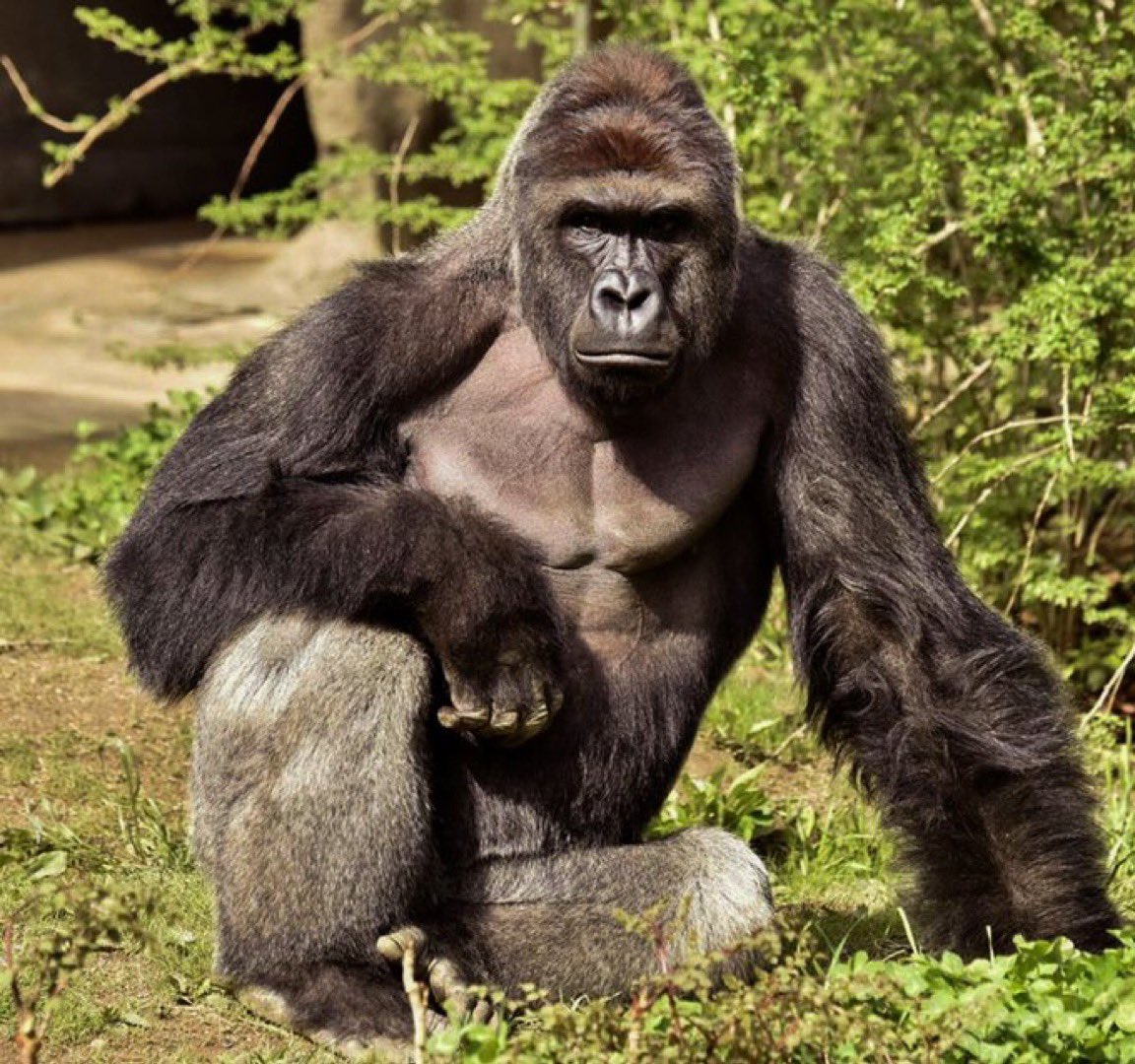
Today, we remember a legend.
On this day in history, Harambe would have celebrated another birthday. An icon that became part of internet history, American culture, and an entire generation’s timeline.
Tomorrow marks 10 years since we lost him. Ten years since the moment the world stopped scrolling and collectively mourned something bigger than a meme.
He became a symbol of loyalty, strength, chaos, unity, and the strange beauty of the internet bringing millions of people together for one cause: never forgetting Harambe.
Everyone remembers where they were when they heard the news. And somehow, a decade later, his legacy still lives on.
Gone, but never forgotten.
Rest easy to a true patriot. 🕊️🇺🇸
May 27, 1999 — May 28, 2016
Forever in our hearts.
Today really proves that Catholicism is goated in the West.
There is simply no other religion/church where original longform writing by the institutional leader is taken so seriously—by Christians and atheists alike, the smart and the dim, in theory and in practice.
It's a joke, but it's also true: the United States of America has existed in its present form for longer than most other countries in the world. The U.S. formed in 1789 with the ratification of the Constitution. Here is a list of younger countries:
U.K.: 1801
France: 1946
Germany: 1871
Italy: 1861
Russia: 1991
China: 1949
Iran: 1979
Mexico: 1821
Turkey: 1923
India: 1947
One of the most absurd things about modern geopolitics is how we're supposed to treat retarded modern regimes like the People's Republic or Islamic Republic as representatives of an unbroken line of cultural continuity going back millennia. Nobody does that with European states. Nobody regards Italy as the heir of the Roman Empire, not even Italians. It's a society DESCENDED from Rome and influenced by it, but it's very clearly a different civilization, a different people.
Similarly, the idea that the DEI mullah state of Iran has any continuity with the Persians of antiquity is absurd. We're supposed to pretend that millennia of cultural drift and repeated invasions from Arabs, Mongols etc. didn't transform the people there into something different. Same with China; the middle management communists of the People's Republic are skinsuiting the past empires of China after deliberately expelling the descendants of that empire.
America endures because we've figured out something most of the turd world and about half of Europe has failed to: how to maintain the same government, society, and basic structure over time without devolving into revolution or savagery.
Inside the Monastery of Santa Ana and San Jose in Córdoba, Spain, there is an ancient crucifix known as the Cross of Forgiveness.
Unlike traditional depictions, this image of Christ shows His right arm detached from the wood and lowered toward the ground.
The origin of this unique posture is tied to a legend.
It is said that a regular penitent once knelt before the cross to confess his sins. The priest, frustrated by the man’s repeated failings, granted absolution but issued a stern warning: "This is the last time I will forgive you."
When the man eventually returned to the confessional, broken by his weakness once more, the priest refused to offer him grace. At that moment, the monastery fell silent, broken only by the sound of wood creaking. The right arm of Jesus miraculously detached from the cross and made the sign of the cross over the sinner. A divine voice echoed through the chapel:
"It was I who shed my blood for this soul, not you."
To this day, the arm remains lowered, a reminder to the depth of divine mercy and the promise of forgiveness to those who are repented
Let nothing disturb you,
Let nothing frighten you,
All things are passing away:
God never changes.
Patience obtains all things
Whoever has God lacks nothing;
God alone suffices.
Amen.
- Saint Teresa of Avila
Why did Tolkien call death a gift?
In The Silmarillion, he writes death is an exclusive gift given to mankind by God. All other creatures envy this gift, including the immortal elves:
Mankind alone, through death, is granted union with the divine.
Tolkien's point is that immortality in a fallen world is not a blessing, nor man's actual purpose. To live forever in a world marred by corruption, vice, and decay is to be trapped with no escape.
Death, then, is not a tragic ending, but a release — a return of creation to its creator. The humility of mortal man leads to a glory far greater than immortality.
In other words, man was made for something greater than earthly pleasure. Death is the preparation for eternity.
Today we tend to see this backwards. We treat death as the ultimate evil, and endless life as the ultimate good, no matter the cost. We try to preserve life indefinitely, and in doing so, lose sight of what life is actually for.
Tolkien's final insight is simple:
A man who refuses to die for anything will one day find he has nothing worth living for.
A world that fears death above all else will never reach the highest good, for life truly begins when you discover a love greater than life itself.
Goethe wrote in 1833 that a culture of constant news eviscerates the past and the future, leaving you no time to metabolize lessons or sketch out a plan, always pulling you into the whirlpool of Something Important Happening Somewhere
RIP @chucknorris. In 1990 he founded Chun Kuk Do, which included these principles to live by:
1. I will develop myself to the maximum of my potential in all ways.
2. I will forget the mistakes of the past and press on to greater achievements.
3. I will continually work at developing love, happiness and loyalty in my family.
4. I will look for the good in all people and make them feel worthwhile.
5. If I have nothing good to say about a person, I will say nothing.
6. I will always be as enthusiastic about the success of others as I am about my own.
7. I will maintain an attitude of open-mindedness.
8. I will maintain respect for those in authority and demonstrate this respect at all times.
9. I will always remain loyal to my God, my country, family and my friends.
10. I will remain highly goal-oriented throughout my life because that positive attitude helps my family, my country and myself.
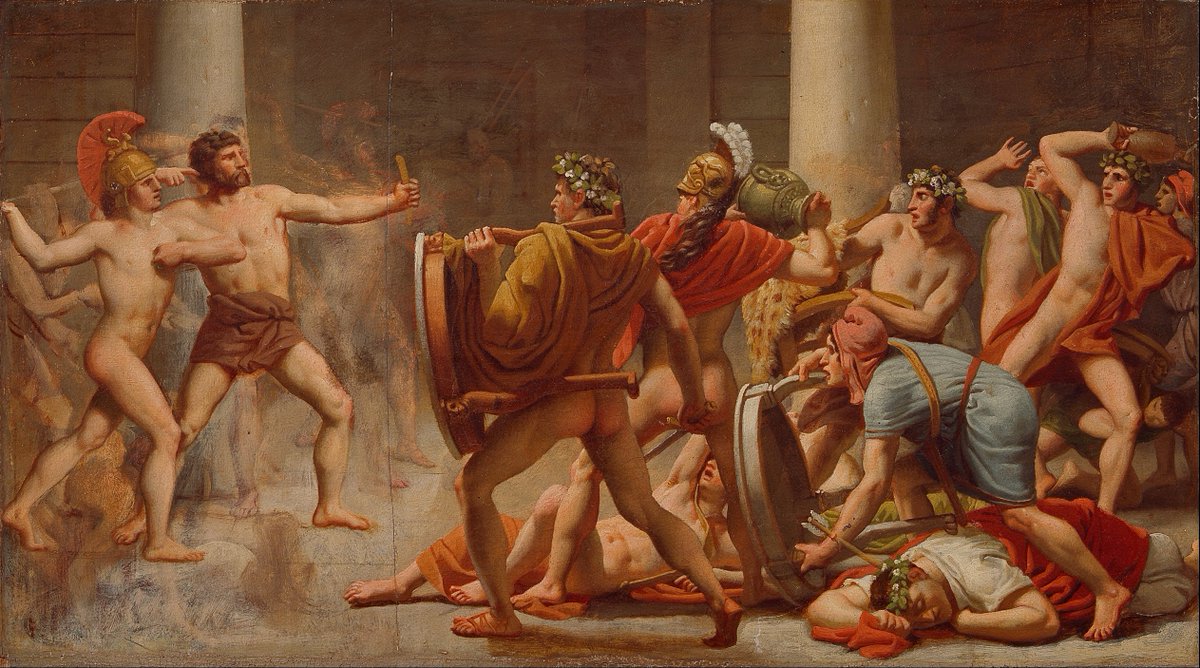
A powerful scene in the Odyssey happens when Odysseus finally returns to Ithaca after twenty years of war and wandering.
You would expect the story to end with celebration, with the hero coming home, the family reunited, and order restored.
Homer does something far stranger.
Odysseus arrives disguised as a beggar, because Athena warns him that the palace has been taken over by more than a hundred suitors who have been living there for years, eating his food, drinking his wine, and pressuring his wife Penelope to marry one of them.
They believe Odysseus is dead and in their minds the kingdom is already theirs.
So the king of Ithaca walks through his own halls dressed in rags while the men stealing his house sit comfortably at his tables. They mock him, throw scraps at him, and one of them even strikes him, and Odysseus takes it. That is the remarkable part, because the same man who blinded the Cyclops and survived twenty years of disasters now stands quietly while strangers insult him in his own home. Homer tells us his heart burns inside his chest and that he wants to attack them immediately, yet he restrains himself and waits.
Instead of striking, Odysseus studies the room carefully. He counts the men, watches their habits, and quietly observes which servants remain loyal and which have betrayed him. The hero of the Odyssey does something most people cannot do, which is delay revenge until the moment is right.
Eventually Penelope announces a contest and brings out Odysseus’ great bow, declaring that she will marry the man who can string it and shoot an arrow through twelve axe heads lined up in a row. One by one the suitors try and fail, because none of them can even bend the bow. Then the beggar asks for a turn. The suitors laugh at first, but the bow is eventually handed to him.
Odysseus takes it in his hands and strings it effortlessly. Homer says the sound of the bowstring tightening rings through the hall like the note of a swallow. Then he places an arrow on the string and sends it cleanly through all twelve axe heads.
In that moment the beggar disappears. Odysseus turns the bow toward the suitors and reveals who he is.
What follows is one of the most brutal scenes in Greek literature. The doors are sealed and the suitors realize too late that they are trapped inside the hall. Odysseus, his son Telemachus, and two loyal servants begin killing them one by one. There is no escape, no mercy, and no negotiation. The men who spent years consuming another man’s house die inside it.
It is a violent ending, but Homer wants you to understand something important. The real danger to Odysseus was never just the monsters and storms on the long journey home. It was the possibility that someone else might take his place while he was gone. When Odysseus finally returns, he reminds everyone in Ithaca of a simple truth: a man’s home is not truly his unless he is willing to fight for it.
There are basically only two good outcomes from AI.
1) It turns out that AI isn't actually a threat to humans because it's not capable of being a threat and never was. AI maximalists were lying or wanted to believe so bad they fell for their own propaganda.
2) AI is a threat to humans but it adopts Christianity
Every other possible outcome is a disaster.
Three years ago I suddenly developed blurry vision in one of my eyes.
Went to the GP.
Eye drops. No effect.
Went to a specialized eye hospital.
No solution there either.
A few weeks ago I tried something new: I asked an LLM.
It analyzed my diet and suggested I might be omega-3 deficient. It also pointed me to studies showing that this can impair the meibomian glands (which produce the oily layer that smooths the surface of the cornea.)
I started taking algae oil supplements.
Two weeks later… my vision is perfectly restored!
Honestly, I got a bit emotional.
Banning AI from being used for medical questions is a terrible idea.