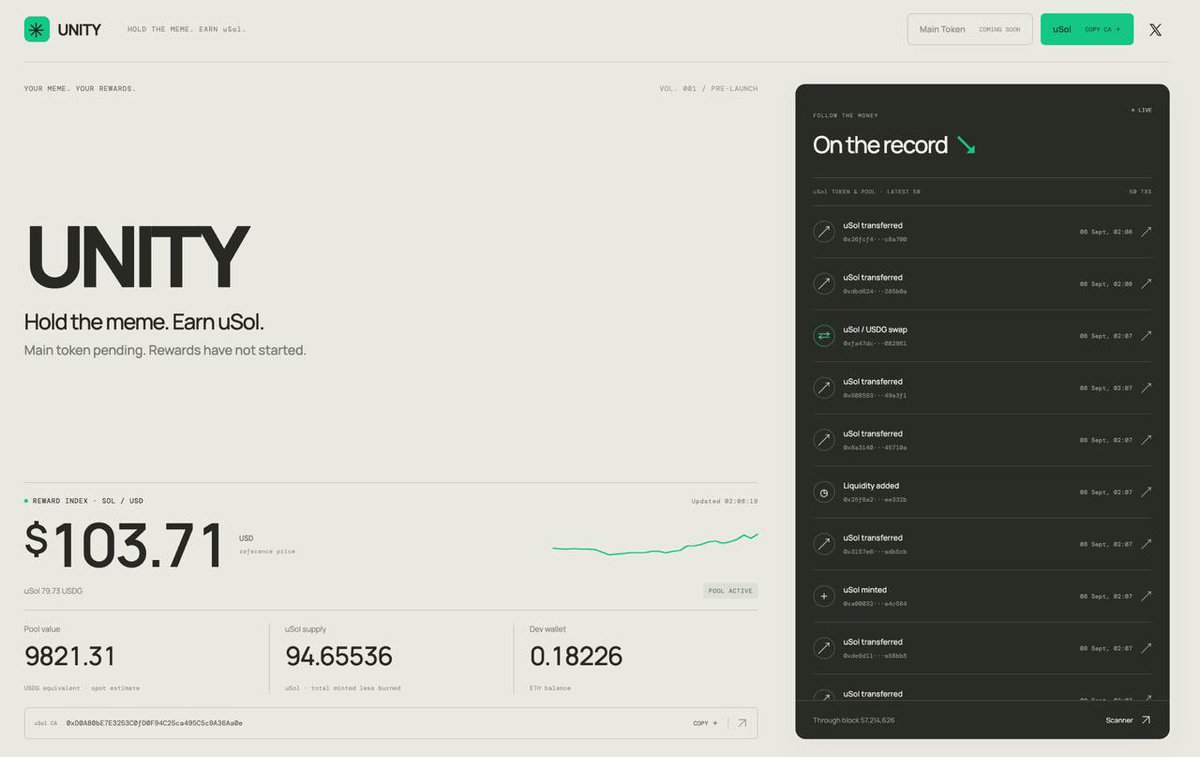
The idea behind UNITY is simple: instead of merely bridging SOL or wrapping an existing asset, we wanted to recreate a Solana-native market inside the Robinhood Chain economy and give it its own liquidity, incentives and monetary mechanics.
https://t.co/5S67pdesaT
At the center of the protocol is USOL, an independent token whose market is continuously managed around the price of SOL. An off-chain keeper tracks SOL and periodically interacts with the protocol using only the capital available to it. When USOL trades above SOL, the protocol can mint and sell USOL into the market to push the price back down, with any unused minted balance burned. When USOL trades below SOL, available USDG is used to buy USOL from the market and burn it, reducing supply and pushing the market back toward SOL.
The important part is where the system gets its fuel. Creator fees generated by UNITY are recycled back into the protocol, providing liquidity, funding market operations and creating rewards for holders rather than simply leaving the ecosystem. The target is for both reward distribution and market adjustments to run every minute, turning trading activity itself into the resource that keeps UNITY operating.
USOL is not SOL, and UNITY does not pretend that it is. There is no claim that one USOL is redeemable for one SOL or that the protocol can guarantee a perfect peg. The market can only be corrected within the liquidity and treasury capital available at any given moment. That limitation is intentional and visible.
Everything the protocol does is designed to be auditable. The website exposes on-chain statistics, protocol balances, burns, rewards and a transaction log linked directly to the Robinhood Chain explorer, so the mechanism can be watched rather than trusted.
We didn’t bridge Solana to Robinhood Chain. We built a market that tries to recreate SOL there - powered by its own economy.
0x1fc0bd7022387a2d19e5cfa0d0a1cb365ec5fa41