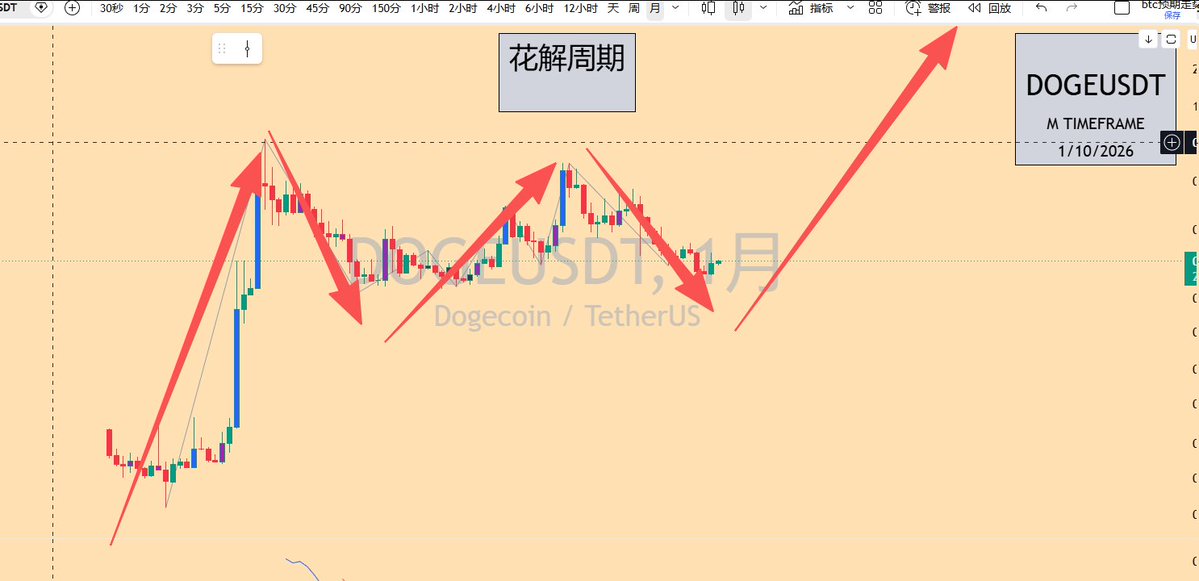
I'd like to present a counter-argument to @TonySeverinoCMT's time-cycle chart. Tony, hope you don't mind.
Firstly, my inclination is that Tony's cycle is off by a fraction, and I think the low window has already passed. The initial evidence for that is the reaction we're seeing now.
I'm not sure of the methodology Tony used to derive his cycles, but mine are plotted using Gann ratios. I suppose we'll find out soon enough which cycle timing proves more precise.
Secondly, regarding the bigger overarching cycle, Tony has chosen to plot the entire period from inception through to the next cycle as one major cycle. I'm not entirely sure why.
From my perspective, if we instead view the period from inception through to 2022 as one complete major cycle, things start to make a lot more sense.
What this would imply is that the 2013 and 2017 bull runs were essentially two legs of the first major cycle's expansion phase.
Starting with the 2017 bear market and including the 2021 bull run, we then entered the first major cycle's distribution phase. IMHO, this could also explain why the 2021 bull run was considered relatively mediocre compared with the two previous runs.
But how could the 2021 bull run be distributive if it made a new high?
Because distribution structures can initially form a higher high, similar to the November top within the smaller 2021 cycle.
This framework could also explain remarkably well why the last bull run was so mean-hugging. Rather than being the expansion phase of another complete major cycle, it may have represented the accumulation phase of the next larger cycle.
If that's correct, the implication here is pretty significant.
We could now be approaching the expansion phase of that larger cycle, potentially unfolding in two distinct legs, with the distribution phase and the major bust many are calling for not actually beginning until around 2032.
I'm not presenting this as certainty. It's simply an alternative interpretation of the larger cycle structure.
For a start, let's give it a few months and see which of the two cycle theses begins to play out.